The Samhain tarot spread is a five-card reading for the turning of the year. It looks at what is ending, what to let go of, what is hidden, what the past is teaching you, and one intention to carry into winter. It suits anyone taking stock at the end of October, whether you mark Samhain as a festival or simply feel the year closing in.
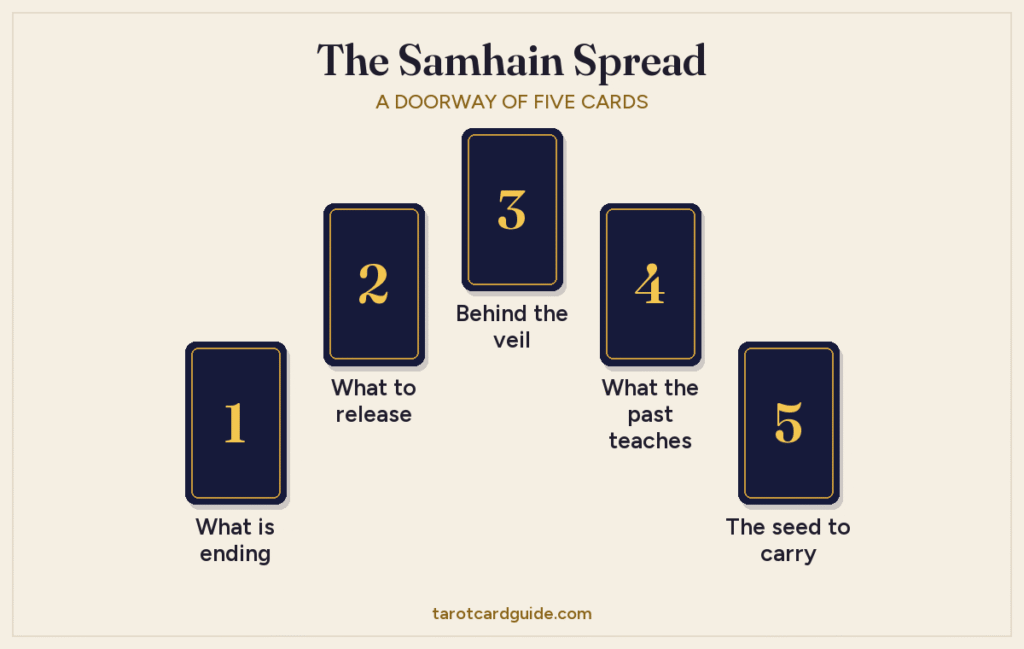
Draw a free Samhain reading now: think back over your year, then deal all five cards below. Each card lands in its place in the doorway, with its position, its question and its meaning listed underneath. You can also add a question of your own before you draw.
Your Samhain Spread reading
- What is ending What is coming to a close for you this year?
- What to release What should you let go of before winter?
- Behind the veil What is hidden, or what does your intuition already know?
- What the past teaches What lesson do your history and those before you offer?
- The seed to carry What intention should you carry through winter?
Read the doorway in pairs: card 1 with card 5 (what ends and what begins), and card 2 with card 4 (what to drop and what to keep), with card 3 at the top as the key to both. How to read the positions together
Jump to a section:
- What is Samhain?
- The five positions at a glance
- Each position in depth
- Reading the positions together
- How to lay out the spread, step by step
- A full example reading
- A reading to remember someone who has died
- Cards with special meaning at Samhain
- Questions to ask, and common mistakes
- Frequently asked questions
What is Samhain?
Samhain (pronounced roughly SOW-in) is a Gaelic festival held from sunset on 31 October to 1 November. In the early Irish calendar it was one of four seasonal festivals, alongside Imbolc, Beltane and Lughnasadh. It marked the end of the harvest and the start of winter, the darker half of the year.
Medieval Irish tales set many important events at Samhain and describe it as a time when the Otherworld lay open and its people could cross into this one. Later folk customs in Ireland, Scotland and the Isle of Man included bonfires, guising and fortune-telling games. Robert Burns’s poem “Halloween” (1785) describes young people using nuts, apples and kale stalks to divine their future sweethearts. Some of these customs fed into Halloween, whose name comes from All Hallows’ Eve, the night before the Christian feast of All Saints on 1 November.
Today many witches and pagans keep Samhain as a time to honour the dead, take stock and set intentions. Many treat it as their new year, though historians debate whether the old Gaels did. It is one of the eight festivals of the modern Wheel of the Year, which took shape in the twentieth century, and “the veil is thin” is a modern way of putting the old idea of an open Otherworld.
Tarot itself has no ancient link to Samhain. Tarot cards began as a card game in fifteenth-century Italy and were not widely used for divination until the late eighteenth century. The Rider-Waite-Smith deck used on this site dates from 1909. Seasonal spreads like this one are modern: they borrow the season’s themes of endings, memory and renewal. You don’t need to follow any tradition to use it.
The Samhain spread positions at a glance
Five cards form an arch, like a doorway, laid from left to right. The left side looks at what is going, the top at what is hidden, and the right side at what stays and grows.
| Position | What it asks | Read it with |
|---|---|---|
| 1. What is ending | What is coming to a close for you this year? | 5, 2 |
| 2. What to release | What should you let go of before winter? | 4, 1 |
| 3. Behind the veil | What is hidden, or what does your intuition already know? | 2 and 4, then all |
| 4. What the past teaches | What lesson do your history and those before you offer? | 2, 5 |
| 5. The seed to carry | What intention should you carry through winter? | 1, 3 |
Each position in depth
For each position: what it asks, how different kinds of card tend to read there, and what to compare it with.
Card 1: What is ending
The first card shows what the year has brought to completion, for better or worse: the harvest you are gathering in, or the chapter that is closing. Ask what has run its course. A pleasant card here is still an ending, perhaps a good season you need to let finish rather than cling to.
- Majors and Minors: a Major marks the end of a significant chapter, one you may look back on for years. A Minor is a smaller cycle closing, such as a project, a habit or a phase of a relationship.
- Numbers: Tens and Nines sit naturally here, since they are the end of their suit’s story.
- Reversed: an ending you are resisting, or one that is only half finished.
- Compare with: card 5, what begins as this ends.
Card 2: What to release
Samhain is a threshold, and it is easier to cross without extra weight. This card names what to put down: a grudge, a worry, a role you have outgrown, or a story you keep telling about yourself. Difficult cards such as the Five of Cups or the Eight of Swords are common here, and they simply show what is ready to go.
- Suits: Swords point to thoughts and fears to release, Cups to feelings and regrets, Wands to overcommitment or restlessness, and Pentacles to a grip on money, possessions or security.
- A positive card: ask what you are holding too tightly. Even a good thing can become a weight.
- Court cards: often a role you play, such as the one who always rescues, or less often the influence of a particular person.
- Compare with: card 4, what to keep from the past.
Card 3: Behind the veil
The top of the doorway looks at what you can’t yet see clearly: something hidden in the situation, or something your intuition already knows and your mind hasn’t admitted. Read it with your gut first and the keywords second. Cards like The Moon or The High Priestess here suggest trusting your instincts over appearances.
- Majors: a deep pattern or truth working beneath the surface of your year.
- Minors: something specific and practical you have overlooked, such as a feeling (Cups), a fear (Swords), a desire (Wands) or a resource (Pentacles).
- Reversed: something you are actively avoiding looking at, or a truth close to surfacing.
- Compare with: cards 2 and 4. The hidden card often explains why something needs releasing, or why a lesson keeps repeating.
Card 4: What the past teaches
This position honours the past: your own history, your family and those who came before you. It asks what wisdom you already have. The Six of Cups might point to memories and childhood, and the Ten of Pentacles to family legacy and tradition.
- Court cards: very often a person who shaped you, such as a parent, grandparent or teacher, or the quality they passed on.
- Difficult cards: a lesson learned the hard way, or a family pattern you don’t want to repeat. Both are worth knowing.
- Reversed: a lesson not yet learned, or an old story that needs looking at with fresh eyes.
- Compare with: card 2 (release the one, keep the other) and card 5 (how the lesson feeds the seed).
Card 5: The seed to carry
The last card is a single intention for the months ahead. Winter is for rest and slow growth, so read it as something to nurture quietly rather than a result to expect straight away. Aces and Pages suit this position especially well, because both are about beginnings.
- Majors: a seed with a long growing season, possibly a new direction for the whole year ahead.
- A hard card: the seed may be a hard-won resolution, such as setting a boundary or facing something honestly.
- Reversed: the seed needs protecting, or more time before it can be planted.
- Compare with: card 1 (what the ending makes room for) and card 3 (what your intuition says about it).
Reading the positions together
The arch is built in pairs, mirrored around the card at the top. Once you have read each card on its own, read them this way.
The foot of the arch: cards 1 and 5
The two outer cards are what ends and what begins, the two sides of the same turning. Look for a thread between them. A card of the same suit at both ends suggests the ending and the new start concern the same area of life. A card of loss beside a card of beginning is the classic Samhain story: something clears so something else can grow.
The sides of the doorway: cards 2 and 4
These two sort your past into what to drop and what to keep. If they share a suit, the same area of life holds both the burden and the wisdom: a way of handling money to lose, say, and a better one you already know. If card 4 looks like the cure for card 2, the reading has handed you its own advice.
The keystone: card 3
Card 3 holds the arch together, so read it against each pair. Does it explain why card 2 is hard to release, or what card 5 needs to grow? If it is the only Major, the hidden theme is the real subject of the reading.
Walking through the door
Finally, read all five from left to right as one sentence: this is ending, so put this down; this is hidden; this is what the past teaches; so carry this. It is the shape of the season itself, from harvest to seed.
How to lay out the Samhain spread, step by step
- Choose a quiet evening. Some readers light a candle, set out a photo of someone they have lost, or keep a notebook ready. If you light a candle, never leave it burning unattended.
- Look back before you shuffle. Spend a few minutes remembering the year: what began, what ended, what surprised you.
- Set your question. The spread works with no question beyond “What do I need to know as this year turns?” You can also focus it on one area, such as work or a relationship.
- Decide on reversals before you shuffle, and keep to your choice.
- Lay the doorway. Card 1 at the bottom left, card 2 above and to its right, card 3 at the top, card 4 coming down on the right, and card 5 at the bottom right.
- Read in two passes. First each card in its position, then the pairs and the arch as a whole.
- Write it down. Note the date and all five cards, and look again at Imbolc (1 to 2 February) or the spring equinox to see how the seed has grown.
When to do it
The evening of 31 October is the traditional night, but any evening from late October to early November works. Many pagans in the southern hemisphere celebrate Samhain around the start of May instead, when their own year is turning towards winter. The spread also works at any real ending, such as leaving a job or a home, whatever the date.
A full Samhain example reading
Here is a complete hypothetical reading. It is an illustration, not a real person or reading. Imagine someone called Maya. She has spent six years in a well-paid office job that has come to feel empty, and this autumn she handed in her notice to train as a teacher. On 31 October she asks: “What do I need to understand as this year closes?” She reads reversals, but all five cards come up upright.
| Position | Card | In brief |
|---|---|---|
| 1. What is ending | Eight of Cups | Walking away from what no longer fulfils her |
| 2. What to release | Four of Pentacles | A fearful grip on security |
| 3. Behind the veil | The High Priestess | She already knows more than she thinks |
| 4. What the past teaches | Queen of Pentacles | Warm, practical care that includes yourself |
| 5. The seed to carry | Ace of Cups | A new beginning of the heart: meaningful work |
Card by card
What is ending: Eight of Cups. This is the card of a quiet, brave decision to leave something that no longer fulfils you, often a job that is stable, well paid and respected but empty. It confirms what Maya has already begun. Had it come up reversed, it would have pointed to fear of leaving and staying stuck, a very different message.
What to release: Four of Pentacles. The Four holds on to money and control. Building a safety net is sensible when income is about to drop, and the card says so. What Maya is asked to release is not her savings but the fear behind the grip. The card’s own advice is to keep planning, then find the one area where fear is making the decision.
Behind the veil: The High Priestess. The hidden card says Maya already knows more than she thinks. Her gut feeling about this change may be more reliable than the arguments she keeps running through her head. The High Priestess also counsels patience: where facts are missing, wait for them rather than forcing a decision.
What the past teaches: Queen of Pentacles. A court card here often shows someone who shaped you. Perhaps Maya thinks of a grandmother who ran a busy home and still found time for everyone. The Queen’s lesson is warm, practical care, and her advice ends with a pointed phrase: include yourself in that care.
The seed to carry: Ace of Cups. A new beginning of the heart. At work, the Ace points to work that feels meaningful rather than simply profitable, and it is especially encouraging for teaching and care. It is the seed Maya has chosen, confirmed.
Putting it together
The foot of the arch tells the story at once. In the Eight of Cups a figure walks away from eight cups; in the Ace of Cups a single new cup overflows. Both are Cups, so the story is about fulfilment, not money. The sides of the doorway are both Pentacles, two ways of holding security: the Four clutches his coin in fear, while the Queen holds hers in her lap with care. The past has already shown Maya the better way to hold it.
At the top, The High Priestess is the only Major in the spread, and the hidden theme is trust in her own judgement. The whole reading says: let the old job go without regret, and keep planning your money without letting fear steer. Look after yourself as well as others, and give the new work the winter to take root.
A reading to remember someone who has died
Samhain has long been a time to remember the dead. A gentle way to honour someone you have lost is a three-card remembrance reading, on its own or before the main spread:
- What I carry from them: a quality, a lesson or a gift they left you.
- What remains unsaid: what you would like to tell them, or what still needs tending in you.
- How I can honour them this year: one thing you could do in their memory.
Read this way, the cards don’t speak for the person who has died; they help you speak about them. Some people do feel close to their dead at this time of year, and what the reading means to you is your own. Two things are worth avoiding: questions about when or how anyone will die, and treating a card as a verdict on whether someone forgave you. Those questions deserve gentler handling than a card can give.
If a loss is recent, you may prefer to wait, or to keep the reading short. Tarot is a tool for reflection, not a substitute for support. If grief feels too heavy to carry alone, please talk to someone you trust, your doctor or a bereavement support service where you live.
Cards with special meaning at Samhain
- Death: the season’s own card. It means transformation and an ending that makes room for something new, not physical death.
- The Hermit: turning inward, with your own light, as the nights draw in.
- Judgement: honest reflection on the past, second chances and hearing a calling.
- The Moon: dreams, intuition and the unseen.
- The Hanged Man: a pause, and seeing the year from a new angle.
- Six of Cups: memory and old ties, the past returning to comfort and teach.
Questions to ask, and common mistakes
The spread works best with an open question about your own year. Some wording that helps, and some that doesn’t:
| Stronger | Weaker |
|---|---|
| “What do I need to understand as this year closes?” | “Will next year be better?” |
| “What is ready to end in my working life?” | “Will I lose my job?” |
| “What can I learn from my family’s story?” | “What is my family secretly thinking about me?” |
| “What should I carry into winter for my health?” | “Am I going to get ill?” |
For health, money or legal worries, use the cards to reflect on how you are coping, and take the practical questions to a professional. More on wording: how to ask the right questions in a tarot reading.
Common mistakes
- Reading the spooky cards literally. Death, The Tower and the darker Swords are about change and truth, not doom. Samhain imagery makes them feel heavier than they are.
- Turning card 5 into a prediction. The seed is an intention to nurture, not a promise of what spring will bring.
- Skipping the pairs. The mirror between cards 1 and 5, and 2 and 4, is where this spread says the most.
- Releasing too much. Card 2 names one thing to put down, not everything that has been hard this year.
Samhain tarot spread: frequently asked questions
When should I do a Samhain tarot reading?
Traditionally on the evening of 31 October, but any evening from late October to early November works well. In the southern hemisphere, many people keep Samhain around the start of May.
Is Samhain the same as Halloween?
Not quite. Samhain is the Gaelic festival at the start of winter. Halloween takes its name from All Hallows’ Eve, the night before the Christian feast of All Saints. They fall on the same night, and some Halloween customs grew out of older Samhain traditions in Ireland and Scotland.
Do I need to be pagan or a witch to use this spread?
No. The themes of endings, letting go and new intentions suit anyone looking back on their year.
What if I draw the Death card?
At Samhain it is almost a welcome sign. Death means an ending that clears the way for something new. In position 1 it confirms a real ending; in position 5 it suggests the seed is a clean break.
Can I use tarot to contact someone who has died?
This page treats tarot as a tool for reflection, not a way to receive messages from the dead. The remembrance reading above uses the cards to help you remember and honour someone, which many people find comforting.
Can I do this spread without a deck?
Yes. Use the free Samhain draw at the top of this page, which deals all five cards into the doorway. For a shorter reading, try the free three-card spread.
More spreads to try
After Samhain comes the Yule spread for the winter solstice, a reading about rest and returning light. For a deeper look at one question, try the Celtic Cross, or the broken heart spread for letting go after a relationship ends. You will find every layout on the tarot spreads page, and every card in the meanings of all 78 cards.