Reading tarot means drawing cards in answer to a question, then interpreting each card through three things: its picture, its place in the spread and the cards around it. You don’t need psychic gifts or a special deck. You need a deck, a clear question and a willingness to look closely.
This guide takes you from a sealed box to your first full reading in eight steps:
- Get a deck and get to know it.
- Learn how the 78 cards are organised.
- Set a clear, open question.
- Shuffle and draw.
- Lay the cards in a spread.
- Read each card in its position.
- Connect the cards into one story.
- Write the reading down.
What You Need to Start
A deck. Start with the Rider-Waite-Smith deck or one of its many clones. Its 78 cards all show a full scene, so even the numbered cards give you a picture to read, and most books and websites, including this one, describe its imagery. Once you know the system, it’s easy to move to any deck that follows it.
A quiet space and a few minutes. A table or the floor is enough. Some readers like a cloth, a candle or a crystal, which can help you settle, but none of it is required.
A notebook. It sounds minor, but writing readings down is how you learn fastest (more on that in step 8).
You may have heard that your first deck must be a gift. It’s a popular superstition, not a rule. Buying your own deck is fine.
Step 1: Get to Know Your Deck
Before you open the guidebook, go through the cards one by one and simply describe what you see. Who is in the picture? What are they doing? What’s the weather like? How does the card make you feel?
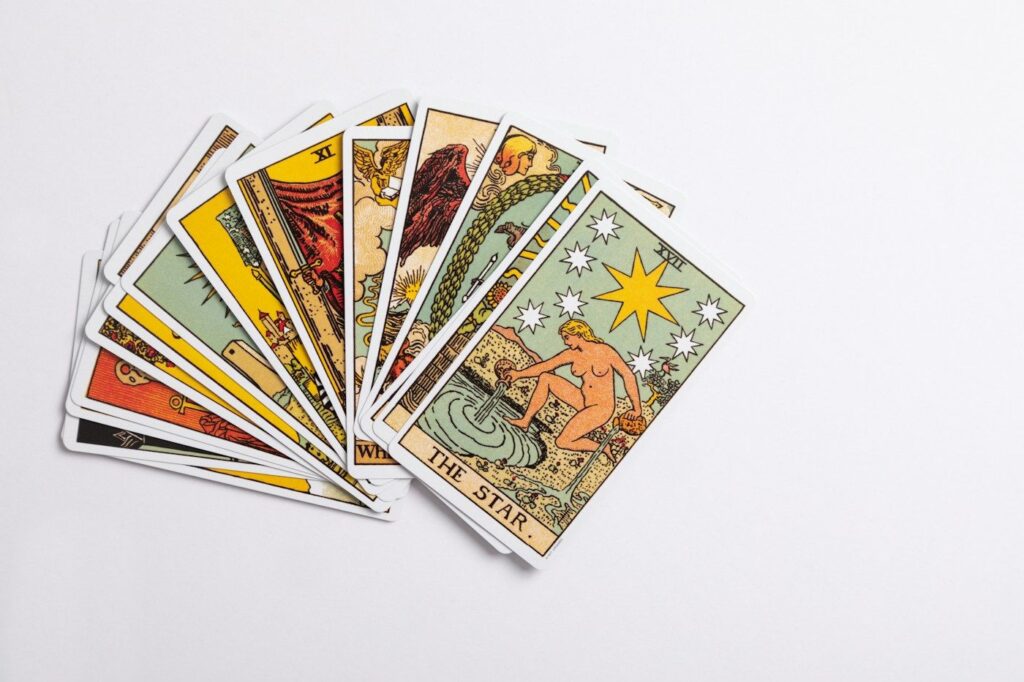
Take the Three of Swords: a heart pierced by three blades under a grey, rainy sky. You could guess it speaks of heartbreak or painful truth without reading a word about it, and you’d be right. Most cards work this way. The symbolism was designed to be read.
A simple habit that helps: draw one card of the day each morning, look at it closely, then read its meaning and notice where it shows up in your day.
Step 2: Learn How the 78 Cards Are Organised
You don’t need to memorise 78 separate meanings. A tarot deck is a system, and once you know its structure you can work out the rough meaning of most cards from their suit and number.
The Major Arcana: 22 big themes
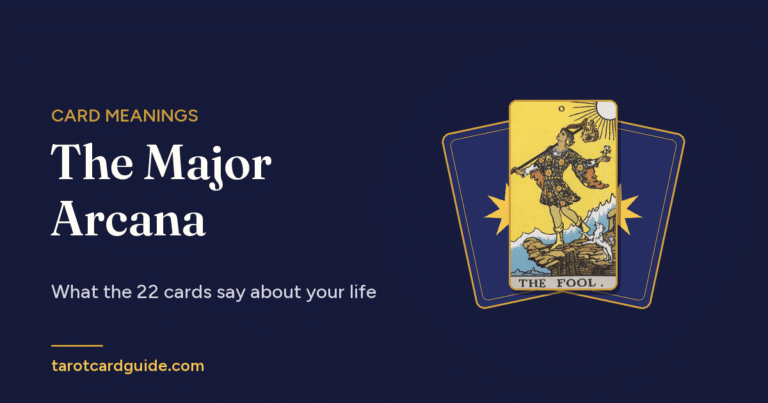
The Major Arcana runs from The Fool (0) to The World (21). These cards describe major life themes and turning points. When several appear in one reading, the situation is usually a significant one.
The Minor Arcana: 56 everyday cards
The Minor Arcana describes day-to-day events and feelings. It has four suits of 14 cards each: Ace to Ten, then four court cards (Page, Knight, Queen and King). Each suit is linked to an element and an area of life:
| Suit | Element | Area of life |
|---|---|---|
| Wands | Fire | Energy, ambition, creativity, career drive |
| Cups | Water | Emotions, love, relationships, intuition |
| Swords | Air | Thoughts, truth, communication, conflict |
| Pentacles | Earth | Money, work, health, home |
What the numbers mean
The numbers follow a rough story from beginning to end, and the same pattern runs through every suit:
- Ace: a new beginning or raw potential
- Two: balance, partnership or a choice
- Three: growth and first results
- Four: stability, sometimes standing still
- Five: conflict, loss or a challenge
- Six: recovery and harmony
- Seven: reflection, testing or assessment
- Eight: movement and effort
- Nine: nearly there, for better or worse
- Ten: completion, or too much of a good or bad thing
Combine the two and you have a working meaning. A Five is a challenge and Cups are feelings, so the Five of Cups is emotional loss. Pentacles are money and a Ten is completion, so the Ten of Pentacles is lasting wealth and family security.
The court cards
Court cards can stand for people in your life, for sides of your own personality, or for an approach the situation needs:
- Pages: curiosity, learning, news and messages
- Knights: action and movement, sometimes too much
- Queens: inner mastery, care and emotional intelligence
- Kings: outer authority, leadership and control
For all 16 at a glance and how to tell which reading applies, see tarot court cards explained.
Step 3: Set a Clear, Open Question
The question shapes the whole reading. Tarot answers best when you ask what you can understand or do, rather than asking it to predict a fixed future.
- Instead of “Will I get the job?”, try “What can I do to give myself the best chance at this job?”
- Instead of “Does he love me?”, try “What do I need to understand about this relationship?”
- Instead of “When will I be happy?”, try “What is standing between me and feeling settled?”
Our guide on how to ask the right questions in a tarot reading has many more examples. If you do want a quick answer, the yes or no tarot reading is built for exactly that.
Step 4: Shuffle and Draw
There is no single correct way to shuffle. Common methods include:
- Overhand: drop small packets from one hand to the other, like shuffling playing cards gently.
- Riffle: split the deck and interleave the halves. It’s quick, but it can crease the cards.
- Wash: spread the cards face down on the table and swirl them around, which also mixes in reversed cards.
Many readers hold the question in mind while shuffling, stop when it feels right, and then cut the deck into three piles before restacking it. Draw from the top, or fan the cards out and pick the ones you’re drawn to. Both work.
Step 5: Lay the Cards in a Spread
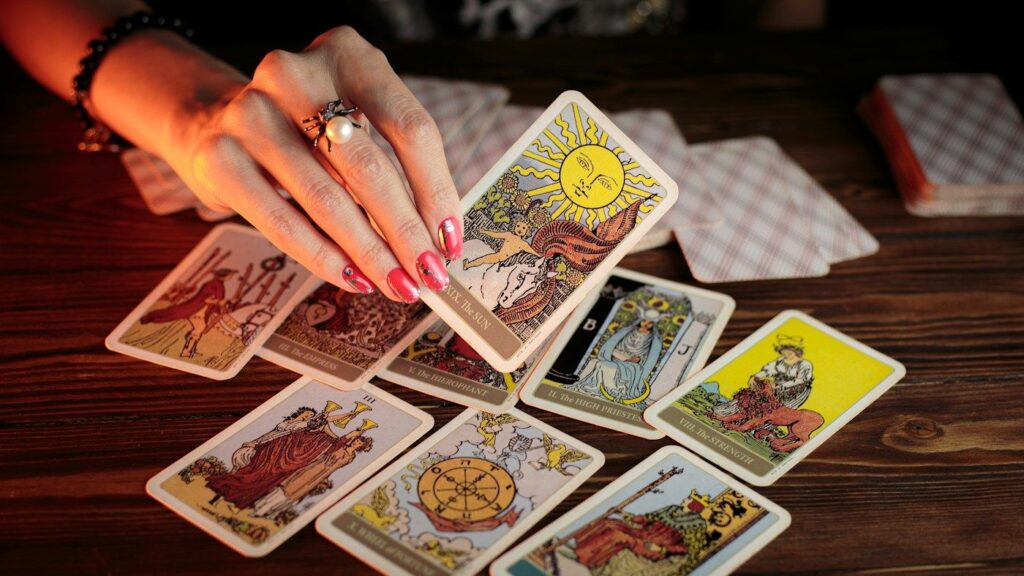
A spread is a layout where each position has a meaning, such as “the past” or “the advice”. Positions give each card a job, which makes interpretation much easier. Start small:
- One card: a daily focus or a quick answer.
- Three cards: past, present and future, or situation, challenge and advice. This is the best spread to learn on.
- Five cards: a closer look at a situation, once three cards feel comfortable.
- The Celtic Cross: the classic ten-card spread. Save it for when you know the cards reasonably well.
Browse more layouts, each with a position diagram, in our tarot spreads guide.
Step 6: Read Each Card in Its Position
Take one card at a time and work through three layers:
- The picture. What’s your first impression? Which detail catches your eye?
- The meaning. What do the suit, number and traditional keywords say?
- The position. How does that meaning answer this position’s question?
The same card changes with its position. The Tower in a “past” position describes an upheaval you’ve already been through. In an “advice” position it might suggest that a structure in your life needs to come down.
Should you read reversed cards?
A reversed card is one that lands upside down. Many readers treat reversals as the card’s energy being blocked, delayed or turned inward. Others ignore them and read every card upright. Both are valid. If you’re just starting, it’s fine to read everything upright and add reversals later. Every card page on this site covers the reversed meaning when you’re ready.
Step 7: Connect the Cards into One Story
This is the step that turns a list of meanings into a reading. (Our guide to tarot card combinations goes deeper, with 24 common pairs.) Look at the spread as a whole and ask:
- Which suit dominates? Lots of Cups means the matter is emotional; lots of Swords, mental or conflict-driven.
- How many Major Arcana cards? Several suggests a significant life chapter rather than a passing issue.
- Any repeated numbers? Three Fives, for example, underline conflict or loss.
- Where are the figures looking? Figures facing towards or away from each other can hint at how the cards relate.
- What changes from first card to last? The movement often is the message.
An example reading
Imagine someone asks, “What do I need to understand about changing careers?” and lays three cards for situation, challenge and advice:
- Situation: Eight of Cups. A figure walks away from a neat row of cups. Emotionally, they’ve already left their current job.
- Challenge: Knight of Pentacles. The slow, careful knight. The obstacle is caution: waiting for a perfect, risk-free plan.
- Advice: Ace of Wands. A hand offers a sprouting wand. Act on the spark with one small, concrete first step.
Read together, the cards move from feeling (Cups) through practical worry (Pentacles) to action (Wands). The story might be: “Your heart has already moved on, but caution is keeping you in place. You don’t need the whole plan yet. Start something small, such as a course, a conversation or a side project, and let it grow.”
Step 8: Write the Reading Down
Note the date, the question, the cards and what you made of them. Look back after a few weeks. You’ll see which interpretations held up, which cards keep appearing, and how your own reading style is developing. If a card keeps turning up, our article on pulling the same tarot card again and again explains what it can mean.
Common Beginner Mistakes
- Taking frightening cards literally. Death almost always means an ending or transformation, not a physical death.
- Asking the same question again and again. Redrawing until you get the answer you want makes every reading meaningless. Give it a few days.
- Reading only from the book. Keywords are a starting point. What you see in the picture matters as much.
- Reading about other people without their knowledge. Focus on your side of a situation: what you can understand and do.
- Using tarot instead of professional help. Tarot is a tool for reflection. For medical, legal, financial or mental health decisions, talk to a qualified professional.
How Long Does It Take to Learn Tarot?
With a card a day and a simple three-card spread now and then, most people can read the basic meanings of the whole deck within a few months. Reading fluently, where the cards form a story without the guidebook, takes longer and keeps deepening for years. There’s no exam. You’re ready to start the day you get your deck.
Frequently Asked Questions
Can you read tarot cards for yourself?
Yes. Reading for yourself is how most people learn. The main challenge is staying objective, so write the reading down and revisit it later. See our tips on doing accurate self-readings.
Do you need to be psychic to read tarot?
No. Tarot is a symbolic system that anyone can learn. Intuition helps you connect the cards, and it grows with practice.
Does your first tarot deck have to be a gift?
No. It’s a common superstition, but buying your own deck works just as well. Choose one whose artwork you enjoy looking at.
How many cards are in a tarot deck?
A standard tarot deck has 78 cards: 22 Major Arcana and 56 Minor Arcana, split into four suits of 14 cards each.
What is the easiest tarot spread for beginners?
A single card or the three-card spread. Three cards give you enough to practise connecting cards without becoming overwhelming.
Start Your First Reading
The best way to learn tarot is to read it. Shuffle your deck, ask one open question and lay out three cards. No deck yet? Try the free three-card reading or draw a card of the day. Each card you draw links to its full meaning, so you can learn as you go.