The broken heart tarot spread is a six-card layout for the weeks and months after a breakup. It does not try to predict whether your ex will return. It asks gentler, more useful questions: what really went wrong, what you can put down, what you learned, what is still with you, how to heal, and what is opening up ahead.
It suits any ending that hurts: a long relationship or a short one, a divorce, a situationship that fizzled out, feelings that were never returned, even a close friendship that has ended. It is a spread for making sense of things, at your own pace. Tarot here is a tool for reflection, not a substitute for the people and support around you.
Draw a free Broken Heart Spread reading now: take a breath, think about the ending you are working through, then deal six cards below. Each position is labelled with its question and linked to the card’s full meaning. There is no need to read it all at once; you can come back to it.
Your Broken Heart Spread reading
- What went wrong What was really at the heart of the ending?
- What to release What are you ready to put down?
- What you learned What will you carry forward from this?
- What still lingers What feeling or tie is still with you?
- How to heal What would help you recover now?
- What’s ahead What is opening up as you heal?
Read each top card with the card below it: 1 with 4, 2 with 5, and 3 with 6. How to read the positions together
Jump to a section:
- What the broken heart spread is for
- When not to read (and what to do instead)
- The six positions at a glance
- Each position in depth
- Reading the positions together
- The heartbreak cards, and the healing cards
- How to lay out the spread, step by step
- A full example reading
- Questions to ask
- Common mistakes
- Frequently asked questions
What is the broken heart tarot spread?
The spread uses six cards in two rows of three. The top row looks back: what went wrong (1), what to release (2) and what you learned (3). The bottom row is about now and next: what still lingers (4), how to heal (5) and what’s ahead (6). Each card in the bottom row sits under a card in the top row, and those columns are where much of the meaning lies.
After a breakup the mind tends to loop: the same scenes, the same questions, the same “if only”. A spread gives those thoughts a shape. Each worry gets one place on the table, and you can look at them side by side instead of all at once. That is the real value of a breakup tarot spread: not a prediction, but a way of sorting what you feel.
Every position in this spread is about you, not the other person. That is deliberate. You cannot change what your ex thinks or does, but you can understand your own part, your own grief and your own next steps. If you are still together and trying to work things out, the relationship spread is the better fit.
When not to read (and what to do instead)
Tarot can help after a breakup, but there are times when it does more harm than good. Be honest with yourself about these:
- When it is too soon. In the first raw days, most cards will look like the Three of Swords, whatever they are. You may not need a reading yet. You may need sleep, food and a friend. Come back to the spread when the shock has eased a little.
- When you keep re-reading. If you are dealing cards about your ex every day, or every hour, the readings have become part of the loop rather than a way out of it. Put the deck away for a week. The answer will not change, but your ability to hear it will.
- When the real question is “Will they come back?” Tarot cannot predict another person’s choices, and asking the same question again and again keeps the door propped open. If you truly need to look at it once, see the cards about the past and second chances. Then turn the question back to yourself: “What do I want, whether or not they return?”
- When you are looking for permission to contact them. The decision to reach out, or not, is yours to make with a clear head. A card is not a green light.
For a gentle daily check-in instead, a single card of the day is often kinder than six cards about the same wound.
The six broken heart spread positions at a glance
Each position asks its own question, and each is best read with the card above or below it:
| Position | What it asks | Read it with |
|---|---|---|
| 1. What went wrong | What was really at the heart of the ending? | 4, 3 |
| 2. What to release | What are you still carrying that you are ready to put down? | 5, 4 |
| 3. What you learned | What will you take forward from this relationship? | 6, 1 |
| 4. What still lingers | What feeling, habit or tie is still with you? | 1, 2 |
| 5. How to heal | What would help you recover now? | 2, 6 |
| 6. What’s ahead | What is opening up for you as you heal? | 3, 5 |
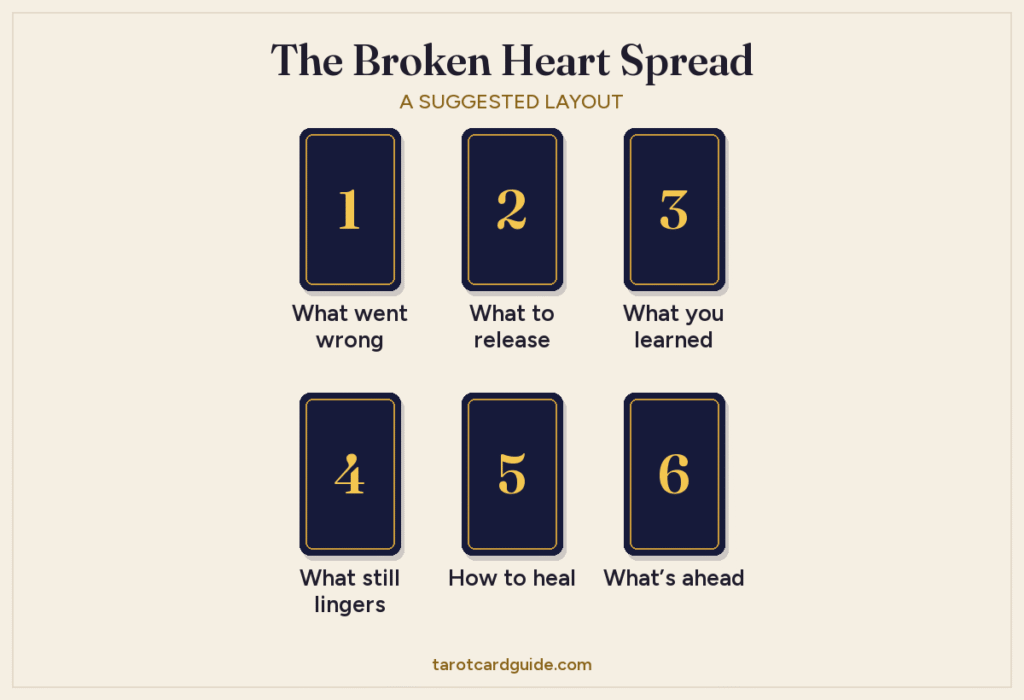
The numbers show the order in which the cards are laid down: cards 1 to 3 from left to right along the top, then cards 4 to 6 from left to right beneath them.
Each broken heart spread position in depth
For each position: what it asks, how different kinds of card tend to read there, and which card to compare it with. A few general patterns help. A Major Arcana card says the breakup is part of a bigger turning point in your life. Cups speak of feelings, Swords of thoughts, words and pain, Wands of energy, desire and identity, and Pentacles of the practical side: home, money, routine and your body. The examples are starting points only.
Card 1: What went wrong
This card names the core of the ending: a single event, a slow pattern, or a mismatch neither of you could fix. Read it for understanding, not blame. It is not asking who was at fault. It is showing what the relationship could not hold. For example, The Tower points to a sudden rupture or a truth that changed everything. The Eight of Cups describes a quieter ending, where there may be no villain, just a slow realisation that the relationship no longer nurtured either of you.
- What stands out here: Swords often point to communication, conflict or a painful truth; Pentacles to practical strains such as money, distance or different life plans. A court card may describe how one of you behaved, not who either of you is.
- Reversed: something that was hidden or slow-burning, or a problem that was avoided for a long time before it ended things.
- Compare with: card 4 below it, to see whether the wound and what still lingers are the same thing.
Card 2: What to release
Card 2 shows something you are still carrying that you are ready, or nearly ready, to put down: resentment, guilt, hope of a reunion, or a belief such as “I will never find anyone”. Letting go does not mean forgetting or pretending it did not matter. It means loosening your grip. For example, the Five of Cups asks you to release a focus on everything that was lost, since two cups still stand behind you. The Nine of Swords points to guilt and late-night overthinking that feel bigger in the dark than they are.
- What stands out here: a Major suggests something deep, such as an old pattern or a way you see yourself. A warm card here, such as the Two of Cups, can mean releasing the hope of a partnership that is no longer there.
- Reversed: something you are already beginning to release, or one you are holding on to more tightly than you admit.
- Compare with: card 5 below it (letting go and healing usually go together) and card 4 (if they match, this is the main work).
Card 3: What you learned
Card 3 is the lesson you get to keep: about boundaries, about what you need, about the kind of love that suits you. It turns the relationship from wasted time into a chapter that taught you something. For example, Strength here speaks of quiet courage and resilience you did not know you had. The Queen of Swords points to clarity and boundaries: knowing your standards and saying them plainly.
- What stands out here: a difficult card is still a lesson. The Five of Swords might teach that winning arguments cost more than they gained.
- Reversed: a lesson you have not quite absorbed yet, or one you are learning too harshly, such as turning healthy caution into a wall.
- Compare with: card 6 below it (what you learned shapes what comes next) and card 1 (is the lesson the answer to what went wrong?).
Card 4: What still lingers
This card shows what is still with you: love, anger, longing, habits, an unfinished conversation, or a practical tie such as a shared flat or friends in common. Nothing here is a failure. Feelings fade at their own pace, and naming what remains is how it starts to move. For example, the Six of Cups shows nostalgia and fond memories. The Moon suggests confusion that has not cleared: parts of the story that still do not make sense.
- What stands out here: Cups show feelings that remain; Swords, thoughts that keep replaying; Pentacles, practical ties still to untangle.
- Reversed: often a feeling that is fading, or one being pushed down rather than felt.
- Compare with: card 1 above it, and card 2 (is what lingers the same thing you are being asked to release?).
Card 5: How to heal
Card 5 is the most practical card in the spread. It shows what would help now: rest, company, solitude, a new focus, or simply time. Look for one small thing you could do this week. For example, the Four of Swords says rest, without guilt. The Three of Cups says lean on your friends. The Hermit suggests quiet time alone to get clear about who you are, as distinct from who you were as a couple.
- What stands out here: Wands often point to energy returning through a project, movement or something that is yours alone. Pentacles point to looking after your body and routine: sleep, food, walks, work.
- Reversed: usually a warning about how not to heal, such as the Four of Swords reversed as refusing to rest.
- Compare with: card 2 above it, and card 6 (healing is the path to what is ahead).
Card 6: What’s ahead
The last card is about your path, not your ex’s and not necessarily a new partner’s. It shows what is opening up for you as you heal. Read it as a direction, not a date. For example, the Six of Swords shows you moving towards calmer water, further from the pain than you were. The Ace of Cups is an emotional fresh start, which may be new love but may equally be self-compassion or creativity.
- What stands out here: a Major marks a new chapter of your life. A Minor points to a more modest, practical next step. A court card is more often a quality you grow into than a new person arriving.
- Reversed: something delayed rather than denied. Healing may take longer than you hoped, and that is all right.
- Compare with: card 3 above it, and card 5 (the healing that leads there).
Reading the positions together
The two rows and three columns give this spread a simple structure. Read the columns first.
The wound and its echo: cards 1 and 4
Card 1 is what went wrong; card 4, directly below, is what is still with you. When they share a suit or theme, the ending itself is what still hurts, and understanding it is the work. When they differ, what lingers may be something else entirely, such as loneliness or a lost routine rather than the person, and it can be tended to directly.
Letting go and healing: cards 2 and 5
The middle column is the practical heart of the spread. Card 2 is what to put down and card 5 is how. If card 2 is a Swords card of anxious thinking and card 5 is a calm card such as the Four of Swords, the healing is to quiet the mind. If card 5 is a social card, such as the Three of Cups, the letting go may happen in company rather than alone.
Lesson and future: cards 3 and 6
What you learned shapes what comes next. A lesson about boundaries followed by a hopeful card at 6 suggests the new chapter is built on that lesson. If card 6 looks like a repeat of card 1, take it as a gentle warning: the old pattern could return if the lesson is not used.
The two rows
Compare the top row, the past, with the bottom row, now and next. A heavy top row over a lighter bottom row is the classic shape of healing: the hard part is behind you. A light top row over a heavy bottom row can mean the ending looks simple on paper but has not yet been felt. Also read the diagonal from card 1 to card 6, the whole path from what went wrong to what is ahead.
Counting the cards
In six cards, expect one or two Majors. Four or more (about 1 reading in 20) mark a real turning point in your life, bigger than this one relationship. Three or more cards of one suit (about 1 reading in 15 for any given suit) set the theme: Cups for grief and feeling, Swords for thoughts and pain, Wands for your energy and sense of self, Pentacles for practical life. A missing suit is common, so do not read much into an absence.
The heartbreak cards, and the healing cards
Some cards turn up again and again after a breakup. Seeing one does not mean things are worse than you thought. It usually means the reading has recognised where you are. Here is what each tends to say, and where it often lands in this spread:
| Card | What it says after a breakup | Often lands in |
|---|---|---|
| Three of Swords | Heartbreak, grief and a painful truth. The hurt is real, and facing it honestly is where healing begins. Reversed, healing and forgiveness are starting. | 1, 4 |
| Five of Cups | Grief and regret, with your eyes fixed on what was lost. Two cups still stand behind you when you are ready to turn. Reversed, acceptance and moving on. | 2, 4 |
| Eight of Cups | Walking away from what no longer fulfils you. Often an ending with no villain, just a slow realisation. Reversed, fear of leaving, or an ex who returns. | 1, 5 |
| The Tower | A sudden breakup, betrayal or shocking truth. It clears away what was false or unsustainable. Reversed, recovering slowly from the crisis. | 1 |
| Ten of Swords | A painful ending or rock bottom. The worst has happened, and from here the only way is up. Reversed, recovery, or clinging to what has clearly ended. | 1, 4 |
| Nine of Swords | Worry, guilt and sleepless nights. Fear feels bigger in the dark than it is. Reversed, fears easing and reaching out. | 2, 4 |
| Death | The end of a cycle and real closure, making room for something new. Reversed, resisting an ending that has already happened. | 1, 6 |
| Two of Cups reversed | Imbalance, broken trust, or feelings that were stronger on one side. | 1, 2 |
And these are some of the cards of recovery, which often appear in cards 5 and 6:
- Six of Swords: leaving the rough water behind. Even if it still aches, you are further from it than you were.
- Four of Swords: rest and recovery. A break from dating, taken without guilt.
- The Star: hope and healing after a hard time. You are healing well, and there is no need to rush.
- Strength: quiet courage and patience with yourself.
- The Three of Swords or Five of Cups reversed: grief beginning to lift, and forgiveness, of them or of yourself, becoming possible.
The hardest love cards each carry advice as well as pain. For how these cards change each other when they appear together, such as the Eight of Cups with the Six of Cups (leaving while still looking back), see tarot card combinations.
How to lay out the broken heart spread, step by step
- Choose a calm moment. Not late at night, not straight after seeing their social media, not after a drink. You want to be as steady as you can be.
- Word the question about yourself, for example “What do I need to understand to heal from this breakup?” See the questions section for more.
- Decide on reversals before you shuffle. If you are feeling fragile, it is perfectly valid to read all cards upright this time.
- Shuffle and cut while you think about the ending as it really was.
- Lay the top row, cards 1, 2 and 3 from left to right, then the bottom row, cards 4, 5 and 6 beneath them.
- Read slowly. Take in the whole spread, then each card, then the three columns. If a card is too much today, stop and come back tomorrow.
- End with one action. Write down one small thing card 5 suggests, and do it this week.
Variations
- Revisiting it later. Some people deal the spread again a few months on and compare. Changes in cards 4 and 5 show how far you have come.
- A seventh card for strength. If the reading feels heavy, draw one more card and ask, “What strength do I have for this?” Place it below card 5.
- A three-card version. On a hard day, deal only cards 2, 5 and 6: what to release, how to heal, what’s ahead. The three-card spread page has more simple layouts.
A full broken heart spread example reading
Here is a complete hypothetical reading. It is an illustration, not a real person or reading. Imagine someone called Robin, whose partner of two years ended things three months ago. They had talked about moving in together, but the plans kept slipping. Robin keeps replaying the good times and wondering what they missed. Robin asks: “What do I need to understand to heal from this breakup?” Robin reads reversals.
| Position | Card | In brief |
|---|---|---|
| 1. What went wrong | Seven of Cups | Wishful thinking; loving an idea of the future |
| 2. What to release | Eight of Swords | The belief that you are stuck, and harsh self-talk |
| 3. What you learned | Queen of Swords | Clarity, honesty and knowing your standards |
| 4. What still lingers | Six of Cups, reversed | Rose-tinted memories of how it used to be |
| 5. How to heal | Four of Swords | Rest and a real pause from dating |
| 6. What’s ahead | The Star | Hope and healing; ready to love again, in time |
The wound and its echo: cards 1 and 4
The Seven of Cups at card 1 is a card of daydreams and choices, some real and some illusions. In love, it can describe falling for an idea of someone, or of a future, rather than what is actually there. It does not blame either person. It suggests the relationship rested on hopes that were never tested: the flat they kept planning, the future they each pictured slightly differently.
Directly below it, the Six of Cups reversed shows what lingers: rose-tinted memories and idealising how things used to be. Two Cups cards in one column, both about pictures in the mind, say the same thing twice. What hurts most is not only the person but the idealised story, and the story is still running.
Letting go and healing: cards 2 and 5
The Eight of Swords shows what to release: feeling trapped by your own thinking. After a breakup, it often sounds like “nobody suitable is out there” or “I’ll only get hurt again”. The card asks whether those beliefs are facts or fears. Below it is the Four of Swords: rest, recovery and a deliberate pause. Taking a break from dating without guilt is exactly what this card allows. Both are Swords, so the healing is mostly in the mind. The way out of the Eight’s circle of thoughts is not to think harder but to let the mind settle.
Lesson and future: cards 3 and 6
The Queen of Swords is the lesson: clear thinking, honest words and strong boundaries. Robin has learned to be clear about what they need, and to look at the facts rather than only the hopes. That answers the Seven of Cups directly. Beneath it is The Star, the only Major in the spread. After heartbreak, it suggests Robin is healing well and becoming ready to love again, with no need to rush. The diagonal from card 1 to card 6 runs from illusion to hope, and the difference between the two is that hope has its eyes open.
Putting it together
The reading does not say whether Robin’s ex will be back, because that was not the question. It says the ending came from a gap between hopes and reality (Seven of Cups), that the idealised memory is what still hurts (Six of Cups reversed), and that the fastest way through is rest, not rumination (Four of Swords). Practical steps might be muting the ex’s social media for a while, noticing the “I’ll never” thoughts when they come, and giving dating a proper rest. When Robin does meet someone new, the Queen of Swords lesson is to talk about plans early and plainly.
The count supports this: three Swords, two Cups, one Major, one court card and one reversal. Thoughts outnumber feelings, which fits someone who is replaying rather than grieving. Much of Robin’s work is to stop replaying and let the grief simply be felt.
Questions to ask with the broken heart spread
Good breakup questions are about you, about now, and about something you can do. Questions about what your ex is thinking or will do keep your attention on the one thing you cannot change.
| Weaker question | Stronger question |
|---|---|
| Will they come back? | What do I want now, whether or not they return? |
| Do they miss me? | What am I still holding on to, and why? |
| Whose fault was it? | What did this relationship teach me? |
| Are they with someone new? | What would help me feel steady again? |
| Will I ever find love? | What is opening up for me as I heal? |
| Should I text them? | What do I need before I decide anything about contact? |
For more on wording, see how to ask the right questions in a tarot reading.
Common broken heart spread mistakes
- Turning it into a reading about your ex. Every position is about you. If you catch yourself reading card 4 as “what they still feel”, bring it back to yourself.
- Reading card 1 as a verdict on who was to blame. It shows what the relationship could not hold, not who failed.
- Re-dealing until you get a kinder answer. One reading, taken to heart, does more than ten that cancel each other out.
- Treating card 6 as a promise or a sentence. It is a direction that depends on the healing in card 5.
- Skipping card 5. It is the card you can act on. The rest of the spread explains; this one helps.
Broken heart tarot spread: frequently asked questions
What are the positions in the broken heart tarot spread?
In the version on this page: 1 what went wrong, 2 what to release, 3 what you learned, 4 what still lingers, 5 how to heal and 6 what’s ahead. Cards 1 to 3 form the top row and cards 4 to 6 the bottom row.
Can tarot tell me if my ex will come back?
Tarot cannot predict another person’s choices. It can help you understand what happened and what you want now, which matters whatever your ex decides. The cards about second chances explain what reunion cards look like, but try not to make that question the centre of your healing.
How soon after a breakup should I do this spread?
There is no rule, but most people get more from it once the first shock has passed, often after a week or two. If you are still in the rawest stage, a single card of the day may be gentler.
What does the Three of Swords mean in a broken heart reading?
It names the hurt plainly: heartbreak, grief or a painful truth. It is not a bad omen for your future. In card 1 or card 4 it simply recognises where you are. Reversed, it points to healing and forgiveness beginning. See the Three of Swords in full.
How often should I repeat the spread?
Every few weeks at most. Healing is slow, and repeating the spread daily tends to feed the loop you are trying to leave. Comparing a reading now with one in a few months can be a good way to see progress.
Can I use it after a friendship ends?
Yes. The positions work for any ending that hurts, including friendships and family rifts. Losing a close friend can be as painful as a romantic breakup, and it deserves the same care.
What if the reading makes me feel worse?
Stop, put the cards away and do something kind for yourself. Come back to it another day, or not at all. A reading should help you understand, not add to the hurt. If you feel low most of the time, talking to someone is the better step.
Tarot is a tool for reflection. It is not a substitute for support from the people around you, or for professional help. If heartbreak has left you struggling to eat, sleep or get through the day for weeks, or you have thoughts of harming yourself, please talk to someone you trust, your doctor, or a crisis line where you live. You do not have to carry this alone.
When you are ready, deal your own reading with the free Broken Heart Spread at the top of this page. You can also look up any card in the love tarot card meanings or try a gentle card of the day. If you are working things out with someone rather than letting go, the relationship spread is the one to use. Every other layout is on the tarot spreads page.