The Celtic Cross is the best-known ten-card spread in tarot. It looks at a situation from every side at once: the present, the obstacle, the past and near future, what you want and what lies underneath, your own part, the people around you, your hopes and fears, and where it is all heading. That is why it suits big, tangled questions, and why it can feel overwhelming at first.
This guide covers all ten positions in depth, how they talk to each other, and a full example reading. If you are new to the cards, start with how to read tarot cards: the Celtic Cross is much easier once three-card spreads feel comfortable.
Draw a free Celtic Cross now: think of your question, then deal all ten cards below. Each position is labelled and linked to its card’s full meaning, and the list under the layout shows which positions to read together. For a quicker look at the heart of the spread, try the five-card interactive Cross Spread.
Loading your deck. If nothing appears, please enable JavaScript.
Jump to a section:
- The 10 positions at a glance
- Each position in depth
- Reading the positions together
- How to lay out the spread, step by step
- A full example reading
- Counting Majors, suits, court cards and reversals
- When the outcome card is confusing
- Love, career and yes or no questions
- Common mistakes
- When to choose a smaller spread
- Frequently asked questions
What is the Celtic Cross tarot spread?
The Celtic Cross uses ten cards in two groups. The first six form a cross: a central card with a second card laid sideways across it, and four cards around them, to the left, to the right, above and below. The last four stand in a column to the right, called the staff. The cross describes the situation itself. The staff describes you within it, and where it is heading.
The layout was published by Arthur Edward Waite in The Pictorial Key to the Tarot (1910), the guidebook to the Rider-Waite-Smith deck, where he called it “an ancient Celtic method of divination”. Despite the name, there is no firm evidence that it is ancient or Celtic. What is certain is that it has been in print for more than a century and appears in a great many tarot books, often with the positions renumbered or renamed. This page uses a widely used modern version; the main variations are covered in the step-by-step section.
Use it when you want a full picture of a complex issue: a major crossroads, a situation with hidden dynamics or several people involved, or a question with layers, such as a relationship, a career change or a move. It is not ideal for quick daily draws or simple yes or no questions, which suit a one-card pull or a three-card spread better.
The 10 Celtic Cross positions at a glance
Each position asks its own question, and each is best read alongside one or two others:
| Position | What it asks | Compare with |
|---|---|---|
| 1. The present | What is the heart of the situation right now? | 2, 7 |
| 2. The challenge | What is crossing you: the obstacle or tension? | 1, 6 |
| 3. The past | What recent events led here? | 4, 6 |
| 4. The near future | What comes next if nothing changes? | 3, 10 |
| 5. Above: conscious | What are you aiming for, or aware of? | 6, 10 |
| 6. Below: subconscious | What is driving things underneath? | 5, 2 |
| 7. Advice / self | How are you approaching this, and what would help? | 1, 8 |
| 8. External influences | What are other people and circumstances doing? | 7 |
| 9. Hopes and fears | What do you most want, or dread? | 5, 10 |
| 10. Outcome | Where is this heading on the current path? | 4, 5, 7 |
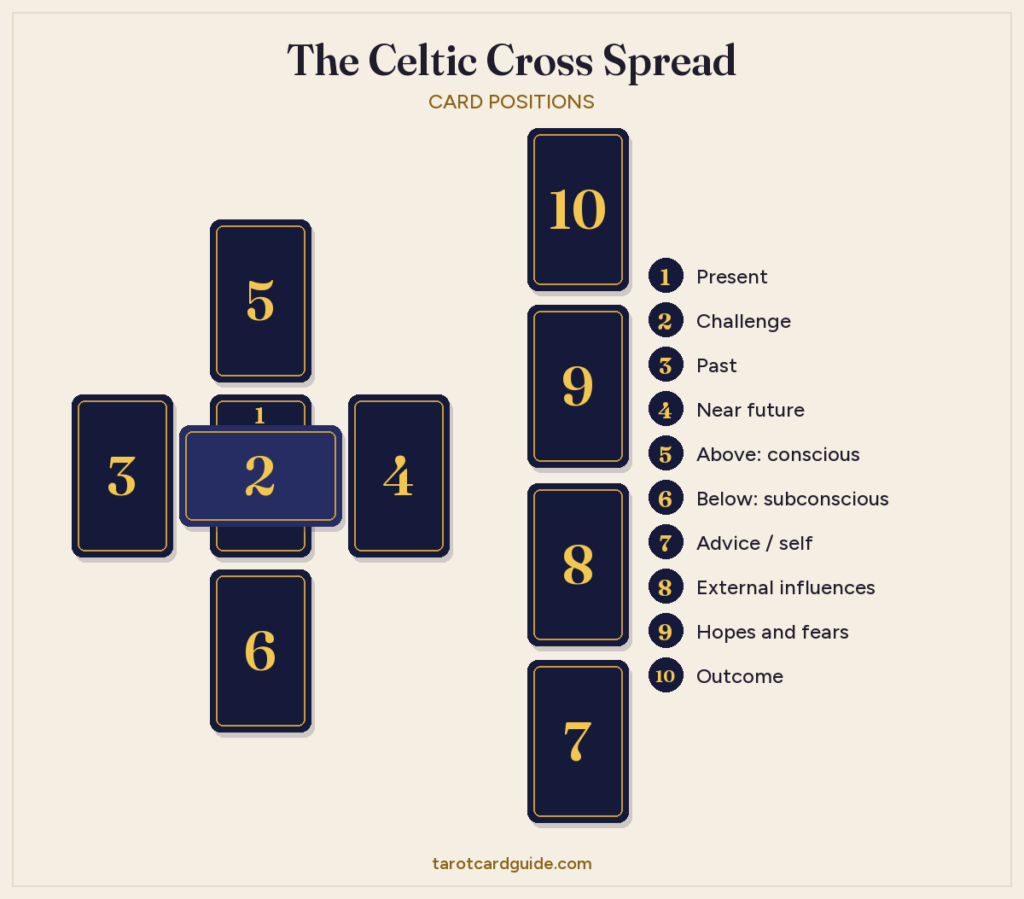
The numbers show the order in which the cards are laid down. In this version the past (3) sits on the left and the near future (4) on the right, card 5 goes above the centre and card 6 below it, and the staff is built from the bottom up, from card 7 to card 10.
Each Celtic Cross position in depth
For each position: what it asks, how to read it, what a Major or Minor Arcana card there tends to suggest, and which positions to compare it with. The one-card examples are only a starting point; always check them against the rest of the spread.
Card 1: The present
The first card sets the scene: the situation as it stands, or the state you are in as you ask. Everything else is read in relation to it. In Waite’s version it “covers” the person asking and shows the atmosphere around the question. For example, The Hermit here could show a period of withdrawal, or looking inward for an answer.
- Major or Minor: a Major says this is a significant chapter, shaped by forces bigger than the week’s details. A Minor places it in everyday life, where you can work with it directly.
- Compare with: card 2, which crosses it, and card 7, your part in it.
Card 2: The challenge (the crossing card)
Laid sideways across card 1, this is what is in the way: an obstacle, a tension, or a second force pulling against the first. Read it as “what is crossing me”, even when it is a pleasant card. Waite noted that a favourable card here can mean the opposition is not serious, or that something good in itself is not helping in this matter. For example, The Devil might show an unhealthy attachment, habit or fear holding you in place.
- Major or Minor: a Major is a challenge with real weight, closer to a life lesson than a hurdle. A Minor is a practical obstacle you can usually do something about.
- Compare with: card 1, and card 6, which often shows the hidden root of the challenge.
Card 3: The past
The card on the left shows what led here: recent events, decisions or patterns that still shape the situation. Ask what it explains about card 1. For example, the Three of Swords may show heartbreak or a painful truth that still colours things.
- Major or Minor: a Major suggests a turning point whose effects are still unfolding, sometimes from further back. A Minor points to a recent event or phase that is passing.
- Compare with: card 4, to see where the story is heading, and card 6.
Card 4: The near future
The card on the right shows what comes next if things carry on as they are: the next few weeks or months, not the final result. It is a direction of travel, and a reversed card here often shows something delayed rather than denied. For example, the Six of Wands suggests recognition or success is close.
- Major or Minor: a Major suggests a development you will feel strongly and may not fully control. A Minor points to a next step you can shape.
- Compare with: card 3, and card 10, since the near future is often the first step towards the outcome.
Card 5: Above, the conscious influence
The card above the centre shows what you are aware of and aiming for: your goal, your ideal, the thoughts at the front of your mind. In Waite’s description it “crowns” the person asking and shows the best that can be reached in the circumstances, not yet made real. For example, The Star here shows a conscious wish for healing, hope or a clear sense of direction.
- Major or Minor: a Major ties the aim to something deep, such as a value or life direction. A Minor points to a specific, practical goal.
- Compare with: card 6 (aim against hidden driver) and card 10 (goal against likely outcome).
Card 6: Below, the subconscious influence
The card beneath the centre shows what is at work underneath: feelings not yet put into words, beliefs you take for granted, the root of the matter. Waite described it as the foundation, what has already become real and part of you. It is often the card people recognise with a jolt. For example, the Five of Pentacles may reveal a deep fear of scarcity, or of being left out in the cold.
- Major or Minor: a Major points to a deep pattern or belief. A Minor shows a feeling or need that is easier to name once you see it.
- Compare with: card 5, and card 2 (is this the root of the obstacle?).
Card 7: Advice, or you in the situation
The first card of the staff turns to you: your attitude, your approach, the part you are playing. Waite’s label was simply “himself”. Many readers also treat it as advice, because how you show up is usually what you can change most easily. Read it both ways and see which fits. For example, the Knight of Swords might suggest you are being too hasty, or that decisive action is needed.
- Major or Minor: a Major suggests the situation is asking you to grow. A Minor points to a habit you can adjust quickly. A court card here very often describes you, acting in that card’s style.
- Compare with: card 1 and card 8.
Card 8: External influences
Card 8 shows the world around the question: other people, the atmosphere at work or at home, circumstances outside your control. Waite called it the person’s “house”, meaning their surroundings and the people close to them. A court card here is often a specific person. For example, The Tower here might signal upheaval around you that forces you to adapt.
- Major or Minor: a Major is a big outside force, such as a restructure or a family change. A Minor shows the everyday influence of people and places.
- Compare with: card 7. The contrast between the two is often the most useful thing in the staff.
Card 9: Hopes and fears
Card 9 shows what you hope for, what you fear, or both at once, because the two are often the same thing seen from opposite sides. Read it as a mirror of your expectations, not a prediction. For example, the Ten of Cups could show a longing for emotional security alongside a fear of letting anyone close.
- Major or Minor: a Major shows hopes or fears about your whole direction. A Minor shows a specific worry or wish.
- Compare with: card 5 and card 10 (does the outcome confirm the hope or the fear?).
Card 10: The outcome
The last card shows where things are heading if the current path continues. Waite’s label for it was “what will come”. It is the likeliest result, not a verdict, and the cards before it show where you can change course. For example, the Wheel of Fortune may mean a turning point: things are shifting, and not everything is in your hands.
- Major or Minor: a Major marks a real change of chapter. A Minor points to a more modest, practical result.
- Compare with: cards 4, 5 and 7, as explained below.
Reading the positions together
The spread comes alive in the relationships between positions. It is a web, not a list, and these are the connections worth checking every time.
The crossing: cards 1 and 2
Read these two as one sentence: “the situation is this, crossed by that”. Two cards of the same suit show a tension within one area of life; different suits show two areas pulling against each other, such as Wands crossed by Pentacles: ambition held back by money or caution. If card 2 looks stronger than card 1, the obstacle may have the upper hand for now.
The timeline: cards 3 and 4
The horizontal line runs from past to near future. Look at the direction of travel: from difficulty towards relief, from ease towards a test, or the same theme repeating.
Above and below: cards 5 and 6
The vertical line compares what you think you want with what is really driving you. When they agree, progress tends to come more easily. When they clash, for example a card of ambition above and a card of exhaustion below, the clash itself is often the answer to the question.
Goal and outcome: cards 5 and 10
Put the card you are reaching for next to the card you are heading towards. If they point the same way, you are on track. If they do not, the staff usually shows why: card 7 for your part in it, card 8 for outside forces, and card 9 for the hope or fear that is steering you.
You and your surroundings: cards 7 and 8
These two show how much of the situation is yours to change. A difficult card at 7 and a supportive card at 8 suggest the help is there and the block is in your approach. The reverse suggests you are doing your part in hard conditions, and patience or a change of setting may matter more than extra effort.
Hopes and fears: card 9
Decide whether card 9 is a hope, a fear or both, then look for it elsewhere. A fear at 9 that echoes card 6 is probably the hidden driver of the whole reading; one that echoes card 10 is worth weighing against the advice at card 7.
The outcome, and why it is not fixed
Card 10 is where things are heading if nothing changes; the rest of the spread shows what could change. Read it together with card 4, the next step towards it, and card 7, your part in it. A hard outcome with a helpful card at 7 is a warning you can act on. A good outcome with a warning at 7 is something you could still lose.
The cross and the staff
Finally, compare the two halves. The cross (cards 1 to 6) is the situation; the staff (cards 7 to 10) is you and where you are going. A cross full of Majors beside a staff of Minors means big forces are at work but your own choices are manageable. A calm cross beside an intense staff suggests the situation may be simpler than your response to it.
How to lay out a Celtic Cross, step by step

- Choose your question. Be specific but open-ended, for example “What do I need to know about changing careers right now?”, “How can I move forward after this breakup?” or “What is my soul calling me towards?”
- Decide your conventions before you shuffle: whether you read reversed cards, whether you use a significator, and which side is the past. The variations are explained below.
- Shuffle and cut while you focus on the question, and cut the deck when you feel ready.
- Lay the cross. Card 1 goes in the centre and card 2 sideways across it. Then card 3 to the left, card 4 to the right, card 5 above and card 6 below.
- Lay the staff. Cards 7, 8, 9 and 10 go in a column to the right of the cross, starting at the bottom.
- Read in three passes. First look at the whole spread and count Majors, suits and reversals (see counting the cards). Then read each card in its position. Then read the pairs, starting with cards 1 and 2 and building the story slowly.
Variations you will find in other books
Books do not all lay out the Celtic Cross the same way. The main differences:
- The numbering of the cross. This page puts the past (3) on the left, the near future (4) on the right, the conscious (5) above and the subconscious (6) below. In Waite’s version card 3 goes above (“crowns”), card 4 below (“beneath”), card 5 behind (the past) and card 6 before (the future). Other books use yet another order. The six places mean much the same in every version; only the numbers change.
- Which side is the past. Most modern layouts put the past on the left, so the cross reads like a timeline. Some readers who use a significator put the past on the side the figure on that card is facing away from, and the future on the side it faces.
- A significator, or not. Waite began by choosing a card to represent the person asking, usually a court card, and laid card 1 on top of it. Many readers now skip this so that any of the 78 cards can turn up. Both work.
- A reversed crossing card. Card 2 lies sideways, so it is not obviously upright or reversed. Some readers always read it upright, since it is an obstacle by definition. Others note which way up it came off the deck and always turn it the same way, so a reversal can still be read.
- The staff. Most layouts build it from the bottom (7) to the top (10); a few go top to bottom. Some books read position 7 purely as advice, others purely as your attitude.
None of these is the one true version. Consistency matters more than which you choose: decide before you draw, so that a position always means the same thing to you.
A full Celtic Cross example reading
To show how it all fits together, here is a complete hypothetical reading. It is an illustration, not a real person or reading. Imagine someone called Sam, who has spent years learning a trade in a salaried job and is thinking about going freelance. Sam asks: “What do I need to understand about leaving my job to work for myself?” Sam reads reversed cards and does not use a significator.
| Position | Card | In brief |
|---|---|---|
| 1. The present | Two of Wands | Planning, weighing options, a decision to make |
| 2. The challenge | Four of Pentacles | Holding tight to the security of a salary |
| 3. The past | Eight of Pentacles | Years of patient skill-building |
| 4. The near future | Ace of Pentacles | A concrete opportunity, such as a first client or contract |
| 5. Above | The Emperor | The goal: to be in charge and build something solid |
| 6. Below | The Moon | Unease and uncertainty that are hard to name |
| 7. Advice / self | Knight of Wands, reversed | Impatience: rushing, then stalling |
| 8. External influences | Three of Pentacles | Skills that others value; collaboration |
| 9. Hopes and fears | The Fool | The leap into the unknown, both wanted and feared |
| 10. Outcome | Seven of Pentacles | Real but gradual growth that needs patience |
The heart of it: cards 1 and 2
The Two of Wands shows Sam at the planning stage, with more resources and options than they may realise, and a decision to make: the figure on the battlements cannot stay there forever. Crossing it is the Four of Pentacles, the tight grip on a steady income. Building a safety net is often exactly the right instinct, but gripping too hard shuts out growth. Wands crossed by Pentacles: ambition held back by money worries.
The timeline: cards 3 and 4
Behind Sam is the Eight of Pentacles: years of focused work and real skill. Ahead is the Ace of Pentacles, one of the clearest green lights for work and money, pointing to a new contract, client or income stream. The story runs from craft to opportunity. Pentacles move slowly, though, and the Ace promises a good beginning rather than overnight wealth.
Above and below: cards 5 and 6
Consciously, Sam wants to be The Emperor: running their own affairs, with structure, clear contracts and tidy accounts. Underneath is The Moon: an unease that is hard to pin down, with parts of the picture not yet visible. Two Majors on this line mark a significant chapter, and the wish for control may be partly a response to the fog. The Moon’s own advice fits: separate intuition from fear, and get important details in writing before deciding.
Self and surroundings: cards 7 and 8
The Knight of Wands is the only reversed card in the spread, and it falls in Sam’s own position. Reversed, the Knight is impatient and scattered, starting things without follow-through: Sam may be swinging between quitting tomorrow and doing nothing. The Three of Pentacles at card 8 is far steadier. Sam’s skills are noticed, and working with the right people, with roles agreed in writing, is well supported. The world around Sam is readier for this move than Sam’s approach to it.
Hopes, fears and outcome: cards 9 and 10
The Fool at card 9 is the leap itself: the hope of a fresh start and the fear of jumping without a net. The outcome, the Seven of Pentacles, is neither triumph nor failure: slow but steady growth, a harvest that is coming but needs time, with a pause to assess progress. Set beside The Emperor at card 5, the goal is realistic, but it is built gradually rather than reached in one leap.
Putting it together
The reading does not say “quit now” or “stay put”. It says the opportunity is real (Ace of Pentacles), rooted in genuine skill (Eight of Pentacles) and supported by the people around Sam (Three of Pentacles). What could spoil it is Sam’s own impatience (Knight of Wands reversed) or fear-driven gripping (Four of Pentacles). The outcome favours a patient route: build a safety net, take on a first client or contract alongside the job, agree terms in writing, and review progress after a set period before making the full leap.
Remember that the outcome is not fixed. If Sam leapt on impulse, the Seven’s slow harvest might feel like failure; if Sam never loosened the Four’s grip, the Ace might never be planted. For the money side, the cards are a prompt for reflection; a qualified adviser is the right person for the numbers.
Counting the cards: Majors, suits, court cards and reversals
Before reading position by position, take a few seconds to count. Patterns across the spread show what kind of question this really is. From a well-shuffled 78-card deck, expect this in ten cards:
| What to count | Typical in 10 cards | What stands out |
|---|---|---|
| Major Arcana | About 3 (22 of the 78 cards) | Five or more (about 1 spread in 10): a major chapter, with forces bigger than day-to-day choices. None at all is rare and suggests an everyday matter you can handle directly. |
| Wands | About 2 | Four or more: drive, ambition, creativity and action are central. |
| Cups | About 2 | Four or more: feelings and relationships are the real subject. |
| Swords | About 2 | Four or more: thoughts, decisions, conflict and stress dominate. |
| Pentacles | About 2 | Four or more: money, work, home, health and practical results. |
| Court cards | About 2 (16 of the 78 cards) | Four or more: other people, or different sides of you, play a big part. |
| Reversed cards | Depends on how you shuffle | Several: energy that is blocked, delayed or turned inwards. Note which positions they fall in. |
Four or more cards of one particular suit turn up in only about 1 spread in 14, so a cluster like that is worth noticing. A suit missing entirely is much more common (about 1 spread in 8 for any given suit), so only read into an absence when that suit’s area of life is obviously part of the question. Repeated numbers repeat a theme: several Aces point to beginnings, fives to difficulty, tens to completion. See also tarot card combinations.
In Sam’s example, the count is 3 Majors (about average), 5 Pentacles (a strongly practical question), 2 Wands, no Cups or Swords, 1 court card and 1 reversal. The Pentacles confirm this is mainly about money and work. The missing Cups are worth a thought, because Sam’s feelings about the change are carried by The Moon rather than by any Cups card.
What to do when the outcome card is confusing
An outcome that seems to contradict the rest of the spread is common, and usually telling you something. Work through it in this order:
- Read it for this question. Check the card’s full meaning, then ask what it means here. Death as an outcome is usually an ending that clears space, not anything literal, and The Tower can be a shake-up that frees you.
- Compare it with cards 7, 8 and 9. If the outcome echoes card 9, ask whether your hope or your fear is speaking. If it echoes card 8, outside forces are shaping the result. If it contrasts with card 7, your approach may be what tips it one way or the other.
- Check card 5. A gap between the goal and the outcome is information, not failure. The staff shows why the gap is there.
- Look at card 4. The near future is often the first step towards the outcome, and it can make the path clearer.
- Draw one clarifier. If the outcome is still unclear, draw one more card and ask, “What do I need to understand about this outcome?” Read it as a comment on card 10, not a replacement for it. One is enough; several clarifiers usually add noise.
Do not deal the whole spread again because you disliked the answer. Sit with it, act on the advice at card 7, and come back to the question when something has changed.
Using the Celtic Cross for love, career and yes or no questions
Love and relationships
In love readings, cards 1 and 2 describe the connection and what is straining it. Card 7 is you in the relationship, and card 8 is often the other person, or how the relationship looks from outside. Give cards 6 and 9 extra attention: unspoken needs, and the hope or fear of being hurt, shape love readings more than most.
Ask about your part and the dynamic rather than about what someone else will do: “What do I need to understand about where this relationship is going?” works better than “Will they come back?” For what each card says in a love reading, see the love meanings of all 78 cards. For something quicker, try the free love tarot reading, the relationship spread or, if the real question is how someone feels, the How do they feel about me? reading.
Career and money
For work, cards 3 and 4 trace your recent track record and your next step, card 5 is the goal, and cards 7 and 8 are you and your workplace, clients or market. A cluster of Swords can point to stress or conflict at work, and Cups to how much the work means to you. The example above is a career reading.
For each card’s work and money meaning, see career tarot card meanings; for a spread built around work decisions, try the career path spread.
Personal and spiritual growth
For questions about personal or spiritual growth, cards 5 and 6 carry the lesson: what you aspire to, and what is holding you back beneath the surface. Card 9 often shows the fear that keeps you from changing, and card 7 the practice or attitude that would help.
Yes or no questions
The Celtic Cross is not built for yes or no. Ten cards nearly always include some that lean yes and some that lean no, so turn the question into an open one, such as “What do I need to know about…?”, and let the spread show the conditions for a yes.
If you still want a leaning, look at card 10 first, then cards 4 and 7, using each card’s answer on the yes or no tarot page. A yes at 10 supported by 4 and 7 is a clear lean; mixed answers mean “it depends”, and the rest of the spread shows on what. For a quick, direct answer, a one-card yes or no reading is the better tool.
Common Celtic Cross mistakes
- Reading ten cards in isolation. The spread is a web, not a sequence. The pairs carry the story.
- Treating the outcome as fate. Card 10 is the likeliest result on the current path, not a guarantee. Don’t project your fears onto it.
- Asking a double question. “Should I move or change jobs?” is two questions. Each deserves its own spread.
- Changing the rules mid-reading. Decide on reversals, sides and the crossing card before you draw.
- Ignoring reversed cards if you use them. They often show delays, inner work or the shadow side of a card.
- Rushing. This spread rewards time. Start with cards 1 and 2 and build the story slowly.
Journaling your Celtic Cross
Write down the date, the question and all ten cards, so you can look back later. You may read the same spread differently a month on, and both readings can be valid. Some prompts:
- What truth did I not want to see, but now recognise?
- Where do my conscious aim (card 5) and my hidden driver (card 6) agree, and where do they pull apart?
- What is one thing I can do this week about the advice at card 7?
When to choose a smaller spread instead
Ten cards is a lot of information. A smaller spread is the better choice when:
- The question is simple or short-term, such as how a meeting will go. Try a one-card pull or your card of the day.
- You want a quick story. The three-card spread covers past, present and future in a minute.
- You want the heart of the Celtic Cross without the staff. The five-card cross does exactly that, and you can draw one free with the interactive Cross Spread.
- You are choosing between two paths. The two options spread sets them side by side.
- You want more than three cards but fewer than ten. The seven-card horseshoe spread keeps most of the Celtic Cross’s ground in fewer cards.
- You are new to tarot and the Celtic Cross feels overwhelming. Build up through three cards, then five, then ten.
You will find every layout on this site on the tarot spreads page.
Celtic Cross: frequently asked questions
What are the 10 positions of the Celtic Cross?
In the version on this page: 1 the present, 2 the challenge, 3 the past, 4 the near future, 5 above (the conscious), 6 below (the subconscious), 7 advice or self, 8 external influences, 9 hopes and fears, and 10 the outcome. Other books use the same ideas with different numbering.
Which card is the most important in a Celtic Cross?
Cards 1 and 2 are the heart of the reading, because they describe the situation and what is crossing it. Card 10 gets the most attention, but it only makes sense in light of the others, especially cards 4, 5 and 7.
Is the Celtic Cross good for beginners?
It is worth learning early, but it is easier once you are comfortable with smaller spreads. Start with the three-card spread and the five-card cross, then add the crossing card and the staff.
Does card 4 go on the left or the right?
It depends on the book. In the version on this page card 3 (the past) goes on the left and card 4 (the near future) on the right. In Waite’s original, card 4 sits below the centre and the past and future are cards 5 and 6. Choose one order and use it every time.
Do I need a significator?
No. Waite began with a significator, a card chosen to represent the person asking, but many readers now leave all 78 cards in the deck so that any card can appear.
How do I read the crossing card if it is reversed?
Because card 2 lies sideways, readers handle it in one of two ways: always read it upright, as an obstacle by definition, or note how it came off the deck and read the reversal. A reversed crossing card often shows an obstacle that is internal, weakening or delayed. Pick one rule and keep it.
Why is it called the Celtic Cross?
A. E. Waite called it “an ancient Celtic method of divination” when he published it in The Pictorial Key to the Tarot in 1910. There is no firm evidence that the layout is ancient or Celtic; the name is best taken as a label.
Ready to practise? Deal a full Celtic Cross with the free reading at the top of this page, draw the five cards at its heart with the interactive Cross Spread, look up any card in the meanings of all 78 cards, or explore the other tarot spreads.