A one card tarot pull is the simplest reading there is: one question, one card, one clear focus. It suits daily reflection, a quick check before a decision, and anyone learning the 78 cards. You get to know each card on its own terms before you have to juggle several at once.
This guide covers how to pull a card, which questions suit it, how to read a single card in depth, and four worked examples. To start straight away, use the free draw below.
Draw a free one card tarot reading now: hold your question in mind, then turn over a card. You will see its core meaning and keywords, with a link to the card’s full guide. Just as with a real deck, the card can come up reversed.
Loading your deck. If nothing appears, please enable JavaScript.
Jump to a section:
- What a one card pull is, and when to use it
- How to do a one card pull, step by step
- Questions that suit a single card
- How to read one card
- Reversed cards in a one card pull
- Four worked examples
- One card yes or no readings
- A daily pull and the card of the day
- Clarifier cards
- Journaling and a 30-day practice
- Common mistakes
- Frequently asked questions
What is a one card tarot pull?
A one card pull means drawing a single card in answer to a question, or as a theme for the day. There are no positions to learn. The card itself is the answer, read in the light of what you asked.
It is the most common way to start a tarot habit, and plenty of experienced readers never stop using it. One card is quick, but not shallow. With no other cards to lean on, you look harder at the one in front of you.
When a single card works best
- Daily reflection. A focus for the day ahead, or a way to look back on it in the evening.
- A quick check before a decision. “What do I need to keep in mind?” rather than “What will happen?”
- Learning the cards. A card a day for a few months gives you a working relationship with most of the deck.
- A simple yes or no, or a clarifier for a card that puzzled you in a bigger spread.
When to choose a bigger spread
One card gives you a focus, not the whole picture. It cannot show how a situation developed, what is blocking it and where it is heading all at once. If your question has several moving parts, use a spread with a position for each of them:
- The three-card spread for a quick story, such as past, present and future.
- The two options spread for choosing between two paths.
- The relationship spread for a connection between two people.
- The Celtic Cross for a big, tangled question with a history.
How to do a one card pull, step by step
- Settle for a moment. No ritual is needed. A few slow breaths help you notice your first reaction to the card, which is part of the reading.
- Choose one question. Keep it to a single subject. Write it down if you can, so you can’t quietly change it once you see the card. There are ideas in the next section.
- Decide about reversals before you shuffle. Either read upside-down cards as reversed, or turn every card upright. Both are valid. Switching after the card appears is not.
- Shuffle until it feels done. Riffle, shuffle overhand or swirl the cards face down on the table. There is no correct number of shuffles.
- Pick your card. Take the top card, cut the deck and take the card at the cut, or fan the deck out and choose one. Settle on one method and keep to it.
- Look before you look it up. Spend half a minute with the picture. What catches your eye? What do you feel? Make a note.
- Read the meaning, on the card’s own page or in the meanings of all 78 cards. Then put the two together: what does this card say about this question?
- Write it down. The date, the question, the card, whether it was reversed, and one sentence of interpretation.
Online, settle your question first, then use the free one card draw at the top of this page.
Questions that suit a single card
A single card answers best when the question asks for one thing: a focus, a piece of advice or a quality to bring. Open questions that start with “what” or “how” work well. Questions with two parts, or questions about someone else’s private thoughts, work badly. For more on wording, see how to ask the right questions in a tarot reading.
| Instead of | Try | Why it works better |
|---|---|---|
| “Will I get the job?” | “What do I need to know about this application?” | It leaves room for advice, not just a verdict. |
| “Does he love me or is he just lonely?” | “What do I need to understand about this connection?” | One question, about something you can act on. |
| “Should I move or change jobs?” | Two pulls, one for each question | One card can’t hold two subjects. |
| “What will happen this year?” | “What should I focus on this month?” | A single card suits a short, specific time frame. |
Ten one card questions that work
- What do I need to know about today?
- What should I focus on this week?
- What quality would help me in tomorrow’s conversation?
- What am I not seeing about this situation?
- What is the next step on this project?
- What do I need to let go of?
- What strength can I rely on right now?
- What would help this relationship this week?
- What would help me rest?
- What did today teach me? (for an evening pull)
How to read one card
With a single card, everything comes from the card itself and your question. Work through these layers in order. You won’t need all of them every time, but together they turn a keyword into a reading.
1. Your first impression
Before anything else, notice your gut reaction. Relief, a sinking feeling, confusion or a laugh all tell you something about where you stand on the question. The book meaning will then confirm that reaction or challenge it, and both are useful.
2. The picture
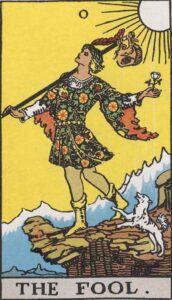
The Rider-Waite-Smith deck is made to be read from its pictures. Pamela Colman Smith drew scenes for all 78 cards, including the numbered Minor Arcana, where many older decks simply showed a pattern of cups or coins. So every card shows a moment you can step into. Take The Fool: a young traveller at the edge of a cliff, a white rose in one hand, a small dog at his heels and a bright sun behind him. You don’t need a book to feel the mix of freedom and risk in that picture.
Ask simple questions of the image. Who is in it, and what are they doing? Is the scene calm or stormy? The detail that catches your eye today is often the part of the card that speaks to your question.
3. Major or Minor Arcana
22 of the 78 cards belong to the Major Arcana, so a little over one pull in four will be a Major. A Major points to a bigger theme: a life lesson, a turning point, or a force larger than the details of the day. The other 56 cards, the Minor Arcana, deal with everyday situations you can usually act on directly. If you draw a Major for a small question, it is worth asking whether the question is bigger than it looks.
4. The suit
Each Minor card belongs to one of four suits, and the suit tells you which area of life the card is talking about:
| Suit | Element | Area of life | In a one card pull, it asks about |
|---|---|---|---|
| Wands | Fire | Energy, ambition, creativity, action | Where your drive is going, or should go |
| Cups | Water | Feelings, love, friendship, intuition | What your heart is doing |
| Swords | Air | Thoughts, decisions, conflict, truth | What your mind is doing |
| Pentacles | Earth | Money, work, home, the body | The practical, material side |
A suit that doesn’t seem to match your question is a clue in itself. A Swords card for a love question suggests your thoughts, or an unspoken conflict, matter more right now than your feelings.
5. The number
The numbers in each suit tell a rough story, from a beginning at the Ace to the full weight of the suit at the Ten. It is a guide rather than a rule, but it helps with an unfamiliar card:
- Aces: a beginning, a seed, raw potential.
- Twos: choice, balance, partnership.
- Threes: growth and first results, often involving other people.
- Fours: stability, rest, or standing still.
- Fives: conflict, loss or disruption.
- Sixes: recovery, harmony, moving on.
- Sevens: assessment, challenge, testing your position.
- Eights: movement and effort, or feeling stuck.
- Nines: the suit at its most intense, just short of completion.
- Tens: completion, and the full weight of the suit, good or bad.
6. Court cards
The 16 court cards (Page, Knight, Queen and King in each suit) often describe a person: someone in your life, or a side of you that the situation calls for. Pages bring curiosity and news, Knights bring action (sometimes too much of it), Queens bring inner mastery and care, and Kings bring outward authority and responsibility. In a one card pull, ask first whether it describes an attitude you could take, then whether it fits someone you know. See tarot court cards explained.
7. Put it back into the question
Finally, return to your question and finish this sentence: “For this question, the card is saying…” Keep it to one or two sentences. If you can’t, the question may have been too broad for one card.
Reversed cards in a one card pull
Reversals are optional. Many beginners keep every card upright, and some experienced readers never use them. If you do read them, a reversed card usually shows the card’s energy blocked, delayed, turned inwards or pushed too far. It is rarely the simple opposite of the upright meaning.
With a single card, read a reversal as a question about how that energy is working for you right now. The reversed Ace of Wands keeps the spark of the upright card but shows it not catching: blocked creativity, delays, or burnout. The reversed Five of Pentacles turns hardship towards recovery and accepting help. So a reversal can be good news as well as bad.
If you prefer not to use reversals, turn every card upright and read the whole range of the upright meaning, shadow side included.
Four worked examples
Here are four hypothetical one card pulls. They are illustrations, not real people or readings, and each interpretation follows the card’s own meaning on this site.
A daily pull: the Knight of Pentacles
Imagine someone with a long to-do list who asks in the morning, “What do I need to know about today?” They turn over the Knight of Pentacles, the card of steady, reliable effort: routines, checklists and finishing what you started. For a busy day the message is plain. This is not the day for a breakthrough or a bold new plan. It is the day to work through the list in order and keep the promises already made. In the evening, the question to ask is whether steady work got further than rushing would have.
Before a hard conversation: the Queen of Swords
Imagine someone who needs to talk to a housemate about bills that keep going unpaid. They ask, “What should I keep in mind before this conversation?” and draw the Queen of Swords. Her advice is to speak clearly and kindly, look at the facts rather than hopes or fears, and set the boundary that has been put off. In practice: bring the numbers, say calmly what needs to change, and agree what happens next.
Had the Queen come up reversed, the same card would have warned against the other extreme: coldness and cutting words that win the argument but damage the friendship.
A reversed card: the Ace of Wands reversed
Imagine someone whose novel has stalled for months. They ask, “What is holding this project back?” and draw the Ace of Wands, reversed. Upright, the Ace is a spark of fresh energy. Reversed, the spark is there but not catching: blocked creativity, hesitation or fear of starting, and sometimes burnout, an empty tank after running on enthusiasm for too long.
The useful question is which of those fits. If they are exhausted, rest comes before any new push. If fear is the block, the upright Ace’s advice shows the way back: one small, concrete step that commits them to the idea, such as writing one scene this week.
A yes or no pull: the Eight of Pentacles
Imagine someone asking, “Should I sign up for the evening course?” They draw the Eight of Pentacles, the card of focused work that builds real skill. It is a yes, especially if they are willing to put in steady work, and it is a green light for study and training in particular. The card also sets the terms. This is not a yes that arrives by magic: the course will pay off if they turn up week after week and do the practice.
One card yes or no readings
A single card is the classic way to ask a yes or no question. Every card leans one way. The Sun and the Ace of Wands are strong yeses, the Three of Swords and the Ten of Swords lean no, and The High Priestess says the answer isn’t visible yet. Three habits make a yes or no pull more useful:
- Ask one clear question about something you can act on. “Should I apply for the course?” works better than “Will everything work out?”
- Read the conditions, not just the verdict. Many yeses come with terms. The Knight of Pentacles is a yes, but a slow one, and Temperance is a yes that needs patience.
- Decide what a reversal means before you draw. A reversed card often softens a yes towards “not yet” and pushes a maybe towards no.
The yes or no tarot page has its own free draw and the answer for all 78 cards, upright and reversed. For a question that matters, treat the card’s answer as one voice in the decision, not the decision itself.
A daily pull and the card of the day
A daily one card pull and a card of the day are the same practice with a slightly different frame. A daily pull usually starts with a question you choose. A card of the day needs no question: the card is simply the theme for the day.
On this site the two tools work differently too. The card of the day gives you one card per day, with a short message and advice, and it stays the same until tomorrow. The one card draw on this page works at any time, whenever you have a genuinely new question.
Morning or evening?
A morning card is a lens for the day ahead: watch for where it shows up. An evening card is a review: read it as a comment on the day. Whichever you choose, keep the same time and question for a few weeks, so your cards are easier to compare.
Clarifier cards
A clarifier is one extra card drawn to shed light on a card that puzzles you, in a single pull or a big spread. Ask a specific follow-up, such as “What does this look like in practice?” Then read the second card as a comment on the first, not a replacement for it.
Imagine someone who asks, “What do I need to know about work this month?” and draws Temperance. At work, Temperance favours a balanced approach, long-term planning over quick wins, and easing back from burnout. But “balance” feels vague. They draw one clarifier and ask, “What does balance look like in practice?” It is the Eight of Pentacles, whose advice is to choose the skill or project that matters most and give it regular, focused time. Together the two cards say: do fewer things, and do them well.
One clarifier is usually enough. If you keep drawing until a card says what you hoped for, you are no longer reading the cards. You are shopping for an answer.
Journaling and a 30-day one card practice
A one card habit pays off most when you write it down. The notes don’t need to be long:
- The date and time.
- Your question, word for word.
- The card, and whether it was reversed.
- Your first impression, before you looked anything up.
- The meaning, in one or two sentences.
- Later that day, or the next: what actually happened, and whether the card fitted.
A 30-day plan
Each week of the month adds one layer:
| Days | Focus | What to do |
|---|---|---|
| 1 to 7 | The picture | Draw one card each morning. Write what you see and feel before you read the meaning. |
| 8 to 14 | The meaning | Add the book meaning, and note where it matches your first impression and where it differs. |
| 15 to 21 | The question | Ask a specific question each day. Practise finishing the sentence “For this question, the card is saying…” |
| 22 to 30 | The patterns | Keep drawing, then review the month: count the Majors, suits, court cards and repeats. |
What to expect at the review: if you shuffle the full deck each day, 30 pulls typically include about 8 Majors, about 5 cards of each suit and about 6 court cards. At least one card will almost certainly have come up twice, because with 30 draws from 78 cards a repeat is more than 99% likely. So one repeat is normal. A card that appears three or four times, or a suit that dominates the month, is worth a closer look. See what it means when you keep pulling the same card.
Journal prompts
- Where did this card show up today?
- What did I expect the card to say, and what did it say instead?
- What is one small thing I can do about it tomorrow?
Common one card mistakes
- Drawing again because you disliked the card. The second card is not more accurate, just more welcome. Sit with the first one.
- Asking a question that is too big. One card can’t cover a whole year or a whole relationship. Narrow the question, or use a three-card spread.
- Reading the keyword and stopping. A keyword is a starting point. Put it back into your question.
- Taking frightening cards literally. Death usually means an ending that makes room for something new, and The Tower a shake-up that clears the way to rebuild. Neither predicts a disaster.
- Pulling single card after single card on one question. Five separate pulls is really a spread without positions, and harder to read than a proper spread.
- Letting the card decide for you. A card is a prompt for reflection. Decisions about health, money or safety deserve proper advice as well.
One card tarot pull: frequently asked questions
Is one card enough for a tarot reading?
Yes, for a focused question. One card gives you a theme, a piece of advice or a leaning. It can’t map out a complicated situation, so for questions with a history or several people involved, use a larger spread such as the three-card spread or the Celtic Cross.
What is the best question for a one card pull?
A single, open question about something you can act on, such as “What do I need to know about today?” Avoid questions with two parts, and questions about what someone else is secretly thinking.
Should I read reversed cards in a one card pull?
It is your choice. Reversals add detail, usually showing a card’s energy blocked, delayed or turned inwards. Reading every card upright is just as valid. Decide before you shuffle and stick to it.
How often can I do a one card pull?
As often as you have a genuinely new question. Once a day is a good rhythm for learning the cards. Asking the same question again and again within an hour tends to muddy the answer rather than sharpen it.
What is the difference between a one card pull and a card of the day?
A one card pull answers a question you choose, at any time. A card of the day is a single theme for the whole day, with no question needed. The card of the day on this site gives you one card per day.
Can one card answer a yes or no question?
Yes. Every card leans towards yes, no or maybe, and many yeses come with conditions. The yes or no tarot page lists the answer for all 78 cards, upright and reversed.
What if I keep pulling the same card?
An occasional repeat is simple chance: over 30 daily pulls, at least one repeat is almost certain. A card that keeps returning over weeks, though, is worth a closer look. Read its full meaning again and ask what you haven’t acted on yet.
Ready to try it? Draw a card at the top of this page, turn over today’s card of the day, or move up to the three-card spread when you want a fuller story. You can look up any card in the meanings of all 78 cards and find every layout on the tarot spreads page.