
The relationship tarot spread is a six-card layout for looking at a connection between two people. One card describes you, one describes the other person, and one describes the relationship itself: the thing you make together. Two more show what is working and what is straining it, and the last shows where things are heading and what would help.
It suits love questions that are bigger than yes or no: a new connection you are unsure about, a long relationship that has gone quiet, a rough patch, or a decision such as moving in together. It works for close friendships and family ties too. If you are new to the cards, how to read tarot cards covers the basics first.
Draw a free Relationship Spread reading now: hold the relationship and your question in mind, then deal all six cards below. Each position is labelled with its question and linked to the card’s full meaning. If your real question is simply how someone feels, the How do they feel about me? reading is quicker.
Your Relationship Spread reading
- You How are you showing up in this relationship?
- Your partner How are they showing up right now?
- The relationship What is the bond between you like?
- Strengths What is working, and worth protecting?
- Challenges What is straining the connection?
- Outcome or advice Where is this heading, and what would help?
Read cards 1 and 2 as a mirror, with card 3 between them, then weigh Strengths against Challenges before the last card. How to read the positions together
Jump to a section:
- What the relationship spread is, and when to use it
- The six positions at a glance
- Each position in depth
- Reading the positions together
- How to lay out the spread, step by step
- A full example reading
- New connections, long relationships, exes, friends and family
- Questions to ask
- Common mistakes
- Frequently asked questions
What is the relationship tarot spread?
The spread uses six cards in three rows. The top row holds the two people and the bond: You (1) on the left, Your partner (2) on the right and The relationship (3) between you. Below sit Strengths (4) and Challenges (5), and the Outcome or advice card (6) goes at the bottom. The shape is the point: the relationship card sits in the middle because it belongs to neither of you alone.
There is no single classic version. Relationship layouts appear in many modern tarot books, with different numbers of cards and different labels. This one keeps the essentials: both people, the bond, its light and shade, and a direction.
Use it when:
- You want to understand a dynamic, not just one person’s feelings.
- Something has shifted: more distance, more arguments, or a new stage.
- You are facing a shared decision, such as moving in, committing or having a hard conversation.
- A connection is new and you are not sure what it is yet.
A different spread is often the better choice:
- The relationship has ended and you are hurting. The broken heart spread is kinder. It looks at your healing, not at the other person.
- You are choosing between two people or two paths. The two options spread sets them side by side.
- You want a quick lean. A yes or no reading or the free love tarot reading is faster.
- The situation is tangled, with history, other people and hidden motives. The ten-card Celtic Cross has room for all of it.
And if a relationship leaves you feeling unsafe, controlled or afraid, tarot is not the right tool. Please talk to someone you trust or a domestic abuse support service where you live.
The six relationship spread positions at a glance
Each position asks its own question, and each is best read alongside one or two others:
| Position | What it asks | Read it with |
|---|---|---|
| 1. You | How are you showing up: your feelings, needs and behaviour? | 2, 3 |
| 2. Your partner | How is the other person showing up right now? | 1, 3 |
| 3. The relationship | What is the bond like, as a thing in its own right? | 1, 2, 6 |
| 4. Strengths | What is working, and worth protecting? | 5, 3 |
| 5. Challenges | What is straining the connection? | 4, 6 |
| 6. Outcome or advice | Where is this heading, and what would help? | 3, 5 |
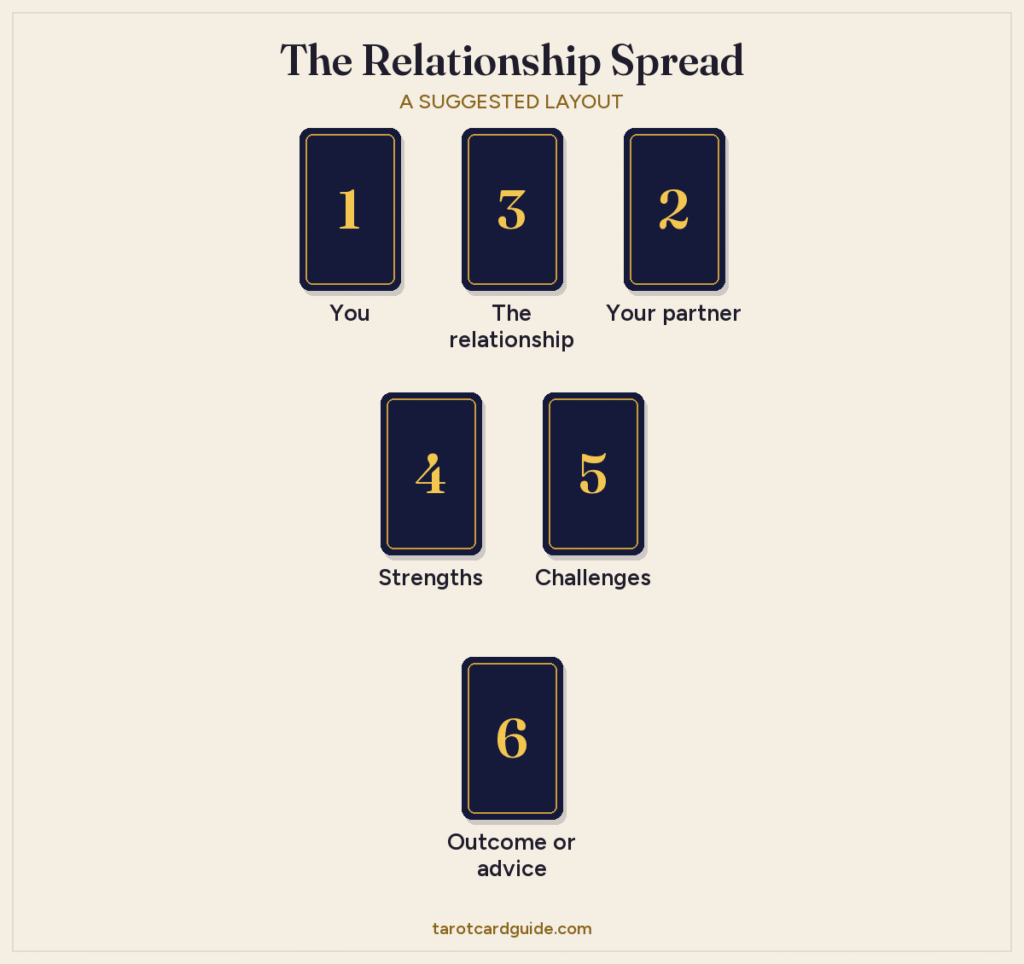
The numbers show the order in which the cards are laid down. You place the two people first, on the outside of the top row, then the relationship card between them. Strengths and Challenges sit side by side underneath, and card 6 goes at the bottom in the centre.
Each relationship spread position in depth
Some patterns hold across all six positions, so it helps to know them before you start:
- Major Arcana: weight. The matter is part of a bigger chapter or life lesson, not just this month’s mood.
- Cups: feelings, affection and emotional needs. The most natural suit for love.
- Wands: desire, energy, ambition and sometimes friction or overload.
- Swords: thoughts, words, doubts and conflict. Often a sign that talking, or not talking, is the issue.
- Pentacles: the practical side of love: time, money, home, routine and commitment shown through actions.
- Court cards: usually a way of behaving, and in cards 1 and 2 very often a description of one of you.
The one-card examples below are only starting points. Always check them against the rest of the spread.
Card 1: You
This card is your side of the connection: what you feel, what you want and how you are behaving, which are not always the same thing. It often names something you half know already. Read it first and read it honestly, because it is the one position you fully control. For example, the Queen of Cups shows you caring deeply and tuned in to your partner, with a reminder to care for yourself as well. The Eight of Swords suggests you feel stuck, or afraid to say what you really feel.
- What stands out here: a Major suggests this relationship is part of a bigger change in you. A court card often describes your manner in the relationship, in that card’s style.
- Reversed: a feeling you are holding back, or one of your strengths tipped too far, such as care turning into over-giving.
- Compare with: card 2, to see whether you mirror each other, and card 3, to see whether you are shaping the bond or reacting to it.
Card 2: Your partner
Card 2 is the other person as they appear in this connection now: their mood, their needs and how they are behaving towards you. It is a reflection, not a window into their head. Tarot can suggest an atmosphere; it cannot confirm what someone thinks, so hold this card more lightly than card 1. For example, the Knight of Pentacles describes someone loyal and steady who shows love through actions rather than words. The Seven of Cups suggests someone unsure what they want, or drawn to the idea of other options.
- What stands out here: a hard card is not a verdict on the person. Pressure from work, family or money often lands here, because it shapes how someone shows up.
- Reversed: guarded, stressed or holding something back. It rarely means “no feelings”; more often, feelings that are blocked or mixed.
- Compare with: card 1. The contrast between the two is usually the heart of the reading.
Card 3: The relationship
The centre card is the bond itself: the atmosphere between you, your habits as a couple, what you have built. It is often the most revealing card, because a relationship can struggle even when both people mean well. For example, The Lovers points to a bond built on intimacy, respect and shared values, and to love as an ongoing choice. The Five of Swords shows a pattern of point-scoring, where winning the argument matters more than understanding each other.
- What stands out here: a Major says the relationship is a significant chapter for both of you. Cups are the most natural fit; Pentacles show a practical bond of shared plans, home or money.
- Reversed: the bond is out of balance, blocked or stuck in a phase. It describes the relationship now, not its fate.
- Compare with: cards 1 and 2 (does the bond look more like one of you?) and card 6 (where is it going?).
Card 4: Strengths
Card 4 shows what is working: the foundation, a shared value, something you do well together. In a hard reading it is the card to hold on to, because it shows what there is to build on. For example, the Three of Pentacles shows good teamwork and respect for what each of you brings. The Six of Cups points to warmth, kindness and happy shared memories.
- What stands out here: if a difficult card lands in Strengths, ask what it has given you. The Ten of Wands, for instance, can be a shared willingness to carry things, even if you are both tired.
- Reversed: a strength that is still there but neglected or taken for granted.
- Compare with: card 5, and card 3 (is the strength visible in the bond, or hidden under it?).
Card 5: Challenges
Card 5 is the strain: the recurring argument, the unmet need, the outside pressure. Try to name it in one plain sentence. It is often the most useful card in the spread, because a challenge you can name is one you can work on. For example, the Two of Pentacles points to busy lives squeezing romance into whatever time is left. The Devil suggests jealousy, control or an attachment that feels more like a hook than love.
- What stands out here: a Major is a deep issue, such as trust, values or a life change. A Minor is usually practical and fixable. A pleasant card here often shows something good in itself that is getting in the way, such as the Three of Cups: a busy social life that leaves little time for each other.
- Reversed: a challenge that is easing, or one that is being kept out of sight.
- Compare with: card 4 (which is stronger?) and card 6 (does the last card answer it?).
Card 6: Outcome or advice
The last card can do two jobs. As an outcome, it shows where the relationship is heading if things carry on as they are. As advice, it shows what would help most. Decide before you deal which you want, or read it both ways and see which fits. For example, The Star suggests renewed faith in each other after a difficult time. Death marks the end of a cycle, which can mean a breakup but just as often means one phase of the relationship closing so that another can begin.
- What stands out here: a Major marks a real turning point. Pentacles often show commitment in practical form, such as a shared home; Swords, a conversation that needs to happen.
- Reversed: as an outcome, often a delay or something to deal with first rather than a flat no. As advice, a warning about what to avoid.
- Compare with: card 3 (where the bond is going) and card 5 (does it resolve the challenge?).
Reading the positions together
Six cards read one by one give you six statements. Read in pairs, they tell you how the relationship works. These are the connections to check every time.
The mirror: cards 1 and 2
Put the two people side by side. The same suit means you are meeting in the same place: both feeling, both thinking, both busy. Different suits can mean you are speaking different languages. Cups for you and Pentacles for them, for instance, can describe one person wanting emotional closeness while the other shows love by doing practical things. Neither is wrong, but each may miss what the other is offering.
Two court cards are two personalities. Compare their ranks: Pages are new to something and learning, Knights are in pursuit and on the move, Queens show inner steadiness and Kings outward authority. Some readers also look at which way the figures face in the Rider-Waite-Smith pictures, towards each other or away. Treat that as a small extra hint, not a rule.
The bond between you: card 3 with cards 1 and 2
Ask whether the relationship card looks more like one of you than the other. If it shares a suit or mood with card 1, you may be setting the tone. If card 3 is harder than both personal cards, the problem may be the pattern between you rather than either person, which is common in long relationships where two decent people have drifted into bad habits.
Light and shade: cards 4 and 5
Read Strengths and Challenges as a balance. If they share a suit, the strength and the problem come from the same place: two Cups cards can mean deep feeling is both what binds you and what hurts. A Major at 4 and a Minor at 5 suggest the foundation runs deeper than the problem. The other way round, the problem is bigger than it looks and the strength may not be enough on its own.
Challenge and outcome: cards 5 and 6
Check whether the last card answers the challenge. A Swords challenge, such as an avoided conversation, followed by Justice or the Queen of Swords at card 6 gives a clear path: honest, fair talk. If card 6 ignores the challenge completely, the outcome it shows may come with that problem still unresolved.
The top row and what lies beneath
The top row (cards 1 to 3) is the relationship as you would describe it to a friend. The lower cards (4 to 6) are what holds it up, what wears it down and where it goes. A tense top row over a strong card 4 suggests a rough patch on good ground. A pleasant top row over a heavy card 5 suggests something important is not being said.
Counting six cards
In six cards from a well-shuffled deck, expect one or two Majors. Four or more turn up in only about 1 reading in 20 and mark a defining period for the relationship. Three or more cards of one particular suit (about 1 reading in 15) set the theme: Cups for feelings, Wands for passion or friction, Swords for communication and stress, Pentacles for practical life. A missing suit is common, about 3 readings in 10 for any given suit, so do not read much into an absence. For how pairs of cards combine, see tarot card combinations.
How to lay out the relationship spread, step by step
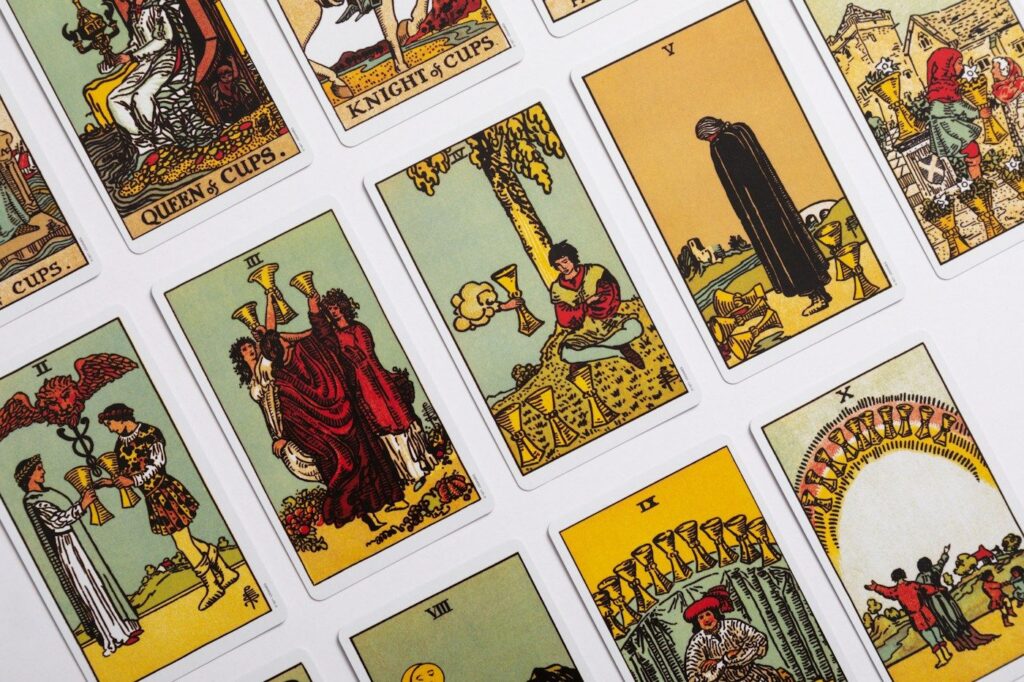
- Word your question. Make it about the connection and your part in it, for example “What do I need to understand about where we are?” There are more ideas in the questions section.
- Set your conventions before you shuffle: whether you read reversals, and whether card 6 is the outcome, the advice or both.
- Shuffle and cut while you think about the relationship as it is now, not as you wish it were.
- Lay the top row. Card 1 on the left, card 2 on the right, then card 3 in the middle.
- Lay the rest. Card 4 below and to the left, card 5 below and to the right, and card 6 at the bottom in the centre.
- Read in three passes. First take in the whole spread and count Majors, suits and reversals. Then read each card in its position. Then read the pairs, starting with cards 1 and 2.
- Write it down, with the date and the question, so you can look back when things have moved on.
Variations
- Significators. Some readers choose a court card for each person and place them before dealing. Others leave all 78 cards in the deck so any card can describe either of you. Both work.
- A seventh card. If you want both an outcome and advice, split card 6 into two: deal card 6 as the outcome and a seventh card beside it as the advice.
- Swapping sides. Some readers put the other person on the left. It makes no difference, as long as you are consistent.
A full relationship spread example reading
Here is a complete hypothetical reading to show how the cards work together. It is an illustration, not a real person or reading. Imagine someone called Alex, who has lived with their partner Jo for four years. Nothing is badly wrong, but they have drifted: they talk mostly about chores, and Alex feels something is missing. Alex asks: “What do I need to understand about where Jo and I are, and what would help us?” Alex reads reversals and reads card 6 as both outcome and advice.
| Position | Card | In brief |
|---|---|---|
| 1. You | Four of Cups | Withdrawn and flat; something feels missing |
| 2. Your partner | Ten of Wands | Caring but weighed down by responsibilities |
| 3. The relationship | Two of Cups, reversed | Imbalance; the spark has faded into habit |
| 4. Strengths | Four of Wands | A real home together and a sense of belonging |
| 5. Challenges | Two of Swords | A conversation both of you are avoiding |
| 6. Outcome or advice | Temperance | Balance restored through patience and compromise |
The two of them: cards 1 and 2
The Four of Cups shows Alex bored, disconnected and not fully present, feeling that something is missing without being able to name it. The card also warns that Alex may be overlooking what is being offered. Jo’s card, the Ten of Wands, describes someone who cares but is carrying too much, with work or family duties leaving little energy for romance. Jo may also feel they are the one doing all the work. Put side by side, each may be reading the other’s tiredness or distance as a lack of interest. Neither card says the feelings have gone.
The bond: card 3
Reversed, the Two of Cups is a relationship where the spark has faded into habit, or where one person is giving more than the other. Next to cards 1 and 2 this reads as drift, not betrayal: two people who are no longer meeting as equals because one is running on empty and the other has checked out. The card’s own advice for the reversal is honest conversation, which points straight to card 5.
Light and shade: cards 4 and 5
The strength is real. The Four of Wands is one of the classic cards of a stable, happy home and of building a shared life. Whatever else is going on, Alex and Jo feel they belong together. The challenge is the Two of Swords: a stalemate kept in place by avoidance. Both are keeping the peace by saying nothing, so the relationship is neither moving forward nor ending. Wands for the strength and Swords for the challenge fits the story: the home is solid, the talking is not.
Outcome and advice: card 6
Temperance is the only Major in the spread, so it carries weight. As an outcome, it shows a partnership finding its rhythm again, with patience and honest communication bringing things back into balance. It is a steady, healing card, not a whirlwind. As advice, it asks for the middle way and for give and take: Jo sharing the load rather than carrying it, Alex engaging rather than withdrawing, and both adjusting without losing themselves.
Putting it together
The reading does not say “leave” or “everything is fine”. It says the foundation is good (Four of Wands) and the drift is real (Two of Cups reversed), kept in place by a conversation neither person has started (Two of Swords). Each card also carries its own advice. The Ten of Wands says put something down and ask for help; the Four of Cups says look again at what is being offered. A practical next step would be one calm talk in which each says what they are carrying and what feels missing, followed by small, steady changes rather than one grand gesture.
The count supports this: one Major, two Cups, two Wands, one Swords, no Pentacles and no court cards. Feelings and everyday load share the reading equally, and the single Swords card sits exactly where the problem is.
Using the spread for different relationships
A new connection
Early on, card 3 shows the potential of the connection rather than a settled relationship, and cards 4 and 5 are early signs worth noticing, not fixed traits. Pages and Knights are common here, especially the Page of Cups (flirtation, sweet messages) and the Knight of Cups (romance and pursuit). Read card 6 as advice: new relationships change quickly, and an outcome card describes only the current direction.
A long relationship
For established couples the spread works best as a check-in on one specific issue, such as money, time together or a decision about the future. Give card 4 generous attention. After years together, strengths are easy to take for granted, and naming them is often what makes a hard conversation possible.
An ex
If you are back in touch or thinking about trying again, card 3 shows what the connection is now, card 5 what ended it or is still unresolved, and card 6 what would help. Cards such as the Six of Cups and Judgement often come up around second chances; see cards about the past and second chances. The Six of Cups carries its own caution: before you rekindle anything, ask honestly whether it ended for a reason. If the relationship is over and you mainly want to heal, use the broken heart spread instead.
Reading about someone who does not know
Most relationship readings are about someone who is not in the room, and many readers are comfortable with that as long as the reading stays about the connection and your own choices. Card 2 describes how the other person shows up in the relationship, not their private thoughts. Keep the question on your side: “What do I need to understand about this connection?” rather than “What is she thinking?”
Some uses cross a line. Checking the cards every day for what someone is doing, reading about a partner’s fidelity instead of talking to them, or using a reading to decide what someone else ought to do all put the cards in the place of an honest conversation. For more on this, see reading about someone else’s feelings and tarot cards as feelings. If you’re not sure this is the right spread for your situation, the guide to tarot for relationships matches each kind of question to a reading.
Friendships and family
The spread works for any close tie. Rename card 2 “the other person” and read the rest as usual. Cups still describe feeling and care, and Pentacles often bring in the practical side of family life, such as a shared home, money or duties. The Three of Cups is a common card of friendship, and the Ten of Cups of family harmony.
Questions to ask with the relationship spread
The best questions are open, about the present, and about something you can act on. Questions that try to lock in another person’s future choices tend to give muddled readings.
| Weaker question | Stronger question |
|---|---|
| Does he love me? | What do I need to understand about how we connect? |
| Will we get married? | What would help us build the future we both want? |
| Why is she being so distant? | What is happening between us right now, and what can I do? |
| Will my ex come back? | What do I need to know before reopening this connection? |
| Is this relationship doomed? | What is straining this relationship, and what is still strong? |
| Who is to blame for our arguments? | What pattern keeps repeating between us? |
For more on wording, see how to ask the right questions in a tarot reading.
Common relationship spread mistakes
- Reading card 2 as a verdict on the other person. It shows how they appear in the connection now, often shaped by pressures you cannot see.
- Skipping card 1. Your own card is the one you can do something about. Readings that jump straight to the partner miss half the story.
- Glossing over Strengths. A hard reading with a good card 4 is a very different reading from one without it.
- Treating card 6 as fate. It is the current direction, and the rest of the spread shows what could change it.
- Using the cards instead of a conversation. A reading can show you what to talk about. It cannot have the talk for you.
Relationship tarot spread: frequently asked questions
What are the positions in the relationship tarot spread?
In the version on this page: 1 you, 2 your partner, 3 the relationship, 4 strengths, 5 challenges, and 6 the outcome or advice. Cards 1 to 3 form the top row, with the relationship card between the two people.
Can I use it if I am single, or the relationship is not official?
Yes. For a crush, a date or a situationship, read card 2 as the other person and card 3 as the potential between you. Read card 6 as advice, since early connections change quickly.
Is it all right to read about someone without them knowing?
Most readers think so, provided the reading stays about the connection and your own side of it. Tarot cannot tell you what someone privately thinks, and it should never replace talking to them. Ask what you need to understand, not what they are doing.
What if I do not like the outcome card?
Card 6 shows the direction things are taking now, not a fixed result. Read it against card 5: if the challenge changes, the outcome can change too. Treat a hard card as a warning you can act on, and look at card 4 for what you have to work with.
How often should I do a relationship reading?
When something has changed, or every few weeks at most for the same question. Daily readings on one relationship tend to feed anxiety rather than clarity. For a light daily check-in, a card of the day is better.
Which cards are the best to see in a relationship reading?
The Two of Cups, The Lovers, the Ten of Cups and the Four of Wands are among the warmest. Position still matters, though: even the Two of Cups reads differently as a challenge than as a strength. The love meanings of all 78 cards cover each one.
Ready to try it? Deal your own reading with the free Relationship Spread at the top of this page, look up any card in the love tarot card meanings, or try the free love tarot reading. If a relationship has ended, the broken heart spread is there for you, and every other layout is on the tarot spreads page.