
The two options tarot spread is a six-card layout for decisions. You give each choice its own column of three cards, asking the same three questions of both: what is at the heart of this option, what happens soon after you choose it, and where it leads over time. Because both columns answer the same questions, you can compare the paths card by card instead of reading two separate stories.
It is the go-to decision spread for any genuine A-or-B choice: two job offers, staying or moving, two courses, or the classic “should I stay or should I go?” This guide covers the positions, how to compare the columns, what to do when neither option looks right, and a full example reading.
Draw a free two options reading now: decide which choice is Option A and which is Option B, and write them down, then deal all six cards below. Option A is the left column (cards 1 to 3) and Option B the right (cards 4 to 6). Each card links to its full meaning.
Your Two Options Spread reading
- Option A: core energy What is at the heart of Option A?
- Option A: short term What happens soon after choosing Option A?
- Option A: long term Where does Option A lead over time?
- Option B: core energy What is at the heart of Option B?
- Option B: short term What happens soon after choosing Option B?
- Option B: long term Where does Option B lead over time?
Compare the columns row by row: card 1 with card 4, card 2 with card 5, and card 3 with card 6. Then see whether each column rises or falls from top to bottom. How to compare the two options
Jump to a section:
- What the two options spread is, and when to use it
- The 6 positions at a glance
- Each position in depth
- Comparing the two columns
- How to lay out the spread, step by step
- When neither option looks right
- A full example reading
- How to word the two options
- Common mistakes
- Frequently asked questions
What is the two options tarot spread?
Most spreads follow one situation through time. This one follows two possible futures side by side. The six cards form two columns: Option A on the left, Option B on the right. Each column has three rows, core energy at the top, the short term in the middle and the long term at the bottom, so every card has a direct partner in the other column.
The spread does not choose for you, and it is not a vote between a “good” column and a “bad” one. It shows the texture of each path: what is driving it, how it is likely to feel at first, and where it tends to go. That helps with the two things that make decisions hard: seeing past the first few weeks, and noticing why you are drawn to each option in the first place.
When to use it
- Two real, concrete choices: two job offers, two flats, two courses, two cities.
- Stay or go: staying is an option too. Put “stay” in one column and “go” in the other, and describe each one specifically.
- Now or later: doing something this year against waiting, such as starting a business now or after a year of saving.
- Going round in circles: when you have made the same list of pros and cons several times and still cannot decide.
When another spread is better
- You are not yet sure what the options are: start with the Horseshoe spread to understand the situation, then come back with two clear choices.
- A single yes or no: “Should I apply?” has one option, not two. Use the yes or no tarot reading, or turn it into a real pair (“apply now” against “wait until spring”).
- A work direction rather than a choice: the career path spread looks at where your working life is heading.
- How a relationship is going: the relationship spread looks at both people and the bond between them.
Tarot is a tool for reflection, not a replacement for your own judgement or for professional advice. If you are weighing whether to leave a relationship because it is harmful, that is not a question for the cards. If you feel unsafe, controlled or afraid, please talk to someone you trust or a support service for domestic abuse where you live.
The 6 positions at a glance
The same three questions are asked of each option, so every position has a partner in the other column:
| Position | What it asks | Read it with |
|---|---|---|
| 1. Option A: core energy | What is at the heart of Option A, and why am I drawn to it? | 4, then 2 |
| 2. Option A: short term | What happens soon after choosing A? | 5, then 1 and 3 |
| 3. Option A: long term | Where does A lead over time? | 6, then 1 |
| 4. Option B: core energy | What is at the heart of Option B, and why am I drawn to it? | 1, then 5 |
| 5. Option B: short term | What happens soon after choosing B? | 2, then 4 and 6 |
| 6. Option B: long term | Where does B lead over time? | 3, then 4 |
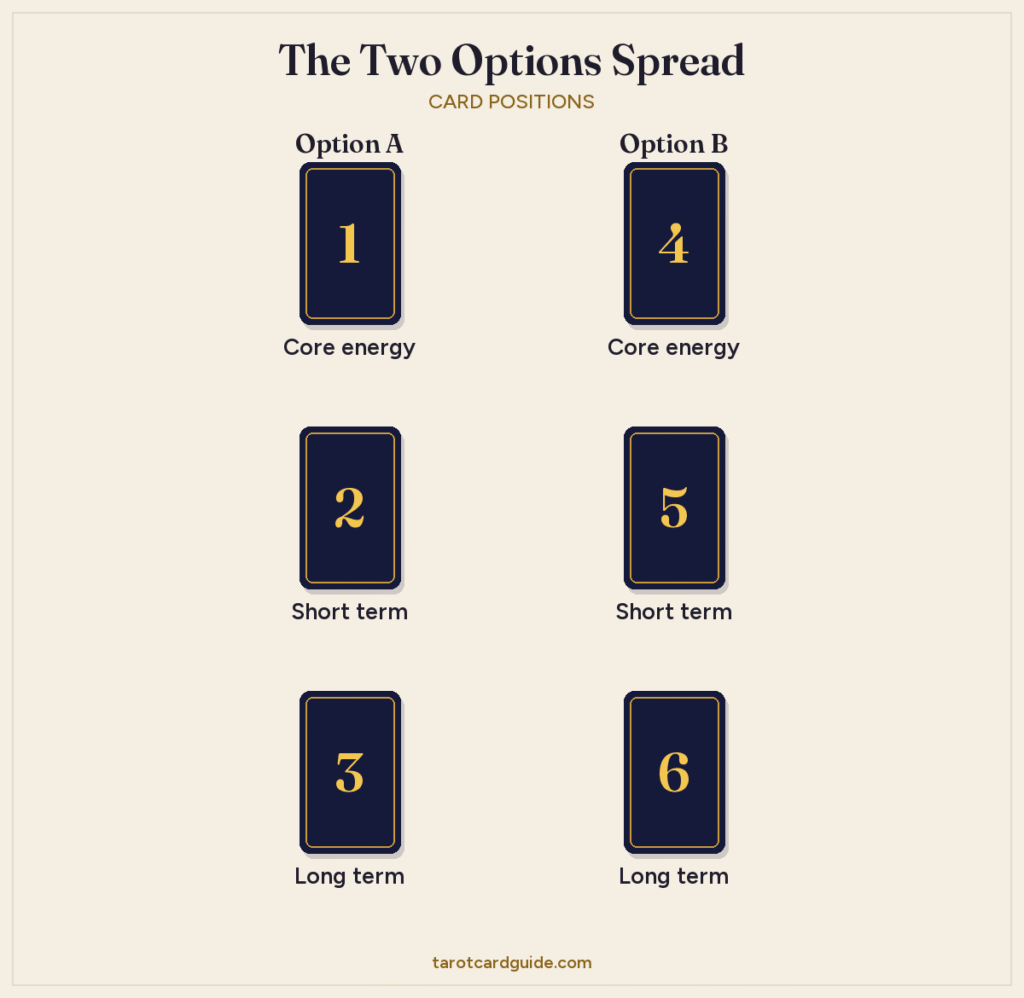
Read down a column to follow one path from its heart to its long-term result. Read across a row to compare the two paths at the same stage. The spread is built for the second kind of reading.
Each position in depth
Because the two columns ask the same questions, the positions are described here row by row. The suits keep their usual areas: Wands for energy, drive and ambition, Cups for feelings and relationships, Swords for thoughts, decisions and conflict, and Pentacles for money, work, home and practical results.
Cards 1 and 4: Core energy
The top row shows what each option is really about, and often why you are considering it at all. It answers “what is at the heart of this path?” and, just as usefully, “what is pulling me towards it?” People are often surprised here. An option you thought was about money may turn out to be about freedom, and one you thought was about love may turn out to be about security. For example, The Lovers as a core card suggests a choice aligned with your values, while The Devil suggests a pull that has more to do with temptation or attachment than with what you want.
- Major or Minor: a Major here means the option touches something deep, such as your values or a life direction. A Minor means it is a practical choice at heart.
- Court cards: usually the version of you that this option would bring out, or a person central to that path.
- Reversed: often a mixed or distorted motive, such as choosing to escape rather than to build, or an option you are idealising.
Cards 2 and 5: Short term
The middle row shows what each choice is likely to bring soon after you make it: the first weeks or months, the adjustment period. This is where you see which path is easier to start and which one has a rough beginning. For example, the Four of Wands here suggests a welcome and something to celebrate, while the Five of Cups suggests regret or grief for what you gave up, early on.
- Keep it in proportion: a hard short-term card does not make an option wrong, and an easy one does not make it right. Many good decisions feel worse before they feel better.
- Reversed: often a delay, a slow start, or a feeling that has not caught up with the change yet.
- Swords in this row: stress, arguments or second thoughts in the early stage. Worth planning for, not necessarily a reason to avoid the option.
Cards 3 and 6: Long term
The bottom row shows where each path tends to lead once the novelty or the upheaval has passed. Like any outcome card, it is the likeliest direction if things carry on as they are, not a fixed result. For example, The World here points to a sense of completion and fulfilment, while The Tower points to upheaval on that path: something built on shaky ground coming down, which is disruptive but not always bad.
- Major or Minor: a Major suggests the path changes your life in a lasting way. A Minor suggests a more modest, practical result.
- Reversed: often a result that is incomplete or slow to come, or a pattern that would need work to avoid.
- Compare with: the core card at the top of the same column. A long-term card that fulfils the core card’s promise is a strong sign. One that contradicts it asks whether the path can deliver what you want from it.
Comparing the two columns
This is where the spread earns its place. Work through these comparisons in order, and write a line for each so you can see the whole picture at the end.
Row by row: 1 with 4, 2 with 5, 3 with 6
Take each row in turn and finish the sentence: “At this stage, Option A brings ___, Option B brings ___, and I would rather have ___.” Do the top row first, because it colours the others. It is fine if different rows favour different options. Most real decisions are trade-offs, and the rows show you exactly what is being traded.
| Row | Question to ask across the row |
|---|---|
| Core (1 and 4) | Which option am I drawn to for the right reasons? |
| Short term (2 and 5) | Which start can I cope with, and which is easier? |
| Long term (3 and 6) | Which result do I actually want to be living in? |
Down each column: does it rise or fall?
Read each column from top to bottom as a short story. A column that starts hard and ends well describes a path that is worth the effort. A column that starts pleasantly and ends heavily describes a path that is comfortable now and costly later. When one column rises and the other falls, the decision is often about how much short-term difficulty you are willing to accept.
Weight: Majors and Minors in each column
Count the Major Arcana cards in each column. In six cards, expect one or two in total. If one column holds most of them, that option carries more weight: it would change more, for better or worse. A column of Minors describes a path that is more ordinary and easier to adjust along the way. No Majors at all, which happens in about one reading in eight, suggests the decision is very much in your hands.
Suits: head, heart, drive or practicality
Look at which suits fall in each column. A column of Pentacles is a practical, material path; a column of Cups is an emotional one. When the columns are dominated by different suits, you often have a head-against-heart decision, and the spread is showing you which option speaks to which part of you. When the same suit appears in the same row of both columns, compare the numbers: a Ten against a Four of the same suit, for example, shows the same area of life going very differently.
Reversals and echoes
Note where any reversed cards fall. Several in one column suggest that path has more blocks or delays, or that your feelings about it are more tangled. Then look for echoes: the same number or a similar image in both columns can mean the same issue follows you whichever way you go. That is worth knowing, because no choice of path will fix it on its own. See tarot card combinations for how pairs of cards modify each other.
How to lay out the two options spread, step by step

- Name both options precisely and write them down. “Option A: accept the job in Leeds and move in March. Option B: stay in my current role and ask for a promotion review.” Vague options give vague readings.
- Decide which is A and which is B before you shuffle. A always goes on the left. Changing your mind once you see the cards defeats the purpose.
- Set your timescales. Decide what “short term” and “long term” mean for this question, for example three months and two years.
- Decide your conventions, such as whether you read reversed cards.
- Shuffle and cut while you think about the decision as a whole, not about either option alone.
- Deal the columns. Cards 1, 2 and 3 go down the left column, top to bottom, for Option A. Cards 4, 5 and 6 go down the right column for Option B. Leave a gap between the columns so they read as two separate paths.
- Read in three passes. First take in both columns as a whole and count Majors, suits and reversals. Then read each card in its position. Then compare across the rows, as explained above.
- Notice your reaction. If you feel relief or disappointment when a card lands in one column, write that down. It is often the clearest information in the whole reading.
Variations
- A seventh card for the choice itself. Many readers add one card between or above the columns for “what do I need to know about this decision?” It comments on both paths rather than favouring one. Draw it after the six, so it does not get mixed up with either column.
- Different row questions. Some layouts swap the rows for “what I gain”, “what I give up” and “the outcome”. Any three questions work, as long as both columns get the same ones.
- Dealing order. Some readers deal one card to each column in turn instead of completing column A first. Either works if you decide beforehand.
- A significator. A few readers place a card representing themselves at the top, between the columns. It is optional.
When neither option looks right
Sometimes both columns look difficult, both look good, or they look so similar that nothing stands out. Each of these tells you something.
Both columns look difficult
First, check the core cards. If both are fearful or heavy, you may be choosing between two ways of avoiding something, and the real issue sits outside both options. Then consider whether the question is too narrow. “Take job A or job B” may be hiding “stay where I am and change something about it”, or “wait until a better option comes along”.
To look for that third way, draw one clarifier and place it between the columns: “What am I not seeing about this decision?” If it points to rest or waiting, such as the Four of Swords, the answer may be not to decide yet. If it describes a new opening, name that as Option C and deal a third column of three cards, with the same row questions, to compare it properly. Keep to one clarifier and at most three columns; beyond that the reading turns into noise.
Both columns look good
That is good news: either path can work. The decision then comes down to values rather than risk. Look again at the core cards, 1 and 4, and ask which one describes the life you want, not the one that seems safer. The long-term row, 3 and 6, can also show which kind of success you would rather have.
The columns look the same
When the cards give no clear lean, the choice may matter less than you fear, or the same issue may follow you either way. Look for echoes across the columns. Then consider the Two of Swords problem: if you have been stuck for a long time, choosing either option may bring more peace than continuing to wait.
Whatever you see, do not deal the whole spread again hoping for a clearer winner. Sit with the first reading for a day or two, and let it inform the decision rather than make it.
A full two options example reading
Here is a complete hypothetical reading, to show the comparisons in action. It is an illustration, not a real person. Imagine someone called Maya, who has lived in a big city for eight years. Her lease is up for renewal, she is tired, and she is thinking about moving back to the town where she grew up, near her family. She writes down:
- Option A: renew the lease and stay in the city.
- Option B: move back to my home town this spring.
She takes the short term as the first three months and the long term as two years, and she reads reversed cards.
| Row | Option A: stay in the city | Option B: move home |
|---|---|---|
| Core energy | 1. Four of Cups: apathy, going through the motions | 4. Six of Cups, reversed: rose-tinted memories of home |
| Short term | 2. Three of Cups: friends and good times | 5. Six of Swords: a bittersweet move to calmer water |
| Long term | 3. Ten of Wands: carrying too much | 6. Four of Wands: home, belonging, stable ground |
The core row: cards 1 and 4
Neither core card is a clean “yes”. The Four of Cups at the heart of staying shows boredom and withdrawal: the city has lost its colour, and Maya may be staying out of inertia rather than desire. The card also carries a warning to look again, because on the card a cup is being offered and ignored; something good may still be available to her there. At the heart of moving home is the Six of Cups reversed: idealising how things used to be. The pull of home may be partly a pull towards the past. Both core cards are Cups, so this is first of all an emotional decision, and both ask Maya to check her motives.
The short-term row: cards 2 and 5
In the short term, staying is easier. The Three of Cups promises friendship and celebration: Maya’s friends are in the city, and the next few months would be sociable. Moving brings the Six of Swords: a transition that leaves something difficult behind, with sadness for what she leaves as part of the journey. It is the harder start, but it is moving towards calmer circumstances.
The long-term row: cards 3 and 6
Here the columns split clearly, and they do it in the same suit. Staying leads to the Ten of Wands: a load that keeps growing, too many responsibilities, the risk of burnout. Moving leads to the Four of Wands: home, belonging and stable foundations. Two Wands cards in the long-term row say the lasting difference between these paths is about Maya’s energy and how she lives day to day. The numbers show which path lightens the load.
The shape of each column
Option A falls: pleasant now, heavy later. Option B rises: bittersweet now, settled later. That is a classic trade-off between short-term comfort and long-term wellbeing. There are no Major Arcana cards at all, which suggests nothing here is fated or out of her hands. It is an ordinary, if important, life choice that she can shape either way.
A clarifier for the choice itself
Because both core cards raised questions, Maya draws one extra card between the columns and asks, “What do I need to know about this decision?” She draws the Two of Pentacles: juggling priorities, weighing two options, staying flexible while choosing what matters most. It brings the practical side in: work, money and time. It also hints that the choice may not be all or nothing. Before committing, she could compare the real costs of each option, or spend a few weeks in her home town to test the reality against the memory.
Putting it together
The reading leans towards Option B in the long run, but with a condition written into its core card: move for the life Maya wants now, not for the one she remembers. It also leaves a third possibility open. The Ten of Wands asks which burdens are truly hers to carry, and the Four of Cups says she may be overlooking something in the city. If she could put some of that load down, by finding a cheaper flat or cutting her hours, staying might look different, and that would be worth its own column. The cards do not make the decision. They show her what each path would ask of her, and which questions to answer before she signs anything.
How to word the two options
Most unclear readings come from unclear options. Each option should be something you could actually do, described specifically enough that you would know if you had done it. For more on wording, see how to ask the right questions in a tarot reading.
| Weak wording | Better as two options |
|---|---|
| Should I stay or go? | A: stay in my job and ask for flexible hours. B: hand in my notice and take the part-time role. |
| Which is the right choice? | A: accept the offer from the agency. B: stay freelance for another year. |
| Should I go back to studying? | A: start the course this September. B: wait a year and save first. |
| Should I pick Sam or Jo? | A: keep seeing Sam. B: see where things go with Jo. (The cards describe each path for you, not what either person thinks.) |
| A: change my life. B: keep things as they are. | A: move to the coast within a year. B: stay in my flat and redecorate it. |
For relationship decisions, the love meanings of all 78 cards help you read each column. For work and money choices, use career tarot card meanings. For large financial decisions, the cards are a prompt for reflection, and a qualified adviser is the right person for the numbers.
Common two options spread mistakes
- Not fixing which option is A before you shuffle. If you decide afterwards, you will be tempted to give the nicer column to the option you already prefer.
- Comparing whole columns by feel. Go row by row. A column that “looks nicer” can hide a heavy long-term card.
- Only reading the long-term row. The core cards often explain the whole decision, and the short-term row tells you what you will need to get through.
- Letting one frightening card decide. Death or The Tower in a column often describes necessary change on that path, not a reason to avoid it.
- Forcing three options into two columns. If there really are three, give the third its own column.
- Handing the decision to the cards. The spread shows what each path involves. The choice, and what you do with it, stays yours.
Two options spread: frequently asked questions
How do you read a two options tarot spread?
Deal three cards for each option in two columns: core energy, short term and long term. Read each card in its position, then compare the columns row by row (card 1 with 4, 2 with 5, 3 with 6) and notice whether each column rises or falls from top to bottom.
Can I use it for “should I stay or should I go” questions?
Yes, it is one of the best uses for it. Make staying Option A and going Option B, and describe each specifically, for example “stay and ask for changes” against “leave by the end of the year”.
What if both options look bad?
Check the core cards for fear or avoidance, then draw one clarifier between the columns and ask what you are not seeing. The reading may be pointing to a third option or to waiting. If a real third option appears, give it its own column of three cards.
Can I compare three options?
Yes. Add a third column with the same three row questions, so all three options answer the same things. More than three columns becomes hard to read; narrow the list down first.
How far ahead do the short-term and long-term cards look?
As far as you decide before you shuffle. A common choice is the first few months for the short term and a year or two for the long term. What matters is setting the timescales in advance.
Is there a simpler decision spread?
Yes: draw one card for each option and one for advice. It is quicker, but you lose the short-term and long-term comparison, which is often where the decision becomes clear. For a single yes or no question, use the yes or no tarot reading.
Can tarot make the decision for me?
No, and it should not. The spread shows what each path is likely to involve and why you are drawn to it. The decision, and what you make of it, is yours.
Ready to decide? Deal your two columns with the free reading at the top of this page, look up any card in the meanings of all 78 cards, or try another layout: the Horseshoe spread to understand a situation first, the career path spread for work, or any of the other tarot spreads.