The Horseshoe tarot spread is a seven-card layout laid in a curve. It tells the story of a situation from start to finish: what led here, where things stand, what is hidden, what is in the way, who and what is around you, what would help, and where it is all heading. It sits between the quick three-card spread and the ten-card Celtic Cross, which makes it a good everyday spread for questions with a few moving parts.
It suits anyone who can already read three cards in a row and wants more depth. This guide covers all seven positions, the pairs that give the spread its shape, the variations in other books, and a full example reading.
Draw a free Horseshoe Spread reading now: hold your question in mind, then deal all seven cards below. Each position is labelled with the question it asks, and each card links to its full meaning. Then come back to the guide to read the positions together.
Your Horseshoe Spread reading
- Past influences What from the past is still shaping this?
- Present situation Where do things stand right now?
- Hidden influences What is at work that you cannot see yet?
- Obstacles What stands in the way?
- External influences How are other people and circumstances affecting this?
- Advice What would help most now?
- Likely outcome Where is this heading if nothing changes?
Read the two ends of the arc together (cards 1 and 7), then the mirror pairs 2 and 6, and 3 and 5. Card 4, at the bottom of the curve, is the turning point. How to read the positions together
Jump to a section:
- What the Horseshoe spread is, and when to use it
- The 7 positions at a glance
- Each position in depth
- Reading the positions together
- How to lay out the spread, step by step
- A full example reading
- Questions to ask
- Common mistakes
- Frequently asked questions
What is the Horseshoe tarot spread?
The Horseshoe uses seven cards laid in a U-shaped arc. Card 1 sits at the top left, the cards curve down to card 4 at the bottom, and they rise again to card 7 at the top right. You read it from left to right, like a sentence, so the shape itself tells a story: the left side is how you got here and what lies underneath, the bottom is the difficulty, and the right side is the world around you, your next move and where things lead.
It covers most of the same ground as the Celtic Cross in three fewer cards. With no crossing card and no separate staff, it is easier to hold in your head at once.
When the Horseshoe works well
- You feel stuck and want to see what is blocking progress, and whether the block is in you or around you.
- A situation has some history, and you suspect the past is still playing a part.
- Other people are involved, such as family, colleagues or a partner, and you want to see their influence without making the reading all about them.
- You want practical advice as well as a sense of direction.
When another spread is better
- Choosing between two paths: the two options spread lays the choices side by side, which the Horseshoe cannot do.
- A simple yes or no: seven cards will nearly always disagree with each other. Use the yes or no tarot reading instead.
- A quick daily check-in: one card is enough. Try your card of the day.
- The state of a relationship between two people: the relationship spread gives each person their own cards.
- A big, tangled life question with several layers of hopes and fears: the Celtic Cross has room for them.
The 7 Horseshoe positions at a glance
Each position asks its own question, and each is best read alongside one or two others:
| Position | What it asks | Read it with |
|---|---|---|
| 1. Past influences | What from the past is still shaping this? | 7, 2 |
| 2. Present situation | Where do things stand right now? | 6, 4 |
| 3. Hidden influences | What is at work that you cannot see yet? | 5, 4 |
| 4. Obstacles | What stands in the way? | 3, 5, 6 |
| 5. External influences | How are other people and circumstances affecting this? | 3, 2 |
| 6. Advice | What would help most now? | 2, 4, 7 |
| 7. Likely outcome | Where is this heading if nothing changes? | 1, 6 |
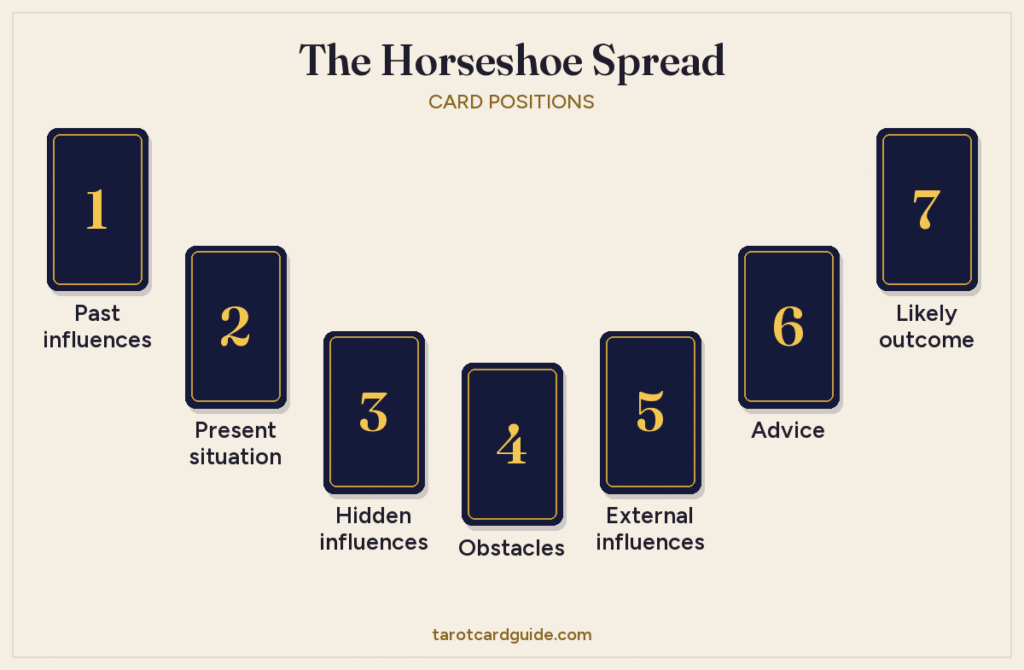
Notice the symmetry. Cards 1 and 7 sit at the two tips, cards 2 and 6 face each other one step down, cards 3 and 5 face each other lower still, and card 4 sits alone at the bottom. Those mirror pairs are the key to reading the spread, and they are explained in reading the positions together.
Each Horseshoe position in depth
For each position: what it asks, how different kinds of card tend to read there, and what to compare it with. The suits keep their usual areas throughout: Wands for energy, drive and projects, Cups for feelings and relationships, Swords for thoughts, decisions and conflict, and Pentacles for money, work, home and the body. The one-card examples are starting points; always check them against the rest of the spread.
Card 1: Past influences
The first card is not the whole history of the situation. It is the part of the past that is still active: an event, a decision, a habit or a feeling that explains why things are the way they are now. Ask, “what does this card explain about card 2?” For example, the Five of Cups here could show a loss or disappointment that still colours how you see the present.
- Major or Minor: a Major Arcana card points to a turning point whose effects are still unfolding, sometimes from years back. A Minor points to something more recent or smaller that is passing.
- Court cards: often a person from the past, or the way you used to handle things.
- Reversed: usually something from the past that was never quite resolved, or an old influence that is finally fading. The cards around it tell you which.
- Compare with: card 7, at the other end of the arc, and card 2, the present it led to.
Card 2: Present situation
Card 2 describes where things stand as you ask: the situation itself, or the state you are in while you deal with it. Every other card is read in relation to this one, so spend a moment on it before moving on. For example, the Eight of Swords could show you feeling trapped, with fewer real restrictions than it seems.
- Major or Minor: a Major says this is a significant chapter, shaped by forces bigger than the week’s details. A Minor places it in everyday life, where you can work with it directly.
- Suit: shows which area of life is really involved. A Swords card here, for a question about work, may mean the problem lives mainly in your thinking about the job.
- Compare with: card 6, which answers it, and card 4, which shows what is keeping it the way it is.
Card 3: Hidden influences
Card 3 shows what is at work beneath the surface. Most often it is something in you that you have not put into words: a feeling, a belief, a motive or a fear. Sometimes it is a fact nobody has shared yet, or something happening behind the scenes. Treat it as “what I have not looked at” before you treat it as “what someone is hiding”. For example, The High Priestess here can mean you already know more than you are admitting, and your intuition is ahead of your reasoning.
- Major or Minor: a Major points to a deep pattern or belief. A Minor shows a specific feeling or fact that is easier to name once you see it.
- Reversed: a reversed card in a hidden position often shows something buried twice over, pushed down because it is uncomfortable to face.
- Compare with: card 5 (inner influences against outer ones) and card 4 (is the hidden thing the root of the obstacle?).
Card 4: Obstacles
Card 4 sits at the bottom of the curve, the low point of the story and the place where it turns. It shows what stands in the way. That may be outside you, such as a lack of money or time, or inside you, such as doubt or a habit. For example, the Five of Wands could show competition, or too many people pulling in different directions.
- A pleasant card here: read it as “what is crossing me”, even when it looks positive. It can show something good in itself that is not helping in this matter, such as comfort that stops you changing, or loyalty that keeps you somewhere too long. It can also mean the obstacle is smaller than you feared.
- Major or Minor: a Major is a challenge with real weight, closer to a life lesson than a hurdle. A Minor is a practical block you can usually do something about.
- Compare with: cards 3 and 5, to see whether the block comes from inside or outside, and card 6, which should tell you how to meet it.
Card 5: External influences
Card 5 turns from you to the world around you: other people, the atmosphere at home or work, timing, and circumstances you do not control. It answers “what is the environment doing?” For example, the Queen of Swords could be a clear-sighted, direct person in your circle whose honesty helps, even if it stings.
- Court cards: very often a specific person. Read them by their qualities, not by gender or age: a Queen of Swords can be anyone who is sharp, fair and direct. See tarot court cards explained.
- Major or Minor: a Major is a big outside force, such as a restructure at work or a change in the family. A Minor shows the everyday influence of people and places.
- Compare with: card 3, its mirror, and card 2.
Card 6: Advice
Card 6 is the practical heart of the spread: what would help most, starting now. Read it as an action or an attitude you can take on. Every card page on this site has an “as advice” section, which is a good place to check. For example, the Four of Swords here says rest and step back before you decide anything.
- A hard card as advice: it still gives advice. It may name what you need to face, or warn you about the way not to go. Ask what the card would have you do, not only what it shows.
- Reversed: often advice to do less of that card’s energy, or to deal with the inner side of it first.
- Compare with: card 2, its mirror, card 4, the obstacle it should help with, and card 7.
Card 7: Likely outcome
The last card shows where things are heading if the current path continues. It is the likeliest result, not a verdict, and the advice card is there precisely because you can change course. The spread has no built-in timescale, so set one in your question if it matters. For example, the Ten of Pentacles here points to lasting security and stability.
- Major or Minor: a Major marks a real change of chapter. A Minor points to a more modest, practical result.
- Reversed: often a result that is delayed, incomplete or still up for grabs, rather than a flat no.
- Compare with: card 1, the other end of the arc, and card 6, the advice that can change it.
Reading the positions together
Read card by card, the Horseshoe is a list. Read in pairs, it becomes a story. These are the connections worth checking every time, in roughly this order.
The two ends of the arc: cards 1 and 7
Put the first and last cards side by side: where the story came from and where it is going. If they share a suit or a theme, the past may be repeating itself, for better or worse. If they are very different, the reading describes a real change, and the cards in between show how it happens.
Situation and response: cards 2 and 6
These two face each other one step down the arc. Card 2 is the situation; card 6 is what to do about it. Read them as one sentence: “things are like this, so try that.” When the advice card seems unrelated to the present, look for the link through card 4: the advice may be aimed at the obstacle rather than at the situation as a whole.
Inside and outside: cards 3 and 5
The lower mirror pair compares what is going on inside you, or out of sight, with what is going on around you. When they agree, for example two cards of support, you are in a good position. When they clash, the clash is useful. A fearful card at 3 beside a supportive card at 5 suggests the help is there but your own worries are keeping you from using it. The reverse suggests you are steadier than your circumstances.
The turning point: card 4
Card 4 sits alone at the bottom, where the arc turns from past and hidden things towards action and outcome. Trace where the obstacle comes from: if it echoes card 3, the block is mainly internal; if it echoes card 5, it is mainly outside you. Then check card 6. Good advice usually answers the obstacle directly, and seeing that link is often the moment the reading makes sense.
Advice and outcome: cards 6 and 7
These two sit next to each other at the end of the arc. A hard outcome with a helpful advice card is a warning you can act on. A good outcome with a cautionary advice card is something you could still lose if you ignore the warning. If both are positive, the path is open; if both are difficult, the question may need rethinking, and a smaller follow-up reading on card 6 alone can help.
The overall pattern
Finally, look at the spread as a whole. Does the mood of the cards rise from the bottom of the curve towards card 7, or sink? Then take a quick count. In seven cards from a full deck, expect about two Major Arcana cards. Four or more turns up in only about one spread in ten and suggests a major chapter. None at all suggests an everyday matter that is largely in your hands. Three or more cards of one suit show which area of life the question is really about, and several reversed cards point to energy that is blocked, delayed or turned inwards. Repeated numbers repeat a theme; see tarot card combinations.
How to lay out a Horseshoe spread, step by step
- Write down your question. Make it open and about you: “What do I need to know about…?” or “How can I move forward with…?” If timing matters, add a timescale, such as “over the next three months”.
- Decide your conventions before you shuffle, such as whether you read reversed cards. Changing the rules once you see the cards makes the reading less honest.
- Shuffle and cut while you think about the question, and stop when you feel ready.
- Lay the arc. Put card 1 at the top left and curve down, so that card 4 sits at the bottom in the middle, then curve back up to card 7 at the top right. A straight row works too if space is short, as long as you keep the numbering.
- Read in three passes. First look at the whole spread and count Majors, suits and reversals. Then read each card in its position. Then read the pairs, starting with the two ends of the arc.
- Draw one clarifier only if you need it. If one card makes no sense, draw one more and ask, “What do I need to understand about this card?” Read it as a comment on that position, not a replacement.
- Write it down. Note the date, the question and all seven cards, so you can look back once events have moved on.
Variations you will find in other books
The seven-card arc is widely used, but the labels are not fixed. Other books and sites keep the shape and the past-to-outcome direction but name the middle positions differently: some make card 3 the near future, some give a position to you and your attitude, and some include hopes and fears. A few draw the arc the other way up, with card 4 at the top. None of these is the one true version. Pick one set of positions, learn it, and use it every time, so that each place always means the same thing to you. This page uses the version shown in the diagram above.
You can also adapt the labels to a topic. For a love question, card 5 can become “the other person”; for work, “my workplace”. Change them before you shuffle, not after.
A full Horseshoe example reading
Here is a complete hypothetical reading, to show how the pairs build a story. It is an illustration, not a real person. Imagine someone called Alex, who started writing a novel two years ago with great excitement and now has a half-finished draft that has not been touched in weeks. Alex asks: “What do I need to know about finishing my novel over the next six months?” Alex reads reversed cards.
| Position | Card | In brief |
|---|---|---|
| 1. Past influences | Ace of Wands | The spark of inspiration that started it all |
| 2. Present situation | Four of Cups | Boredom and withdrawal; going through the motions |
| 3. Hidden influences | Nine of Swords | Worry and fear of failure, bigger at night than in daylight |
| 4. Obstacles | Seven of Cups | Too many ideas and options; none gets finished |
| 5. External influences | Three of Cups | Supportive friends and creative company |
| 6. Advice | Knight of Pentacles | Steady routine; keep showing up |
| 7. Likely outcome | The World, reversed | Nearly finished, but stuck before the last step |
The ends of the arc: cards 1 and 7
The story runs from the Ace of Wands to The World reversed: from a beginning to an ending that has not quite happened. The Ace is the burst of inspiration that got the book started. The card itself warns that its energy is strongest at the start and can burn out as quickly as it flares. The World reversed at the other end is the feeling of being stuck just before the finish line, with a final piece still missing. Put together, the reading is not about whether Alex can write. It is about finishing.
Where things stand: cards 2 and 6
The Four of Cups describes the present exactly: the draft has lost its colour, and Alex is going through the motions or not opening the file at all. Its mirror, the Knight of Pentacles, is the answer. He is the card of routines, checklists and finishing what you started, and he gets there later than his fiery cousin, the Knight of Wands, but with nothing left undone. The advice is not to wait for the spark to return. It is to keep showing up, one steady session at a time, and to adjust the plan rather than abandon it.
Inside and outside: cards 3 and 5
The hidden influence is the Nine of Swords: worry, overthinking and fear of failure, the kind that grows at night and rehearses worst-case outcomes. Alex may not have said it aloud, but the fear that the book will not be good enough is doing quiet damage. Its mirror is the Three of Cups: friends, a creative circle, people who would be glad to read a chapter and celebrate progress. This is the classic clash between the two sides. The support is there, and the fear is kept private. The Nine’s own advice fits: say the worry out loud, and let people in.
There is a neat echo, too. The figure on the Four of Cups ignores a cup being offered. With the Three of Cups at card 5, that offered cup may be literal help from friends that Alex has not taken up.
The turning point: card 4
At the bottom of the curve is the Seven of Cups: many tempting options and wishful thinking, or, as its career meaning puts it, so many creative plans that none of them get finished. For a writer this might be new book ideas, endless rewrites of chapter one, or several possible endings. Read with card 3, the obstacle makes sense: chasing a shiny new idea is more comfortable than finishing one and letting people judge it. The Knight of Pentacles answers the Seven directly. Choose one version and bring it down to earth.
Putting it together
The outcome, The World reversed, is not a failure card. It says completion is still within reach, and it names a common reason for stalling: finishing something means letting it go. The rest of the spread shows how to change the ending. Alex could pick one version of the story and park the other ideas in a notebook, then set fixed writing sessions each week. Telling a friend about the fear, and sharing chapters with the people shown by the Three of Cups, would ease the Nine of Swords. Followed through, those steps are exactly what turns a reversed World into an upright one: loose ends tied up and a finished draft.
The count supports this. There is only one Major Arcana card, fewer than average, so this is an everyday matter that Alex can do a lot about. Three of the seven cards are Cups, so feelings about the book matter more than skill or time. There is one court card, the advice, which describes the approach to take, and one reversal, in the outcome, showing a result that is delayed rather than denied.
Questions to ask with the Horseshoe spread
The Horseshoe answers open questions about a situation you are part of. Weak questions usually ask for a yes or no, ask about someone else’s mind, or leave out what you actually want to know. For more on wording, see how to ask the right questions in a tarot reading.
| Weak wording | Better for the Horseshoe |
|---|---|
| Will I get the job? | What do I need to know about my application for this role? |
| Does she still like me? | What is really going on between me and my friend, and how can I help it? |
| What will happen this year? | What do I need to understand about my finances over the next six months? |
| Should I quit or stay or retrain? | What is keeping me stuck at work? (Then use the two options spread for the choice itself.) |
| Why does everything go wrong for me? | What pattern keeps repeating in my relationships, and what would help me change it? |
For love questions, card 5 often shows the other person or how the relationship looks from outside, and card 3 the feelings nobody has said out loud. The love meanings of all 78 cards help here. For work and money, card 1 is your track record, card 5 your workplace, clients or market, and card 6 your next practical step; see career tarot card meanings, or the career path spread for a work-specific layout. For money, the cards are a prompt for reflection, and a qualified adviser is the right person for the numbers.
Common Horseshoe spread mistakes
- Reading seven cards as seven separate answers. The mirror pairs carry the story. Always read 1 with 7, 2 with 6, and 3 with 5.
- Skipping the advice card to get to the outcome. Card 6 is the one you can act on. It is often the most useful card on the table.
- Turning hidden influences into suspicion. Card 3 is usually about you. Assume it is your own unspoken feeling before you assume anyone is hiding anything.
- Asking about someone else’s thoughts. The spread works best when you are the one in the story. If the real question is how someone feels, use the How do they feel about me? reading.
- Dealing again because you disliked the answer. Sit with the first reading, act on card 6, and come back when something has changed.
Horseshoe spread: frequently asked questions
What are the 7 positions of the Horseshoe tarot spread?
In the version on this page: 1 past influences, 2 present situation, 3 hidden influences, 4 obstacles, 5 external influences, 6 advice and 7 likely outcome. Other books keep the seven-card arc but label some positions differently.
Is the Horseshoe spread good for beginners?
Yes, once a three-card spread feels comfortable. The first two cards and the last work like a past, present and future reading, and the four in between add depth one position at a time.
What is the difference between the Horseshoe and the Celtic Cross?
The Horseshoe uses seven cards in a single arc and reads like a story from past to outcome. The Celtic Cross uses ten, adds a crossing card for the challenge and separate positions for your conscious aims, hidden drivers, and hopes and fears. Use the Horseshoe for most everyday questions, and the Celtic Cross when a situation is complex enough to need the extra cards.
How far ahead does the Horseshoe spread look?
It has no fixed timescale. Many readers take the outcome as the next few weeks or months on the current path. If timing matters, put it in the question, for example “over the next three months”.
Can I use the Horseshoe spread for love questions?
Yes. Ask about the relationship or your part in it, and read card 5 as the other person or the relationship seen from outside. For questions about two people’s feelings side by side, the relationship spread is built for it.
What if the outcome card is negative?
Read it as a warning about the current path, not a verdict. Look at card 6 for what would change it and card 4 for what needs to be dealt with first. If the outcome is still unclear, draw one clarifying card and read it as a comment on card 7.
Can I ask a yes or no question with this spread?
It is not built for it, because seven cards rarely all lean the same way. Rephrase the question as “What do I need to know about…?”, or use a one-card yes or no reading for a direct answer.
Ready to practise? Deal a Horseshoe with the free reading at the top of this page, look up any card in the meanings of all 78 cards, or try another layout: the quick three-card spread, the full Celtic Cross, or any of the other tarot spreads.