The career path spread is a six-card tarot spread for questions about work. It looks at where your working life stands, the kind of work that draws you, the strengths you can build on, what is in the way, the most useful next step and where the path leads over time. It suits anyone who feels stuck, restless or at a crossroads at work, whether you are job hunting, weighing an offer or wondering if it is time to leave.
Tarot will not tell you what to earn or which contract to sign. What it does well is help you step back, name what you already sense, and turn it into a practical next move. Used that way, this is one of the most useful career tarot spreads you can learn.
Draw a free Career Path Spread reading now: think of your work question, then deal the six cards below. Each position shows its question, your card and what it means there, with a link to the card’s full meaning.
Your Career Path Spread reading
- Current situation Where does your working life stand right now?
- Passion or calling What kind of work draws you?
- Strengths and skills What do you bring that you can build on?
- Obstacles What is getting in the way?
- Guidance What is the most useful next step?
- Long-term outcome Where does this path lead over time?
Read each column from top to bottom as well: card 1 with card 4, card 2 with card 5, and card 3 with card 6. How to read the positions together
Jump to a section:
- What the career path spread is for
- The 6 positions at a glance
- Each position in depth
- What each suit says about work
- Reading the positions together
- Job offers, quitting, promotions, job hunting and starting a business
- How to lay out the spread, step by step
- A full example reading
- Good questions to ask
- Common mistakes
- Frequently asked questions
What is the career path tarot spread for?
The spread uses six cards in two rows of three. The top row is about you and where you stand: your current situation, what draws you and what you bring. The bottom row is about the road ahead: what is in the way, what to do next and where it leads. Each card in the bottom row sits under the card it answers, so the spread can be read across and down.
Use it when the question is about direction rather than a single event. It works well for:
- feeling bored, stuck or undervalued in a job that looks fine on paper
- wondering whether to retrain, change field or go for a promotion
- a job search that has stalled
- testing a business idea or side project before committing to it
- coming back to work after a break and not knowing where to start
It is not the best tool for every work question. To compare two specific jobs or offers side by side, the two options spread is clearer. For a quick read on one small question, such as how a meeting might go, try a one-card pull or the yes or no tarot. For a big decision with many moving parts, the ten-card Celtic Cross gives more room.
One thing to say plainly: tarot is a tool for reflection, not financial, legal or careers advice. It can help you see your own thinking more clearly. Decisions about money, contracts and notice periods deserve real figures and, where it matters, a qualified adviser.
The 6 career path spread positions at a glance
| Position | What it asks | Read it with |
|---|---|---|
| 1. Current situation | Where does your working life stand right now, and how does it feel? | 4, 6 |
| 2. Passion or calling | What kind of work draws you, or would feel meaningful? | 3, 5 |
| 3. Strengths and skills | What do you bring that you can build on? | 2, 6 |
| 4. Obstacles | What is getting in the way, inside you or around you? | 1, 5 |
| 5. Guidance | What is the most useful next step? | 2, 4 |
| 6. Long-term outcome | Where does this path lead over the longer term? | 1, 3 |
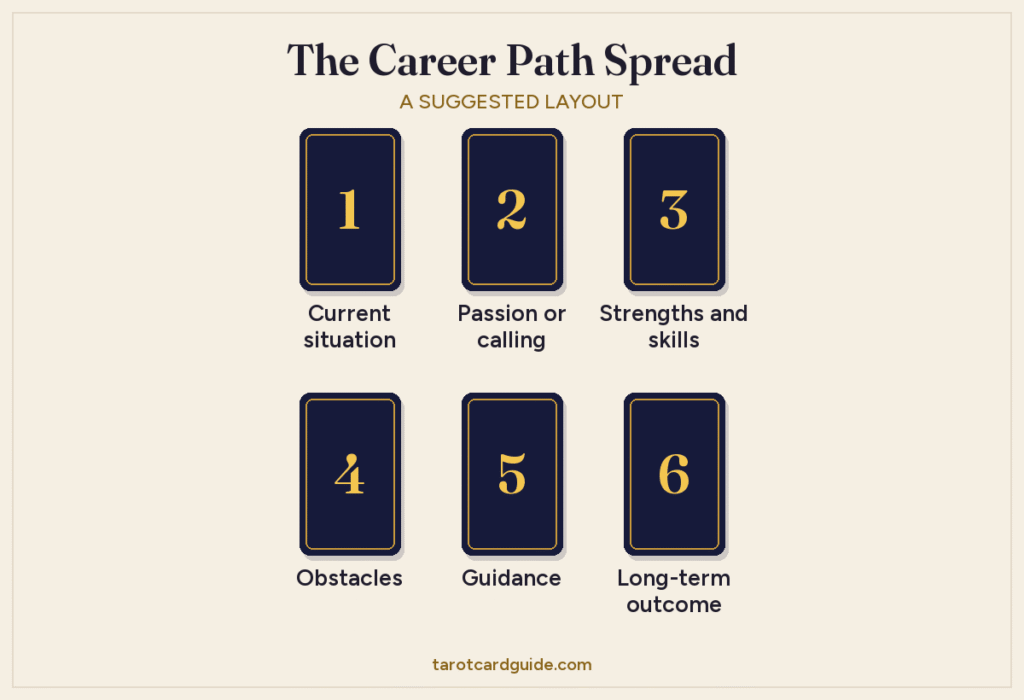
Cards 1 to 3 go in the top row from left to right, and cards 4 to 6 in the bottom row. That puts the obstacle under the current situation, the guidance under the calling and the outcome under your strengths. Those three columns are the heart of the reading.
Each career path position in depth
For each position: what it asks, how different kinds of card tend to read there, and which cards to compare it with. The examples are a starting point; always check them against the rest of the spread and your own situation.
Card 1: Current situation
The first card describes your working life as it is now: the job, the conditions and how it feels to be there. Read it as a snapshot, not a verdict. It often names something you already know but have not said out loud. For example, the Ten of Wands here is a classic sign of overwork: too many roles, too much of the team’s load and a pace that cannot last.
- Major or Minor: a Major suggests a bigger chapter in your working life, such as a change of identity or direction, not just a bad month. A Minor describes day-to-day conditions you can work with directly.
- Court cards: often you in your current role, or someone with real influence over it, such as a manager or a key client.
- Reversed: something stalled, blocked or turned inwards. A reversed card here often shows how the job feels rather than how it looks from outside.
- Compare with: card 4, directly below it, and card 6, to see how far the path travels.
Card 2: Passion or calling
This card shows the kind of work that draws you. It is rarely a job title. Read it as a quality you want more of in your work: creating, caring, teaching, leading, analysing, building. If it seems unrelated to your current job, that gap is useful information. For example, The Empress points to creative or caring work, and her career meaning says nurturing skills are worth something, both personally and professionally.
- Major or Minor: a Major ties the calling to your wider life direction or values. A Minor points to a specific interest or a kind of task you enjoy.
- Court cards: a role or style you would like to grow into. A Page suggests learning something new; a King or Queen suggests mastery or leading others.
- Reversed: a calling that has been pushed aside, one you are unsure about, or an old ambition you may have outgrown. Ask which fits.
- Compare with: card 3 (do your strengths serve it?) and card 5 (does the next step move towards it?).
Card 3: Strengths and skills
Card 3 shows what you bring: skills, qualities and experience you can build on, including the ones you undervalue. People often recognise this card with some surprise, because it names a strength they take for granted. For example, The Magician here says you have the tools and the skill to turn ideas into results, and could become known for what you do well.
- Major or Minor: a Major is a core strength that shapes how you work anywhere. A Minor is a specific, practical skill, often a transferable one.
- Court cards: usually you at your best at work, acting in that card’s style.
- A difficult card: a hard card here is not an insult. Read it as a strength won the hard way, such as the resilience of the Nine of Wands, or as a skill turned against you.
- Reversed: a skill that is underused, undervalued, or overused until it becomes a weakness.
- Compare with: card 2 and card 6. The outcome is built on what you bring.
Card 4: Obstacles
Card 4 shows what is in the way. It may be outside you, such as a tight job market, a difficult manager or money constraints. It may be inside you, such as fear, habit or an old belief about what you deserve. Ask which it is before you decide what to do. For example, the Eight of Swords shows feeling trapped in a job, believing you have no options when you almost certainly have more than you think.
- Major or Minor: a Major is a serious block, closer to a life lesson than a hurdle. A Minor is a practical problem you can usually tackle directly.
- A pleasant card: a comfortable card in this position often means comfort itself is the obstacle. A good salary, a kind team or an easy routine can make change feel less urgent.
- Court cards: often a specific person whose influence is holding things up, or your own habit in that card’s style.
- Reversed: an obstacle that is weakening, internal or partly of your own making. Read the card’s reversed meaning and see which fits.
- Compare with: card 1, directly above it, and card 5, which often shows the way round it.
Card 5: Guidance
This is the most practical card in the spread. It suggests the most useful next step: an action, an attitude or a change of approach. Turn it into something concrete you can do this week or this month. Every card page on this site has an As advice section, which is a good place to start. For example, the Four of Swords here says rest, take leave or plan quietly before your next push.
- Major or Minor: a Major asks for a change of approach, not just a task. A Minor gives you a specific step.
- Court cards: either act in that card’s style, or find someone like it, such as a mentor or a person who has made the move you are considering.
- Reversed: read it as what to stop doing, or as a warning about how not to take the step. A reversed Page of Pentacles, for instance, warns against signing up for something without reading the details.
- Compare with: card 4 (does the advice answer the obstacle?) and card 2 (does it move you towards what draws you?).
Card 6: Long-term outcome
The last card shows where this path leads over the longer term, if you work with what the spread has shown. It is a direction of travel, not a promise. Decide the time frame before you draw; six months to a year works well for most career questions. For example, the Ten of Pentacles points to established success and long-term security, the kind measured in years rather than pay cheques.
- Major or Minor: a Major marks a real change of chapter. A Minor points to a more modest, practical result.
- A hard card: read it as a warning about where the current approach leads, while there is still time to change it. Look at cards 4 and 5 for what to change.
- Reversed: often a delay or a slower route, rather than a closed door.
- Compare with: card 1 (how far you travel) and card 3 (what the result rests on).
What each suit says about your work
Before you read card by card, look at the mix. The suits tell you what kind of question this really is, which is not always the one you asked.
| Cards | At work they cover | Two or more in six cards |
|---|---|---|
| Wands | Ambition, drive, projects, ideas, leadership, competition and overload | The question is about energy and direction: what you want to build, and whether you have the fuel for it. |
| Cups | How you feel about your work, colleagues, satisfaction and meaning | The real issue may be fulfilment, not pay or status. Ask how the work feels, not just how it looks. |
| Swords | Decisions, communication, stress, office politics, contracts and analysis | Your thinking is central: a decision to make, a conversation to have, or stress to deal with. |
| Pentacles | Money, skills, training, steady work, security and practical results | A practical question about pay, security or skills, which usually moves slowly and rewards patience. |
| Major Arcana | Turning points bigger than one job: vocation, identity, life direction | This is a significant chapter. The question may be about who you want to be, not just what you do. |
| Court cards | People at work, or a role or style you are taking on | Other people play a big part: a manager, a mentor, a client, or different sides of you at work. |
With six cards, two of one suit is common and does not mean much on its own. Three or more of one suit, or three or more Majors, is worth noticing. Among the court cards, Pages often point to learning, beginner roles or news about a job, Knights to pursuing something, Queens to mastery with care, and Kings to authority and leadership.
For what every card means for work and money, see career tarot card meanings, which lists all 78 cards with a line on your career and a line on your finances for each.
Reading the positions together
The layout is built to be read down the columns as well as along the rows. These are the connections worth checking every time.
Situation and obstacle: cards 1 and 4
Read them as one sentence: “this is where I am, and this is what keeps me here”. If card 4 explains card 1, you have found the knot to work on. If they seem unrelated, the obstacle may be outside your current job altogether, such as money worries or confidence.
Calling and guidance: cards 2 and 5
This column tells you whether the next step points towards what draws you. When the two cards agree, the advice is usually a small, real step towards the calling. When they clash, for example a calling card full of creative fire above a Guidance card that says rest, the message may be “yes, but not yet”.
Strengths and outcome: cards 3 and 6
The outcome sits under your strengths for a reason: it is built on them. A strong outcome above a weak or reversed strengths card suggests the result depends on a skill you still need to develop or value properly. A good strengths card above a hard outcome suggests your abilities are not the problem; look at card 4.
Calling and strengths: cards 2 and 3
Where these two overlap is often the most promising direction in the whole spread: work you are drawn to and already good at. If they are far apart, the calling may need training, or the strengths may point to a route you had not considered.
Obstacle and guidance: cards 4 and 5
Card 5 is often the answer to card 4. A fear at 4 and an action card at 5 says the way through is to act on a small scale. A practical block at 4 and a card of patience or rest at 5 says to wait, prepare and let the conditions change.
The two rows
Finally, compare the rows. A strong top row above a difficult bottom row says you have what you need, but the route is hard; the obstacles are the work. A difficult top row above a hopeful bottom row says things are harder now than they will be. Several reversed cards in one row show where the energy is blocked.
Using the spread for a job offer, quitting, a promotion, job hunting or a business
The six positions stay the same, but you can tilt how you read them to fit the question. These are the most common career questions, with the wording and positions that help most.
A job offer
Ask: “What do I need to know before I answer this offer?” Read card 1 as the offer and your position now, card 2 as how well it fits what draws you, and card 4 as the catch: hidden costs, a difficult culture or your own doubts. Card 5 often shows what to find out or ask for before you answer, and card 6 where accepting would lead. If you are choosing between two offers, or an offer and your current job, use the two options spread instead. Whatever the cards say, read the contract and ask your questions in writing.
Should I quit my job?
Avoid asking this as a yes or no question. Ask “What do I need to understand about leaving my job?” and give card 4 extra attention: is the obstacle a real constraint, such as money, or fear? The Eight of Cups is the classic card of walking away from work that no longer fulfils you, but its career meaning is clear that it does not say hand in your notice tomorrow. It asks you to be honest about what is missing and start moving towards it. If cards like the Ten of Wands or Four of Swords appear, the first need may be rest or a lighter load, not a new job. For the practical side, know your outgoings and notice period, and build a cushion of savings before you leave. If work stress is affecting your health, talk to your doctor. The cards about stress, burnout and leaving a job are worth reading too.
A promotion or a pay rise
Ask “What would help me get this promotion?” rather than “Will I get it?”. Card 3 is your case: what you have achieved and should put forward. Card 4 is what could count against you or slow things down. Card 5 is how to ask. The Six of Wands is the classic promotion card. Its career meaning says to ask for what your work is worth and, when recognition is slow, to keep a record of what you have achieved. The cards can show whether the timing looks good, but they cannot read your employer’s mind. The case still has to be made.
Job hunting
Ask “What would help my job search now?” Card 1 is where the search stands, card 2 the kind of role worth aiming for, and card 3 what to lead with in applications and interviews. Card 4 is what is slowing things down, which is sometimes the method, not you: too many applications sent out, or too few. Cards such as the Eight of Wands (fast replies and offers) or the Page of Pentacles (a new job, course or apprenticeship) are encouraging here. If rejections are wearing you down, the cards for a new job or interview give a fuller picture.
Starting a business or side project
Ask “What do I need to know about starting this business?” Read card 2 as the idea and what draws you to it, card 3 as what you bring, and card 4 as the practical risks. Card 5 is the first step, and card 6 the longer-term shape of the venture. The Ace of Wands is a strong card for a new venture, but its money meaning is about potential rather than instant profit. Many readers find the most useful answer is “test it small first”. Tarot cannot assess a business plan, cash flow or tax; an accountant or business adviser can.
How to lay out a career path spread, step by step

- Write your question down. Make it open and about you: “What do I need to know about my next step at work?” works better than “Will I get the job?”. The question ideas below can help.
- Set the time frame. Decide how far ahead card 6 looks, such as six months or a year.
- Decide on reversals before you shuffle. Either way is fine, as long as you keep to it.
- Shuffle and cut while you think about the question.
- Lay the top row from left to right: card 1 (current situation), card 2 (passion or calling), card 3 (strengths and skills).
- Lay the bottom row from left to right: card 4 (obstacles) under card 1, card 5 (guidance) under card 2, card 6 (long-term outcome) under card 3.
- Read in three passes. First count the suits, Majors and reversals. Then read each card in its position. Then read the three columns and the two rows.
- End with one action. Write down one step from card 5 that you can take in the next week.
Variations
- In a line. Some readers lay all six cards in one row. The meanings are the same, but the columns are harder to see.
- How to read the outcome. Some readers take card 6 as where the current path leads if nothing changes; others as where it leads if you follow card 5. Choose one before you draw.
- A clarifier for the guidance. If card 5 is unclear, draw one extra card and ask “What does this step look like in practice?”. One is enough.
- A shorter version. For a quick check, the three-card spread with situation, obstacle and advice covers the core of this spread in three cards.
A full career path spread example reading
Here is a complete hypothetical reading, to show how the positions work together. It is an illustration, not a real person. Imagine someone called Jo, who has worked in payroll for several years. Jo is good at the job but has stopped learning, and enjoys training new starters more than anything else in the role. Jo asks: “What do I need to know about the next step in my career?” Jo reads reversed cards and sets the time frame at one year.
| Position | Card | In brief |
|---|---|---|
| 1. Current situation | Eight of Pentacles, reversed | Skilled work that has stopped growing; boredom, feeling undervalued |
| 2. Passion or calling | The Hierophant | Teaching, training, passing on knowledge |
| 3. Strengths and skills | Queen of Swords | Clear thinking, clear explanations, careful with figures |
| 4. Obstacles | Four of Pentacles | Holding tight to a secure salary |
| 5. Guidance | Page of Pentacles | Start small: a course, a new skill, a savings goal |
| 6. Long-term outcome | Three of Wands | Plans in motion, early results, steady expansion |
The top row: where Jo stands
The Eight of Pentacles is the card of patient skill-building. Reversed, it describes feeling undervalued or bored, or doing work that no longer matches your goals. Its advice is to reassess whether your effort is going where you want it to. That fits Jo well: competent, but no longer growing.
The Hierophant at card 2 is the teacher of the deck. Its career meaning points to a calling to teach, counsel or guide others, and to training programmes, qualifications and learning from a mentor. Jo’s enjoyment of training new starters is not a side note; it may be the direction.
The Queen of Swords at card 3 is Jo at their best: clear-thinking, direct and fair, the kind of person who reads the contract and checks the figures. Clear communication is exactly what a good trainer needs, so cards 2 and 3 overlap. That overlap is the most promising thing in the spread.
The columns: what stands in the way, and what to do
Cards 1 and 4. Under the reversed Eight sits the Four of Pentacles: job stability, a cautious approach and holding on to what feels safe. Read together: “I am not growing here, and I stay because the salary is secure.” The Four’s career meaning is fair to Jo. In uncertain times caution can be sensible, but it warns against refusing to invest in yourself, for example in a course, because change feels frightening.
Cards 2 and 5. Under the Hierophant sits the Page of Pentacles: a new course, apprenticeship or skill, the early stage of something that could grow into something long-term. Its advice is to start small, keep going and measure progress over months, not days. The Hierophant’s own advice says much the same: find a mentor, take the course. The calling and the guidance agree.
Cards 3 and 6. Under the Queen of Swords sits the Three of Wands: plans in motion and early returns from earlier effort, with growth that is gradual rather than dramatic. The outcome rests on Jo’s clarity and ability to explain, which is exactly what the Queen brings.
Counting the cards
Three Pentacles in six cards make this a practical question about skills, money and security. There is one Major (the Hierophant, in the calling position), two court cards and one reversal, in the current situation. There are no Cups. The spread says little about how teaching would feel day to day, and that is best tested in real life, which is exactly what the Page of Pentacles suggests.
Putting it together
The reading does not say “quit and retrain”. It says the pull towards teaching is real (the Hierophant), Jo has the strengths for it (the Queen of Swords), and the thing in the way is the grip on security (the Four of Pentacles). The guidance is a small, practical first step: a part-time course, or asking to run more of the training at work, while keeping the salary for now. The Queen of Swords also suggests asking for that clearly, rather than hoping someone notices.
The Three of Wands shows where that leads in a year: early results and a plan with momentum, not a finished career change. Jo could review progress then and draw again. The Four of Pentacles supports building an emergency fund, which would make any later move easier. For course fees or a possible drop in pay, the cards are a prompt to reflect; the numbers belong with a qualified adviser.
Good questions for a career path spread
The spread works best with open questions about your part in things. Questions about what someone else will decide, or yes or no questions, give the six positions too little to work with. For more on wording, see how to ask the right questions in a tarot reading.
| Instead of | Try |
|---|---|
| Will I get the job? | What would help me most in this application? |
| Should I quit? | What do I need to understand about leaving my job? |
| Will my boss give me a raise? | How can I make the strongest case for a pay rise? |
| What job should I do? | What kind of work would use my strengths and feel meaningful? |
| Will my business make money? | What do I need to know before I start this business? |
| Why does nobody reply to my applications? | What is slowing my job search, and what would help? |
Common career reading mistakes
- Treating the cards as financial advice. A good Pentacles card is not a reason to sign a loan, and a hard one is not a reason to panic. Use the reading to think, then check the real figures.
- Reading the calling as a job title. The Empress does not mean “become a gardener”. Read card 2 as a quality you want more of in your work.
- Skipping the obstacle. Card 4 is often uncomfortable, and it is often the most useful card in the spread.
- Ignoring the columns. The layout places each answer under its question. Read down as well as across.
- Acting on impulse. A card of change, such as the Eight of Cups or The Tower, describes a situation. It is not an instruction to resign today.
- Drawing again and again. Repeating the spread because you disliked the outcome adds noise, not clarity. Act on card 5 and come back when something has changed.
Career path spread: frequently asked questions
What are the positions in the career path spread?
There are six: 1 current situation, 2 passion or calling, 3 strengths and skills, 4 obstacles, 5 guidance and 6 long-term outcome. They are laid out in two rows of three, so each card in the bottom row sits under the card it answers.
Can tarot tell me whether to quit my job?
Tarot can help you see what you feel and what is holding you back, but the decision is yours. Ask “What do I need to understand about leaving?” rather than “Should I quit?”, pay attention to the obstacle card, and check the practical side, such as savings and your notice period, before you act.
Can I use this spread for money questions?
You can use it to reflect on your attitude to money and work, and the Pentacles cards often speak to it directly. It is not financial advice. For debts, investments, tax or big financial decisions, talk to a qualified adviser or a free debt advice service.
How far ahead does the long-term outcome card look?
As far as you decide before you draw. Six months to a year suits most career questions. Choose the time frame first, so you are not tempted to stretch it to fit the card afterwards.
What if the outcome card looks bad?
Read it as a warning about where the current approach leads, not a fixed fate. Look at the obstacle (card 4) and the guidance (card 5) for what could change, and check the card’s full meaning: many hard-looking cards describe an ending that makes room for something better.
Which tarot cards are best for career?
Some of the strongest are The Magician, the Eight of Pentacles, the Ace of Pentacles, the Six of Wands and the King of Pentacles. The career tarot card meanings page covers all 78.
How often should I do a career reading?
When something has changed, or every few months to check progress. Keep a note of each reading, including the step you chose from card 5, so you can see what happened when you look back.
Ready to try it? Deal your own free career path reading at the top of this page, compare two jobs with the two options spread, look up any card in the career meanings of all 78 cards, or browse the other tarot spreads.