Tarot can’t tell you for certain whether your ex will come back, because nobody can read another person’s mind or promise what they’ll choose. What a “will my ex come back?” tarot spread can do is show you the relationship more clearly: why it ended, where each of you seems to stand now, what is still between you, and what getting back together would really ask of you both.
This page gives you a six-card reconciliation tarot spread built around that honest version of the question. It covers every position, the cards that often lean towards reconnection and the ones that lean towards closure, a full example, and how to word the question so the answer is useful. It also has a free draw, so you can try it straight away.
Draw a free Will My Ex Come Back? reading now: think about the relationship as it really was, not only the good bits, then deal six cards below. Each position is labelled with the question it asks, and each card links to its full meaning. Then come back to the guide to read the cards together.
Your Will My Ex Come Back? Spread reading
- Why it ended What was really at the heart of the break-up?
- Where they are now How do things seem to stand on their side?
- Where you are now Where are you, honestly, at this point?
- What’s still between you What tie, feeling or unfinished business remains?
- What it would ask What would reconnecting ask of you both?
- The likely direction Where is this heading if things carry on as they are?
Read the two side cards together first (2 and 3), then the centre line from top to bottom: why it ended, what remains, what it would ask and where it is heading. How to read the positions together
Jump to a section:
- What this spread can and can’t tell you
- When not to read (and what to do instead)
- The six positions at a glance
- Each position in depth
- Reading the positions together
- Cards that point towards reconnection or closure
- How to lay out the spread, step by step
- A full example reading
- Questions to ask
- Common mistakes
- Frequently asked questions
What this spread can and can’t tell you
“Will my ex come back?” is one of the most common questions people bring to tarot. It is also one of the hardest, because the answer depends on another person’s choices. A reading that promises a return, or rules one out forever, is claiming more than tarot can give.
So this spread asks a slightly different question: what is really going on between us, and what would a way back involve? That version has answers you can use.
Read card 2, “where they are now”, with care. It is your reading of how things look from their side, shaped by what you know of them. It is not a window into their head. If you want to spend longer on the feelings question, the How Do They Feel About Me? reading is built for it, and tarot cards as feelings explains how each card reads in that role.
When another spread is better
- You have decided it’s over and want to heal: the broken heart spread keeps every card on you and your recovery.
- You are back together and want to make it work: the relationship spread gives each of you a card and looks at strengths and challenges.
When not to read (and what to do instead)
This is a spread about a sore subject, and it helps to be honest with yourself before you shuffle.
- When you have already asked this week. Drawing the same question every day doesn’t make the answer clearer. You just keep pulling until a card says what you hoped. One careful reading, then a few weeks’ gap, tells you far more.
- When it is very raw. In the first days, every card looks like heartbreak or hope depending on the hour. Sleep, eat, talk to a friend, and come back later.
- When you want a card to decide whether to text them. A card isn’t permission or a warning light. Make that choice with a clear head, based on what you know.
- When the relationship was controlling or unsafe. If it was, the question to ask is how to stay safe, not how to get them back.
If you find yourself reaching for the deck several times a day, try a single card of the day about yourself instead. It keeps the habit gentle and turns your attention back to your own life.
The six positions at a glance
Each position asks its own question, and each is best read alongside one or two others:
| Position | What it asks | Read it with |
|---|---|---|
| 1. Why it ended | What was really at the heart of the break-up? | 4, 6 |
| 2. Where they are now | How do things seem to stand on their side? | 3, 4 |
| 3. Where you are now | Where are you, honestly, at this point? | 2, 5 |
| 4. What’s still between you | What tie, feeling or unfinished business remains? | 1, 2, 3 |
| 5. What it would ask | What would reconnecting ask of you both? | 1, 3 |
| 6. The likely direction | Where is this heading if things carry on as they are? | 1, 5 |
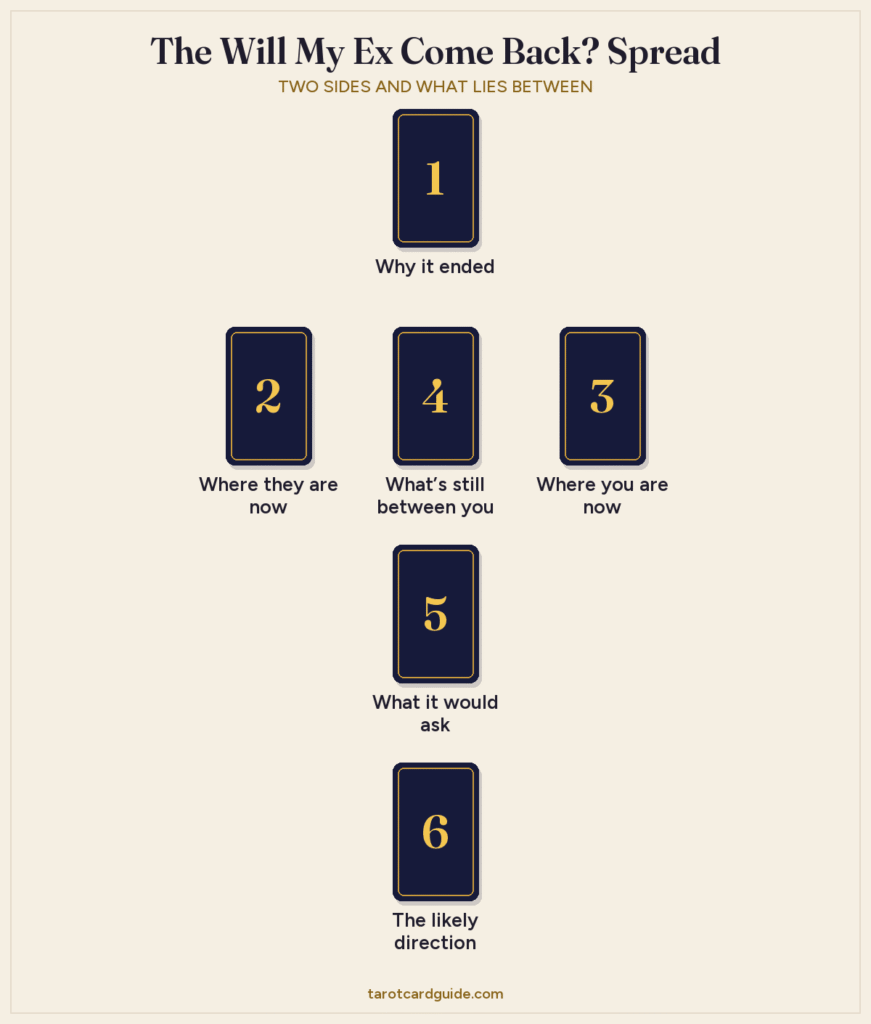
Across the middle row, card 2 (them) and card 3 (you) sit on either side of card 4, like two people with a small table between them. Down the centre runs the story of the relationship, from why it ended at the top to the likely direction at the bottom.
Each position in depth
For each position: what it asks, how different kinds of card tend to read there, and what to compare it with. The suits keep their usual areas. Cups are feelings and closeness, Swords are thoughts, words and conflict, Wands are desire, energy and independence, and Pentacles are the practical side: money, home, time and distance. The one-card examples are starting points; always check them against the rest of the spread.
Card 1: Why it ended
The first card names the real reason for the ending, which is not always the reason given at the time. It might be a single event, a pattern that wore you both down, or a mismatch in what you each wanted. Read it for understanding, not blame. For example, the Five of Swords points to fights, point-scoring and trying to win rather than understand. The Tower points to a sudden rupture or a truth that changed everything.
- Why it matters most: if the reason for the ending is still there, a reunion tends to end the same way. This card is the one to hold every other card up against.
- Reversed: often a problem that was hidden, avoided or slow-burning for a long time before it ended things.
- Compare with: card 4, to see whether the reason is still between you, and card 6, the other end of the centre line.
Card 2: Where they are now
Card 2 describes how things seem to stand on the other person’s side: their mood, their focus, how close to or far from the relationship they appear to be. Treat it as a possibility to hold loosely, not a fact about their inner life. The “as feelings” section on each card page is the best guide here. For example, the Six of Swords describes someone trying to move on and looking for peace rather than drama. The Judgement card describes someone reflecting seriously and perhaps reconsidering the past.
- Court cards: read them as the way your ex is behaving or coping at the moment, not as a new person in their life.
- Reversed: often mixed or blocked feelings, such as someone who cares but is holding back, or who is stuck in the past.
- Compare with: card 3, you, on the other side of the table, and card 4.
Card 3: Where you are now
This card is about you, and in many readings it is the most useful one on the table. It can show whether you are healing, holding on, torn, or quietly ready to move on and not quite admitting it. For example, the Two of Swords shows someone guarding their heart and putting off a decision. The Star suggests you are healing well and becoming ready to love again, whoever that turns out to be with.
- Reversed: often a feeling you are pushing down, or one that is fading faster than you expected.
- Compare with: card 2, to see whether you are in the same place, and card 5, to see whether you are ready for what it would ask.
Card 4: What’s still between you
Card 4 sits in the middle of the table. It shows what still connects you: affection, attraction, shared memories, unresolved anger, an unfinished conversation, or a practical tie such as a shared flat, a pet or friends in common. Not everything that remains is a reason to get back together. For example, the Six of Cups shows fond memories and a feeling of familiarity. The Three of Swords here says the thing still between you is hurt that hasn’t healed.
- Reversed: a tie that is loosening, or one that is being ignored rather than dealt with.
- Compare with: card 1 (is what remains the same thing that ended it?) and cards 2 and 3 on either side.
Card 5: What it would ask
This is the practical heart of the spread. It shows what a way back would require from you both: an apology, patience, a hard conversation, a change in habits, or time. Read it as a cost as well as a route. Realising you wouldn’t pay it is a useful answer too. For example, Temperance asks for patience, compromise and meeting in the middle. The Five of Swords reversed asks you both to put the fight down and make peace.
- A hard card here: it doesn’t mean “never”. It shows the size of the work involved. The Tower here, for instance, would suggest the old relationship can’t simply be restarted; anything new would have to be built from the ground up.
- Compare with: card 1 (does it answer the reason for the ending?) and card 3 (are you ready for it?).
Card 6: The likely direction
The last card shows where things are heading if they carry on as they are. It is a direction, not a verdict, and it can change as soon as either of you does something different. It is also not always about the two of you. A card of peace or a fresh start here may be describing your life moving on, with or without them. For example, the Two of Cups points towards mutual feeling and making peace. Death points to the end of a cycle and real closure.
- Reversed: often something delayed, unfinished or still being decided, rather than a flat no.
- Compare with: card 1, the top of the centre line, and card 5, the work that could change it.
Reading the positions together
Read in pairs, this spread tells you whether a reunion would be a fresh start or a rerun. Check these connections in roughly this order.
The two sides: cards 2 and 3
Start with the middle row. Are the two of you in the same place? Two cards of moving on, such as the Six of Swords on both sides, describe an ending that both people are settling into. Two cards of longing suggest the door is not fully closed. A mismatch is the most common result, and the most telling: one of you reflecting and reaching back, the other stepping away. That gap is the real subject of the reading.
The reason and what remains: cards 1 and 4
Compare the top of the centre line with the card in the middle. If they share a suit or a theme, the problem that ended things is still between you, and a reunion would have to deal with it first. If card 4 is warm and card 1 is hard, the affection is real, but it wasn’t what went wrong. Love and a workable relationship are not the same thing, and this pair shows the difference.
The cost and the reason: cards 5 and 1
Good advice answers the problem. If card 1 is conflict and card 5 is compromise, the reading is consistent: the way back is to fight less and listen more. If card 5 seems unrelated to card 1, look at card 3. The work may be yours alone, such as healing or deciding, before any conversation with them makes sense.
Counting the cards
In six cards, expect one or two Major Arcana cards. Three or more suggest a bigger turning point in your life. Three or more of one suit show what the story is really about, and several reversals often point to things still unsaid or undecided.
Cards that point towards reconnection or closure
Some cards come up again and again in readings about an ex. None of them settles the question on its own. A reunion card shows a possibility, not a promise, and it says nothing about whether going back would be good for you. Read these next to card 1 and card 5, and next to what you already know.
Cards that often lean towards reconnection
| Card | What it suggests here |
|---|---|
| Six of Cups | Someone returning from your past, fond memories, a rekindled romance. The card also asks whether it ended for a reason. Reversed, one of you may be idealising the past, or has moved on. |
| Judgement | Someone reconsidering the past and wanting to make things right. A reconciliation built on forgiveness and a real change in behaviour, if you have both changed enough. Reversed, stuck in guilt, doubt or regret. |
| The Star | Renewed faith and forgiveness after a difficult time. Reversed, hope held back by past hurt. |
| Two of Cups | Mutual feeling and making peace after an argument. Reversed, the balance is off: feelings stronger on one side, or broken trust. |
| Temperance | Patience, compromise and honest talk bringing things back into balance, slowly. Reversed, hot and cold, or mismatched expectations. |
| Eight of Cups reversed | A period of distance ending, or someone who pulled away and is reconsidering. Look at what has changed before you open the door again. |
| Five of Swords reversed | Apologies, regret and the fighting coming to an end. It can also mean making peace by walking away. |
| Three of Swords reversed | Healing, forgiveness and rebuilding trust. That healing can happen together or apart. |
| Four of Cups reversed | Interest and warmth returning after a withdrawn spell, or regret at having held back. |
Cards that often lean towards closure
| Card | What it suggests here |
|---|---|
| Death | The end of a cycle. Things cannot go back to how they were, though sometimes a very different relationship follows. Reversed, clinging to what has ended. |
| Ten of Swords | A definite ending, often one that had been building for a while. Reversed, recovery and moving on, or a warning against holding on. |
| Eight of Cups | Walking away from what no longer fulfils you. Often an ending with no villain, just a slow drifting apart. |
| Six of Swords | Moving on towards calmer water. If you are apart, it can show someone putting distance between themselves and the past. |
| The Tower | A truth or upheaval that changed everything. What was false or unsustainable has been cleared away, and the old version can’t be rebuilt as it was. |
| Two of Cups reversed | Separation, broken trust, or feelings that are stronger on one side. |
| Six of Cups reversed | Outgrowing old ties. A healthy break with the past, or someone who has moved on. |
And the cards that say “not decided yet”. The Two of Swords shows someone torn and guarding their heart, with the relationship neither moving forward nor ending. The Knight of Cups reversed is the classic hot-and-cold card: sweet words one week, silence the next. With both, look for consistency before you invest more hope.
For more on how each card reads in love, see the love meanings of all 78 cards, especially the cards about the past and second chances. For the cards that show someone holding back, see cards that show distance.
How to lay out the spread, step by step
- Pick a calm moment. Not straight after seeing their photos, not late at night, not after a drink. You want to be as steady as you can be.
- Write the question down. Something like “What do I need to understand about my relationship with my ex, and what would a way back involve?” See the questions section for more.
- Decide your conventions before you shuffle, such as whether you read reversed cards. Changing the rules after you see the cards makes the reading less honest.
- Shuffle and cut while you think about the relationship as it really was, the hard parts included.
- Lay the cards. Card 1 at the top centre. Card 2 below it on the left, card 3 on the right, and card 4 between them. Then card 5 below card 4, and card 6 at the bottom.
- Read in three passes. First the whole spread: count Majors, suits and reversals. Then each card in its position. Then the pairs, starting with cards 2 and 3.
- Write it down and put the deck away. Note the date, the question and all six cards. Then leave the question alone for at least a few weeks, unless something real changes, such as a proper conversation with your ex.
A full example reading
Here is a complete hypothetical reading. It is an illustration, not a real person or reading. Imagine someone called Alex, who split up with their partner Sam four months ago after three years together. The last year was one long argument about Sam’s working hours. They have swapped a few friendly messages since. Alex asks: “What do I need to understand about my relationship with Sam, and what would a way back involve?” Alex reads reversals.
| Position | Card | In brief |
|---|---|---|
| 1. Why it ended | Five of Swords | Arguments where each tried to win |
| 2. Where they are now | Eight of Cups, reversed | Conflicted; may have pulled away and be reconsidering |
| 3. Where you are now | Two of Swords | Torn, guarding the heart, putting off a decision |
| 4. What’s still between you | Six of Cups | Fond memories and familiarity |
| 5. What it would ask | Judgement | Honest reflection and a real change in behaviour |
| 6. The likely direction | Three of Swords, reversed | Healing and forgiveness beginning |
The two sides: cards 2 and 3
Card 2, the Eight of Cups reversed, describes someone whose feelings are conflicted. As a feelings card, it can show a person who pulled away and is now reconsidering, and sometimes someone who misses the relationship. Across the table, the Two of Swords shows Alex torn and guarding their heart, keeping the peace by not deciding. The card’s own advice is to take off the blindfold: look honestly at what is being avoided, and give the decision a deadline.
Neither has closed the door, and neither has walked through it. The reading isn’t saying “Sam is coming back”. It says both are undecided, and Alex has a decision of their own to make.
The reason and what remains: cards 1 and 4
The Five of Swords at the top names the ending plainly: arguments where each person tried to win rather than understand. Directly below, in the middle of the table, the Six of Cups shows what is still between them: warmth, shared history and fond memories. But its love meaning carries a caution: before you rekindle anything, ask honestly whether it ended for a reason. Card 1 has already answered that. It did.
What a way back would ask: card 5
Judgement is the only Major in the spread, and it lands in the position about the cost. In love, it can mark a reconciliation based on forgiveness and a real change in behaviour, and it asks whether both people have changed enough for a second attempt to be healthier than the first. Its advice includes looking at the past honestly, including your own part in it. For Alex, that means being honest about the point-scoring on both sides, and asking whether anything about the old argument would really be different now.
The likely direction: card 6
The Three of Swords reversed at the bottom is a card of healing, forgiveness and rebuilding trust. Notice that its love meaning covers both outcomes: someone letting go of an old heartbreak, or a couple repairing the damage together. The reading points towards healing either way. Whether that happens with Sam or without depends on the conversation Judgement asks for. The card also warns against pretending everything is fine when the hurt hasn’t been dealt with, which is exactly the risk of drifting back together on nostalgia alone.
Putting it together
The count supports this reading. There are three Swords, so the story is mostly about words, arguments and decisions. There are two Cups, the feelings, one Major and two reversals, both about things still being worked out. A practical next step for Alex might be to stop checking for signs and decide what they actually want. If the answer is to try again, the reading suggests one honest conversation about the old argument before anything else.
Questions to ask with this spread
Good questions about an ex are open, include you, and ask about something you can understand or act on. Weak ones ask for a guarantee, or try to read the other person’s mind.
| Weak wording | Better for this spread |
|---|---|
| Will my ex come back? | What would a way back with my ex involve, and do I want it? |
| Do they still love me? | What is still between us, and what does it mean for me? |
| When will they text me? | What do I need to understand before I decide anything about contact? |
| Is it my fault? | What really ended the relationship, and what can I learn from it? |
For more on wording, see how to ask the right questions in a tarot reading. If you really do want a quick lean on one simple question, the yes or no tarot page gives a one-card answer; read it as a nudge, not a ruling.
Common mistakes
- Drawing the same question every day. The cards change, the situation doesn’t, and each new reading makes the last one feel less trustworthy. One reading, then a pause of a few weeks.
- Reading card 2 as proof of their feelings. It is a possibility based on a card, not a message from them. What they actually say and do counts for more.
- Skipping card 1 because it hurts. The reason for the ending is the most important card in the spread. A reunion that ignores it tends to end the same way.
- Treating one warm card as a yes. A Six of Cups or a Two of Cups is a good sign about feeling. It says nothing on its own about whether the relationship would work second time round.
Will my ex come back tarot: frequently asked questions
Can tarot tell me if my ex will come back?
Not with certainty. Tarot can’t read another person’s mind or predict their choices. It can help you see why the relationship ended, where you both seem to stand, and what a way back would involve, which is often what you really need to know.
Which tarot cards mean an ex is coming back?
The cards most often read that way are the Six of Cups, Judgement, The Star and the Eight of Cups reversed. Each shows a possibility of reconnection, not a promise, and none says whether going back would be good for you.
Which cards suggest the relationship is really over?
Death, the Ten of Swords, the Eight of Cups and the Six of Swords often point towards closure. Read them as a direction on the current path, not a final ruling.
How often should I ask if my ex will come back?
Once, and then leave it for a few weeks unless something real changes. Asking every day tends to feed the worry rather than ease it, and the readings start to contradict each other.
What if the reading says they won’t come back?
Treat it as a direction, not a sentence, and turn to card 3, which is about you. If you are ready to let go, the broken heart spread is a kinder next step than asking again.
Tarot is a tool for reflection, not a substitute for the people around you. If a break-up has left you struggling to eat, sleep or get through the day for weeks, or you have thoughts of harming yourself, please talk to someone you trust, your doctor, or a crisis line where you live. You don’t have to carry this alone.
When you’re ready, deal your own reading with the free spread at the top of this page. If you’re back together and want to build on it, try the relationship spread. If you’re letting go, the broken heart spread is there for that. Every other layout is on the tarot spreads page.