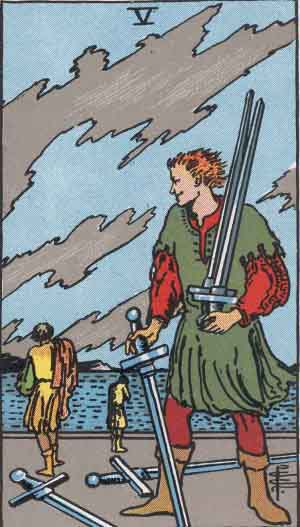
The Five of Swords is a card of conflict, arguments and unresolved tension. It appears when pride, competition or the need to be right has led to damaged relationships, hollow victories or emotional fallout. You may still be standing, but the card asks a pointed question: was it worth it?
Every Five in the tarot marks a moment of disruption, and in the suit of Swords that disruption plays out through words, arguments and mind games. This card can describe you, the person you are clashing with, or the situation itself. Its lesson is about learning when to fight, and when to walk away.
- Symbolism
- Upright
- Reversed
- Love
- Career
- Spirituality
- Yes or no
- Feelings
- Advice
- As a person
- Past, present, future
- Combinations
- FAQ
Five of Swords Symbolism
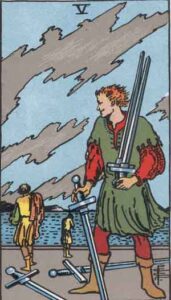
On the Rider-Waite-Smith card, a man in the foreground gathers up swords after a fight. He holds three, and two more lie on the ground at his feet. He looks back at his defeated opponents with what seems to be a smirk.
Behind him, two figures walk away towards the water, their backs turned. One of them has a hand raised to his face, as if in grief or shame. Above them, the sky is torn by jagged, windswept clouds.
The picture captures the whole problem with this kind of victory. The winner has the swords, but he is alone with them, and the people he beat are leaving. The card asks you to notice who you are in the scene: the one collecting the prize, the one walking away, or the one deciding whether to pick up a sword at all.
Five of Swords Upright Meaning
Upright, the Five of Swords represents clashes, disagreements and ego-driven decisions. Someone may be acting selfishly, manipulating the facts or trying to win at all costs, even if others get hurt in the process. The energy is tense and sharp.
If you are the one on the winning side, the card asks you to count the cost. Being right can leave you isolated if the way you got there damaged trust. If you are on the losing side, it may show a humiliation or unfair defeat, and the painful but wise choice to walk away rather than keep fighting a battle you cannot win.
Either way, it encourages you to re-evaluate your approach, recognise the damage and choose peace over pride where you can. Not every argument needs to be finished, and not every challenge needs to be answered. Compare the Five of Wands, where rivalry is lively but mostly harmless; here the stakes feel personal.
Key upright themes
- Arguments, hostility or betrayal
- Winning at a cost to others or yourself
- Tension and resentment in relationships
- Loss through selfishness or pride
- Learning from defeat or humiliation
Five of Swords Reversed Meaning
Reversed, the Five of Swords suggests reconciliation, regret or walking away from conflict. The dust is settling, and now you can see the fallout more clearly. It may be the moment to apologise, to accept an apology, or simply to stop.
It can also signal lingering resentment or passive-aggressive behaviour that still needs to be addressed. The open fight may be over, but the grudge has gone underground. Old arguments may flare up again if nobody deals with the hurt beneath them.
Sometimes the reversal urges you to drop the fight entirely and look for a truer kind of victory: peace, self-respect and relationships that are still intact.
Key reversed themes
- Making amends or apologising
- Letting go of resentment
- Ending unnecessary conflict
- Holding on to past wounds or grudges
- Learning to compromise
Five of Swords in Love
In love, the Five of Swords points to fights, mind games or unresolved resentment. You or your partner may be trying to win arguments rather than understand each other. Hurtful words, point-scoring or silent treatment may be causing real damage.
If you are single
The card can reflect bitterness left over from a past relationship, or dating that feels more like a game of strategy than a connection. Be wary of anyone who plays games with your feelings, and notice if you are guarding yourself by keeping score. Walking away from a situation that feels manipulative is a strength, not a loss.
If you are in a relationship
You may be locked in a cycle of arguments where neither of you will back down. Ask yourself what winning would actually achieve. Talking calmly about the real issue beneath the conflict, or taking time out when things get heated, will do more than trying to have the last word. If you ever feel unsafe or controlled, reach out to someone you trust or a support service.
Reversed in love
Reversed, this card can point to apologies, reconciliation or the realisation that the conflict is not worth the cost. It may also show one partner choosing to leave a relationship that has become too combative. Either way, the fighting is coming to an end.
Five of Swords in Career and Money
In a career reading, this card warns of office politics, power struggles or cut-throat competition. You may be facing unfair treatment, someone taking credit for your work, or a situation that tests your values. Even if you come out on top, it may leave a bitter taste.
With money, the Five of Swords can point to disputes over payment, unfair deals or a bargain where one side gains at the other’s expense. Keep records, get agreements in writing, and consider advice from a qualified professional if a disagreement becomes serious.
Reversed, you may find a way to resolve the conflict, reach a fair compromise or remove yourself from a toxic environment. It can also be a reminder to let go of a grudge against a colleague so that you can move forward.
Five of Swords in Spirituality
Spiritually, the Five of Swords challenges you to examine your relationship with control, pride and being right. Are you holding on to a fight you have already won, or already lost? Growth comes from releasing the need to prove your point.
Try noticing where your ego gets involved: the urge to have the last word, the replayed argument, the imagined comeback. Simply seeing those patterns clearly takes away some of their power.
Reversed, the card shows forgiveness, humility and a wish to live more in line with your values. Letting go of a grudge can be a genuine relief.
Is the Five of Swords a Yes or No Card?
No. The Five of Swords is a no. Even if you get what you want, it is likely to come at a cost that outweighs the gain.
If you are asking whether to pursue a fight, a confrontation or a competitive situation, this card suggests stepping back. The victory it offers is hollow.
Reversed, the answer leans towards maybe, especially for questions about reconciliation. Conflict is easing, and an apology or compromise could turn things around.
Have a question of your own? Try the free yes or no tarot reading: hold the question in mind and draw one card.
Five of Swords as Feelings
As feelings, the Five of Swords describes tension and resentment. The person may feel hurt, defensive or angry after a conflict with you, or they may feel they need to win and keep the upper hand. Their feelings are tangled up with pride.
It can also show someone who feels defeated or humiliated and has walked away rather than keep fighting.
Reversed, they may regret how things went and want to make peace. Equally, they may still be holding a grudge that they are not ready to let go of, even if they are polite on the surface.
Five of Swords as Advice
As advice, the Five of Swords says: pick your battles. Before you respond, ask what you really want: to be right, or to be at peace? Sometimes the strongest move is to walk away.
If you have caused harm, apologise simply and sincerely. If you have been treated unfairly, protect yourself and set boundaries, but do not let the conflict consume you. And keep an eye on anyone who seems to win every argument at your expense.
Five of Swords as a Person
As a person, the Five of Swords is someone who plays to win and keeps score. They quote your words back at you, bring up old mistakes in new arguments and treat a discussion as something to be won rather than shared. At work they may be the colleague who takes the credit in the meeting; in a friendship group, the one who stirs things and then stands back to watch.
The card can also describe someone on the other side of that dynamic: a person who has just lost a fight they did not choose, and is walking away with their pride bruised. Imagine someone leaving a job after a campaign of small humiliations. They are not weak; they have simply decided the battle is not worth more of their life. Sometimes the Five asks which of these two figures you have been lately.
Reversed, the Five of Swords as a person is someone ready to lay down arms. They may offer a clumsy apology, finally admit they went too far or quietly stop competing. Less happily, it can describe someone who has swapped open fighting for sulking and sly remarks, so the conflict continues out of sight.
Five of Swords in the Past, Present and Future
In the past
In a past position, the Five of Swords points to a fight that left a mark: a falling out, a bruising exit or a win that cost a friendship. Even if nobody talks about it now, it may explain a coolness between people or a wariness you carry into similar situations.
In the present
In the present, a power struggle is live. Look at what each side actually wants beyond winning. This is the time to decide whether the issue is worth the damage, and to notice if anyone is shifting the facts to suit themselves.
In the future
In a future position, the card warns that a disagreement could harden into a contest if it is handled badly. Treat it as advance notice: get agreements in writing, keep your tone even and think now about where your line is, so you do not have to decide it in the heat of the moment.
As the outcome
As the outcome, the Five of Swords suggests that someone may technically get their way, but at a price. If that someone is you, ask whether the result is still worth having once you count the goodwill it would use up.
Reversed in these positions, the conflict is winding down. In the past it can show a feud that was eventually settled; in the present or future, a chance to make peace, or a grudge that needs to be spoken about before it resurfaces.
Five of Swords Tarot Combinations
The Five of Swords sets the tone for any argument in a spread, and its neighbours show how that argument plays out:
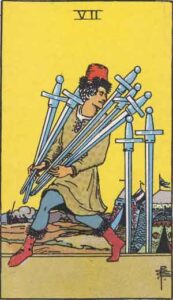
- Seven of Swords: underhand tactics. Together they point to office politics, someone taking credit or a win that is not worth what it costs (more on this pair).
- Five of Wands: conflict doubled. Noisy rivalry is at risk of turning into genuine point-scoring, so calm it down before it gets personal (more).
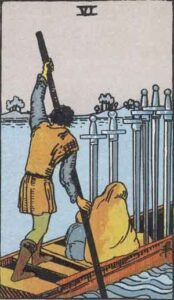
- Six of Swords: walking away. The next card in the suit shows you leaving the fight behind for calmer ground.
- Justice: fairness restored. A dispute may be settled on the facts rather than on who shouts loudest, which favours whoever has acted honestly.
- Temperance: compromise. Both sides give a little, and a middle way cools the conflict down.
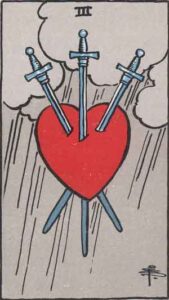
- Three of Swords: words that wound. The argument leaves real hurt, and in love it can point to a painful split.
For more pairings like these, and a simple method for reading two cards side by side, see the tarot card combinations guide.
Five of Swords: Frequently Asked Questions
What does the Five of Swords mean in love?
It points to arguments, mind games, point-scoring or lingering resentment. Couples may be caught in a cycle of fights where nobody backs down, and singles may meet people who play games. Reversed, it suggests apologies, reconciliation or recognising that the conflict is not worth what it costs.
Is the Five of Swords a yes or no card?
It is a no. The card suggests that pursuing the situation leads to conflict or a hollow win that costs more than it gives. Reversed, it softens to a maybe, particularly for questions about making peace, because tension is easing and compromise becomes possible.
What does the Five of Swords mean as feelings?
It shows tension, pride and resentment. Someone may feel hurt or defensive after a clash with you, or they may be focused on keeping the upper hand. Reversed, they may regret the conflict and want to make peace, or quietly hold a grudge behind polite behaviour.
What does the Five of Swords reversed mean?
Reversed, the Five of Swords usually means the conflict is ending. It points to reconciliation, apologies, compromise or simply walking away. It can also show a grudge that has gone underground, with passive-aggressive tension that still needs to be dealt with openly.
What does the Five of Swords mean for career?
It warns of office politics, power struggles, unfair competition or someone taking credit for your work. Even a win may feel empty. Keep records and agreements in writing. Reversed, it shows conflicts being resolved, fair compromises or leaving a toxic workplace behind.
Final Thoughts
The Five of Swords is a hard lesson in ego, pride and hollow victory. It teaches that real strength does not come from dominating others but from choosing peace, self-awareness and compassion. You can win the battle and still lose what matters.
Wondering whether to stand your ground or walk away? A two options spread can help you weigh both paths. Then see how the suit moves on with the Six of Swords, a card of leaving troubled waters behind.