

To cleanse tarot cards, give the deck a small, deliberate reset: knock on it, put the cards back in order, leave them in moonlight, pass them through incense smoke or ring a bell over them. Pick the method that suits you and can’t damage the cards, and use it whenever the deck needs a fresh start.
Nobody has proven that cards soak up energy, and I’m not going to pretend otherwise. Cleansing is ritual, and ritual works on the person doing it. It clears your head, draws a line under one reading before the next, and gives you a moment to notice what state your cards are actually in. That’s reason enough.
Below you’ll find when to cleanse, nine methods with steps and cautions, a comparison table, how to look after the physical deck, and a five-card spread for getting to know a new one.
What Cleansing Does, and What It Doesn’t
Many readers believe a deck picks up residue from the people and questions it handles, the way a room can feel heavy after an argument. Others treat that as a metaphor. You don’t have to settle it to get something out of the practice.
What cleansing reliably offers is practical and psychological:
- Focus. A minute of ritual pulls your attention off your phone and onto the cards.
- A fresh start. If the last few readings went round in circles, a reset lets you approach the next one without expecting more of the same.
- A boundary. Read for a friend in the middle of a breakup, then for yourself, and a quick cleanse in between keeps their story from bleeding into yours.
- A physical check. Several methods involve handling every card, which is when you spot the bent corner or the missing Page.
What it won’t do is rescue a vague question. If readings keep feeling off, the wording is often the real culprit, so it’s worth reading up on how to ask the right questions in a tarot reading before you blame the deck.
When to Cleanse Your Tarot Cards
- A new deck. Before the first reading, as a welcome. It’s also the moment to check all 78 cards are there.
- A second-hand deck. An inherited or pre-loved deck has had a life before you, and cleansing marks it as yours. (The superstition that your first deck must be a gift? Plenty of readers buy their own and do fine.)
- After reading for other people. Especially after several readings in a row, or a party where the cards went through many hands.
- When readings feel muddled. Cards that refuse to connect, the same card turning up whatever you ask (here’s what it can mean when you keep pulling the same card), or cards flying out of the shuffle more than usual. Our guide to jumping tarot cards covers that last one.
- After a heavy reading. Grief, illness, a betrayal. When the Three of Swords and the Ten of Swords have just landed side by side, a cleanse is a way of setting that reading down before you pick up the next.
- On a rhythm. The new moon, the first of the month, or a seasonal festival such as Samhain, which has its own Samhain tarot spread. A rhythm means you never have to decide.
If none of these apply, you don’t need to cleanse. A deck used only for your own card of the day can go months without it. And a run of upside-down cards isn’t a sign the deck needs fixing either; reversed cards are part of the language, not a fault.
9 Ways to Cleanse Tarot Cards
The methods fall loosely under the four elements, which is handy if you like a ritual to echo the suits. Smoke belongs to fire and air, like the Ace of Wands. Moonlight is traditionally tied to water and the Ace of Cups. Sound and breath are air, the element of the Ace of Swords, and salt and crystals are earth, like the Ace of Pentacles. That’s a framing, not a rule. Choose by what’s practical in your home.

1. Knocking
The quickest method there is. Hold the deck face down and rap the top card with your knuckles, usually once or three times. Some say the knock shakes loose what the last reading left behind; either way, it’s a clear full stop.
Watch out: knock on the deck with your hand, never the deck against the table. Tapping the edges on a hard surface dents the corners over time.
2. Putting the Deck Back in Order
Honestly, this is the one worth learning first. You sort the whole deck back into its starting order, which resets it symbolically and doubles as an inventory check.
- Lay out the Major Arcana from The Fool (0) to The World (21).
- Then sort each suit from Ace to King: Wands, Cups, Swords and Pentacles. Any fixed order works, as long as it’s the same every time.
- Count as you go: 22 Majors and 14 cards in each suit, 78 in all.
- Shuffle the ordered deck thoroughly before your next reading.
It takes ten to fifteen minutes and it’s oddly calming. It also teaches the deck’s structure faster than any chart, as you watch each suit climb from Ace to Ten (tarot numerology explains the pattern).
Watch out: an ordered deck is a stacked deck. Shuffle properly, or your next reading will be suspiciously full of Pentacles.
3. Moonlight
Leave the deck where the moon can reach it overnight, usually at the full moon for letting go or the new moon for a fresh start. Put the cards face up on an indoor windowsill and collect them first thing. It asks almost nothing of you, which is its charm.
Watch out: keep the deck indoors or in a closed box. A night on a garden table means dew, and dew warps card stock by morning. Move it before the sun comes round too, because hours of direct sunlight fade the colours.
4. Smoke
Light an incense stick or a small bundle of dried herbs, blow out the flame so it smoulders, and pass the deck slowly through the smoke a few times, turning it so every side gets a pass.
Watch out: open a window, keep a heatproof dish under the bundle to catch embers, and never leave anything smouldering unattended. Hold the cards well above the tip so they don’t scorch. Smoke is hard on people with asthma and on pets, birds especially, and a smoke alarm will happily join in.
A word on white sage. White sage (Salvia apiana) is sacred to many Native American peoples and grows wild only in southern California and northern Mexico. Commercial demand has led to over-harvesting and poaching, and many Indigenous voices have asked people outside those traditions not to buy it. I’d skip it. Rosemary, lavender, garden sage and cedar all smoke well, and a stick of good incense does the job with less fuss.
5. Sound
Ring a small bell, tap a singing bowl or strike a tuning fork over the deck, and let the note fade out completely. The belief is that the vibration breaks up stale energy. The practical effect is that you stop and listen for ten seconds, which is its own kind of reset. It suits shared homes and anyone who can’t burn things.
Watch out: hold the bowl beside the cards, not on them. A metal bowl rattling on top of a deck is a good way to nick the edges.
6. Crystals
Rest a crystal on top of the deck overnight, or keep a small one in the box. Selenite and clear quartz are the usual choices, and they’re cheap. A smooth tumbled stone or a flat slab is better than a raw point.
Watch out: nothing damp goes near the cards, so no crystal fresh from a rinse or a bowl of moon water. Selenite is a soft form of gypsum that water damages, so never wash it anyway. Check the underside of the stone for rough edges that could scratch.
7. A Salt Bowl or Salt Pouch
Salt has a long history as a purifier, and it’s in every kitchen. Set a small bowl of coarse salt next to the deck overnight, or tuck a sealed pouch of salt beside it in the drawer where it lives. Throw the salt away afterwards rather than cooking with it.
Watch out: never put salt on or under the cards. It’s abrasive, and it pulls moisture out of the air, so loose salt scratches the finish and leaves cards damp and wavy. Beside the deck, never touching it.
8. Breath and Visualisation
Hold the deck in both hands, breathe in slowly, and breathe out over the cards. Some readers picture light running through the deck from top to bottom, or the last reading draining away like water. It needs nothing and works on a bus.
It shows most plainly what all nine methods are doing: bringing your attention back to this moment and this question.
9. Shuffling With Intention
Shuffle more slowly than usual while you tell yourself, out loud or silently, that the last reading is finished. Some readers spread the whole deck face down and swirl it around the table with both hands for a minute. The shuffling step in our beginner’s guide covers the basic techniques.
Watch out: the riffle shuffle, where you split the deck and bend the halves into each other, creases tarot cards over time. The overhand shuffle and the table swirl are much kinder.
Cleansing Methods Compared
| Method (time) | What you need | Best for |
|---|---|---|
| Knocking (seconds) | Your knuckles | Between readings |
| Putting in order (10 to 15 minutes) | A clear table | New and second-hand decks, checking for missing cards |
| Moonlight (overnight) | An indoor windowsill | Monthly resets |
| Smoke (1 to 2 minutes) | Incense or dried herbs, a heatproof dish, an open window | A clean slate after a heavy reading |
| Sound (under a minute) | A bell, singing bowl or tuning fork | Shared or smoke-free homes |
| Crystals (overnight) | Selenite or clear quartz, completely dry | Ongoing upkeep in storage |
| Salt bowl or pouch (overnight) | Coarse salt in a bowl or sealed pouch | After reading for other people |
| Breath (under a minute) | Nothing | Reading away from home |
| Shuffling with intention (1 to 2 minutes) | Nothing | Before every reading |
If you want one routine: knock between readings, shuffle with intention at the start of each session, and put the deck back in order once a month. That covers almost every situation above.
How to Look After Your Deck
The kindest thing you can do for a deck is keep it in one piece. These habits matter more than any ritual.
- Store it somewhere dry. The original box, a drawstring bag or a wrap of silk or cotton all work. Keep it away from bathrooms, radiators and sunny windowsills, since damp and heat both warp card stock.
- Read on a cloth. It protects the cards from spills, crumbs and rough tables, and laying it out becomes a signal to your brain that a reading is starting.
- Clean, dry hands. Hand cream and snack dust leave oils behind, and oily cards clump and stop shuffling smoothly.
- Shuffle gently. Overhand or swirled, as above. Your corners will last years longer.
- Wipe, don’t wash. A clean, dry microfibre cloth lifts most grime. Test anything stronger on a single card first.
What Never to Do
Skip the salt bath; your cards won’t survive it. The same goes for soaking, rinsing or spraying with moon water, all of which you’ll find recommended somewhere. Card stock swells and curls as soon as it gets wet, and it rarely flattens again. No hot cars, no sunny sills all afternoon, no flames up close.
If a card does get damaged, you don’t need a new deck. A stained Star still means hope, and some readers grow fond of the card with the coffee ring.
Bonding With a New Deck
A new deck is stiff, shiny and a bit of a stranger. The quickest way to make it yours is to handle it a lot in the first week.
- Look at every card. Go through the deck face up, slowly, and note the first detail that catches your eye on each one. Getting to know your deck is step one for a reason.
- Put it in order. Method two above, which also tells you whether a card went missing at the factory.
- Keep it close. An old habit is to sleep with a new deck under your pillow. A bedside table works just as well, and your neck will thank you.
- Draw one card a day. A month of daily draws teaches you more than a weekend with the guidebook. The one-card spread keeps it simple.
- Interview it. Treat the deck like a new colleague and ask it about itself.
The Deck Interview Spread
Deck interviews are a common tradition, and this five-card version was written for this site. Lay three cards in a row, then two beneath them.
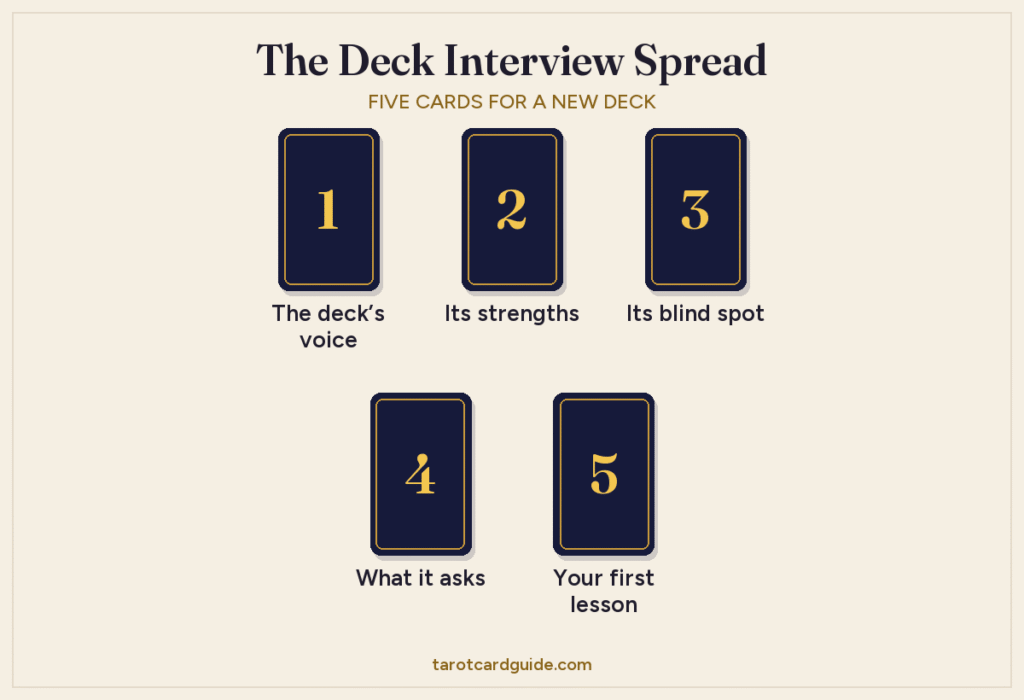
- The deck’s voice: how does this deck speak? Gently, bluntly, playfully?
- Its strengths: the kind of question it will answer clearly.
- Its blind spot: where you’ll need to read carefully or ask a follow-up.
- What it asks: what the deck needs from you in return.
- Your first lesson: what the two of you will work on first.
Say you draw the Knight of Swords as the voice, the Six of Pentacles as its strength, the Seven of Cups as the blind spot, the Four of Swords as what it asks and the Page of Cups as the first lesson.
That’s a deck that talks fast and doesn’t sugar-coat. It’s good on practical questions of give and take, but gets foggy when you ask it to choose between daydreams. It wants you rested before you read, not squeezing a spread in at midnight. And its first lesson is to trust the small, soft hunches you usually dismiss. Write the five cards down and look again in three months.
Cleansing Your Space and Yourself
A clean deck on a cluttered table only gets you so far. Before a reading, clear the surface, lay your cloth, open a window for a minute and light a candle if you like. The bell or the incense works for a room as well as a deck.
Then yourself. Wash your hands, put both feet on the floor and take three slow breaths. Say the question out loud once. If you’re exhausted, furious or desperate for a particular answer, wait; the cards will still be there tomorrow, and reading for yourself is hard enough when you’re calm. If what you want to look at is the difficult stuff underneath, a shadow work tarot session is a better fit than a quick draw.
Try Your Freshly Cleansed Deck
Once the deck is reset, give it a simple first job. Lay out a three-card spread for the week ahead, or, if you want the full picture of one situation, the Celtic Cross. For a quick check that you and the deck are on speaking terms, ask the yes or no tarot something small and see how it answers.
Frequently Asked Questions
How often should you cleanse tarot cards?
There’s no fixed rule. A quick knock between readings, plus a fuller reset such as moonlight or putting the deck in order once a month, covers most people. Cleanse sooner after reading for others or after a heavy reading.
Can you cleanse tarot cards without sage?
Yes. Knocking, sound, moonlight, breath and putting the deck back in order need no smoke at all. If you like smoke, rosemary, lavender, cedar or ordinary incense are good alternatives to white sage.
Do you have to cleanse a new tarot deck?
No, but many readers like to. The most useful first step is to go through every card and put the deck in order, which lets you check that all 78 cards are there and gets you familiar with the art.
Should you cleanse tarot cards after someone else touches them?
That’s personal. Some readers let the person they read for shuffle and then cleanse afterwards; others prefer nobody else handles the deck. If it bothers you, a knock or a shuffle with intention is enough.
Can you use salt to cleanse tarot cards?
Only beside them. Salt is abrasive and draws moisture, so salt on the cards, under them or in a salt bath will scratch and warp them. A bowl of salt or a sealed pouch next to the deck is the safe way to do it.
How do you know when your tarot cards need cleansing?
Most readers go by feel: readings that won’t connect, heaviness after a hard session, or a deck that has sat unused for months.