A reversed tarot card is one that lands upside down when you turn it face up. To read it, start from the card’s upright meaning and ask how that energy has changed: blocked or delayed, turned inward, overdone or underdone, weakened, or (now and then) flipped into its opposite.
That’s the short version. The longer one is that reversals are a choice rather than a rule, and there are at least seven sensible ways to read them. The real skill is picking your method before you shuffle, so the cards can’t simply tell you whatever you’d like to hear.
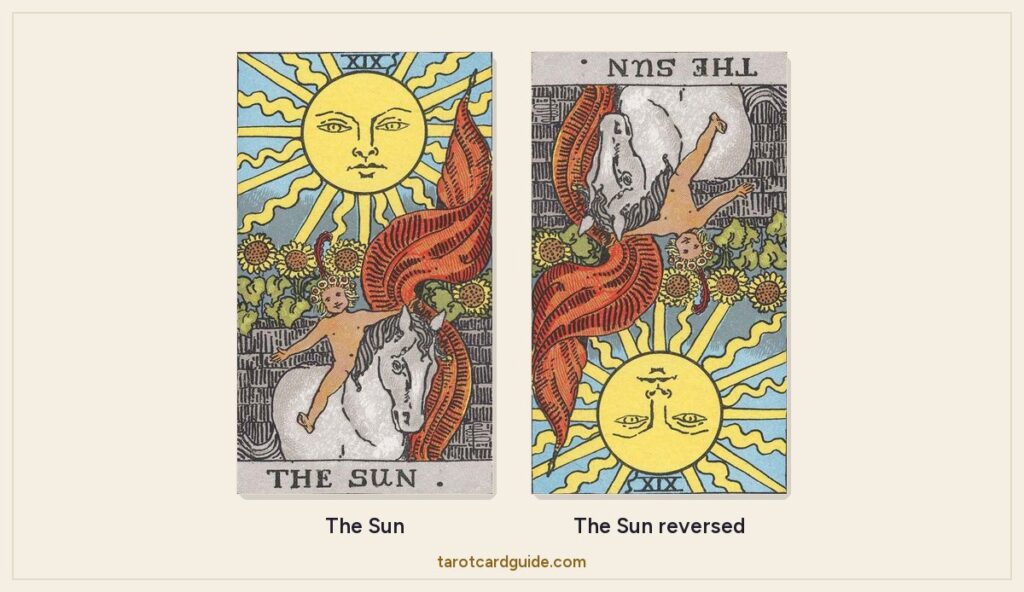
Below you’ll find each method with a real card example, a worked three-card reading and some exercises. Every card page on this site has its own reversed section, and I’ll link straight to them as we go. Start with the pair below: The Sun upright is joy with nothing in the way, and reversed it’s the same joy behind a bit of cloud.
Should You Use Reversals at All?
Only if you want to. Plenty of skilled readers never use reversals, and plenty of others wouldn’t read without them. Both camps are doing real tarot.
The case for reversals: they add a note the upright card can’t play on its own, the sense that something is stuck, slow or unfinished. A spread of all-upright cards can feel oddly tidy when life isn’t.
The case against: every card already holds its light and its shadow. The Tower is frightening and freeing at once, and the Four of Cups can be healthy rest or plain apathy. Position and neighbouring cards often show which side is in play, so reversals can feel like a second system bolted on top.
You don’t have to decide for life, either. Use reversals in a deep Celtic Cross and leave them out of a quick card of the day if you like. Just decide before each reading, never halfway through. If you’re in your first few months, I’d learn the upright meanings first (the beginner’s guide to reading tarot walks you through them) and add reversals once those feel familiar.
How Reversals Get Into Your Deck
A new deck comes out of the box with every card facing the same way, and an ordinary overhand shuffle never turns any of them round. If you want reversals, you have to put them there.
- The table wash. Spread the cards face down, swirl them around with both hands and gather them up. It’s the most random method, and gentle on card edges.
- Cut and turn. Cut the deck into piles, rotate one pile end to end, stack them again and shuffle as normal.
- Flip cards like a book page. When you turn a card face up, flip it from side to side, not top to bottom. A top-to-bottom flip turns an upright card upside down, and it quietly changes the reading.
“Upright” means upright from where you sit as the reader. The shuffling step of the beginner’s guide has more ways to mix a deck, and the free three-card reading on this site turns roughly one card in three if you want practice without a physical deck.
Seven Ways to Read a Reversed Card
These are the seven methods most readers draw on. None of them is the official one, and each suits some cards better than others, so every method comes with a card where it really clicks.
| Method | The question it asks | A card where it works |
|---|---|---|
| 1. Blocked or delayed | What’s in the way? | Eight of Wands |
| 2. Internalised | Is this happening out of view? | The Tower |
| 3. Too much or too little | Which way has it tipped? | Strength |
| 4. The opposite | Is the hard part ending? | Ten of Swords |
| 5. Weakened | Is it the same, only quieter? | The Sun |
| 6. The literal image | What falls or spills? | Ace of Cups |
| 7. An echo of the past | What hasn’t finished with you? | Three of Swords |
1. Blocked or Delayed
The upright energy is present, but something is in its way. It hasn’t arrived yet, or it’s stuck at the door. This is the most common approach and the safest default, because it works for almost every card.
The Eight of Wands reversed is the classic example. Upright, eight staves fly over open country towards their target: news, results, things moving fast. Reversed, the momentum stalls. The reply doesn’t come, the trip gets moved. The message is “it’s coming, just not on your timetable.”
2. Internalised or Private
The energy is real, but it’s happening inside you or out of sight, rather than out in the world where other people can see it.
Upright, The Tower is the lightning strike everyone notices. Reversed, it can describe the same collapse happening quietly on the inside: an old belief about yourself cracking, or an identity you’ve outgrown giving way. You’re just not quite the same person afterwards. This method suits the Majors well, and it’s a kind one: it doesn’t turn every reversal into bad news.
3. Too Much or Too Little
Here the reversal shows the upright quality out of balance, either overflowing or running dry. Look at the card and ask which way it has tipped.
Strength shows a woman gently closing a lion’s jaws with her bare hands: courage without force. Reversed, too much looks like the lion getting loose, all impatience and snapping. Too little looks like backing away when courage is needed. Same card, two opposite problems, and the rest of the spread usually tells you which one you’ve got. It works just as well for Temperance reversed, where the mix is simply off.
4. The Opposite (Use Sparingly)
The reversed card means the reverse of its upright meaning. It’s the method most beginners assume is the rule, and honestly it’s the one I’d reach for least. Try it on The Lovers reversed and you get “hatred”, which throws away everything the card shows about choice, values and connection.
Where it does work is on the hardest cards. The Ten of Swords reversed is widely read as recovery, the swords falling away as someone gets back on their feet. The Five of Pentacles reversed is similar: a hard stretch starting to lift. When a card is already at the bottom, turning it over often points back up.
5. Lessened or Weakened
The upright meaning still applies, just at a lower volume. Good cards are less good, hard cards are less hard. The Sun reversed is the best example in the deck: still a positive card, only a dimmer one. Success is slower than you hoped, or happiness is there but stress is stopping you from feeling it.
6. Read the Upside-Down Picture
Turn the card over and look at what the image does now. Things fall. Things spill. Figures end up on their heads, or back on their feet. This is the most intuitive method, and it’s where the Rider-Waite-Smith pictures really earn their keep.
Upright, the Ace of Cups is a hand from a cloud holding a cup that overflows in five streams into a pool below. Upside down, the cup simply empties. The feeling drains away, or it isn’t reaching you at all.
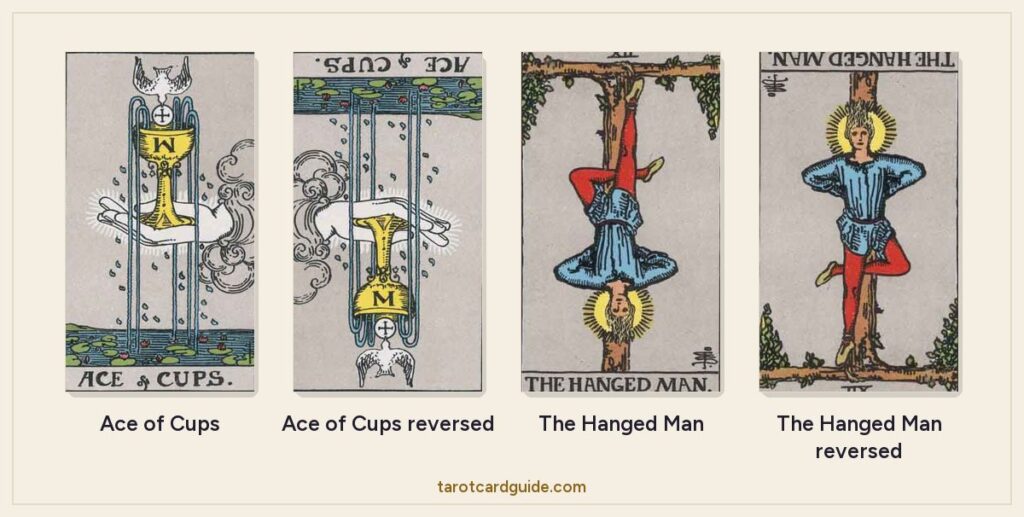
The Hanged Man works the other way round. He hangs upside down by one foot, so reversed he looks as if he’s standing up. Some readers take that as the pause being over. Others see someone refusing to hang there long enough to learn anything. Both readings come from simply looking.
7. An Echo of the Past
The reversed card describes something that has already happened but hasn’t quite finished with you: unfinished business, an old pattern, a wound you’re still carrying.
Upright, the Three of Swords is a heart pierced by three swords under grey, rainy skies. That’s heartbreak, now. Reversed, many readers take it as the same grief in the past tense, healing or still being carried quietly. In a present or future position, this method can flag that an old story is colouring the new one.
Choose Your Method Before You Shuffle
If you decide what a reversal means after you’ve seen it, you’ll pick whichever reading you like best. A reversed Tower becomes “oh, it’s internal, so nothing bad will happen” because that’s the answer you wanted.
So choose before you shuffle. For a practice period, pick one default method and use it for every reversed card. I’d start with blocked or delayed, because it fits almost every card and it’s hard to bend into wishful thinking.
Later you can keep two or three methods, as long as you have a rule for choosing. A decent one: use your default, unless the upside-down image says something louder (method six) or the card is already at rock bottom (method four).
Write your method at the top of the page before you start. It takes ten seconds and keeps you honest, especially when you’re reading tarot for yourself and nobody else is there to notice you bending the rules.
Reversed Majors, Minors and Court Cards
Major Arcana. A reversed Major Arcana card usually points to a big lesson that hasn’t landed yet, or one that’s being resisted. Death reversed is often an ending you know is due but haven’t let happen. The Star reversed is hope that’s still there but hard to feel. Give reversed Majors real weight; they tend to be the headline.
Minor Arcana. Reversed Minors are usually smaller and more practical: a delay, a hiccup, a mood. As a rough guide, Wands slow down or burn out, Cups get held in or spill, and Pentacles point to practical wobbles with money, work or health. Several of the painful Swords cards ease when reversed. Don’t give a reversed Minor more weight than it earns: the Two of Cups reversed can be a rough patch or a misunderstanding, not a verdict on the whole relationship.
Court cards. A reversed court card usually describes a person, or a side of you, showing the card’s qualities in an immature, overdone or blocked way. The Queen of Cups reversed can be someone so absorbed in other people’s feelings that they lose track of their own. The King of Swords reversed is sharp judgement turned cold or controlling.
The guide to tarot court cards explained covers how to tell whether a court card is you, someone else or a situation, and the same options apply upside down. For one reversed court card up close, see the Page of Cups reversed in new dating.
When a Spread Is Full of Reversals
A little maths first. If each card has an even chance of landing reversed, all three cards in a three-card spread will be upside down about one time in eight, and seven or more reversals in a ten-card Celtic Cross turn up roughly one time in six.
Still, when most of a spread is upside down, it’s fair to treat that as part of the answer. The common readings are:
- Resistance. Something in the situation, or in the person asking, is pushing against change.
- Timing. The matter isn’t ready to move yet. Come back to it later rather than forcing it.
- Inner work. The action is internal for now, not out in the world.
- A tired question. The question itself may be the problem. Try asking a better tarot question another day.
Check the practical explanation first, though. If you rotated half the deck and then drew mostly from that half, you’ll get a run of reversals that means nothing at all. And if the same card keeps turning up reversed, there’s a whole guide to pulling the same tarot card again and again.
A Worked Example with Three Reversed Cards
Imagine someone asks, “Why can’t I get my creative project off the ground?” Before shuffling, they choose blocked or delayed as their method. They lay out a three-card spread for past, present and future, and all three cards land upside down.
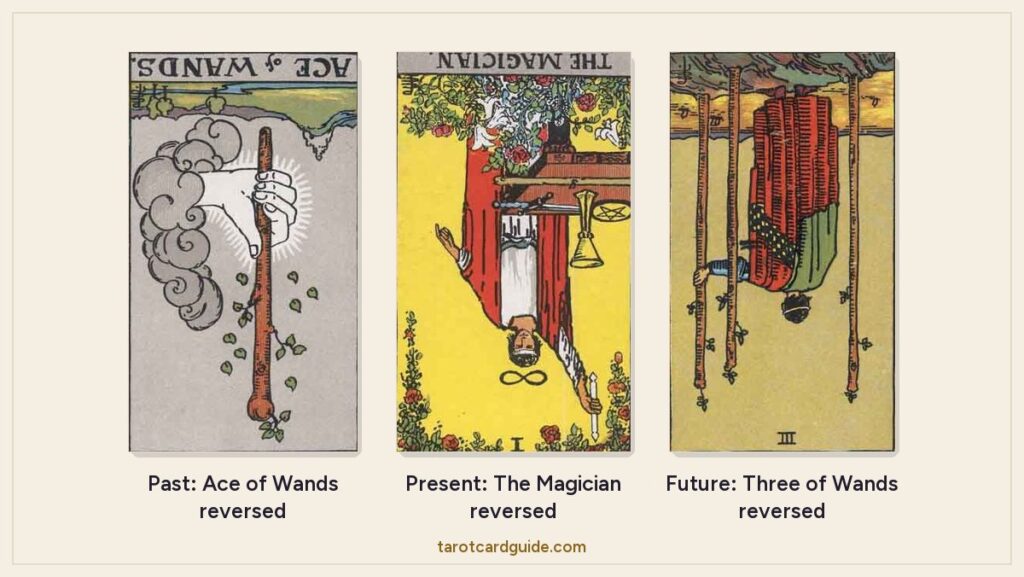
Past: Ace of Wands reversed. Upright, a hand from a cloud offers a freshly cut, sprouting wand: the spark of a new idea. Blocked, it’s an idea that never caught. The enthusiasm was there, but it didn’t get fuel, whether through fear, burnout or plain distraction.
Present: The Magician reversed. Upright, every tool is on the table and in use. Blocked, the tools sit there untouched. This reversal often points to scattered energy and self-doubt, and after the Ace that makes a clear picture: plenty of ability, spread across too many half-starts, with a quiet voice asking “who am I to do this?”
Future: Three of Wands reversed. Upright, a figure on high ground watches ships at sea, the plan sent out and growing. Blocked, the ships haven’t come in yet. That’s a delay, not a failure.
Now read them together. Three reversals out of three is part of the message: the energy is stuck, and most of the stuckness is internal. Two Wands cards and a Magician holding a wand put fire in every position, yet none of it is moving. A fair summary: “The idea was good and your skills are real. The block is the scattering and the doubt. Pick one piece, finish it, and expect progress to be slower than you’d like, but coming.”
Notice what didn’t happen. Nobody read the reversed Magician as a con artist. That meaning exists, but nothing in the question or the neighbouring cards supports it. Context chooses the meaning, which is the same skill you use for tarot card combinations.
Practice Exercises
- One card, seven ways. Pick a card, turn it upside down and write one sentence for each method. The Empress reversed is a good first choice: too little care, too much care, care turned inward, a creative block. Notice which methods feel forced.
- Look before you read. Go through one suit, say Cups, from Ace to Ten. On each card page, press “See it reversed” and describe what the turned image does before you read the reversed section.
- Two weeks, one method. Commit to one method for a fortnight of daily draws with the card of the day. Note each reversal and what the day actually held. Treat it as reflection, not a scorecard.
- Two methods, one hard card. Read The Devil reversed with method four (breaking free of the chains) and then method seven (an old habit still pulling). Which would you trust in a reading about a bad habit?
Reading Without Reversals
If you’d rather keep every card upright, you lose very little, provided you read position and neighbours carefully. Those two do most of the work reversals would have done.
Position first. A card in a challenge position is already showing its difficult side. The Chariot in the crossing position of a Celtic Cross doesn’t need to be upside down for you to read it as willpower pulled two ways, like its black and white sphinxes.
Then neighbours. The Sun beside the Five of Cups reads as joy shadowed by regret, which is very close to what The Sun reversed would say. The method for reading two cards together gives you a simple way to do this every time.
Some readers add elemental dignities as well. Fire and water weaken each other, so a Wands card between two Cups cards is dampened, much as if it had come out reversed.
Whichever way you go, the fastest teacher is volume. Pull a free five-card reading, pick your method before you click, and read every reversed card before you open its page.
Frequently Asked Questions
What does it mean when a tarot card is reversed?
It means the card landed upside down. Most readers take it as the upright energy changed in some way: blocked, delayed, internal, out of balance or weaker. Only occasionally does it mean the straight opposite.
Do you have to read reversed tarot cards?
No. Reading every card upright is a perfectly good way to read, and many experienced readers do it. You can also use reversals in some readings and not others, as long as you decide before you shuffle.
Are reversed tarot cards bad?
Not necessarily. A reversed happy card is usually still hopeful, just slower or quieter, and several difficult cards, such as the Ten of Swords, are often read as recovery when reversed.
What does it mean if most of my cards are reversed?
Often resistance, bad timing or a situation that’s mostly internal for now. First check that your deck was properly mixed, since a half-turned deck can produce a run of reversals by chance.
Is a reversed card a no in a yes or no reading?
Not automatically. Many readers treat a reversal as a softer answer, so a yes card becomes “not yet”. The free yes or no tarot reading works this way.