Tarot numerology is the idea that every number in the deck carries a meaning of its own, so a Five tells you something before you’ve even looked at its suit. In the Minor Arcana the numbers run from Ace to Ten as one story of starting, growing, stumbling and finishing, and in the Major Arcana the numbers 0 to 21 reduce to link cards such as The Magician, Wheel of Fortune and The Sun.
It’s the biggest shortcut in tarot. Forty of the 56 Minor Arcana cards are numbered, so ten number meanings and four suit meanings give you a working feel for all forty before you’ve memorised a single card page. Below you’ll find each number across the four suits, the nine families of the Majors and how to use numbers in a real reading.
How Tarot Numerology Works
A tarot deck has two numbered sequences. Each suit of the Minor Arcana runs from Ace (one) to Ten, and the 22 cards of the Major Arcana run from 0, The Fool, to 21, The World. The court cards sit outside both.
In the Minor Arcana, the number tells you where you are in a process and the suit tells you what it’s about. Wands are fire: drive and ambition. Cups are water: feelings and relationships. Swords are air: thoughts, words and conflict. Pentacles are earth: money, work, home and the body.
So a Five is always some kind of disruption, and the suit tells you whether it’s a squabble, a loss, a fight over pride or a money worry. If you’ve read how the 78 cards are organised, this is the layer underneath. The Majors work differently: their numbers are added up and reduced, which comes further down.
The Numbers from Ace to Ten
Read the ten numbers as one arc: a seed, a choice, growth, a solid base, a shake-up, recovery, a test, a push, the last stretch and the finish. Each suit tells that story in its own element.
Ace (One): Beginning
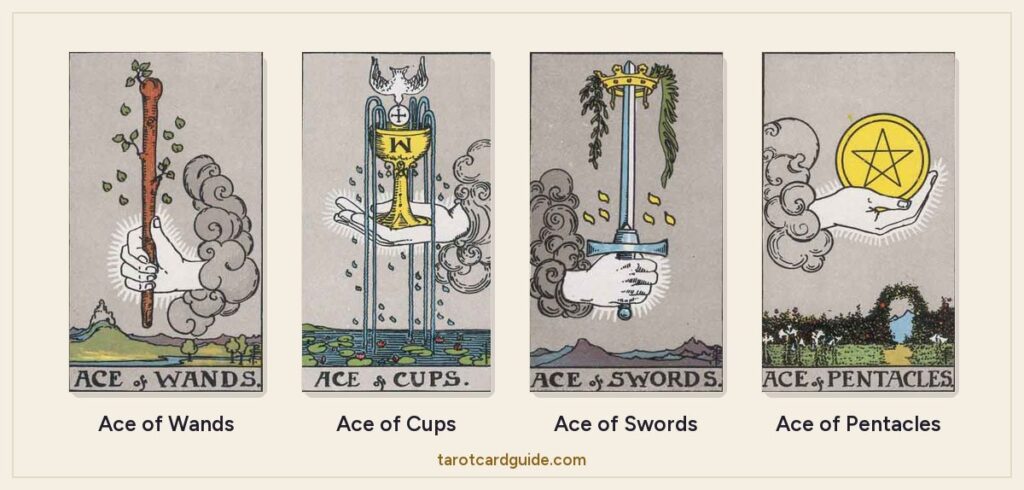
Every Ace shows a hand reaching out of a cloud to offer the suit’s symbol: pure potential, with nothing done with it yet.
The Ace of Wands is a living branch still sprouting leaves, the spark of an idea. The Ace of Cups overflows in five streams, a heart opening. The Ace of Swords points straight up through a crown, a flash of clarity. The Ace of Pentacles holds a coin above a garden, a practical opening that still needs planting.
Two: Choice and Balance
Two brings a second thing into the picture, and with it partnership, comparison and decisions.
In the Two of Wands, a man on castle walls holds a small globe, weighing where to take his plans. The Two of Cups is two people pledging cups as equals. The Two of Swords is the awkward twin: a blindfolded woman with two swords crossed over her chest, balanced but stuck because she won’t choose. The Two of Pentacles juggles two coins inside a figure-eight ribbon, balance kept by staying on the move.
Three: Growth
Three is the first result: one and two meet and something new appears.
The Three of Wands watches ships from a high cliff, plans already out in the world. The Three of Cups is three friends raising a toast at harvest. The Three of Swords is growth the hard way: a heart pierced by three blades in the rain, a truth that hurts but moves you on. The Three of Pentacles puts a stonemason, a monk and a planner around a church arch, skill growing through teamwork.
Four: Stability
Four is a square, a table with four legs. Each suit shows a different attitude to security.
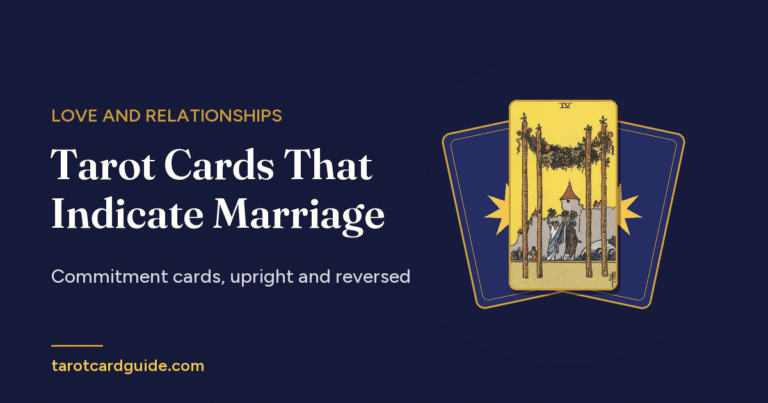
The Four of Wands is a garlanded canopy and a party, stability open to the sky. The Four of Cups is stability gone stale: a young man under a tree, so bored with three cups that he ignores a fourth being offered. The Four of Swords is a knight’s effigy resting on a tomb, a deliberate pause. The Four of Pentacles clutches a coin to his chest and pins two more under his feet, security held so tightly that nothing moves.
Five: Conflict
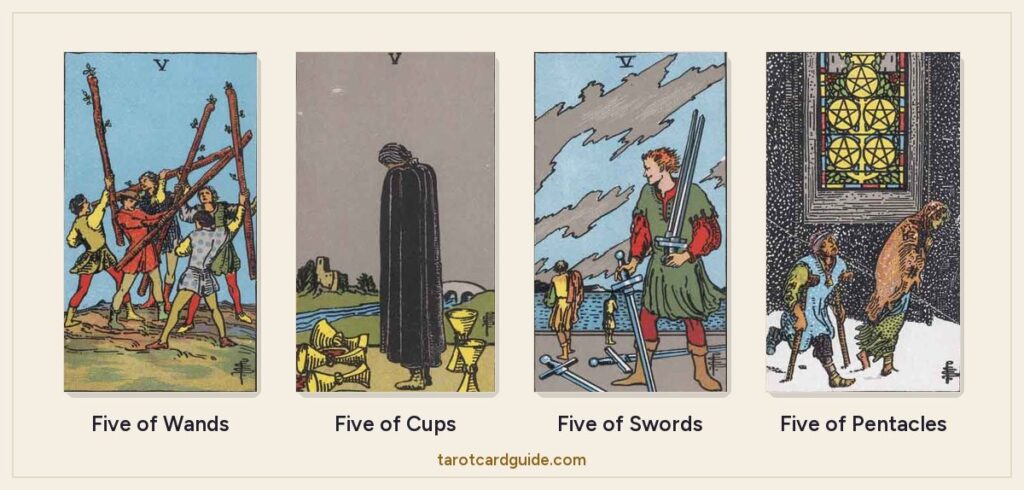
After the steadiness of four, five knocks the table over. People dread the Fives, but honestly they’re useful: they show exactly where the friction is.
The Five of Wands is five young men waving staves with no clear sides, noisy competition rather than real danger. The Five of Cups mourns three spilled cups while two still stand behind. The Five of Swords is the smirking winner gathering blades as the others walk away. The Five of Pentacles shows two people struggling through snow past a lit church window, with help closer than it looks.
Six: Harmony
Six restores balance after the upset of five. Things settle and help flows.
The Six of Wands is a rider crowned with laurel and cheered by a crowd, recognition after a struggle. The Six of Cups shows one child handing another a cup of flowers, the comfort of memory. The Six of Swords is a ferryman poling his passengers from rough water towards calm. The Six of Pentacles holds a pair of scales while giving coins away, fairness restored.
Seven: Reflection
Seven is where things get tested. Each Seven makes you stop and ask what’s real, what’s worth defending and what’s worth the effort.
The Seven of Wands defends high ground against six wands, in mismatched shoes because the challenge caught him off guard. The Seven of Cups floats seven visions on a cloud, from jewels to a dragon, and asks which are fantasies. The Seven of Swords tiptoes away with five swords and leaves two behind, a plan cleverer than it is complete. The Seven of Pentacles leans on his hoe and studies the crop, weighing whether the work is paying off.
Eight: Movement
Eight gets things moving again, including the moments when you only think you can’t move.
The Eight of Wands is the most literal: eight wands flying through open sky, news arriving fast. The Eight of Cups walks away from eight neatly stacked cups under the moon, heading for something that means more. The Eight of Swords is a bound, blindfolded woman who could simply walk out, because her feet are free. The Eight of Pentacles is a craftsman hammering coin after coin, movement as steady practice.
Nine: Near-Completion
Nine is the last stretch. Look closely and you’ll see that all four Nines show a single figure, which suits a number about who you’ve become by the end of the road.
The Nine of Wands is bandaged but still guarding his line of wands. The Nine of Cups sits contentedly in front of nine cups, the wish card. The Nine of Swords sits up in bed, face in hands, beneath nine swords: worry at its loudest. The Nine of Pentacles stands alone in a vineyard with a hooded falcon on her glove, independence earned through patient work.
Ten: Completion
Ten ends the cycle and seeds the next: add its digits and you’re back at one.
The Ten of Wands staggers under a bundle he can’t see past, ambition turned into burden. The Ten of Cups shows a couple and two dancing children beneath a rainbow of cups. The Ten of Swords lies face down under ten blades while dawn breaks, rock bottom and the end of the worst. The Ten of Pentacles gathers an old man, a couple, a child and two dogs by an archway, wealth become legacy.
Tarot Numbers at a Glance
| Number | Keyword | Wands, Cups, Swords, Pentacles |
|---|---|---|
| Ace (1) | Beginning | Spark, new love, clarity, opportunity |
| Two | Choice and balance | Planning, partnership, stalemate, juggling |
| Three | Growth | Expansion, friendship, heartbreak, teamwork |
| Four | Stability | Celebration, apathy, rest, holding on |
| Five | Conflict | Competition, loss, hollow victory, hardship |
| Six | Harmony | Recognition, nostalgia, moving on, generosity |
| Seven | Reflection | Standing firm, illusion, secrecy, patience |
| Eight | Movement | Speed, walking away, feeling trapped, practice |
| Nine | Near-completion | Resilience, wishes, anxiety, independence |
| Ten | Completion | Burden, fulfilment, rock bottom, legacy |
The Major Arcana Numbers and Digit Reduction
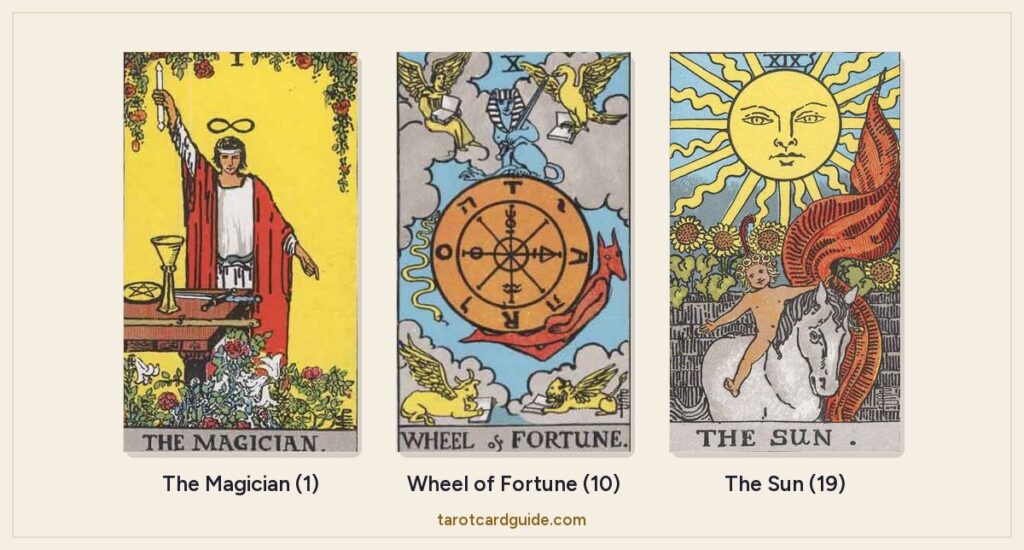
The Majors run from 0 to 21. To link them, add the digits of any two-digit card until you reach a single digit. Wheel of Fortune is 10, and 1 + 0 = 1, so it belongs with The Magician. The Sun is 19: 1 + 9 = 10, then 1 + 0 = 1, so it joins them.
The tarot birth card calculator uses the same reduction on birthdays. It gives nine families, each with partners among the pips:
- 1, 10, 19: The Magician, Wheel of Fortune and The Sun. Will, turning points, success. The Magician has all four suit symbols within reach, so every Ace traces back to him.
- 2, 11, 20: The High Priestess, Justice and Judgement. Inner knowing, weighing up, a final reckoning. The Twos share her two pillars: two sides held in tension.
- 3, 12, 21: The Empress, The Hanged Man and The World. Growth, surrender, completion. Like the Threes, each is about something coming to fruit.
- 4, 13: The Emperor and Death. Structure, and the ending that clears ground for a new one. The Fours share the Emperor’s stone throne.
- 5, 14: The Hierophant and Temperance. Tradition, and the art of blending. The Fives show the rules breaking down; Temperance mixes things back together.
- 6, 15: The Lovers and The Devil. A choice made from your values, and an attachment that only feels like a choice. The Devil’s chained couple echoes the Lovers’ pair.
- 7, 16: The Chariot and The Tower. Will that builds, and structures that fall. The Sevens test your position just as the Chariot does.
- 8, 17: Strength and The Star. Quiet courage and renewed hope. The Eights share Strength’s steady, patient effort.
- 9, 18: The Hermit and The Moon. Solitude, and finding your way in the dark. The lone figures of the Nines belong here.
The Fool: 0 or 22
The Fool is unnumbered in many older decks and 0 in the Rider-Waite-Smith. Zero doesn’t reduce, so readers split: some leave it outside the families as pure potential, others count it as 22, which reduces to 4 and puts it with The Emperor and Death, as the fresh start after every structure and every ending. The birth card calculator uses 22.
For the whole sequence read as one story, see what the Major Arcana reveal about your life.
Why Strength and Justice Swap Numbers
If you own more than one deck, you may have noticed Strength and Justice trading places. In the Tarot de Marseille and most decks before 1909, Justice is VIII and Strength is XI. In the Rider-Waite-Smith deck, Strength is VIII and Justice is XI.
The change came from the Hermetic Order of the Golden Dawn, the occult society A. E. Waite belonged to. The order matched the Majors to the Hebrew letters in sequence, and each letter carried a zodiac sign. The lion card needed Leo, the card with the scales needed Libra, and Leo’s letter comes first, so the two cards swapped.
Waite’s 1909 deck made the swap public, and most modern decks followed. Not all: Aleister Crowley’s Thoth deck keeps the older order, with Adjustment (its Justice) at VIII and Lust (its Strength) at XI.
For numerology, use the numbers printed on your own deck. This site follows the Rider-Waite-Smith order, so Strength sits with The Star (8 and 17) and Justice with The High Priestess and Judgement (2, 11 and 20).
Do Court Cards Have Numbers?
Not in any agreed way, and traditions genuinely differ. Some readers carry on counting after the Ten, so the Page of Cups would be 11, the Knight of Cups 12, the Queen of Cups 13 and the King of Cups 14. Others link the courts to elements or astrology instead, and plenty leave them out of numerology altogether.
I’d read court cards as people, using the four ranks, and only number them when totalling a spread. Decide before you shuffle whether they count as 11 to 14 or not at all.
How to Use Numbers in a Reading
Repeated numbers
When the same number turns up two or more times, its theme gets loud. Three Fives in a Celtic Cross say friction is the story, whatever the question. Four Tens is about as clear as tarot gets that a chapter is closing.
Old fortune-telling lists give set meanings for three of a kind, but they disagree, so trust the core number meaning. It works like pulling the same card again and again: repetition is emphasis. Numbers are also one of the checks in reading two cards together.
Progressions
Numbers that climb or fall show direction. The Two of Cups, Three of Cups and Four of Cups in a row trace a relationship from connection to celebration to boredom. A falling run, say a Nine, a Seven and a Five, suggests something unwinding back towards its messy middle, whatever the suits.
The quintessence card
The quintessence is an established way of finding one Major Arcana card that sums up a whole spread. You don’t draw it; you work it out.
- Add up the numbers of every card in the spread. Aces count as 1, the other pips as their number, Majors as their number and The Fool as 0.
- Leave court cards out, or count them as 11 to 14 if that’s your system.
- If the total is over 22, add its digits together. Repeat until you have 22 or less.
- Find that Major Arcana card. A total of 22 is The Fool.
Read the quintessence as the background theme or the advice behind the reading, not an extra prediction. Some readers reduce all the way to a single digit instead. Both are in use, so pick one and be consistent.
A Worked Example
Imagine someone with years in a steady job asks, “What do I need to know about going freelance?” They lay out a three-card spread for past, present and future and draw the Four of Pentacles, the Five of Wands and the Six of Wands.
Four, five, six is the textbook arc: stability, a shake-up, then a new balance. The old security gives way to a noisy, competitive stretch that can settle into something good.
The suits move from Pentacles (earth: salary, safety) to Wands (fire: ambition), which is the whole question in two suits.
The quintessence adds a note of caution: 4 + 5 + 6 = 15, The Devil. Here it points to whatever keeps someone tied to a job out of fear rather than choice, echoing the grip of the Four of Pentacles. Reduce 15 once more and you get 6, The Lovers: a choice made from your values. That pair makes a good prompt for shadow work. What am I holding on to, and why?
None of this says whether the business will make money; that needs a proper look at the finances. What the numbers give is a frame: expect the noise of the Five, aim for the Six, and look honestly at what the Four has been protecting.
Practise the Numbers
Pull a card of the day and, before you open its page, name its number and suit and guess the meaning from those two alone. After a few weeks the pips stop feeling like forty separate cards.
For a longer exercise, use the free five-card spread, write down every number, look for repeats and runs, and work out the quintessence. And to find the Majors that are yours for life, the birth card calculator uses exactly the reduction above.
Frequently Asked Questions
What is tarot numerology?
It’s reading the numbers on the cards as meanings in their own right. Each number from Ace to Ten marks a stage in a cycle, and the Major Arcana numbers reduce to link the Majors into nine families.
What does the number 5 mean in tarot?
Conflict and disruption after the calm of the Fours: competition in Wands, loss in Cups, a hollow win in Swords and hardship in Pentacles. Among the Majors, The Hierophant (5) and Temperance (14) share the number.
How do you find the quintessence card in a tarot spread?
Add up the numbers of all the cards, then add the digits of the total until you reach 22 or less. The Major Arcana card with that number is the quintessence, read as the underlying theme or advice.
Is Strength card 8 or 11?
In the Rider-Waite-Smith deck and most modern decks, Strength is 8 and Justice 11. The Tarot de Marseille reverses them. Use your own deck’s numbering.
Do reversed cards change the number’s meaning?
The number stays the same, but its energy is often blocked, delayed or turned inwards. A reversed Ten can be a cycle that won’t quite finish. See how to read reversed tarot cards for the main methods.