Shadow work tarot means using the cards to look at the parts of yourself you’d rather not see: the jealousy you don’t admit to, the anger you swallow, the ambition you’re faintly embarrassed by. The pictures give those feelings somewhere to land, so you can study them at arm’s length instead of arguing with them in your head at 3am.
Below: what Carl Jung meant by the shadow, how to keep the work safe, the cards that tend to stir it up, an original five-card spread, a three-card trigger spread, 27 journal prompts and a way to close a session so it doesn’t follow you to bed.
If you’re new to the cards, read how to read tarot cards first. You don’t need to know every meaning for this, though. Your reaction to a picture is the raw material.
What the Shadow Actually Is
The idea comes from Carl Jung, the Swiss psychiatrist. His “shadow” is the part of the personality that the conscious self doesn’t identify with. It holds the traits we learned were unacceptable and pushed out of sight: anger in a child told to be nice, neediness in someone praised for coping, selfishness in the family’s designated helper.
Out of sight isn’t gone. Jung noticed that disowned traits tend to come back as projection: we see them, vividly, in other people. The colleague who “always has to be the centre of attention” can be maddening partly because some unlived part of you would quite like a turn in the spotlight.
So the clues are strong reactions. When a small thing provokes a big feeling, or you hear yourself say “I would never”, something may be worth a look. Not always: sometimes the colleague is simply rude.
One thing people forget: the shadow isn’t only dark. Some Jungian writers talk about a “golden shadow”, the good qualities we disown too, like confidence, creativity or the right to rest. They often show up as admiration of someone else that’s so intense it almost hurts.
Why Tarot Suits Shadow Work
A tarot deck is 78 pictures of people in situations. That makes it very good at the one thing shadow work needs most: something outside you to react to. Look at the Five of Swords and notice who you side with, the smirking man gathering up the swords or the two figures walking away. Your reaction is the information.
You’re using projection on purpose: onto a card instead of onto your partner, and the card can’t be hurt by it.
The deck also refuses to be all sunshine. In the Major Arcana, The Devil, The Tower, The Star and The Moon are four cards in a row, with hope sitting right in the middle of the hard stuff. Every suit has its difficult cards too. The Swords alone give you worry, cruelty, betrayal and defeat. When one of those turns up, it gives you permission to talk about the thing you usually talk around.
Reversals help too, if you use them. Many readers treat a reversed card as energy that’s blocked, hidden or turned inwards, which is shadow territory almost by definition. Our guide to reading reversed tarot cards walks through the different ways to read them.
Before You Start: Go Gently
Shadow work stirs things up. That’s the point, and it’s why it deserves some care. Sensible, not solemn.
Pace yourself
One spread, one question, about 20 to 40 minutes. Once or twice a week is plenty. If one card brings up a lot, stop there.
Ground yourself before and after
Before you shuffle, sit with both feet on the floor and take a few slow breaths. Afterwards, do something physical and ordinary: drink a glass of water, eat something, step outside, wash your hands. If you feel shaky, name five things you can see and four you can hear. Basic, and it works.
Plan the aftercare
Decide in advance what you’ll do when the reading ends: a walk, a shower, a call to a friend, an episode of something silly. Don’t start a shadow spread at midnight before an early start, and don’t start one when you’re already running on empty.
Know what this isn’t
Tarot is a tool for reflection, not therapy. It can help you notice a pattern, but it can’t hold you through it the way a trained person can. If a reading touches trauma, abuse or grief that feels too big to hold, that’s a sign to work with a qualified therapist and to put the cards away for now. Plenty of people do both: therapy for the heavy lifting, the cards for curiosity in between.
If things get dark: if a session leaves you feeling hopeless, unsafe or unable to cope, stop and reach out to someone. That could be a friend, your doctor or a local crisis line. You don’t have to wait for an emergency to ask for support.
The Cards That Often Point to Shadow Material
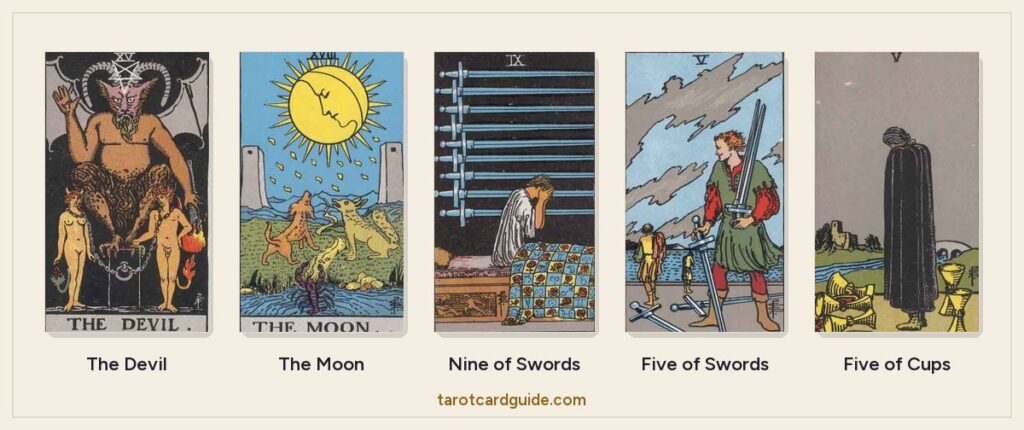
Any card can open a shadow conversation, but some do it more readily than others. Here’s what they tend to point at, with a kinder way to hold each one.
| Card | What it may point to | A kinder reading |
|---|---|---|
| The Devil | Attachments, cravings, control, the things you say you can’t stop | The chains are loose. Seeing them is the first step. |
| The Moon | Fears, illusions, the stories you tell yourself in the dark | Not everything you fear is real. Go slowly until the picture clears. |
| Nine of Swords | Anxiety, guilt, the thoughts that keep you awake | The swords hang on the wall. They never touch the sleeper. |
| Five of Swords | Pride, winning at all costs, or being the one who walks away hurt | Notice which figure you are, then ask if the fight is worth it. |
| Seven of Swords | Secrets, self-deception, getting away with things | What are you not quite telling yourself? |
| Five of Cups | Regret, grief, fixing on what went wrong | Two cups are still standing behind you. |
| Four of Cups | Apathy, withdrawal, turning down what’s offered | A hand is holding out a cup you haven’t noticed yet. |
| Two of Swords | Avoidance, the blindfold, refusing to look | She can lower the swords whenever she chooses. |
Reversed court cards
Court cards are people, which makes them handy mirrors. Reversed, they often show a trait gone sour or kept under wraps: the Queen of Cups reversed who absorbs everyone’s moods and forgets their own needs, the King of Wands reversed whose confidence has tipped into control, the Knight of Swords reversed who argues first and thinks later. Ask whether it’s someone you know, someone you fear becoming, or someone you won’t let yourself be. The guide to reading court cards covers each angle.
Reading hard cards without catastrophising
A difficult card describes a pattern, not a verdict. The Devil doesn’t say you’re a bad person. It says something has a hold on you, and if you look at the imagery on The Devil, the chains around the two figures’ necks hang loose enough to lift off. The Nine of Swords shows someone awake in the dark, yet the swords never touch them.
A useful habit: for every hard card, also ask, “What’s the smallest kind thing I could do about this?” That keeps the reading moving instead of spiralling.
A Five-Card Shadow Work Spread
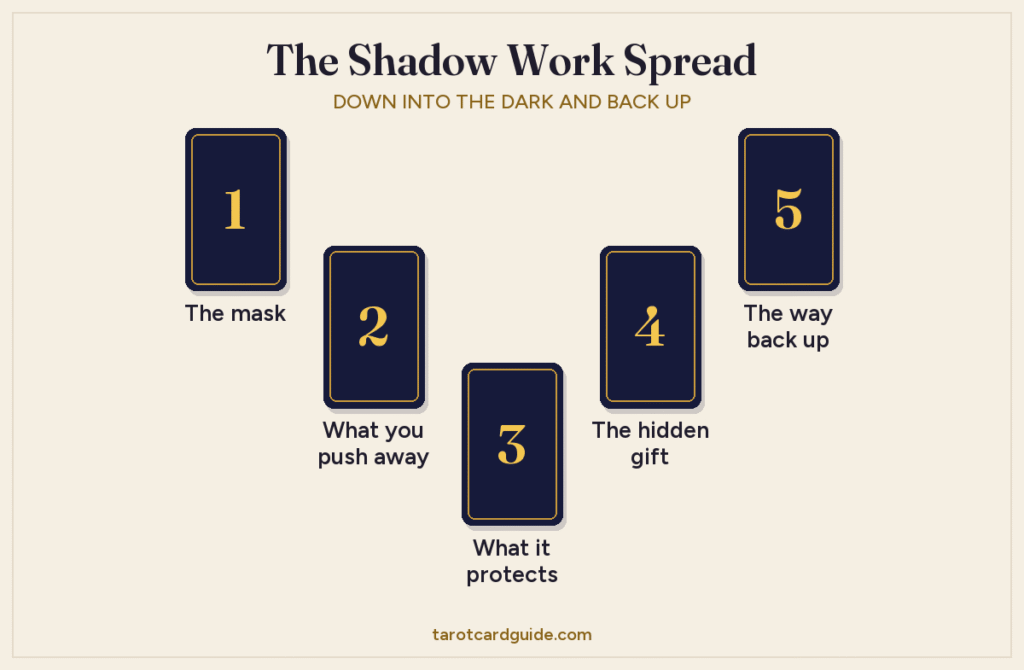
This spread goes down and comes back up, like carrying a lantern into the cellar and climbing the stairs again. Lay five cards in a V: two stepping down on the left, one at the bottom, two climbing back up on the right. Hold one theme in mind as you shuffle, such as “why does criticism floor me?” or “what am I avoiding about money?”
- The mask: the side of you that you show the world, especially around this theme.
- What you push away: the trait, feeling or wish you’d rather not own.
- What it protects: why that part of you went underground, or what it has been keeping safe.
- The hidden gift: what that energy could offer if you stopped fighting it.
- The way back up: one small, kind step to bring it into the light.
How to read the positions
Card 1 is usually easy to recognise, which is deliberate. Card 2 is the heart of the spread. If it’s a card you dislike, good. Your dislike is data.
Card 3 asks for compassion. Most shadow traits went into hiding for a reason that made sense at the time, like a child who learned that anger made things worse at home. Ask “what was this part of me trying to do?”, not “what’s wrong with me?”
Card 4 turns the reading round. Even The Devil carries something useful: appetite, pleasure, the plain honesty of wanting things. Card 5 should be practical and small. If it’s a big Major Arcana card, shrink it: what would Strength look like for ten minutes on a Tuesday?
A Three-Card Trigger Spread
Use this one when someone gets under your skin and you can’t work out why. Picture the person and the moment clearly, then draw three cards in a row:
- What they did: the behaviour that stung, as the cards see it.
- What it touched in me: the old feeling or disowned trait it poked.
- What I can take back: the part that’s mine to own, heal or allow myself.
Say someone is furious that a friend cancelled plans at the last minute, again, and draws the Four of Cups, the Five of Cups and The Hermit. The friend’s withdrawal (the Four) pokes an old grief about being left out (the Five). The Hermit in the last spot hints that the reader may crave solitude too, and resent the friend for taking what they won’t allow themselves.
That doesn’t make the friend’s behaviour fine, but it makes the anger easier to understand. No deck to hand? The free three-card reading works; just use these positions instead of past, present and future.
A Worked Example
Imagine someone who is everyone’s reliable helper at work. They’re quietly seething at a colleague who talks up their own work in every meeting. They lay the five-card spread with the theme “why does this person bother me so much?” and draw:
- The mask: Queen of Pentacles. Capable, caring, holding everything together. No surprise there.
- What you push away: Six of Wands. A rider in a laurel wreath, cheered by the crowd. The wish to be seen and praised.
- What it protects: Nine of Swords. The worry that wanting credit would make them arrogant or unlikeable.
- The hidden gift: The Sun. Warmth, visibility and the confidence to be seen without apology.
- The way back up: Three of Pentacles. Skilled work recognised within a team, where everyone’s part is named.
Read together, the colleague looks less like a villain and more like a mirror. The helper has disowned a healthy wish for recognition (a golden shadow), and the Nine of Swords shows the fear keeping it locked away. The Three of Pentacles suggests a concrete step: in the next meeting, say plainly what they contributed.
Notice that the reading doesn’t call the helper secretly vain. It points to one feeling worth owning and one small action, which is what a good shadow reading does.
27 Shadow Work Journal Prompts
Pick one prompt per session, or draw a card and use its group. Write fast and don’t edit. The first answer is usually the honest one.
The Devil: attachment and desire
- What do I keep going back to, even though I say I want to stop?
- Where have I told myself I have no choice, when the chains are actually loose?
- What pleasure do I feel guilty about, and who taught me to feel that way?
- If I admitted what I really want, what would have to change?
The Moon and the Nine of Swords: fear
- Which fear feels biggest at night and smallest in daylight?
- What story about myself have I never checked against the facts?
- What do I feel guilty about, and is it actually mine to carry?
- If a friend described this worry to me, what would I tell them?
- What am I avoiding looking at by staying busy?
The Five and Seven of Swords: conflict and honesty
- In my last argument, was I trying to be right or trying to be understood?
- When did I last win something and lose something else in the process?
- What am I not quite telling the people closest to me?
- Where do I let myself off the hook in a way I’d never allow someone else?
- What secret would feel lighter if I said it out loud to one safe person?
The Five and Four of Cups: grief and withdrawal
- What loss have I stared at for so long that I can’t see what’s still standing?
- What am I refusing because accepting it would mean admitting I need it?
- Who or what have I stopped showing up for, and why?
- What would I have to feel if I stopped feeling bored?
Reversed court cards: the people in you
- Which reversed court card describes me on my worst day?
- Who in my life irritates me most, and which of their qualities do I share?
- Which trait was I praised for as a child, and which one did I learn to hide?
- What kind of person do I secretly hope I’m not?
The Sun and the Six of Wands: the golden shadow
- Whose success do I admire so much that it stings?
- What would I do if I weren’t afraid of looking like a show-off?
- Which compliment do I always brush aside?
- What part of me did I tone down to be liked?
- If I let myself shine for one ordinary day, what would I do first?
How to Close a Session
Shadow readings can leave a residue, and a simple routine tells your brain the session is over.
- Write one sentence. What did you notice, in plain words? A note, not a conclusion.
- Finish on a chosen card. Some readers deliberately pick The Star or Temperance out of the deck and leave it face up for a minute. It isn’t a draw, it’s a full stop.
- Shuffle the spread back in. The cards are just cards again.
- Move your body. Stretch, drink some water, eat, open a window.
- Leave it alone. Don’t reread your notes at 2am. Look again in a few days, once the feelings have settled.
The next morning, a light pull from the card of the day makes a nice check-in. If one card keeps turning up across several sessions, the guide to pulling the same tarot card again and again may help you work out why.
Shadow Work in the Dark Half of the Year
There’s a reason shadow work gets popular every October. In the northern hemisphere the nights are drawing in, and Samhain, the Gaelic festival from sunset on 31 October to 1 November, marks the start of the darker half of the year. Many modern witches treat it as a time for reckoning and letting go. In the southern hemisphere it’s spring, and many readers there keep Samhain around 1 May instead.

The season’s cards suit this work: Death for endings that make room, The Hermit for turning inward, The Hanged Man for seeing yourself from a new angle. Try the Samhain tarot spread first, then lay the shadow work spread a few days later, taking the Samhain spread’s “what to release” card as your theme.
Shadow Work Tarot FAQs
Is shadow work with tarot safe?
For most people, gentle shadow work with tarot is a reflective exercise, much like journaling. Go slowly, ground yourself afterwards and stop if you feel overwhelmed. If you’re dealing with trauma or a mental health condition, work with a qualified therapist rather than alone with the cards.
What is the best tarot card for shadow work?
The Devil is the classic shadow card. Upright it shows what has a grip on you, and reversed it often means facing the shadow and breaking free. The Moon comes a close second for fears and self-deception.
Can beginners do shadow work with tarot?
Yes. You don’t need to know every card meaning, because your reaction to the picture is the material. Start with a one-card spread and a single prompt, or the three-card trigger spread, before trying all five positions.
What if my shadow work reading is all positive cards?
Look at your reaction. If The Sun feels irritating or out of reach, that may be your golden shadow talking. And sometimes a bright spread simply means today isn’t the day for digging. That’s allowed.
Do reversed cards mean shadow in a reading?
Not automatically. A reversal can show blocked or hidden energy, which often overlaps with the shadow, but it can also mean a delay or a softer version of the card. The guide to reversed tarot cards explains the options.