The Suit of Swords: Truth, Thought and the Courage to Face Things
The Cups feel, the Wands act and the Pentacles build. The Swords think. This is the suit of the mind: your ideas, your words, your decisions, and the stories you tell yourself at 3 a.m. when you can’t sleep.
Swords have a reputation as the “scary” suit, and it’s easy to see why. Heartbreak, conflict, anxiety and painful endings all live here. But a sword is also a tool for cutting through confusion. At their best, the Swords bring clarity, honesty and the courage to face what’s real.
This page goes deep on the Swords alone: all 14 cards at a glance, the story the numbered cards tell from Ace to Ten, the four court cards as people, and what the suit means in love, at work and as a yes or no answer. For how the four suits and the numbers work across the whole deck, start with the Minor Arcana guide.
- All 14 Swords cards at a glance
- The story of the Swords, Ace to Ten
- The court cards as people
- Swords in love, career and money and yes or no
- A reading full of Swords, or none at all
- Reversed Swords and FAQ
Swords = Air = The Mind
Each tarot suit is linked to an element, and Swords belong to air. Air is invisible but powerful: it can be a fresh breeze that clears your head, or a storm that knocks everything over.
In a reading, that airy energy covers:
- Thoughts and beliefs: how you see a situation, and the assumptions shaping it
- Communication: conversations, arguments, contracts and the truth coming out
- Decisions: weighing options, making a clean cut, or avoiding a choice altogether
- Conflict: disagreements, competition and power struggles
- Mental health: worry, stress and overthinking, but also rest and recovery
The Swords belong to the three air signs, Gemini, Libra and Aquarius (zodiac tarot cards gives the card for every sign), and in an ordinary pack of playing cards they became spades.
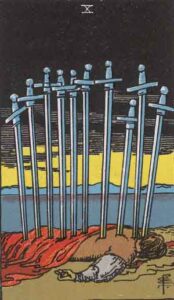
In the Rider-Waite-Smith deck, it helps to watch the weather. There is a pale sky over the Ace, rain on the Three, torn clouds above the Five and a black sky on the Ten, with a band of gold breaking along its horizon. The sky in each picture is a quick read of the card’s mood, and the Ten’s dawn is the suit’s last word.
Suit of Swords Meanings: All 14 Cards at a Glance
Each card’s upright and reversed keywords and its yes or no answer, taken from the card’s own page. Tap a name for the full meaning, including love, career, feelings and advice.
| Card and yes or no | Upright keywords | Reversed keywords |
|---|---|---|
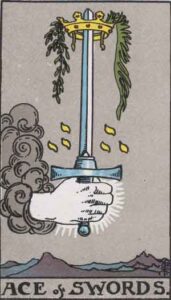
| Ace of Swords Yes | clarity, truth, breakthrough, new ideas, clear communication, mental focus | confusion, mental fog, miscommunication, hidden truth, rash decisions |
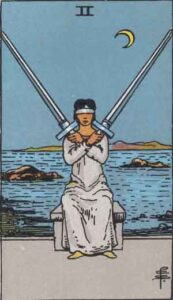
| Two of Swords Maybe | indecision, stalemate, difficult choices, avoidance, inner conflict | information overload, truth revealed, forced decisions, anxiety, the stalemate breaking |
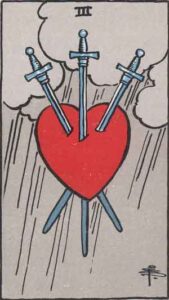
| Three of Swords No | heartbreak, sorrow, grief, emotional pain, painful truth, betrayal | healing, forgiveness, releasing grief, suppressed pain, making peace with the past |
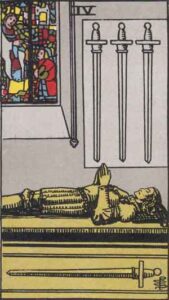
| Four of Swords Maybe | rest, recovery, reflection, retreat, mental peace | burnout, restlessness, forced rest, resisting a break, returning to action |
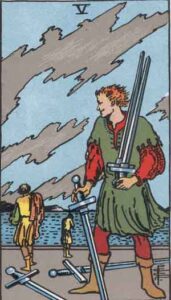
| Five of Swords No | conflict, ego, hollow victory, tension, power struggles, winning at all costs | reconciliation, walking away, regret, lingering resentment, compromise |
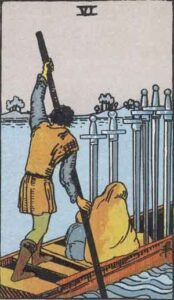
| Six of Swords Yes | transition, moving on, healing, calmer waters, travel, leaving difficulty behind | resistance to change, emotional baggage, stuck in transition, unfinished business, delayed recovery |
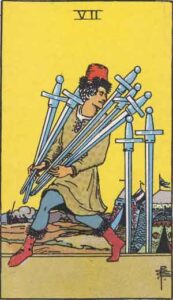
| Seven of Swords No | deception, strategy, secrecy, cleverness, acting alone | truth revealed, coming clean, self-deception, getting caught, a change of heart |
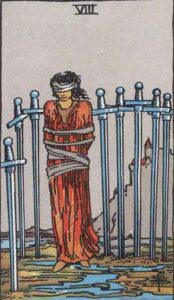
| Eight of Swords No | feeling trapped, self-doubt, restriction, fear, paralysis, limiting beliefs | release, new perspective, self-acceptance, taking back control, denial |
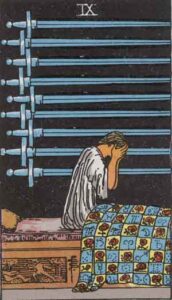
| Nine of Swords No | anxiety, worry, sleepless nights, guilt, fear, overthinking | recovery, hope returning, reaching out, hidden distress, fears easing |
| Ten of Swords No | painful ending, rock bottom, betrayal, defeat, exhaustion, the end of a cycle | recovery, survival, resisting an ending, rising again, breaking a cycle |
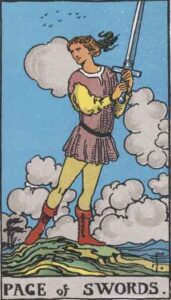
| Page of Swords Maybe | curiosity, new ideas, communication, vigilance, mental agility, seeking the truth | gossip, hasty words, scattered thinking, defensiveness, all talk |
| Knight of Swords Yes | ambition, fast action, determination, directness, bold moves, speaking up | recklessness, impatience, harsh words, scattered energy, burnout |
| Queen of Swords Yes | clarity, independence, honesty, direct communication, boundaries, wisdom from experience | coldness, harsh judgement, bitterness, cutting words, guardedness |
| King of Swords Yes | authority, truth, logic, clear thinking, ethical leadership, expert advice | manipulation, abuse of power, coldness, rigid thinking, poor judgement |
The Story of the Swords, Ace to Ten
Read in order, the ten numbered Swords follow a single mind from its first clear idea to the moment it hits the bottom, and then points to the dawn. It is the most uncomfortable story in the tarot, and one of the most honest about how thinking can both free you and trap you.
Ace to Three: the truth arrives
- Ace of Swords: a breakthrough. A new idea, a moment of clarity or the truth finally cutting through.
- Two of Swords: stalemate. A difficult choice you’ve been avoiding, or two sides that won’t budge.
- Three of Swords: heartbreak. Painful truths, grief and emotional hurt.
The suit opens with a gift: a clear mind and the truth. But the truth has consequences. The Two holds it off with a blindfold, and the Three shows what happens when it lands anyway. Clarity is not always comfortable.
Four to Six: rest, conflict and moving on
- Four of Swords: rest. A pause to recover, reflect and recharge before the next step.
- Five of Swords: conflict. Arguments, ego clashes and wins that cost more than they’re worth.
- Six of Swords: moving on. Leaving troubled waters for calmer ones, even if it feels sad.
After the hurt comes a pause, then a fight about it, then a crossing to calmer water. The middle of the suit is about what you do with a painful truth: rest and process it, argue with it, or carry it with you and keep going. The Six doesn’t leave the swords behind, but it gets them to the other shore.
Seven to Ten: the mind turns on itself
- Seven of Swords: strategy or deception. Acting alone, keeping secrets, or someone not being straight with you.
- Eight of Swords: feeling trapped. Restrictions that are often more in your head than in the world.
- Nine of Swords: anxiety. Worry, guilt and sleepless nights, where fear feels bigger than reality.
- Ten of Swords: rock bottom. A painful ending, with the reassurance that it can’t get worse and dawn is coming.
The last four cards are the hardest, and they have something in common: the danger is increasingly inside the head. The Seven schemes, the Eight believes it can’t move (though its feet are free), and the Nine lies awake with swords that never actually touch it. The Ten is the end of that road. Once there is nothing left to fear, the fear loses its grip, and a new cycle, a new Ace, can begin.
That arc is the key to reading the suit. When a hard Sword turns up, ask where in the story you are. The Nine and the Ten are not the same message: one says the fear is bigger than the facts, the other says the ending has already happened and it is time to get up.
The Court of Swords: Thinkers, Talkers and Truth-Tellers
The Swords court cards can describe people in your life or sides of yourself (our guide to reading the court cards explains how to tell which). All four share a sharp mind, but they use it in different ways:
- Page of Swords: the curious one. Alert, inquisitive and full of questions, sometimes a little too keen to know everyone’s business. As a person: a student, a researcher, the friend who reads everything before forming a view.
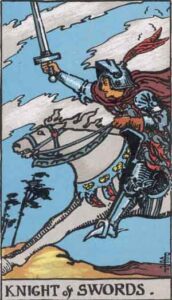
- Knight of Swords: the charger. Fast, direct and determined, but can rush in without thinking about who gets hurt. As a person: the debater, the campaigner, the one who says what everyone else is thinking.
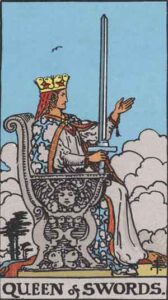
- Queen of Swords: the clear-sighted one. Perceptive, independent and honest, with firm boundaries and no patience for nonsense. As a person: someone shaped by experience who tells you the truth kindly but plainly.
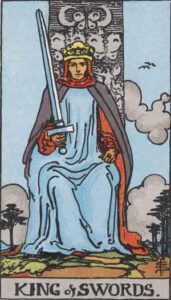
- King of Swords: the judge. Logical, fair and principled, he leads with reason and makes decisions others can trust. As a person: an expert or authority whose word carries weight, such as a lawyer, doctor or manager.
Together they show the mind maturing: from curiosity (Page), to action (Knight), to insight (Queen), to wise authority (King). When a Swords court card appears as advice rather than as a person, it tells you how to use your head in the situation: ask questions, speak up, set a boundary or make the fair call.
The Suit of Swords in Love
In relationships, Swords are about communication and honesty. They can point to difficult conversations, arguments or heartbreak, but also to the clarity that comes from finally saying what needs to be said, or setting a boundary.
- The hopeful Swords: the Ace brings an honest conversation or a meeting of minds, the Six shows healing after a hard time, and the Page and Knight describe attraction that starts with talk, wit and curiosity.
- The hard ones: the Three (heartbreak), the Five (fights and point-scoring), the Seven (secrets), the Nine (worry and fear of loss) and the Ten (a definite ending).
- The in-between: the Two and Four show avoidance or a need for space, and the Queen and King show commitment built on respect and clear standards, sometimes with some emotional reserve.
A hard Sword in a love reading is rarely proof of anything on its own. The Seven can point to a secret, or just as easily to someone keeping their feelings to themselves, so read it alongside the other cards and what you actually know. For every card’s love meaning in one place, see Swords love meanings, and if you are working through a breakup, the broken heart spread was written for exactly that.
The Suit of Swords in Career and Money
At work, Swords highlight strategy, negotiation, problem-solving and competition. They favour clear thinking and good communication, and warn against office politics, burnout from overthinking, or decisions made in a panic.
The Ace is strong for pitching an idea, the Knight for deadlines and negotiations, the Page for study and research, and the Queen and King for law, analysis, writing and leadership. The warnings: the Five for power struggles, the Seven for underhand tactics, the Nine for stress that follows you home and the Ten for a job or project that has run its course.
Swords rarely talk about money directly; that’s the Pentacles’ job. When they turn up in a money question, they usually point to the thinking around it: a contract to read carefully, a negotiation, a financial decision you have been putting off, or worry that is bigger than the numbers. The Swords career and money meanings give every card’s reading side by side.
Swords as a Yes or No Answer
Of the 14 Swords cards, 5 lean yes (the Ace, Six, Knight, Queen and King), 3 are a maybe (the Two, Four and Page) and 6 lean no (the Three, Five, Seven, Eight, Nine and Ten).
That makes the Swords the only suit with more no cards than yes cards. Even so, the pattern is easy to read. The Swords say yes when the answer depends on facts, honesty and a clear decision, and no when it depends on avoiding a truth, winning a fight or hoping nobody looks too closely. The maybes (the Two, Four and Page) all ask for the same thing: more information, or a decision you haven’t made yet. The free yes or no tarot reading draws a single card for your question, and its Swords yes or no table gives the reasoning card by card.
When a Reading Is Full of Swords
Lots of Swords in a reading usually means the heart of the matter is mental: a decision to make, a conversation to have, or a way of thinking that needs to change. Even when the question is about love or money, the Swords point to beliefs, communication and honesty.
What counts as “lots”? The Swords are 14 of the 78 cards, so in a ten-card Celtic Cross you would expect one or two. Four or more happens in only about one reading in fourteen. In a three-card reading, two Swords or more turns up about one time in twelve. Either is worth noticing.
Upright, they often bring clarity, truth and decisive action, though sometimes that truth hurts. The other cards around them sharpen the message:
- Swords with Cups: head against heart. What you think and what you feel are pulling in different directions.
- Swords with Wands: quick decisions and quick tempers. Words may fly faster than thought.
- Swords with Pentacles: contracts, plans and practical decisions, or work stress showing up in the body.
- Swords with Major Arcana: a decision with lasting consequences. Look especially at Justice, the Major that most echoes the Swords’ theme of truth and fair judgement.
Don’t panic if the Swords look grim. These cards rarely predict disaster. More often they show what you are afraid of, so you can see it clearly and deal with it. Tarot card combinations shows how pairs of cards change each other’s meaning.
When there are no Swords at all
A reading with no Swords (quite common in a short spread, and about one Celtic Cross in eight) suggests the answer isn’t mainly a matter of thinking it through. Feelings, action or practical steps may matter more than analysis. It can also be a gentle hint about overthinking. Imagine someone who has spent weeks making lists of pros and cons about a move and then draws only Cups and Wands: the cards may be saying the decision is already made in their heart, and more thinking won’t change it.
Reversed Swords
Reversed Swords tend to go one of two ways, and knowing which is half the work:
- The hard cards ease. Reversed, the Three, Five, Eight, Nine and Ten usually point to recovery: healing after heartbreak, walking away from a fight, the blindfold coming off, fears easing, getting back up. The pain is still there, but it is on its way out.
- The clear cards cloud over or turn sharp. Reversed, the Ace, Page, Knight, Queen and King show the mind misfiring: confusion and miscommunication, gossip, rash words, coldness or rigid, controlling thinking.
In between, a reversed Two means the stalemate is breaking, a reversed Four warns of burnout, a reversed Six is stuck halfway across and a reversed Seven means the secret is coming out. Reversals are optional, so if you don’t use them, read the reversed keywords in the table above as the shadow side a card can show upright in a difficult position.
Swords and Wellbeing
As the suit of the mind, Swords often reflect stress and anxiety. The Four of Swords is a reminder to rest; the Nine suggests worry is taking over. Tarot can help you name what you’re feeling, but it isn’t a substitute for support: if worry is affecting your sleep or your days, talk to your doctor, and if you ever feel unsafe, contact emergency services or a crisis line straight away, such as Samaritans on 116 123 in the UK and Ireland, or 988 in the US.
Suit of Swords: Frequently Asked Questions
What does the Suit of Swords represent in tarot?
The Swords are the suit of air and the mind. They cover thoughts, beliefs, communication, decisions, conflict and truth. In a reading they show how you are thinking about a situation and what needs to be said or decided.
Are the Swords a bad suit?
No, though they are the most challenging suit. They hold some of the hardest cards in the deck, such as the Three, Nine and Ten, but also its clearest thinking, and their hard cards usually describe fears and truths you can deal with, not disasters.
What is the most positive card in the Suit of Swords?
The Ace of Swords, a breakthrough of clarity and truth, is usually read as the most positive. The Six of Swords (moving towards calmer waters) and the Queen and King of Swords (honesty and fair judgement) are also hopeful cards.
What do the Swords mean in a love reading?
They point to communication: honest conversations, arguments, boundaries and the truth coming out. Several Swords in a love reading suggest the relationship needs a clear talk more than a grand gesture. The Three and Ten are the hardest love cards in the suit; the Ace and Six are the most hopeful.
Which zodiac signs go with the Suit of Swords?
The three air signs: Gemini, Libra and Aquarius. Each sign also has its own Major Arcana card (The Lovers, Justice and The Star), listed in zodiac tarot cards.
Final Thoughts: Cut Through the Noise
The Suit of Swords asks you to look at what you’d rather avoid. But clarity is a gift: once you can see a situation as it really is, you can decide what to do about it. Your thoughts are powerful. Use them wisely, speak honestly, and don’t believe every scary story your mind tells you at 3 a.m.
Explore the other suits: the Suit of Cups, the Suit of Wands and the Suit of Pentacles, or start with the Major Arcana. For every card in the deck on one page, see tarot card meanings.