- Upright fairness, truth, accountability, cause and effect, balance, legal matters
- Reversed injustice, dishonesty, avoiding responsibility, bias, imbalance
- Arcana Major Arcana, card XI
- Element Air
- Astrology Libra
- Yes or no Yes
Justice is the card of truth, fairness and cause and effect. It represents the idea that actions have consequences, and that honesty should guide your decisions. When Justice appears, you are being asked to look at a situation clearly and make choices rooted in the truth, even when the truth is uncomfortable.
It is card XI of the Major Arcana. Justice is often mistaken for a cold or punishing card, but it isn’t about punishment. It is about balance being restored. It covers legal matters, contracts and official decisions, and just as often it describes moral accountability: owning your part, treating people fairly and living in line with what you believe.
- Symbolism
- Upright
- Reversed
- Love
- Career
- Spirituality
- Legal matters
- Astrology and numerology
- Yes or no
- Feelings
- Advice
- As a person
- Combinations
- Past, present, future
- FAQ
Justice Symbolism
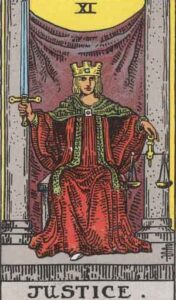
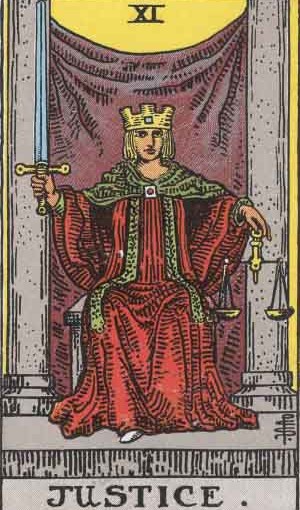
In the Rider-Waite-Smith deck, a crowned figure in a red robe and green cloak sits on a stone throne between two grey pillars, with a purple veil hanging behind. She looks straight ahead, holding a sword upright in her right hand and a pair of scales in her left.
The scales
The scales stand for balance, fairness and the careful weighing of evidence. Every situation has more than one side, and Justice asks you to look at all of them before deciding.
The sword
The double-edged sword points straight up. It represents clarity, decisive action and the truth that cuts through excuses. Its two edges are a reminder that every decision cuts both ways: choices have consequences for everyone involved, including you.
The open eyes
Unlike the familiar Lady Justice statues, the Justice of the Rider-Waite-Smith deck wears no blindfold. She sees clearly and looks you in the eye. That is the heart of this card: justice here is clear-sighted, and it asks you to see clearly too.
The pillars and the veil
The two pillars echo those of The High Priestess and suggest the structure of law and order. The veil behind them hints that there is always more to a situation than the surface, and that the full truth may still be coming to light.
Justice Upright Meaning
Upright, Justice represents fair outcomes, legal matters, contracts and ethical decisions. You may be seeking clarity, facing an important choice or dealing with the consequences of past actions. The card reminds you that what you put into the world tends to come back to you.
It also invites honesty with yourself. Are you acting with integrity? Are you seeing both sides, or only the one that suits you? Justice asks you to step outside your bias and decide based on the facts and on what is right, not only on what is easy.
When Justice appears, a situation is often being settled. Past efforts may be recognised, a dispute resolved or a truth brought into the open. Imagine someone who has worked diligently and honestly while a colleague took the credit. Justice would suggest the record is about to be set straight.
Key upright themes
- Legal outcomes, contracts and official decisions
- Fairness and objective thinking
- Cause and effect, and truth coming to light
- Making wise, honest choices
- Accepting responsibility for your actions
Justice Reversed Meaning
Reversed, Justice warns of injustice, dishonesty or imbalance. You may be facing unfair treatment, a biased situation or a decision that doesn’t reflect the facts. It can point to legal delays, disputes or rulings that feel wrong.
The reversal can also turn the question inward. Someone may be avoiding accountability, and it might be you. Blaming others, making excuses or refusing to admit a mistake all fall under this card. It can also show secrets and hidden truths that are likely to surface in time.
For example, imagine a falling-out between friends where each person tells the story with themselves as the wronged party. Reversed Justice would ask both of them the same uncomfortable question: what is the part of this you would rather not look at? Owning that part, even quietly, is often what breaks the stalemate.
On a deeper level, reversed Justice suggests self-deception or an inner imbalance: telling yourself a story that isn’t quite true, or being far harsher on yourself than the situation deserves. The card urges you to take an honest look at the truth. Uncomfortable as that is, clarity is where things start to improve.
Key reversed themes
- Lack of accountability or blaming others
- Dishonesty, secrets or hidden truths
- Legal delays or unfair decisions
- Imbalance in relationships or agreements
- Self-deception or harsh self-judgement
Justice in Love
In love, Justice points to honesty, fairness and clear communication. It favours relationships where both people take responsibility and effort is shared equally. If there has been tension, the card suggests resolving it through open conversation and a genuine effort to see each other’s side.
If you are single
Justice suggests looking honestly at your past relationships and your part in how they unfolded. What patterns do you want to leave behind? It favours a partner who treats you as an equal, and it asks you to be clear about your standards. It can also point to meeting someone through work, law or a shared sense of principle.
If you are in a relationship
The card may point to a relationship finding its balance again, or to a formal commitment such as marriage, a civil partnership or a shared legal agreement like a mortgage. It asks both partners to be accountable for their roles and to make decisions together fairly. For couples going through a separation, it can suggest a fair settlement.
Reversed in love
Reversed, it may reveal secrets, inequality or a partner who isn’t holding up their end emotionally or practically. One person may be doing all the giving, or one may refuse to take responsibility for their behaviour. It can also show an unfair or difficult separation. Honest conversations, and honesty with yourself about what you are accepting, are the way forward.
Justice in Career and Money
Professionally, Justice says that truth and integrity come first. Contracts, negotiations, HR matters or legal questions may come into focus. Read the small print, keep records and make sure you are acting ethically and not cutting corners.
Upright, it points to fair treatment. Hard work may be recognised, a dispute resolved in a balanced way or a decision made on merit. It can also favour careers in law, mediation, public service or any role built on fairness and good judgement.
If you are negotiating a salary, a freelance rate or the terms of a new role, Justice supports asking for what is genuinely fair. Know your worth, back it up with evidence and be willing to meet the other side reasonably. Agreements made openly now will save disputes later.
With money, Justice asks for balance and honesty: settling debts, dividing shared costs fairly and making decisions based on the numbers rather than hopes or fears. A financial agreement or settlement is likely to be even-handed.
Reversed, it can indicate bias, workplace injustice or a lack of recognition. You may feel you have been treated unfairly, or there may be dishonesty around money or contracts. Stand firm in your principles, gather the facts before acting and seek proper professional advice if a dispute becomes serious.
Justice in Spirituality
Spiritually, Justice is about living in line with your values. It asks whether your beliefs match your actions, and whether you treat others with the fairness you would want for yourself. It invites deep self-honesty and a fresh look at the lessons that keep repeating in your life.
Justice can be a helpful card for shadow work. Useful questions to journal on include: where am I avoiding responsibility? Where am I not being honest with myself or others? Am I being fair, including to myself? Uncomfortable answers are often the most freeing ones.
Reversed, it may point to spiritual bypassing: using positive thinking or spiritual ideas to avoid difficult truths. Don’t skip the work. Clarity brings relief.
Justice in Legal Matters
Justice is the card most associated with legal questions: court cases, contracts, settlements, disputes, custody arrangements and official paperwork. Upright, it points to a fair, transparent process and an outcome that reflects the facts. That usually favours whoever has acted honestly, though it will not necessarily favour you if you haven’t.
Reversed, it can suggest delays, complications, bias or an unfair ruling. It may also warn that something important is being hidden, or that details in a contract need a closer look.
Whatever the card shows, tarot is a tool for reflection, not legal advice. For any legal matter, speak to a qualified solicitor or adviser, keep good records and read everything carefully before you sign.
Justice Astrology and Numerology
Libra and the element of Air
Justice is linked to Libra, the sign of the scales, which values balance, harmony, fairness and partnership. Libra is ruled by Venus, which softens the card: this is fairness with compassion in it, not cold logic alone. Libra’s shadow side, indecision and people-pleasing, also shows up in the card’s reversed meanings.
Air is the element of thought, communication and clarity. Where fire acts on passion and water on feeling, air steps back to weigh the facts. Justice asks you to do the same.
The number eleven and the numbering swap
As card XI, Justice carries the energy of eleven: two ones standing side by side, a picture of balance between opposites. In older decks such as the Tarot de Marseille, Justice is card VIII and Strength is XI. A. E. Waite swapped them for the Rider-Waite-Smith deck so the order would match the Golden Dawn’s astrology, with Leo (Strength) before Libra (Justice).
Is Justice a Yes or No Card?
Yes. Justice is a yes, as long as the situation is fair and you have acted honestly. The outcome will reflect the truth.
Justice is a conditional yes. If you have done the work and dealt fairly, the answer is likely to go your way. If there is dishonesty or imbalance involved, expect the result to reflect that instead.
Reversed, the answer leans towards no, or a yes that rests on shaky, unfair or dishonest foundations. Look closely at the facts before you move forward.
Have a question of your own? Try the free yes or no tarot reading: hold the question in mind and draw one card.
Justice as Feelings
As feelings, Justice suggests the person you are asking about is weighing things up carefully. Their feelings are likely genuine but thoughtful rather than impulsive. They want the relationship to be fair and balanced, and they may be thinking seriously about what a commitment would mean.
They may respect you deeply and value honesty above grand gestures. If there has been conflict between you, they may want to set things right.
Reversed, their feelings may be clouded by resentment, a sense of unfairness or guilt. They may be holding something back, or feel the relationship is one-sided. There may be things left unsaid on either side.
Justice as Advice
As advice, Justice says: be honest and act fairly. Look at the facts, consider every side and make the decision you could stand behind if everyone could see your reasons.
Take responsibility for your part, including mistakes, and put right what you can. Then let go of what isn’t yours to carry. Justice isn’t about beating yourself up. It is about bringing your actions, your words and your values back into line.
If a decision feels muddled, try writing the facts on one side of a page and your feelings on the other. Both matter, but Justice asks you to be clear about which is which before you choose.
Justice as a Person
As a person, Justice is someone who cares about what is fair and says so. It can describe a lawyer, mediator, auditor, manager or teacher, but also the friend who always hears both sides before taking one, or the colleague who points out that a decision has been made on the wrong grounds. They are clear-thinking, consistent and hard to flatter.
In your life, this person may be the one who holds you accountable, settles a dispute or gives you an honest assessment you did not want but needed. They keep their word and expect others to keep theirs. In love, they want a partnership that feels balanced. Their shadow side is a tendency to judge quickly and to find it hard to forgive once someone has crossed a line.
Reversed, Justice as a person has lost their balance. It can describe someone who is biased, who bends the truth when it suits them or who avoids responsibility for their own part. It may also be someone who feels they have been treated unfairly and cannot move past it.
Justice Tarot Combinations
Justice weighs the facts, and the card beside it shows what is on the scales and how honestly it is being judged:
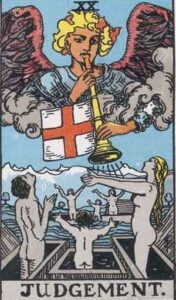
- Judgement: accountability. A decision, review or legal matter reaching its conclusion, leaning towards a fair outcome if you have been honest. For anything legal, take proper advice rather than relying on the cards (more on this pair).
- Two of Swords: a decision you have been avoiding. Justice asks you to take off the blindfold, look at the facts and choose.
- Ace of Swords: the truth comes out clearly. A moment of clarity cuts through confusion and makes the fair course obvious.
- King of Swords: expert, impartial judgement. The pair often points to a professional whose advice is worth seeking.
- The Lovers: a choice made on principle. In love, it describes a partnership of equals, or a commitment weighed carefully before it is made.
- Seven of Swords: dishonesty catching up with someone. What was hidden is likely to be found out, and consequences follow.
More pairs, with a step-by-step method for reading two cards together, are in the tarot card combinations guide.
Justice in Past, Present and Future Positions
In the past position
In the past, Justice suggests that earlier decisions or actions are shaping the present. A fair or unfair outcome, a contract or a moment of reckoning set things in motion. It may be time to recognise how that chapter still affects you.
In the present position
In the present, a decision or a truth is in front of you now. You are at a point where clarity matters more than comfort. Gather the facts, be honest about your part and choose fairly.
In the future or outcome position
As a future or outcome card, Justice says the result will be fair, though it may not look exactly as you hoped. It will reflect how you act now. As a challenge card, for example in the Celtic Cross, it can show difficulty accepting the truth or taking responsibility.
Justice: Frequently Asked Questions
What does Justice mean in love?
In love, Justice points to honesty, equal effort and fairness between partners. It can signal a formal commitment, such as marriage, or a relationship finding its balance again. Reversed, it can reveal secrets, inequality or one partner avoiding responsibility for their behaviour.
Is Justice a yes or no card?
Justice is a conditional yes. If the situation is fair and you have acted honestly, the outcome should reflect that. Reversed, it leans towards no, or suggests a result built on dishonesty or imbalance that needs a closer look.
What does Justice mean as feelings?
As feelings, Justice shows someone who is thinking carefully about you and wants a fair, honest relationship. Their feelings are considered rather than impulsive. Reversed, they may feel resentment, guilt or that the relationship is one-sided.
What does Justice reversed mean?
Reversed, Justice points to unfairness, dishonesty, avoiding accountability or a biased outcome. It may also show legal delays or hidden truths. It asks you to face the facts honestly, including your own part, and to seek proper advice where a dispute is involved.
Does Justice mean a court case?
It can. Justice is the card most linked to legal matters, contracts and official decisions, and upright it suggests a fair process. But it often simply means fairness and accountability in everyday life. For any real legal issue, speak to a qualified professional.
Final Thoughts
Justice is a call to live with truth, fairness and integrity. Whether you are facing a decision, a conflict or the consequences of past choices, it asks you to be honest with yourself and with others, and to let clarity rather than emotion guide your next step.
If you are weighing up a decision, the two options spread can help you see both sides clearly. Or explore how Justice fits into the wider story of the Major Arcana.