Tarot timing means reading when something is likely to happen from the cards you draw, usually by treating the suits as seasons or units of time, by using the astrological dates linked to each card, or by noticing whether the cards are fast or slow. It’s also the least reliable thing tarot does, so any date you get is a rough window to check in on, never a deadline.
Plenty of thoughtful readers refuse timing questions altogether, and I understand why. Still, people ask “when?” more than almost anything else, so it’s worth knowing the methods properly: where each one comes from, where it falls down, and what to ask instead when the date isn’t really the point.
Below you’ll find the main methods, each labelled for what it is: one convention among several. There’s also a summary table, an original timing spread with a worked example, and a section on pairing timing with a yes or no reading.
Why Timing Is Tarot’s Weakest Spot
Tarot is good at describing a situation: what’s going on, how you feel about it, what might help. It’s much worse at pinning events to a calendar. There’s no single agreed system, and the systems that exist contradict each other. A Three of Cups can mean three days, three months, summer or the first week of July, depending on whose book you read.
There’s a second problem. Most things people want dated depend on someone else’s choices: a recruiter, an ex, a buyer for the house. Cards can reflect the mood of a situation, but they can’t schedule another person’s inbox.
So why bother? Because an honest timing reading gives you a window to check in on, and often shows that the real question was something else.
Decide your method before you shuffle. If you choose the system after you see the cards, you’ll pick whichever one gives the answer you were hoping for. Write it down first.
Method One: Suits as Seasons
The simplest timing method gives each suit a season. The most common scheme runs like this:
- Wands: spring. Fire, new shoots, things starting to grow.
- Cups: summer. Water, feeling, long evenings with people you love.
- Swords: autumn. Air, clearing out, cooler and sharper thinking.
- Pentacles: winter. Earth, stillness, slow work happening underground.
This version lines up with astrology: the sign that opens each season belongs to that suit’s element. Aries (fire) starts spring, Cancer (water) summer, Libra (air) autumn and Capricorn (earth) winter. It isn’t the only scheme: some readers give Wands to summer because fire feels hot, and Pentacles to autumn for the harvest. Pick one and stay with it. Majors and court cards get no season here; most readers either ignore them or draw a clarifier from the Minors.
If You Live in the Southern Hemisphere
Seasons flip south of the equator, so spring in Buenos Aires or Sydney runs from September to November. Tie the suits to the weather, so Wands is spring wherever you live, or tie them to the zodiac, so Wands is Aries season (late March to April) everywhere, even though that’s autumn for you. Readers genuinely split on this. I’d follow the weather, because the method is built on how a season feels, but choose once and write it down.
Method Two: Suits as Units of Time
Here the suit gives the unit and the card’s number gives the count. A common scheme, from fastest to slowest:
- Wands: days. Fire catches quickly.
- Swords: weeks. Thought is quick, but decisions take a little longer.
- Cups: months. Feelings take their own time.
- Pentacles: years. Earth is the slowest element of all.
So the Three of Cups would be about three months and the Six of Swords about six weeks. Variants are everywhere. Some readers swap Wands and Swords, because air is the quickest element, and some use Cups for weeks. Again, choose one and keep to it.
The numbers carry meaning as well as a count, and our guide to tarot numerology goes through each one. Reading the Ten of Pentacles as “ten years” is less useful than noticing it’s a card about something built to last.
Court cards have no number printed on them. Some readers count Pages as 11, Knights as 12, Queens as 13 and Kings as 14; others read them as people rather than time, which is how our guide to the court cards treats them. Majors usually sit outside this method.
Scale the unit to the question. If you ask about a reply to an email and draw the Nine of Pentacles, nine years is not a sensible answer. Take it as a sign the question isn’t ready to be timed.
Method Three: Decan Dates From the Golden Dawn
This is the most precise method. The Hermetic Order of the Golden Dawn, the Victorian magical society that Arthur Edward Waite and Pamela Colman Smith both belonged to, gave each numbered Minor card from 2 to 10 a decan: a ten-degree slice of a zodiac sign, which works out at roughly ten days of the year. Each of the twelve signs also has a Major Arcana card.
So a numbered card points to a specific window. A few examples, using the dates from our zodiac tarot cards guide:
- Two of Wands: 21 March to 30 March, the first decan of Aries.
- Seven of Pentacles: 10 May to 20 May, the last decan of Taurus.
- Three of Cups: 1 July to 11 July, the middle decan of Cancer.
- Four of Swords: 13 October to 22 October, the last decan of Libra.
- Eight of Wands: 22 November to 1 December, the first decan of Sagittarius.
A zodiac Major points to the whole sign. The Chariot is Cancer (21 June to 22 July), Temperance is Sagittarius (22 November to 21 December) and The Star is Aquarius (20 January to 18 February). The planetary Majors, such as The Magician for Mercury, don’t give a date. Neither do the Aces, which the Golden Dawn treated as the root of each element rather than a slice of the year. Some systems give the court cards a span of the zodiac too, but they disagree with each other, so I’d leave them out.
What I like about decans is that they’re fixed: the Eight of Wands means the same ten days to everyone, in either hemisphere, so there’s less room to fudge. What I don’t like is the false precision. Read a decan as “around then”, and remember the next one might be eleven months away.
Method Four: Fast Cards, Slow Cards and Aces
You don’t need a system to feel the pace of a spread. Some cards are all movement; others are all waiting. If you only learn one timing method, honestly, make it this one, because it works with what the cards already mean.
The Fast Cards
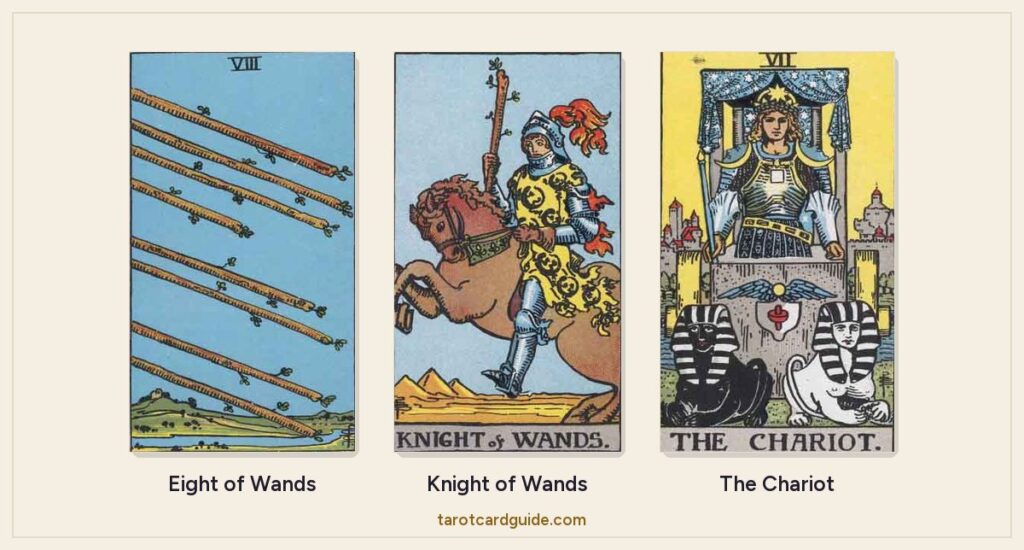
- Eight of Wands. Eight flowering staffs fly through a clear sky, angled down as if coming in to land. News, replies, travel, several things arriving at once.
- Knight of Wands. A rider on a rearing horse, the plumes on his helmet streaming like flames. Sudden, impulsive action: fast, though he may not know where he’s heading.
- The Chariot. Forward motion driven by will. Things move because someone decides they will, so this is less luck and more push.
The Slow Cards
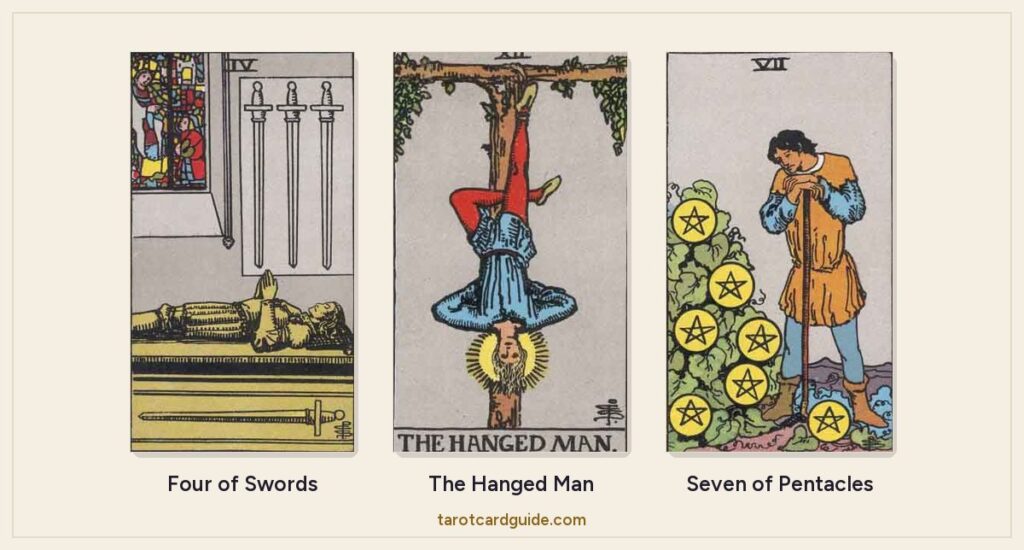
- Four of Swords. A knight’s effigy lies on a tomb, hands together in prayer. Rest, recovery and a deliberate pause: nothing moves until someone has recharged.
- The Hanged Man. He hangs upside down by one foot, calm, with a halo round his head. Suspension, the kind of waiting that changes how you see things. It can’t be hurried.
- Seven of Pentacles. A young man leans on his hoe and looks at a bush heavy with coins. The growth is real, but the harvest isn’t ready. Think months, not days.
Other cards set the pace too. Wheel of Fortune says the timing is out of your hands and turning anyway. The Tower is sudden, which isn’t the same as soon. Many readers also treat reversals as delays, and our guide to reading reversed cards covers that approach and the alternatives.
Aces: Something Is Starting
Every Ace shows a hand coming out of a cloud, offering a gift. In timing terms, an Ace says the thing is beginning now, or has already begun without you noticing. The Ace of Wands is a spark you can act on, the Ace of Cups a feeling opening up, the Ace of Swords a moment of clarity and the Ace of Pentacles a practical opportunity landing in your hand.
In the units method an Ace counts as one, but many readers simply read it as “the start”: the clock has started, not run out.
Tarot Timing Methods at a Glance
| Method | How it works | Watch out for |
|---|---|---|
| Suits as seasons | Commonly Wands spring, Cups summer, Swords autumn, Pentacles winter | Other schemes exist; seasons flip in the southern hemisphere |
| Suits as units | Commonly Wands days, Swords weeks, Cups months, Pentacles years, times the card’s number | Variants swap the units; scale to the question |
| Decans | Cards 2 to 10 give a ten-day window; zodiac Majors a whole sign | False precision; Aces, planetary Majors and courts have no date |
| Fast and slow cards | The pace of the cards themselves | Tells you speed, not a date |
| Aces | Something is beginning now | Counts as “one” in the units method |
| Set the window yourself | Put the timeframe into the question | You need a sensible window to start with |
If you want one rule for the lot: choose a method before you shuffle, and treat the others as colour rather than a second opinion.
The Hourglass Spread for Timing Questions
This six-card spread is for any “when will…” question. It looks at what stands between you and the thing you’re waiting for, then gives you one card to read with your chosen timing method.
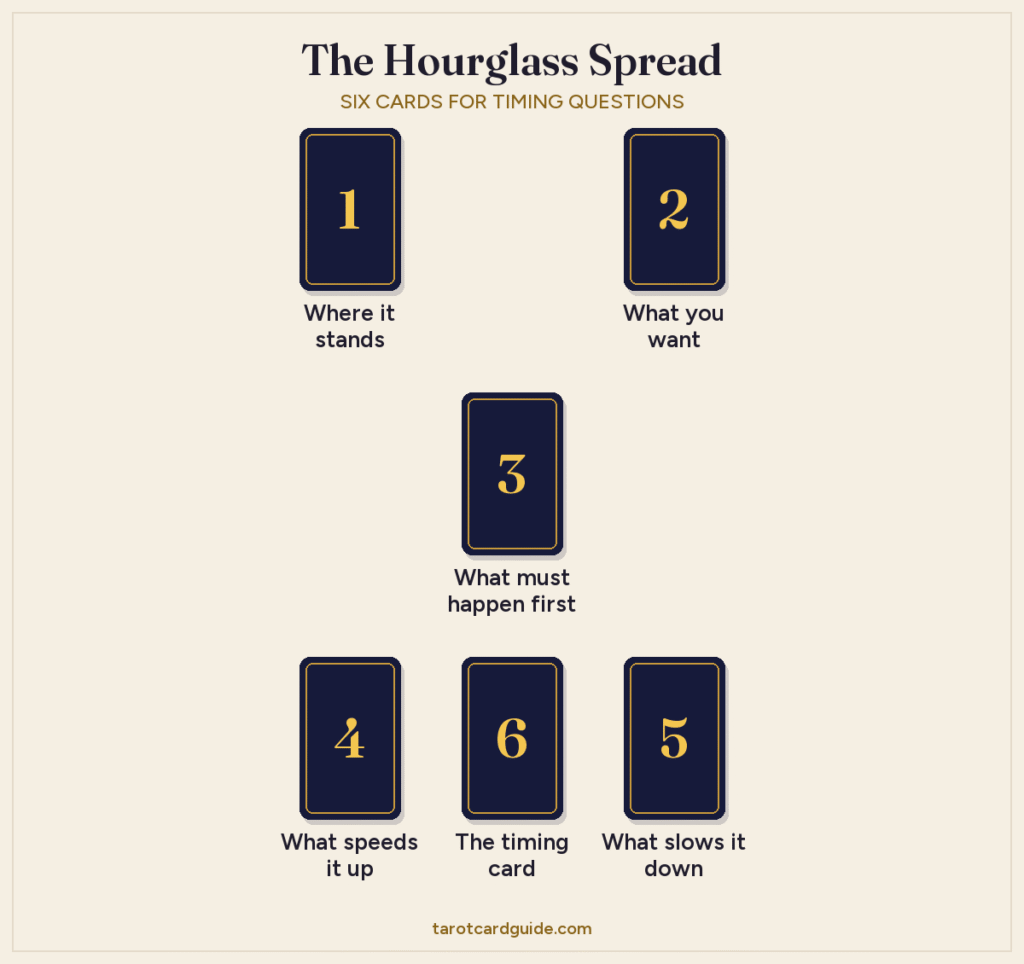
- Where it stands. The situation right now.
- What you want. The outcome you’re waiting for, as the cards see it.
- What must happen first. The neck of the hourglass: the step everything has to pass through.
- What speeds it up. Something you, or someone else, can do to help.
- What slows it down. The hold-up, inside you or outside.
- The timing card. Read with the method you chose in advance.
Lay cards 1 and 2 across the top, card 3 alone in the middle, and cards 4, 6 and 5 along the bottom, so the timing card sits in the centre where the sand lands. Read card 3 before card 6: if what must happen first hasn’t started yet, the timing card counts from the moment it does, not from today. For a smaller version, use the three-card spread with positions 1, 3 and 6.
A Worked Example
Imagine someone in mid-March asks, “When will I hear back about the job I applied for?” They decide beforehand to read the timing card by its decan dates, then lay out the Hourglass Spread:
- Where it stands: Three of Wands. A figure on high ground watches ships at sea. The application is out, and they’re watching the horizon.
- What you want: Ace of Pentacles. A concrete offer, something solid in the hand.
- What must happen first: Page of Pentacles. A practical step or message: references, a test task, some paperwork.
- What speeds it up: Knight of Wands. A confident follow-up, actually sent rather than drafted for a week.
- What slows it down: Four of Swords. A pause on the other side: someone on leave, or a process on hold.
- The timing card: Four of Wands. Celebration and a milestone reached.
The Four of Wands decan runs from 10 April to 19 April, late in Aries. So the reading points to a window about a month away, once the Page’s practical step has come through. The Four of Swords suggests the silence so far is a pause rather than a rejection, and the Knight says a polite nudge would help.
As a unit, the same card would have said four days; as a season, spring. It would have been easy to grab whichever answer felt nicest, which is exactly why the method was chosen first.
So what should they actually do? Send the follow-up, get the references ready and put a note in the diary for mid-April. If April passes with nothing, that isn’t the cards failing. It’s new information, and a new question: “What’s really holding this up?”
Better Questions Than “When?”
Most “when” questions hide a more useful one. “When will I meet someone?” is often really “What’s keeping me from meeting people?” Our guide to asking the right questions in a tarot reading goes into this properly, but these swaps work well:
- Instead of “When will this happen?”, ask “What needs to happen first?”
- Instead of “When will they call?”, ask “What can I focus on while I wait?”
- Instead of “When will I get a new job?”, ask “What’s slowing my search down?” and lay out the career path spread.
- Instead of “When will I find love?”, ask “What would help me be ready for a relationship?” and try the free love tarot reading.
Another fix is to set the timeframe yourself. “What’s the energy around my finances over the next three months?” gives the reading a frame, so the cards describe that stretch of time instead of guessing at a date. The card of the day works the same way, with its timeframe built in.
If you keep asking “when” about the same thing, it may be worth asking why the waiting feels so hard, which is where shadow work with tarot comes in.
Yes or No Plus Timing
Timing works best as a yes or no question with the window built in: “Will I hear back before the end of the month?” That turns a vague date hunt into something a single card can answer. Try it with the free yes or no tarot reading, which draws one card and gives you yes, no or maybe.
On our reading, a reversed “yes” card softens to “not yet”, which is a timing answer in itself. An upright Eight of Wands or The Chariot is a clear yes, and a quick one. A “maybe” card such as the Seven of Pentacles or The Hanged Man often means the window you chose is too short.
Why Expectations Change the Timing
Once you have a date in your head, you start acting around it, and that changes what happens. It’s the old idea of the self-fulfilling prophecy.
It cuts both ways. Someone told “spring” for a new job might sit back until March and miss the openings in January. Someone else, told “soon”, might apply everywhere with fresh energy, get a result faster and credit the cards. Neither person saw the future. The prediction changed the effort.
Memory plays tricks too: the hits stick, the misses vanish. Write down every timing reading with its date and check back later. It’s humbling, and useful.
Timing your own situation is hardest of all, because you want a particular answer, and our tips on reading tarot for yourself help with that. Use timing to plan, never as a reason to stop doing the things that make an outcome more likely. If a date starts making you anxious, put the deck down for a while.
Tarot Timing FAQs
Can tarot predict when something will happen?
It can suggest a rough window if you use one method consistently, but timing is the least reliable part of tarot. Treat any date as a time to check in, not a deadline, and remember that other people’s choices can change everything.
Which tarot suit means days, weeks, months or years?
In the most common scheme, Wands are days, Swords weeks, Cups months and Pentacles years, with the card’s number as the count. Some readers swap Wands and Swords, so decide which version you use before you read.
Which tarot cards mean something will happen quickly?
The Eight of Wands is the fastest card in the deck. The Knight of Wands and The Chariot are quick too, and any Ace marks a beginning. Slow cards include the Four of Swords, The Hanged Man and the Seven of Pentacles.
How do I use decans for tarot timing?
Each numbered Minor card from 2 to 10 covers about ten days of a zodiac sign. Look up the card’s dates in our zodiac tarot cards guide: the Eight of Wands, for example, runs from 22 November to 1 December.
Try a Timing Reading
Pick one method, write it down, and try the Hourglass Spread on something low-stakes this week, where you’ll find out the answer soon. Or browse our other tarot spreads for questions that don’t need a date at all.