Tarot symbolism is the visual language of the cards: the colours, objects, animals, plants and gestures that carry meaning beyond the scene itself. In the Rider-Waite-Smith deck the same symbols come back again and again, so once you know a dozen of them you can make sense of a card you’ve never studied.
The deck was drawn by the artist Pamela Colman Smith under the direction of the occultist A. E. Waite, and published in London by Rider in 1909. Waite chose much of the esoteric content; Smith gave it faces, weather and body language. Her story deserves its own post, so here we’ll stay with the pictures.
Below are the symbols that turn up most often, what they’re usually taken to mean, and a simple method for reading the picture when a card’s meaning has gone right out of your head. The interpretations are traditional readings, not rules. Symbols are there to start a thought, not to finish it.
Colour: Yellow Skies, Grey Skies, Red and White
Before you look at any figure, look at the sky. It’s the quickest mood reading in the deck.
Yellow skies. The Fool, The Magician, The Empress, The Chariot and Strength all stand against bright yellow. Yellow is often read as consciousness, optimism and active energy: daylight, when things are seen clearly and can be acted on. A yellow card tends to be a “you can do something about this” card.
Grey skies. Grey is harder to pin down. Look at the Ace of Cups, the Ace of Swords, The Hierophant, Temperance and many of the Swords, such as the Three, Four and Six. Readers take grey as neutral ground, the world of thought, or a heavier, overcast mood. On the Aces it feels like a blank page; on the Three of Swords it feels like rain.
Red and white. The Magician wears a red robe over a white tunic, and red roses grow beside white lilies at his feet. Red is usually read as passion, desire and action, and white as purity, spirit and clear intention. When the two appear together, the card is often about holding both at once. You’ll find the pairing again on the red cross of the white banner in Judgement and in the white horse and red banner of The Sun.
Black is rarer and louder: the black pillar beside The High Priestess, the black banner in Death, the dark background of The Devil. When a card goes dark, pay attention.
The Lemniscate and Other Endless Loops
The lemniscate is the sideways figure eight, the infinity sign. It floats above the head of The Magician and above the woman in Strength, and it appears again as the looping green ribbon that joins the coins in the Two of Pentacles.
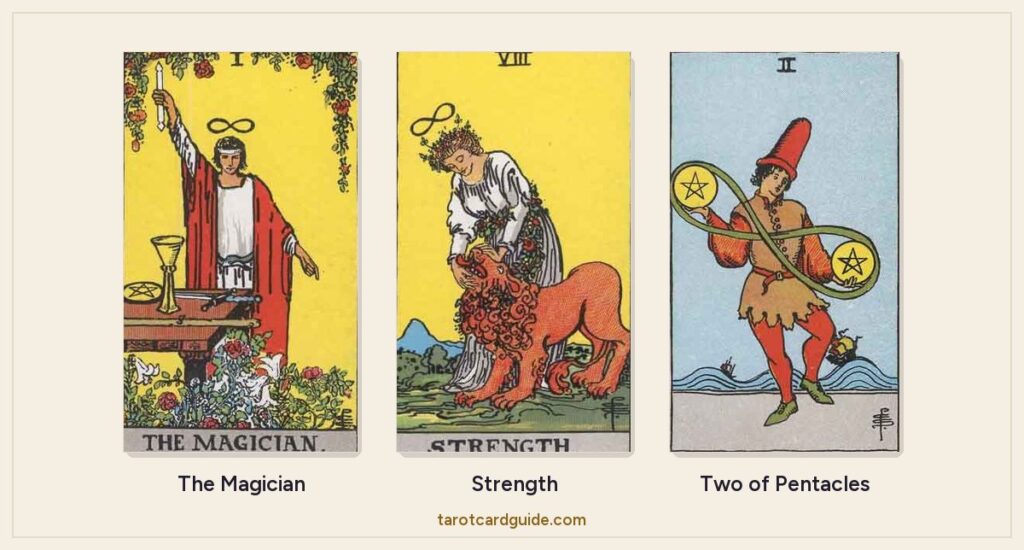
It’s usually read as endless potential, continuous flow and energy that renews itself. Put the three cards side by side and a nice pattern appears: the Magician’s loop is about will, Strength’s is about patience, and the juggler’s is about keeping things moving. Three different kinds of stamina.
The same idea hides in smaller details. The Magician’s belt is a snake swallowing its own tail, and the salamanders on the robe of the King of Wands bite their tails to form closed circles. If you spot a loop, think continuity.
Pillars and Gateways
Three Major Arcana figures sit between two pillars, and the pillars change the feel of each card.
- The High Priestess: one black pillar marked B and one white marked J, named after Boaz and Jachin, the pillars of Solomon’s Temple. She sits between opposites without choosing, which is why the card is about hidden knowledge and intuition.
- The Hierophant: two grey stone pillars, the setting of an institution. The mystery of the High Priestess has become a formal teaching.
- Justice: two grey pillars with a purple veil hung between them. Structure and law, with a hint that more lies behind the surface.
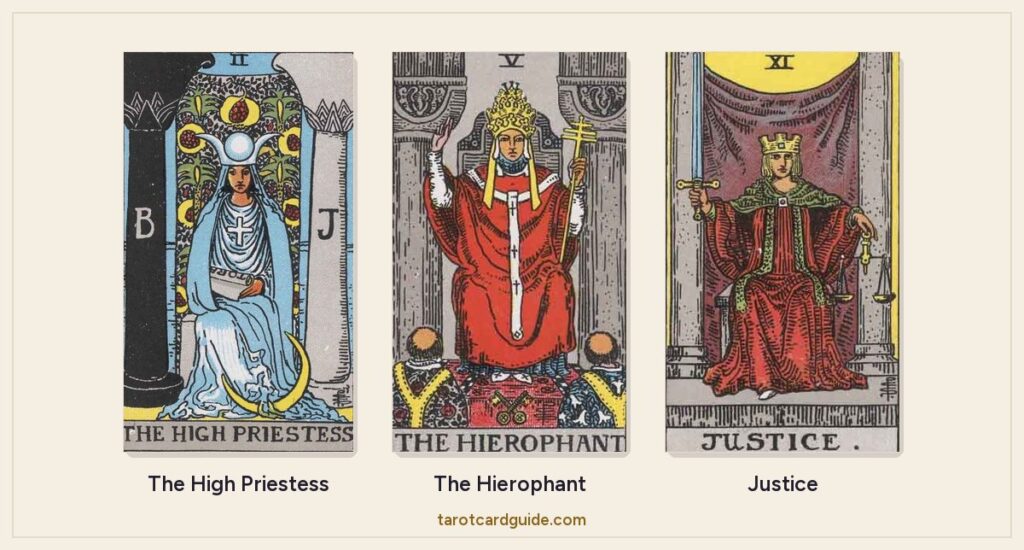
Pillars are usually read as a threshold: you’re at the entrance to something, and the figure between them is its gatekeeper. The same idea turns up as two towers on the horizon of Death and either side of the path in The Moon, where the way ahead passes between them into unknown country.
Pomegranates, Roses, Lilies and Other Plants
Pomegranates decorate the veil behind the High Priestess and the gown of The Empress. They’re an old symbol of fertility and of Persephone, who ate pomegranate seeds in the underworld. On the Priestess they suggest hidden, inner abundance; on the Empress, abundance that has ripened into the open.
Roses are commonly read as desire, love and beauty. Lilies are commonly read as purity and spirit. The Magician grows both. One of the kneeling followers of The Hierophant wears roses and the other wears lilies, as if they come to the same teaching by two routes. The Fool carries a single white rose, and Death carries one on his banner.
Other plants are worth a glance too: the sunflowers of The Sun and the Queen of Wands (warmth, turning towards the light), the ripe wheat at the Empress’s feet (harvest), the grapes of the Nine of Pentacles (patient work paying off) and the leaves sprouting from every Wands staff (life still growing). Even the beam in The Hanged Man has leaves on it.
Water, Mountains, the Sun and the Moon
Water is almost always feeling, intuition or the unconscious. It pours from the Ace of Cups, flows from jug to earth and pool in The Star and runs between two cups in Temperance, where the angel stands with one foot in it. Notice its state. The rough sea behind the Two of Pentacles is a very different mood from the still pool of The Star, and the Six of Swords shows choppy and calm water in the same crossing.
Mountains are usually challenge, perspective or a goal still far off. Snow-capped peaks rise in the distance behind The Fool, The Hermit stands on one, a single mountain rises between the couple in The Lovers, and The Emperor sits in front of bare, rocky ones. Snow and bare rock suggest a hard, lonely height; a distant blue mountain, like the one behind Strength, feels more like somewhere you’re heading.
The sun brings clarity and life. It shines behind the angel in The Lovers, hangs white in the Fool’s sky and sits low between the towers in Death, and whether it’s rising or setting there is left for you to decide. The moon brings intuition, cycles and uncertainty. The High Priestess wears a lunar crown with a crescent at her feet, the charioteer has crescent moons on his shoulders, a thin crescent hangs over the blindfolded woman in the Two of Swords, and a moon with a face watches the figure walk away in the Eight of Cups.
Animals: Lions, Dogs, Wolves and a Crayfish
Lions stand for courage, passion and raw instinct. The woman in Strength calms one with her hands, a lion sits in a corner of both the Wheel of Fortune and The World, and lions are carved into the thrones of the Queen and King of Wands.
Dogs are loyalty and tamed instinct. The Fool’s little white dog leaps at the cliff edge, often read as the instinct that senses danger first, and the elder in the Ten of Pentacles rests with his dogs. In The Moon a dog and a wolf howl side by side, the tame and the wild parts of you, while a crayfish crawls out of the pool below. That crayfish is a favourite symbol of fears and old material rising from the depths, which is why the card is so useful in shadow work with tarot.
A few more to watch for: the white horses of The Sun and Death, the serpent coiled round the tree behind the woman in The Lovers, the rams’ heads on the Emperor’s throne, the dove carrying a wafer down to the Ace of Cups, the hooded falcon on the hand of the woman in the Nine of Pentacles and the black cat at the Queen of Wands’ feet.
Angels, Crowns, Keys and Hands
Angels appear on three Majors: blessing the couple in The Lovers, mixing water between two cups in Temperance and blowing the trumpet in Judgement. They’re usually read as guidance, healing or a call from something bigger than the self. The Devil, with his bat-like wings and the chained couple at his feet, is often read as a dark mirror of the angel in The Lovers.
Crowns mark authority, and it matters whose head they’re on. The Empress wears twelve stars. The Hierophant wears a triple crown. The charioteer’s crown carries a star. On the Ace of Swords a crown rings the tip of the blade. And two crowns fall: one lies on the ground beneath Death’s horse, and one is blown off the top of The Tower.
Keys are rarer than you might expect. The clearest are the two crossed keys, one gold and one silver, at the Hierophant’s feet, usually read as access to knowledge that’s passed down.
Hands tell you what a figure is doing with its power. The Magician points one hand up and one down: as above, so below. The Hierophant raises two fingers in blessing, and The Devil raises an open hand in what many readers see as a parody of it. Every Ace is a hand reaching out of a cloud with a gift. The blindfolded woman in the Two of Swords crosses her arms over her chest, and the figures in Judgement throw theirs open.
The Wheel’s Letters and the Sphinxes
The Wheel of Fortune is the most diagram-like card in the deck. Around the rim are the letters T, A, R and O. Read clockwise from the top they spell TARO; read the other way they spell TORA, the word on the scroll in the High Priestess’s lap; and they also suggest ROTA, Latin for wheel. Between them sit four Hebrew letters that spell the divine name, and inside the wheel are alchemical symbols.
On top of the Wheel sits a blue sphinx holding a sword, calm while everything turns. A snake slides down one side and a jackal-headed figure, usually identified as Anubis, rises on the other. In the corners, an angel, an eagle, a lion and a bull read books; the same four creatures return on The World, where the reading is done.
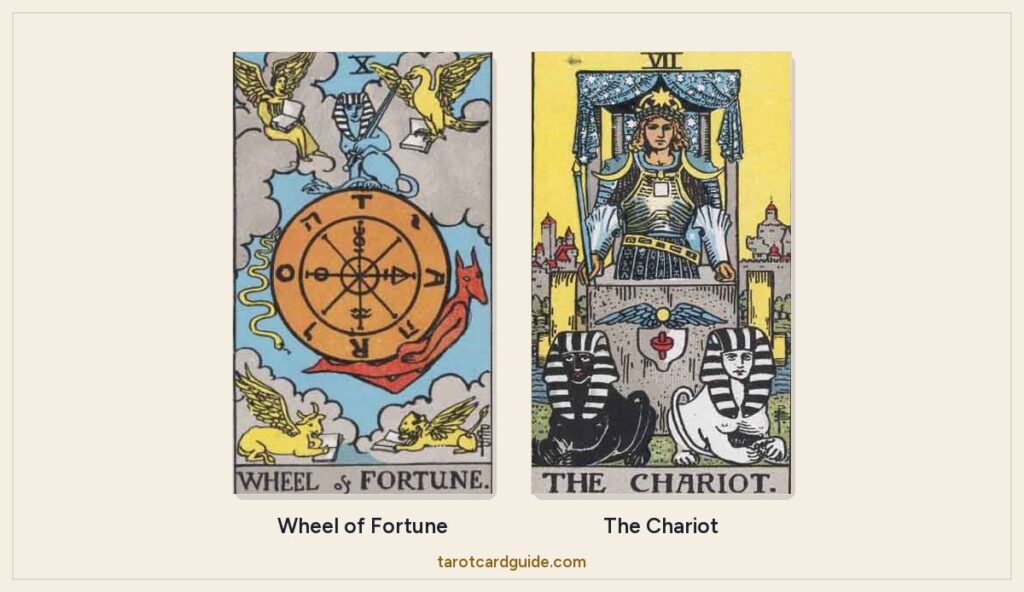
The Chariot has two sphinxes, one black and one white, and the charioteer holds no reins. Opposites pulling in different directions, steered by will alone. Put the two cards together and you get a neat lesson: the Wheel’s single sphinx is wisdom that stays still through change, and the Chariot’s pair is the effort of keeping opposing forces on one road.
Death’s Rose and the Tower’s Falling Figures
Death rides a white horse and carries a black banner marked with a white five-petalled rose. It’s one of the most telling details in the deck: new life and purity held inside the ending itself. Below him a king has fallen with his crown on the ground, while a bishop, a young woman and a child meet the ending in their own ways.
In The Tower, lightning strikes the top of a grey tower on a rocky peak, knocks off its crown and sends two figures falling headfirst, one of them still crowned. Small flames shaped like the Hebrew letter yod drift through the air. Similar yod-shaped drops fall around the Ace of Swords and from the sky in The Moon, and they’re often read as sparks of grace coming down even in hard moments.
Numbers are the other layer of the picture. The Tower is XVI and Death is XIII, and the guide to tarot numerology explains what each number adds.
How to Read the Picture of an Unfamiliar Card
This is where symbolism earns its keep. When a card lands and its meaning won’t come, stop trying to remember and start looking.
- Say what you literally see. Who is there, and what are they doing? Keep it plain: “a man lies on a tomb with his hands together.”
- Check the sky and the weather. Yellow, grey, blue or black? Rain, night or clear day?
- Notice direction. Is the figure facing you, turning away or looking into the distance? The figure in the Eight of Cups walks away, and the passengers in the Six of Swords face where they’re going.
- Find one symbol you already know. A pillar, a lion, water, a crown. Borrow its meaning from the card where you learned it.
- Look for what’s odd. The blindfold in the Two of Swords, or the missing blindfold on Justice, who looks straight at you. The odd detail is often the point.
- Put it in one sentence about the question. Then check it against the card’s page, and notice what you got right.
Say you draw the Four of Swords and draw a blank. You see a knight lying on a tomb inside a church, hands pressed together, three swords on the wall and one beside him. The light comes through a stained-glass window, and the colours are quiet. Nobody is fighting. A fair sentence: “Rest, and let the battles hang on the wall for a while.” That’s very close to the card’s traditional meaning, and you got there by looking.
The same habit is the heart of the “read the upside-down picture” method in how to read reversed tarot cards. It also gives you something to do with a card of the day: spend two minutes describing the picture before you read a single word about it.
Tarot Symbols at a Glance
| Symbol | Common meaning | Where it appears |
|---|---|---|
| Yellow sky | Consciousness, optimism, energy | The Fool, The Magician, The Empress, The Chariot, Strength |
| Grey sky | Neutrality, thought, a heavy mood | The Aces of Cups and Swords, The Hierophant, many Swords |
| Lemniscate (∞) | Endless potential, flow | The Magician, Strength, Two of Pentacles |
| Pillars | A threshold, duality, structure | The High Priestess, The Hierophant, Justice |
| Pomegranates | Fertility, hidden abundance | The High Priestess, The Empress |
| Roses and lilies | Desire and purity | The Magician, The Hierophant, The Fool, Death |
| Water | Emotion, intuition, the unconscious | Ace of Cups, The Star, Temperance, The Moon |
| Mountains | Challenge, perspective, distant goals | The Fool, The Hermit, The Lovers, The Emperor |
| Moon | Intuition, cycles, uncertainty | The High Priestess, The Moon, Two of Swords, Eight of Cups |
| Lion | Courage, instinct, passion | Strength, Wheel of Fortune, The World, Queen and King of Wands |
| Dog and wolf | Tame and wild instinct | The Fool, The Moon, Ten of Pentacles |
| Angel | Guidance, healing, a calling | The Lovers, Temperance, Judgement |
| Crown | Authority, status | The Empress, The Hierophant, Justice, Death, The Tower |
| Keys | Access to knowledge | The Hierophant |
| Sphinx | Wisdom, opposing forces | Wheel of Fortune, The Chariot |
| Yods | Grace coming down | The Tower, The Moon, Ace of Swords |
If you want to put this into practice straight away, draw a card with the free three-card reading, cover up the text and read only the pictures. Every card on the Major Arcana page and the four suit pages has a symbolism section to check yourself against.
Frequently Asked Questions
What are the most common symbols in tarot?
In the Rider-Waite-Smith deck, the symbols that recur most are coloured skies, water, mountains, the sun and moon, pillars, crowns, lions, dogs, angels, roses and lilies, and the infinity sign. Learning these helps you read almost any card.
What does the infinity symbol mean in tarot?
The infinity sign, or lemniscate, is usually read as endless potential and energy that renews itself. It appears above The Magician and the woman in Strength, and as the ribbon in the Two of Pentacles.
What do the two pillars mean on the High Priestess card?
They’re marked B and J for Boaz and Jachin, the pillars of Solomon’s Temple. One is black and one is white, and they’re usually read as opposites such as light and dark or known and unknown, with the Priestess sitting between them.
Who created the Rider-Waite-Smith tarot deck?
Pamela Colman Smith drew the cards under the direction of A. E. Waite, and the deck was published by Rider in London in 1909. Many people now add Smith’s name to the deck’s title in recognition of her part in it.
Do tarot symbols have fixed meanings?
No. There are traditional readings, and it helps to know them, but symbols shift with context. Water in The Star feels very different from water in the Six of Swords. Use the tradition as a starting point and trust what you see.