A soulmate tarot spread is a six-card reading for people who are single or dating and want to understand the love they’re looking for: what you truly want, what you bring, what’s in the way and what kind of partner suits you. It can’t name a person, a date or a place, but it can show you where to put your energy now.
Some people believe a soulmate is one destined person. Others use the word loosely for a deep, lasting match. This spread works for both views, because every position is about you and your choices rather than about fate.
Draw a free Soulmate Spread reading now: think about the kind of love you want, then deal all six cards below. Each position shows the question it asks, and each card links to its full meaning.
Your Soulmate Spread reading
- What I’m looking for What do I truly want from a partner, beneath the checklist?
- What I bring What do I bring to a relationship?
- What’s in the way What stands between me and the love I want?
- Who suits me What kind of partner suits me?
- Where to open up Where could I open up to meeting someone?
- What to know now What do I most need to know about love right now?
Read the cards in their three columns: 1 and 2 are you, 4 and 5 point outwards to a partner and a meeting, and 3 and 6 sit in the middle. Then compare card 1 with card 4. How to read the positions together
Jump to a section:
- What the soulmate spread can and can’t do
- The 6 positions at a glance
- Each position in depth
- Reading the positions together
- Court cards as a possible partner
- Cards often read in soulmate spreads
- A full example reading
- Future spouse readings
- “When will I meet my soulmate?”
- Am I ready for love? A 3-card variant
- Red flags
- Soulmate or twin flame?
- Frequently asked questions
What the soulmate spread can and can’t do
To be plain: no tarot card can tell you your future partner’s name, looks, or where and when you’ll meet. Anyone who promises that is guessing. The cards also can’t guarantee a meeting at all.
What it can do is more useful than it sounds. It shows what you’re really looking for, which is often different from the list on a dating profile, plus what you offer, what’s holding you back and what kind of person tends to suit you.
If you believe in a destined soulmate, the reading helps you get ready to recognise them. If you think of a soulmate as a great match you build with someone, it helps you choose well. The work it points to is the same.
When another reading is better
- You have someone specific in mind: try How do they feel about me? or the three-card love tarot reading.
- You’re already in a relationship: the relationship spread looks at both people and the bond between them.
- You’re curious how two signs or birth cards match: the tarot compatibility calculator is a lighter, playful take.
- You’re hurting after a breakup: start with the broken heart spread, or the self-love tarot spread if your confidence has taken a knock.
The 6 soulmate spread positions at a glance
Each position asks one question, and each has a partner it reads best with:
| Position | What it asks | Read it with |
|---|---|---|
| 1. What I’m looking for | What do I truly want from a partner, beneath the checklist? | 4, 2 |
| 2. What I bring | What do I bring to a relationship? | 1, 3 |
| 3. What’s in the way | What stands between me and the love I want? | 2, 6 |
| 4. Who suits me | What kind of partner suits me? | 1, 5 |
| 5. Where to open up | Where could I open up to meeting someone? | 4, 6 |
| 6. What to know now | What do I most need to know about love right now? | 3, 5 |
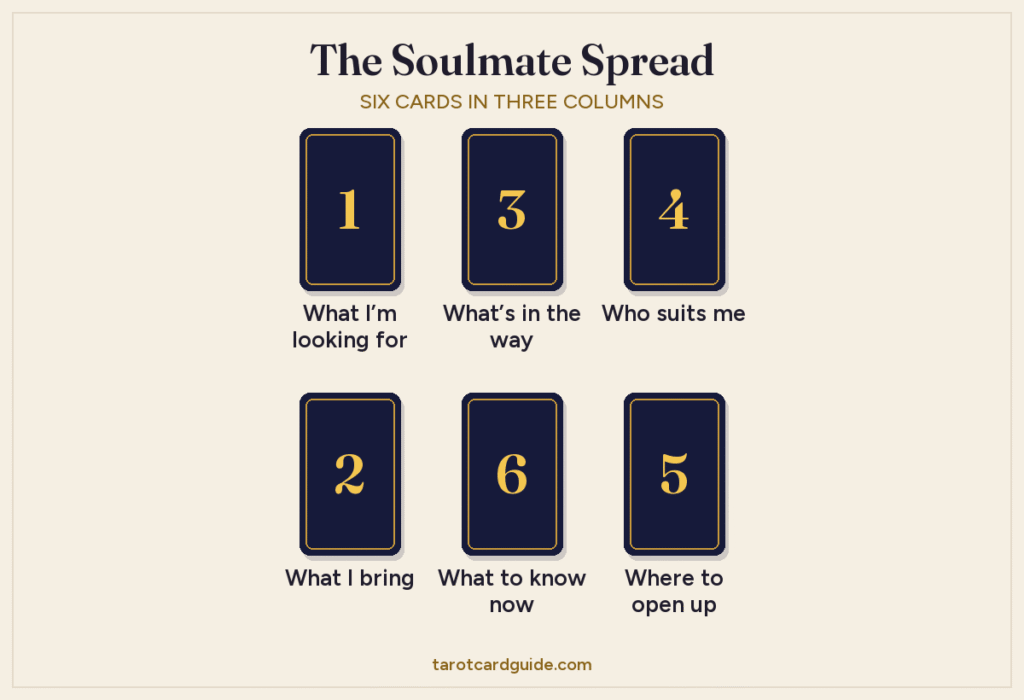
Lay the cards in two rows of three. The left column (1 above 2) is you: what you want and what you offer. The right column (4 above 5) points outwards: the kind of partner who suits you and where you might meet them. The middle column holds what’s in the way (3, top) and the message to take away (6, bottom), sitting between you and the person you hope to find.
Each soulmate spread position in depth
For each position: what it asks, how cards tend to read there, and what to compare it with. The suits keep their usual areas. Cups are feelings and connection, Wands are attraction, energy and adventure, Swords are thoughts and communication, and Pentacles are stability, home and everyday life.
Card 1: What I’m looking for
This card names the feeling you want from love, which usually runs deeper than the traits on your list. You might ask for a tall, funny partner with a good job; card 1 might say you want to feel safe. For example, the Ten of Cups here points to a relationship that feels like home, with shared values and a settled future.
- Reversed: what you want may be unclear to you, or shaped by an ideal that real people can’t match. It’s worth writing down what you want in plain words.
Card 2: What I bring
Card 2 shows what you offer a partner, which people single for a while tend to forget. Even a difficult card can describe a strength: the Nine of Wands shows resilience and loyalty through hard times. For example, the Queen of Wands here is warmth, confidence and loyalty, along with a need for room to pursue your own interests.
- A court card: often a description of you as a partner. See court cards as a possible partner for how to read rank and suit.
- Reversed: a quality you have but aren’t showing, perhaps because past hurt taught you to hide it.
Card 3: What’s in the way
This is the honest card: what stands between you and love right now. It might be a fear, a habit, a busy life or an old relationship you haven’t let go of. It never means you’re unlovable. For example, the Six of Cups reversed can show someone comparing every new date with an ex, or idealising how things used to be.
- A Swords card: often thinking that gets in the way, such as harsh self-talk, cynicism or overthinking every message.
Card 4: Who suits me
The card most people want to see first describes the qualities of a partner who suits you, not their face or name. A common convention reads a court card here as a picture of the person, and any other card as the qualities they bring. For example, The Hermit here can point to someone quiet, thoughtful or a little reserved, who cares deeply but takes a while to let anyone in.
- A Major Arcana card: check the card’s “as a person” section. Some Majors describe a type of person well; others read better as a theme the relationship might carry, such as healing or commitment.
- Reversed: the card’s qualities in a less healthy form. Read it as a warning about a type you’re drawn to, not a description of your future partner.
Card 5: Where to open up
Card 5 suggests where or how you could open up to meeting someone: a place, an activity or a change in attitude. It won’t give you an address, so turn it into one thing you could do this month. For example, the Three of Cups here suggests friends, celebrations and group events: say yes to the party.
- Wands: through activity, travel, sport or a creative project.
- Cups: through friends, social life and letting your feelings show.
- Swords: through conversation, learning, honest messages or a class.
- Pentacles: through work, everyday routine, your local area or a slow-building friendship.
Card 6: What to know now
The last card is the reading’s message: advice to carry with you, not a prediction of how things end. A hard card here usually names something to deal with first. Check the “as advice” section on the card’s own page. For example, The Star here is hope and healing, with a reminder that there’s no need to rush.
Reading the soulmate positions together
Read in pairs, the six cards start to explain each other. These comparisons are worth making every time.
What you want and who suits you: cards 1 and 4
This is the heart of the spread. When cards 1 and 4 agree, you’re looking for someone who would genuinely suit you. When they clash, notice it. Say card 1 is the Knight of Wands, all excitement and fast-moving chemistry, and card 4 is the Four of Wands, a stable and joyful home. The reading may be saying that the thrill you go looking for isn’t what makes you happy.
What you bring and what’s in the way: cards 2 and 3
The strength in card 2 is usually the tool for dealing with card 3. A confident card at 2 and a fearful one at 3 suggest the confidence is there but isn’t reaching your love life yet.
The step and the message: cards 5 and 6
Card 5 is what to do; card 6 is the attitude to do it with. If card 5 says “group events” and card 6 says “go slowly”, the plan is to go out more without pressing anyone for a label.
Across the spread
Compare card 3 with card 6, since the message often answers the block. Then count suits: several Cups put feelings at the centre, several Swords point to thinking that needs to soften. Repeated numbers repeat a theme; see tarot card combinations for common pairs.
What’s normal? With 22 Major Arcana cards in a 78-card deck, six cards hold about 1.7 Majors on average, so one or two is ordinary and four or more is unusual. The draw on this page reverses each card with a one-in-three chance, so expect about two reversals; only about 9% of draws have none.
Court cards as a possible partner
Reading a court card as “what they might be like” is a common convention, not a rule, and it works best in card 4. Elsewhere, a court card more often describes you. Gender and age aren’t literal: a King can be a woman, and a Page can be forty.
The deck has 16 court cards out of 78, so card 4 is a court card about one time in five (16 ÷ 78, roughly 20%). About three draws in four have at least one court card somewhere.
Read the rank for the stage or style of love, then the suit for temperament:
| Rank | As a partner, it may suggest |
|---|---|
| Page | Someone curious and open, or a connection at the sweet, early stage of flirting and messages |
| Knight | Someone who pursues, acts and moves things along, sometimes too fast |
| Queen | Someone emotionally mature, nurturing and secure in themselves |
| King | Someone steady and responsible, ready to commit and build |
| Suit | Temperament it may suggest |
|---|---|
| Wands | Passionate, confident, adventurous, full of plans |
| Cups | Romantic, caring, emotionally open, intuitive |
| Swords | Clever, honest, direct, needs good conversation |
| Pentacles | Reliable, practical, shows love through actions and time |
So the Knight of Cups is the classic romantic suitor, sincere and charming, while the King of Pentacles points to someone dependable who shows care in practical ways. For all 16, see court cards in love. Reversed, read the less healthy version of the type: the reversed Knight of Cups blows hot and cold. That’s a pattern to watch for, not a prophecy.
Cards often read in soulmate spreads
These cards speak directly to questions about lasting love. The wording follows each card’s own love section.
| Card | What it may say in a soulmate spread |
|---|---|
| The Lovers | A bond of real intimacy and shared values; love as a choice you make, and clarity about what you want |
| Two of Cups | Mutual attraction and respect; interest that is returned, sometimes a friendship becoming more |
| Ace of Cups | Emotional openness and a heartfelt new start; often ready to love again after healing |
| Ten of Cups | Lasting love that feels like home; knowing the home life you want helps you recognise a match |
| Four of Wands | Commitment and celebration; meeting through friends, family or a community event |
| Knight of Cups | Romance and a sincere suitor; check that actions match words |
| Page of Cups | Flirtation and sweet beginnings, sometimes from an unexpected direction |
| The Star | Healing after heartbreak and hope returning; a gentle, honest connection, with no need to rush |
| The Hermit | Time to know yourself first; or a quiet, thoughtful partner |
| Wheel of Fortune | Love through chance and circumstance; reversed, repeating the same pattern |
| Six of Cups | Someone familiar or from your past; reversed, comparing everyone with an ex |
| Four of Cups | Closed off or tired of dating; someone’s interest you haven’t noticed |
| Eight of Swords | Beliefs such as “nobody suitable is out there” that are fears, not facts |
| The Devil | Drawn to an exciting type who is bad for you; notice the pattern |
For quick definitions of every card in a love reading, see love tarot card meanings.
A full soulmate spread example reading
Here is a complete hypothetical reading, not a real person. Imagine Jo, 36, single for two years after a long relationship, dipping in and out of dating apps and starting to feel discouraged. Jo asks: “What do I need to know about finding lasting love?” and reads reversed cards.
| Position | Card | In brief |
|---|---|---|
| 1. What I’m looking for | Ten of Cups | A relationship that feels like home |
| 2. What I bring | Queen of Wands | Warmth, confidence and loyalty |
| 3. What’s in the way | Eight of Swords | “Nobody suitable is out there” |
| 4. Who suits me | The Hermit | Someone quiet and thoughtful |
| 5. Where to open up | Four of Cups, reversed | Ready to say yes again |
| 6. What to know now | Wheel of Fortune | Stay open to chance; change the pattern |
What Jo wants and what Jo brings: cards 1 and 2
The Ten of Cups is long-term fulfilment and a shared future. For a single person, its love text says that knowing the home life you want helps you recognise a partner whose values match. The Queen of Wands shows what Jo offers: warmth, loyalty and a healthy spark. Her love text adds that you are at your most attractive when you are doing what you love.
What’s in the way: card 3
The Eight of Swords is the block. Its love text describes telling yourself that nobody suitable is out there, and asks whether that belief is a fact or a fear. Set beside the Queen of Wands, the reading says Jo’s confidence is real but isn’t reaching the dating part of life.
Who suits Jo and where to open up: cards 4 and 5
The Hermit in card 4 isn’t the loud, sweep-you-off-your-feet type. It points to someone quiet and thoughtful who needs space and may take a while to let anyone in. Next to the Queen of Wands, who also needs room for her own interests, that can be a good fit. Fast, flashy app chats may not be where this person shines.
The Four of Cups reversed in card 5 is renewed openness: being ready to date again and to give someone a real chance. The offer you ignored may start to look more appealing. For Jo, that might mean replying properly to the person who seemed “not my usual type”, or joining something slower-paced, such as a book group or a walking club.
The message: card 6
The Wheel of Fortune in love points to chance meetings and circumstances beyond your planning: a friend of a friend, a trip you almost didn’t take. Its advice is to say yes to new experiences and look at your patterns, because changing your response is the part you control. It doesn’t say when.
Putting it together
The spread runs from a clear wish (Ten of Cups) to an open door (Wheel of Fortune), and the only thing in the middle is a belief. Three small steps come out of it:
- Write down three values a shared home would need, and use them to judge dates instead of a checklist of looks and jobs.
- Each time the thought “nobody suitable is out there” comes up, write one fact against it.
- Say yes to one invitation a week for a month, ideally something Jo enjoys anyway, where a quieter person might also be.
The count supports this: two Cups put feelings at the centre, the single Sword is the worry, and the one reversal, in card 5, reads as good news.
Future spouse tarot readings
“Future spouse” readings are popular on video sites, where a reader promises your partner’s initials, job or star sign. Tarot can’t do that. A future spouse reading is the same kind of reading as this one, with marriage as the theme.
For that focus, keep the six positions and adjust the wording. Card 1 becomes “what I want from a lifelong partnership”, and card 4 becomes “the qualities of a partner I could build a life with”. Pentacles and the Four of Wands or Ten of Cups in card 4 suggest steadiness and commitment. A Knight there suggests excitement first, so check whether that fits what you want long term. The full list is in tarot cards that indicate marriage.
The cards won’t give you a name, a face or a wedding date. If a reading seems to, you’re choosing details to fit.
“When will I meet my soulmate?”
Tarot can’t date a meeting. Some readers use timing systems, such as matching suits to seasons, but they disagree with each other and there’s no evidence any of them work, so this page doesn’t use one. A card that seems to say “soon” is better read as “start now”.
Waiting for a date also keeps life on hold. What you can do is make meeting someone more likely: be in more places with people, let friends know you’re open to being introduced, keep your profile honest and current, and do the things you love where others do them too. Card 5 of your spread is the place to start, and a month ahead spread gives you a plan rather than a forecast.
Am I ready for love? A 3-card variant
Sometimes the real question comes before the soulmate one. This three-card spread is a good check after a breakup, a long single spell or a run of disappointing dates.
| Position | What it asks |
|---|---|
| 1. Where my heart is | How open am I to love right now? |
| 2. What still needs care | What hurt or habit still needs attention? |
| 3. What would help | What would help me feel ready? |
A warm card at 1, such as the Ace of Cups, suggests the door is open. A card like the Three of Swords at 2 says grief still needs time, and that’s fine. Card 3 is the advice. If you’d rather not use your own deck, the three card spread page has a free draw you can use with these positions in mind.
Red flags: when soulmate readings stop helping
- Reading again and again about one person. If every soulmate reading is really about one crush or an ex, the spread has become a way to wait for them. Ask about yourself instead, or try will my ex come back? once and let it rest.
- Waiting instead of living. If you turn down plans because “my soulmate is coming anyway”, the reading is working against you. Card 5 always asks you to do something.
- Someone using “soulmate” to pressure you. Be wary of anyone who says you’re fated, so you must forgive them, move fast or ignore how they treat you. Being soulmates, if you believe in it, never makes control or disrespect acceptable. If you feel unsafe, talk to someone you trust or a support service.
Soulmate or twin flame?
Both ideas belong to belief, not to tarot itself. As people who use the terms usually describe them, a soulmate is someone whose bond with you feels deeply natural and supportive, and some believe you can have more than one. A twin flame is described as one soul split in two, and the connection is often said to be intense and turbulent.
One caution. Twin flame stories sometimes treat pain, chasing or repeated breakups as proof of a destined bond. A relationship that keeps hurting you is a relationship that keeps hurting you, whatever you call it. Either way, ask the spread’s questions: does this person suit you, and do you both feel respected?
Soulmate tarot spread: frequently asked questions
Can tarot tell me if I will meet my soulmate?
No reading can promise a meeting. Tarot is a tool for reflection, so it can show what you’re looking for, what might be in the way and where to put your energy. Those are the things that make meeting someone more likely.
What are the positions in a soulmate tarot spread?
In the version on this page: 1 what I’m looking for, 2 what I bring, 3 what’s in the way, 4 who suits me, 5 where to open up and 6 what to know now. Other soulmate spreads use different positions, so pick one and stick with it.
Which tarot card represents a soulmate?
There isn’t an official soulmate card. The Lovers and the Two of Cups are the cards most often read that way, because both describe a deep, mutual bond. The Ten of Cups adds lasting happiness and a shared home.
Can tarot tell me what my soulmate looks like?
Not reliably. Court cards are often read as a picture of a person’s temperament, but not their looks, age or gender. Read card 4 for qualities, such as warmth, steadiness or honesty, and leave the face to real life.
What does it mean if I get The Devil in a soulmate reading?
Usually a pattern rather than a person. The Devil in love can point to being drawn to someone exciting but bad for you, or to an on-off bond that’s hard to let go of. In card 3 especially, it asks what you want from a partner beyond the rush.
How often should I do a soulmate reading?
Once every month or two, so you have time to act on card 5. In between, a daily card of the day keeps the habit light.
Can I do a soulmate reading if I’m in a relationship?
You can, but the relationship spread usually fits better, because it looks at the person you’re with.
Is the free soulmate reading on this page random?
Yes. It picks six different cards from a full 78-card deck with your browser’s secure random generator, and reverses each one with a one-in-three chance. Nothing is chosen in advance.
Ready to try it? Deal your six cards with the free reading at the top of this page, look up any card in the meanings of all 78 cards, or browse the other tarot spreads.