
A month ahead tarot spread uses seven cards: a theme for the month, something to begin, something to finish or release, where to focus, what may test you, what supports you, and how the month could end. Lay it on the first day of the month, or at the new moon if you prefer, and it gives you a clear, practical plan to hold for the next four or five weeks.
It is built for coming back to. Each new month you deal a fresh spread, then look back at the old one before you do. This guide covers every position, how the cards pair up, when to lay it, a full example, a month-end look back with journal prompts, and a quick three-card version for busy months.
Draw a free Month Ahead reading now: think about the month in front of you, then deal all seven cards below. Each position shows the question it asks, and each card links to its full meaning. Then come back to the guide to read the cards together.
Your Month Ahead Spread reading
- Theme of the month What runs through this month as a whole?
- What to begin What is worth starting this month?
- Finish or release What is ready to be finished or let go?
- Where to focus Where should most of my energy go?
- What tests you What may challenge me this month?
- What supports you What or who can I lean on?
- The month’s end Where could this month lead if I follow the advice?
Read the centre column from top to bottom first (theme, focus, month’s end), then compare the cards side by side: begin with release, and test with support. How to read the positions together
Jump to a section:
- What the month ahead spread is, and when to use it
- The 7 positions at a glance
- Each position in depth
- Reading the positions together
- When to lay it: the first of the month or the new moon
- How to lay out the spread, step by step
- A full example reading
- The month-end look back and journal prompts
- A quick three-card month
- Weekly check-ins and seasonal spreads
- Common mistakes
- Frequently asked questions
What is the month ahead tarot spread?
It is a planning spread with a longer view than a weekly reading. Instead of a card per week, it asks the questions that shape a month: what to start, what to clear, where your effort goes and what may push back. Months don’t split neatly into four weeks, so the positions follow themes, not dates.
The first of the month feels like a small fresh start, which makes a new month tarot spread an easy habit to keep. Laid twelve times a year, it becomes a record of your year.
When another spread is better
- One situation with a history, such as a stalled project or a hard relationship: the Horseshoe spread follows a single story from past to outcome.
- A choice between two paths: the two options spread sets them side by side.
- Day-to-day planning: the week ahead spread gives each day its own card.
- A plain yes or no: seven cards seldom agree. Use the yes or no tarot reading.
The 7 month ahead positions at a glance
Each position asks one question, and each is best read alongside one or two others:
| Position | What it asks | Read it with |
|---|---|---|
| 1. Theme of the month | What runs through this month as a whole? | 4, 7 |
| 2. What to begin | What is worth starting this month? | 3, 6 |
| 3. Finish or release | What is ready to be finished or let go? | 2, 5 |
| 4. Where to focus | Where should most of my energy go? | 1, 5, 6 |
| 5. What tests you | What may challenge me this month? | 6, 3 |
| 6. What supports you | What or who can I lean on? | 5, 2 |
| 7. The month’s end | Where could this month lead if I follow the advice? | 1, 4 |
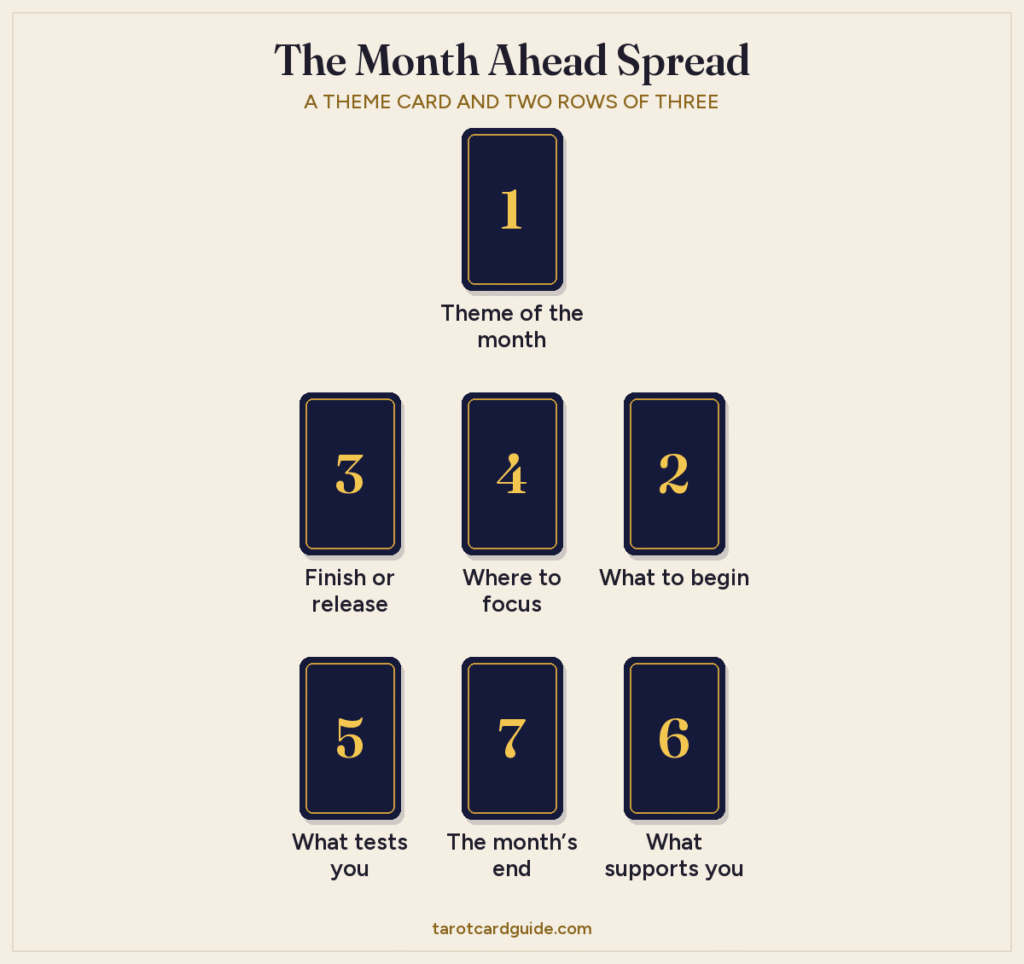
The theme sits alone on top, with two rows of three below. The centre column is the month itself: theme, focus, and how it could end. The left column holds what weighs on you (release and test), and the right holds what moves you forward (begin and support).
Each month ahead position in depth
The suits keep their usual areas: Wands for energy, drive and projects, Cups for feelings and relationships, Swords for thinking, talking and decisions, and Pentacles for work, money, home and the body.
Card 1: Theme of the month
The theme card names the thread you will keep bumping into: a lesson, a mood or the area of life that needs most attention. Every other card is read in its light. For example, Strength as the theme suggests a month for patience, calm persistence and a gentle hand, rather than force.
- A Major Arcana theme: the month may carry a bigger lesson than usual. See the Major Arcana for the full set.
- Reversed: the theme is present but blocked or turned inwards. Treat it as the thing to work on, not a bad omen.
- Compare with: card 4, which turns the theme into effort, and card 7, where the month could land.
Card 2: What to begin
This card points to something worth starting: a habit, a project or a conversation. Keep it small enough to begin this month. For example, the Ace of Pentacles here says pick one practical step, such as a budget, an application or a daily routine, and make it real.
- Reversed: a start that needs more preparation, or one you keep putting off. Ask what is in the way.
- Compare with: card 3, its opposite on the same row, and card 6, which shows what will help it grow.
Card 3: Finish or release
Card 3 shows what is ready to go: a task that has dragged on, or a habit, worry or commitment to let go. Ask, “What would make room for card 2?” For example, the Eight of Cups here asks you to be honest about something that no longer fulfils you. Reversed, it points to the fear of leaving, which is often the thing to release first.
- A pleasant card here: not everything you release is bad. It may be a good thing that has run its course, or one you are holding too tightly.
- Compare with: card 2, and card 5. If the test echoes what you are meant to release, the test is probably the letting go itself.
Card 4: Where to focus
Card 4 is the practical centre of the spread. With only so much time and energy, where should it go? Read it as an action or an attitude. For example, the Three of Wands here says look ahead and plan for the long term, and line up this month’s effort with the bigger picture.
- Court cards: usually an approach to take, such as the steadiness of a King or the curiosity of a Page. See tarot court cards explained.
- Compare with: card 1 above it, card 7 below it, and the test and support cards on either side.
Card 5: What tests you
Card 5 shows what may push back this month: a pressure, a habit or a moment where the theme gets tested. Knowing it in advance means you can plan for it. For example, the Nine of Wands here suggests tiredness near the finish line, and asks you to hold on and complete what you started.
- A gentle card here: read it as “what could trip me up”. Comfort, distraction or saying yes to everything can test you as much as a crisis.
- Compare with: card 6, which should help you meet it, and card 3, in case the test is about letting go.
Card 6: What supports you
Card 6 shows what you can lean on: people, a place, a skill or a quality in yourself. Don’t skip it. For example, the Four of Wands here points to home, community and people who are glad to see you, and suggests you mark small milestones with them.
- Reversed: support that is there but not being used. Ask for it.
- Compare with: card 5, its mirror on the bottom row, and card 2, the new thing it can help to grow.
Card 7: The month’s end
The last card shows where the month could lead if you work with the other six. It is a likely direction, not a promise; cards 2 to 6 give you a say in it. For example, the Six of Wands here points to recognition and pride in what you have done, while The Star points to a calmer, more hopeful end after a hard stretch.
- Major or Minor: a Major suggests the month closes a real chapter. A Minor points to a modest, practical result.
- Reversed: often a result that is delayed or still forming, rather than a no.
- Compare with: card 1, the theme it should answer, and card 4, the effort that leads to it.
Reading the positions together
Seven single answers make a to-do list. The pairs turn them into a month you can picture.
The spine: cards 1, 4 and 7
Read the centre column from top to bottom as one sentence: “This month is about card 1, so put your energy into card 4, and it could lead to card 7.” If the three share a suit or a mood, the month has a clear direction. If card 7 looks nothing like card 1, the month describes a change, and the side cards show how it happens.
In and out: cards 2 and 3
Card 3 is what goes out and card 2 is what comes in. Look for the link: often the thing to release is taking up the room the new thing needs.
Pressure and help: cards 5 and 6
Read the support card as the answer to the test. If they share a suit, the help lives in the same area as the pressure. If the support looks too small for the test, line up more help in advance.
Counts and repeats
In seven cards from a full 78-card deck, expect about two Major Arcana cards. Four or more turns up in about one month in eleven and suggests a month that matters. No Majors at all is about as likely, and suggests an everyday month that is largely in your hands. Three or more cards of one suit show where the month’s attention will go. Several reversals suggest a month for slowing down or working inwardly. Repeated numbers repeat a theme; see tarot card combinations.
When to lay it: the first of the month or the new moon
The simplest choice is the first day of the calendar month, or the evening before. It lines up with bills, work targets and the dates in your diary, so the cards have something concrete to attach to. Whichever you choose, stick with it, so each look back covers the same stretch as its spread.
Some readers prefer the new moon. In folklore and in many modern witchcraft traditions it is linked with beginnings, so a spread about what to start feels at home there. That is tradition and taste: there is no evidence that the moon changes which cards you draw or what they mean. The practical difference is timing: a lunar cycle lasts about 29.5 days, so the new moon drifts through the calendar and gives you twelve or thirteen readings a year.
How to lay out the month ahead spread, step by step
- Look back first. If you laid a spread last month, read your notes and answer the look-back questions before you shuffle.
- Glance at the month. Note any fixed dates: deadlines, trips, birthdays, appointments.
- Set your question and conventions. “What do I need to know about the month ahead?” works well. Decide whether you read reversed cards before you shuffle, not after.
- Shuffle and deal. Card 1 at the top centre. Then the middle row: card 3 on the left, card 4 in the centre, card 2 on the right. Then the bottom row: card 5 on the left, card 7 in the centre, card 6 on the right.
- Read in three passes. First count Majors, suits and reversals. Then read each card in its position. Then read the pairs, starting with the centre column.
- Turn it into one or two actions. Cards 2, 3 and 4 usually give you something to do this week. Write it where you will see it.
- Write it down. The month, the question, all seven cards and a line for each. A photo of the layout helps too.
A full month ahead example reading
Here is a complete hypothetical reading, not a real person or reading. Imagine someone called Jo, who has just started an evening course alongside a full-time job, and has been putting off deciding whether to step back from a volunteering role. On the first of the month, Jo asks: “What do I need to know about the month ahead?” This month Jo reads all cards upright.
| Position | Card | In brief |
|---|---|---|
| 1. Theme of the month | Temperance | Balance, moderation, the middle way |
| 2. What to begin | Eight of Pentacles | Regular, focused practice |
| 3. Finish or release | Two of Swords | A decision that has been avoided |
| 4. Where to focus | The Empress | Nurture what you want to grow, including yourself |
| 5. What tests you | Seven of Wands | Pressure; holding your boundaries |
| 6. What supports you | Six of Cups | Old friends, kindness, simple joys |
| 7. The month’s end | Nine of Pentacles | Pride and comfort in what you have built |
The spine: Temperance, The Empress, Nine of Pentacles
Temperance sets the theme: balance, and avoiding extremes. Its advice even fits Jo’s situation, since it favours study alongside work over quitting one for the other. The Empress at the centre says nurture what you want to grow, and that includes Jo: eating well, getting outside and resting are part of the plan. The Nine of Pentacles at the bottom shows where that could lead: pride in something built on your own terms. Keep the pace sustainable and the month can end well.
In and out: Eight of Pentacles and Two of Swords
What to begin is the Eight of Pentacles, a clear green light for training courses: give the course regular, focused time. What to release is the Two of Swords, the stalemate over the volunteering role. Its advice is to take off the blindfold, set a fair process and a deadline, and decide. The link is plain: the indecision is using energy the course needs.
Pressure and help: Seven of Wands and Six of Cups
The test is the Seven of Wands: outside pressure and holding your ground. For Jo, that could be requests to take on more just when the course needs time. The card’s advice is to choose which challenges deserve your energy and keep boundaries clear and calm. The support is the Six of Cups: old friends, kindness and simple pleasures. An evening with an old friend may do more for Jo’s stamina than another hour of effort.
Putting it together
There is a neat echo between cards 2 and 7. The Nine of Pentacles follows the Eight in the suit, and its own meaning speaks of the patient skill-building of the Eight coming to fruition. So the month tells a small story: start the practice, clear the decision, protect your time, lean on old friends, and by the end of the month you may feel proud of what you have built.
The count supports this. Two Majors is about average for seven cards, so this is a normal month with a clear lesson. No suit dominates, and there are no court cards, so the month is about Jo’s own choices. Jo’s two actions for the first week: set fixed study evenings, and set a date to decide about the volunteering role.
The month-end look back and journal prompts
This is what makes a monthly spread worth doing. Before you deal the new month, spend ten minutes with the old one.
Keep the record simple: a page per month in a notebook or a note on your phone, with the seven cards, a line each and the actions you chose. At the end of the month, answer these:
- Did the theme card describe the month? If not, which card would have?
- Did I begin what card 2 suggested? What happened when I did, or what stopped me?
- What did I actually finish or let go of? Is card 3 still waiting?
- Where did my energy really go, compared with card 4?
- What tested me, and was it the thing card 5 showed?
- Who or what supported me? Did I use the help card 6 pointed to?
- How does the real end of the month compare with card 7?
- What do I want to carry into next month, and what do I want to leave here?
Be honest about the misses. A card that didn’t fit is information about how you read it, not a failed reading. Over a few months, patterns appear. You might always misread the test card, or keep drawing Swords whenever work is busy.
A note on repeats. Two seven-card spreads from a full deck share at least one card about half the time, so one card turning up two months running is ordinary. Any particular card lands in a given month’s spread only about one time in eleven, though. The same card three months in a row is worth attention; see what it means when you keep pulling the same tarot card.
Once a year, read all twelve pages in one sitting. It is one of the most useful things you can do with your cards.
A quick three-card month
Some months arrive too fast for seven cards. This version takes five minutes:
| Card | What it asks |
|---|---|
| 1. The month’s theme | What is this month about? |
| 2. Let go | What should I stop carrying? |
| 3. Start | What is one thing worth beginning? |
Say you draw The Star, the Four of Pentacles and the Page of Cups. The theme is hope and healing after a hard stretch. What to let go is the tight grip of the Four: its advice is to protect what matters but loosen your grip where fear is making the decisions. What to start is the Page of Cups, a small creative or heartfelt beginning: make the first sketch, or send the kind message. For more simple layouts, see the three-card spread.
Weekly check-ins and seasonal spreads
A month is long enough to lose track of seven cards, so a weekly check-in helps. Each weekend, glance at your monthly spread and ask which card feels most active. For more detail, lay the week ahead spread each Sunday and read its theme card against your monthly theme. The three-card week is lighter still.
Some months also have a seasonal spread of their own. If you are reading in October, try the Samhain tarot spread as well, which looks at endings and what to carry forward. In December, the Yule tarot spread looks at the dark half of the year and the return of the light. Both sit well alongside the monthly spread.
Common month ahead spread mistakes
- Treating card 7 as fixed. It shows where things could lead. Cards 2 to 6 exist so you can change it.
- Reading each card as a week. The positions are themes, not dates. A test can arrive on day two or day twenty-eight.
- Skipping the support card. People read the test and stop. Card 6 is half the answer to it.
- Redealing halfway through the month. Let the month run, then look back. A midway redeal wipes out the record you are trying to build.
- Never looking back. Without the month-end review, the spread is a horoscope. With it, it becomes practice.
Month ahead tarot spread: frequently asked questions
How do you do a monthly tarot reading?
Shuffle while thinking about the coming month, then deal seven cards: theme, what to begin, what to finish or release, where to focus, what tests you, what supports you, and the month’s end. Read each card in its position, then the pairs. Write it down and look back at the end of the month.
When should I do a new month tarot spread?
On the first of the month, or the evening before, is the easiest to keep up. Some readers use the new moon instead, for tradition’s sake. Choose one and stay with it, so each look back covers the same stretch as its spread.
Why doesn’t this spread have a card for each week?
Months don’t split neatly into four weeks, and events rarely wait for the right one. Themes such as what to begin or what tests you hold for the whole month. For week-by-week detail, add the week ahead spread.
Does the month ahead spread predict what will happen?
Treat it as a tool for reflection and planning, not a forecast. The cards suggest what to pay attention to. What actually happens is shaped by your choices and by everything else going on.
Should I read reversed cards in a monthly spread?
It’s up to you, as long as you decide before shuffling. Reversals add detail, which suits a monthly spread you have time to think about. Read a reversed card as that energy blocked, delayed or turned inwards, not as a bad month.
Can I do the month ahead spread for love or work only?
Yes. Ask about the month in that area and read every position through it. For a deeper look at a relationship, the relationship spread is built for two people; for work, try the career path spread.
Ready for your month? Deal it with the free Month Ahead reading at the top of this page, and come back on the first of next month to look back and deal again. If you want a small daily habit in between, draw a card of the day, or look up any card in the meanings of all 78 cards. For more layouts, browse all the tarot spreads.