
A week ahead tarot spread uses eight cards: one theme card for the whole week, then one card for each day from Monday to Sunday. Draw it on Sunday evening or Monday morning, and it gives you a simple map of the week’s mood, where to put your energy, and which days might ask a little more of you.
It is one of the easiest weekly tarot readings to keep up, because each card has one plain job. This guide covers how to read the theme card and the day cards, how to read the week as a whole, a quick three-card version for busy weeks, a full example, and a simple way to keep a record and look back on Sunday.
Draw a free Week Ahead reading now: think about the coming week, then deal all eight cards below. The first card is the theme and the rest run from Monday to Sunday. Each card links to its full meaning, so you can read as much or as little as you like.
Your Week Ahead Spread reading
- Theme of the week What runs through the whole week?
- Monday What mood or focus does Monday bring?
- Tuesday What mood or focus does Tuesday bring?
- Wednesday What mood or focus does Wednesday bring?
- Thursday What mood or focus does Thursday bring?
- Friday What mood or focus does Friday bring?
- Saturday What mood or focus does Saturday bring?
- Sunday What mood or focus does Sunday bring?
Read each day card against the theme card first, then compare Monday with Sunday and look for suits that repeat through the week. How to read the week as a whole
Jump to a section:
- What the week ahead spread is, and when to use it
- The 8 positions at a glance
- How to read the theme card and the day cards
- Reading the week as a whole
- How to lay out the spread, step by step
- A quick three-card week
- A full example reading
- Keeping a weekly record
- Questions to ask
- Common mistakes
- Frequently asked questions
What is the week ahead tarot spread?
The week ahead spread is a planning spread. The theme card sits on top and describes the thread running through the week: a mood, a lesson or an area of life that keeps coming up. The seven day cards sit below it, one for each day, and each one suggests the tone of that day or what to pay attention to.
It is more detailed than a single card of the day and much lighter than a big spread like the Celtic Cross. You deal it once, glance at the day’s card each morning, and look back on Sunday. That rhythm is what makes it useful. Over a few weeks, you start to see which cards match your days and which don’t, and your reading improves quickly. For a longer view, the month ahead spread sets the theme that your weekly readings sit inside.
When the week ahead spread works well
- You want a weekly ritual that takes ten minutes, not an hour.
- The week has a lot going on and you want to think about where your energy goes.
- You are learning the cards and want steady practice with real days to check them against.
When another spread is better
- One big question that happens to fall this week, such as a job decision: use the Horseshoe spread or the two options spread, which are built for a single situation.
- Not much time: the three-card week below, or one card each morning.
- A plain yes or no: eight cards will rarely agree. Try the yes or no tarot reading.
The 8 positions at a glance
| Position | What it asks |
|---|---|
| 1. Theme of the week | What runs through the whole week? |
| 2. Monday | What mood or focus does Monday bring? |
| 3. Tuesday | What mood or focus does Tuesday bring? |
| 4. Wednesday | What mood or focus does Wednesday bring? |
| 5. Thursday | What mood or focus does Thursday bring? |
| 6. Friday | What mood or focus does Friday bring? |
| 7. Saturday | What mood or focus does Saturday bring? |
| 8. Sunday | What mood or focus does Sunday bring? |
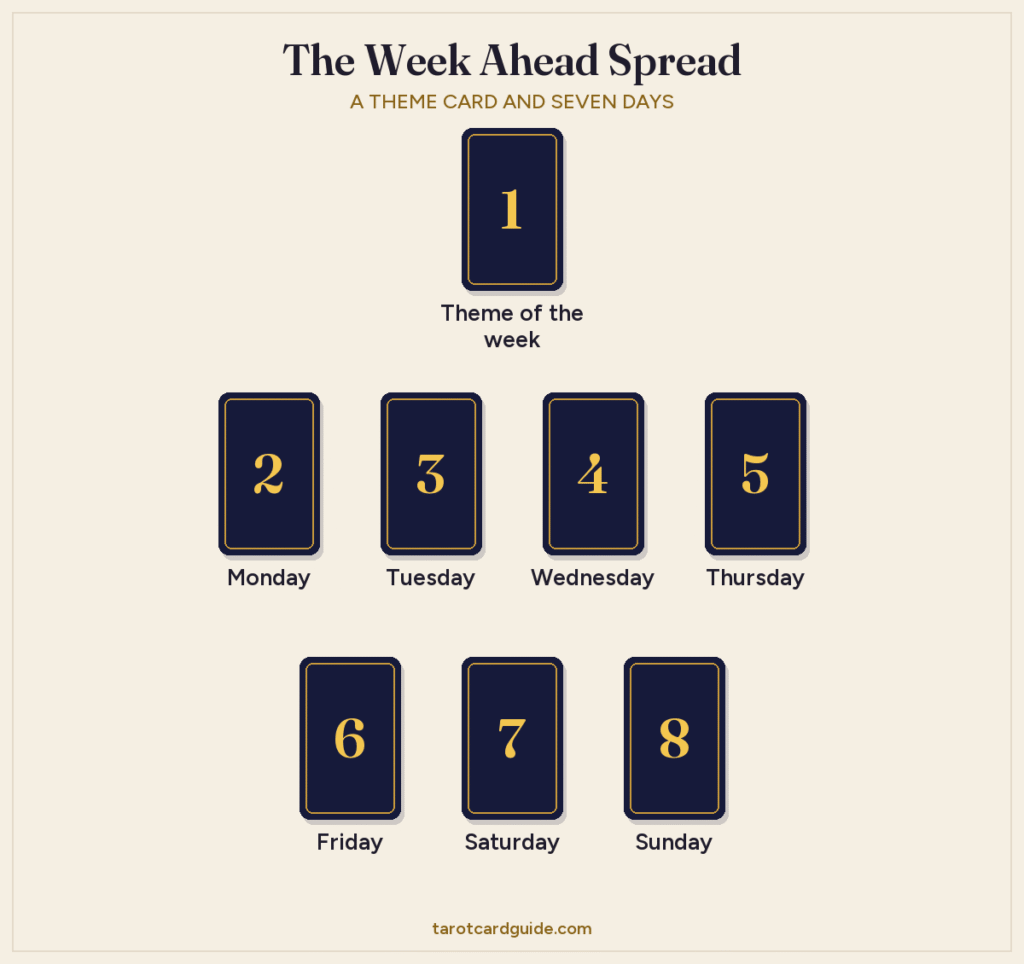
Why this shape rather than one long row of seven? A row of seven day cards needs a very wide table, and it is hard to take in at a glance. Here the theme card sits on top, Monday to Thursday form the middle row, and Friday to Sunday sit underneath. The whole week fits on a small table or a phone screen, and the bottom row gives the run into the weekend a place of its own.
How to read the theme card and the day cards
Card 1: Theme of the week
The theme card is the most important card in the spread. Read it first and read it slowly. It names the thread that runs through all seven days: something to focus on, a lesson, or the area of life that will take up most of your attention. Every day card is read in its light. For example, the Two of Pentacles as the theme suggests a week of juggling, where staying flexible and choosing priorities matter more than getting everything perfect.
- A Major Arcana theme: the week may carry a bigger lesson or turning point than usual. See the Major Arcana for the full set.
- A court card theme: often an attitude to take on this week, such as the patient steadiness of a Knight of Pentacles. Occasionally it is a person who features heavily. See tarot court cards explained.
- Reversed: the theme’s energy may be blocked or turned inwards. Treat it as something to work on this week rather than a warning.
Cards 2 to 8: the day cards
This is where most people go wrong. A day card is a mood or a focus, not a fixed prediction. The Ten of Swords on Thursday doesn’t mean disaster on Thursday. It might mean a tiring day, a plan that needs to be let go, or simply a reminder not to stack too much on that day. Read each day card as “what to pay attention to” or “the likely tone”, and let the day itself fill in the details.
Keep each day card short. One or two keywords from the card are plenty, for example “rest” for the Four of Swords or “friends” for the Three of Cups. You can always open the full meaning later if the day turns out to need it.
- Suit: Wands days lean towards energy, drive and projects; Cups days towards feelings, friends and relationships; Swords days towards thinking, talking and decisions; Pentacles days towards work, money, home and the body.
- A Major on one day: that day may matter more than it looks on the calendar, or it may bring the week’s theme into focus.
- A court card: an approach that suits the day, or someone who plays a part in it.
- Reversed: often a gentler or more inward version of the card, or advice to go easy on that energy. It is not a bad day by default.
- A hard card: read it as the part of the day that needs care, and look at the theme card for how to meet it.
An optional extra layer. In traditional astrology each weekday is linked with a planet, which is where many of the names come from: Monday with the Moon, Tuesday with Mars, Wednesday with Mercury, Thursday with Jupiter, Friday with Venus, Saturday with Saturn and Sunday with the Sun. Some readers like to keep that flavour in mind, so a Cups card on a Friday (Venus) might lean towards love and pleasure. It is entirely optional.
Reading the week as a whole
Eight separate cards make a list. Read together, they make a week with a shape. Check these, in roughly this order.
The theme and each day
Hold each day card up against the theme card. Days that agree with it are where the theme is easiest to act on. Days that clash with it are where the theme is tested. If the theme is rest and Tuesday is the Five of Wands, Tuesday is the day your need for calm meets other people’s noise.
Monday and Sunday
The first and last day cards are the two ends of the week. Compare them to see how the week moves: from busy to quiet, from uncertain to settled, or the other way round. A calm Sunday card after a hard run of days is a good sign that the week has room to recover.
The two rows
Compare the middle row, Monday to Thursday, with the bottom row, Friday to Sunday. For most people that is the working week against the run into the weekend. A heavy top row and a light bottom row say push early and ease off later. The reverse suggests the week builds slowly, so don’t plan to recover at the weekend.
Repeats and counts
Three or more cards of one suit show where the week’s attention will go. Expect two or three Majors in eight cards. Four or more turns up in only about one week in seven, and points to a week that matters. Several reversals suggest a week for slowing down or working inwardly. Repeated numbers, such as two Threes, repeat a theme; see tarot card combinations.
How to lay out the spread, step by step
- Choose your moment. Sunday evening or Monday morning both work. Pick one and stick with it, so the habit forms.
- Look at your calendar first. A quick glance at what is planned gives the day cards something to attach to.
- Set your question and conventions. Something like “What do I need to know about the week ahead?” Decide whether you read reversed cards before you shuffle.
- Shuffle and deal. Card 1, the theme, goes at the top. Then Monday to Thursday in a row beneath it, and Friday to Sunday in a row below that.
- Read the theme card first, then each day in one line, then the week as a whole.
- Write it down. Note the week’s date and all eight cards, with a word or two for each. The record section shows a simple way to do it.
- Check in each morning. Glance at the day’s card and its keyword. That’s all. No need to redeal.
Adapting the spread to your week
- Your week doesn’t start on Monday. If you work shifts or your week really begins on a Wednesday, start the day cards there. Keep the order fixed so each position always means the same day.
- Working days only. Deal a theme card and five day cards, Monday to Friday, and leave the weekend open.
- One big day. If an interview or a hard conversation falls midweek, draw one extra card for that day only and ask, “What would help me on this day?” Place it beside the day card.
A quick three-card week
Some weeks, eight cards is too much. The three-card week gives you the same planning habit in two minutes:
| Card | What it asks |
|---|---|
| 1. The week’s focus | Where should my attention go this week? |
| 2. The challenge | What might get in the way? |
| 3. The advice | What would help most? |
Read card 3 as the answer to card 2. Every card page on this site has an “as advice” section, which is a good place to check the third card. Say you draw the Page of Pentacles, the Seven of Cups and the Knight of Pentacles. The focus is a practical new start, perhaps a course or a savings goal. The challenge is too many tempting options at once. The advice is steady routine: pick one thing and keep showing up. For more simple layouts, see the three-card spread.
A full week ahead example reading
Here is a complete hypothetical reading. It is an illustration, not a real person or reading. Imagine someone called Priya, who has a project deadline on Friday and a friend’s birthday dinner on Saturday. On Sunday evening she asks: “What do I need to know about the week ahead?” This week she reads all cards upright.
| Position | Card | In brief |
|---|---|---|
| Theme | Two of Pentacles | Juggling; stay flexible and choose priorities |
| Monday | Page of Pentacles | A practical start; begin small |
| Tuesday | Five of Wands | Friction and competing opinions |
| Wednesday | Four of Swords | Rest and a pause |
| Thursday | Three of Pentacles | Teamwork and feedback |
| Friday | Ten of Wands | Carrying too much; ask for help |
| Saturday | Three of Cups | Celebration with friends |
| Sunday | The Hermit | Quiet time alone |
The theme
The Two of Pentacles sets the tone: a busy week of keeping several things moving at once. Its advice is to stay flexible but choose priorities, and to leave a margin for the unexpected. The card’s own meaning has a line worth remembering this week: you can juggle two coins with grace, but not ten.
Monday to Thursday
Monday’s Page of Pentacles is a practical beginning: a good day to start the final stretch of the project methodically, one small piece at a time. Tuesday’s Five of Wands brings friction, perhaps a meeting where everyone has a different idea. Its advice is to choose your battles and let the smaller things go. Wednesday’s Four of Swords is a pause in the middle of the week. Priya might protect Wednesday evening and keep it free. Thursday’s Three of Pentacles is teamwork and feedback: share the draft, listen to the people who know the brief, and build carefully.
Friday to Sunday
Friday is the Ten of Wands, and here the theme card speaks up. The Two of Pentacles warned that you can’t juggle ten coins, and the Ten of Wands is a person carrying ten wands at once. On deadline day, the card’s advice is to put something down and ask for help with at least one thing. Saturday’s Three of Cups is the birthday dinner: celebration and the company of friends, after an earned week. Sunday’s Hermit is quiet time alone, and a natural moment for Priya to look back over the week.
The week as a whole
Three Pentacles, the theme included, make this a practical, work-focused week. Two Wands, on Tuesday and Friday, mark the days with the most pressure. There is just one Major, The Hermit, on Sunday, fewer than the usual two or three, so this is an everyday week that Priya can shape. The top row mixes effort with a midweek pause; the bottom row runs from strain to celebration to rest. The plan almost writes itself: guard Wednesday, get help lined up before Friday, and enjoy Saturday without guilt.
Keeping a weekly record, and looking back on Sunday
A week ahead spread becomes much more useful when you write it down. A notebook or the notes app on your phone is fine. Keep it simple enough that you will actually do it:
- At the start of the week: the date, the theme card, and each day’s card with one or two keywords.
- Each evening (optional): one line on how the day actually went. A single word is enough.
- On Sunday: a few minutes looking back before you deal the next week.
For the Sunday look back, these questions are enough:
- Which day card fitted best, and which didn’t fit at all?
- Did the theme card hold for the whole week?
- Did I use any of the cards’ advice, and did it help?
- Has a card turned up in more than one week recently?
Be honest about the misses. A card that didn’t fit is not a failed reading; it is information about how you read that card, and it will make next week’s reading sharper. After a month or two, flick back through the record. You may find the cards you misread have something in common, such as always reading Swords too darkly, and that is worth knowing. If the same card keeps coming back week after week, see what it means when you keep pulling the same tarot card.
Questions to ask with the week ahead spread
The spread works best with an open question about your week. Questions that ask for exact events, or about other people’s choices, ask the day cards to do a job they can’t do.
| Weak wording | Better for this spread |
|---|---|
| What will happen this week? | What do I need to know about the week ahead? |
| Which day will I get the email? | How can I handle the waiting this week? |
| Will my boss be in a bad mood? | Where should I put my energy at work this week? |
| Is this going to be a bad week? | What would help me look after myself this week? |
For more on wording, see how to ask the right questions in a tarot reading.
Common week ahead spread mistakes
- Treating day cards as fixed predictions. A hard card on Wednesday is a prompt to take care, not a reason to dread the day.
- Skipping the theme card. It is the key to the whole spread. The day cards make much more sense once you have read it.
- Redealing midweek because the cards feel wrong. Let the week play out, then look back on Sunday. That is how you learn.
- Reading every card in full. A keyword per day is enough. The detail can wait until a day needs it.
- Never writing it down. Without a record, you can’t see what the cards got right, and the practice never builds.
Week ahead tarot spread: frequently asked questions
How do you do a weekly tarot reading?
Shuffle while thinking about the coming week, then deal one theme card followed by seven day cards, Monday to Sunday. Read the theme first, then each day in a line or two, then the week as a whole. Write it down and look back on Sunday.
When is the best time to do a week ahead tarot spread?
Sunday evening or Monday morning. Sunday evening lets you plan before the week starts; Monday morning catches the week as it begins. Either works if you keep to the same time each week.
Do the day cards predict what will happen each day?
Treat them as a mood or a focus, not a forecast. A day card suggests what to pay attention to or the likely tone of the day. What actually happens is still up to you and to everything else going on.
What if a scary card lands on one day?
Read it as the part of the day that needs care. Check its “as advice” section, and read it next to the theme card for how to handle it. Cards like Death or The Tower usually point to change or an unexpected shift, rarely anything literal.
Can I do a weekly spread with fewer cards?
Yes. The three-card week uses focus, challenge and advice, and takes a couple of minutes. You can also deal only the theme card and draw a card of the day each morning.
Should I read reversed cards in a weekly spread?
It’s up to you, as long as you decide before you shuffle. Reversals add nuance, but with eight cards a week many people find upright-only readings easier to keep up. If you do read them, treat a reversed day card as a gentler or more inward version of the card, not a bad day.
Ready for your week? Deal it with the free Week Ahead reading at the top of this page. If you would rather work one day at a time, draw a card of the day each morning; it is the best daily practice there is, and it pairs well with a theme card on Monday. Look up any card in the meanings of all 78 cards, or browse more tarot spreads.