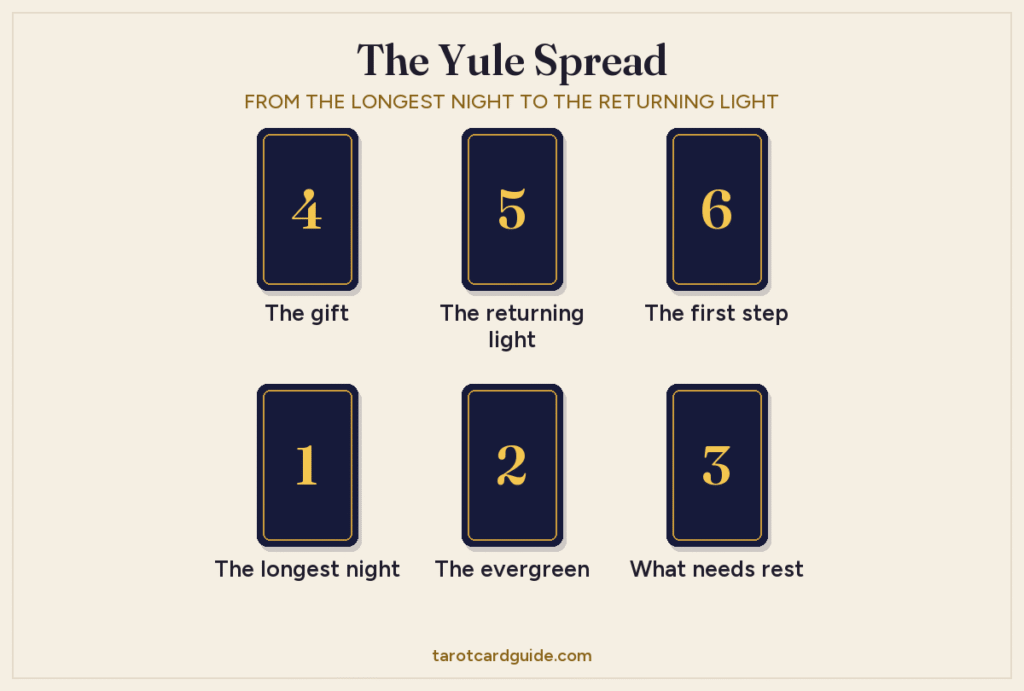
The Yule tarot spread is a six-card reading for the winter solstice, the longest night of the year. The bottom row looks at the dark half of the year: what it has shown you, what has kept you going and what needs rest. The top row looks at the light that returns after the solstice: a gift, a hope and a first step towards spring. Use it on the solstice itself or on any evening in the week around it.
Draw a free Yule reading now: think back over the darker months, then deal all six cards below. The bottom row is dealt first, then the top row, and each position is listed with its question and its card’s meaning underneath.
Your Yule Spread reading
- The longest night What has the dark part of the year shown you?
- The evergreen What has stayed strong in you all year?
- What needs rest What part of your life should lie quiet over winter?
- The gift What is the season offering you?
- The returning light What hope or new energy is starting to grow?
- The first step What small step can you take before spring?
Read each column from bottom to top as a pair: card 1 with card 4, card 2 with card 5, and card 3 with card 6. The top card shows what grows out of the one below it. Read the columns as pairs
Jump to a section:
- What is Yule, and when is the solstice?
- The six positions at a glance
- Each position in depth
- Reading the columns as pairs
- How to lay the spread, step by step
- A full example reading
- Other ways to read at midwinter
- Cards with special meaning at Yule
- Tips and common mistakes
- Journal prompts for the solstice
- Frequently asked questions
What Is Yule?
Yule is a midwinter festival. The word comes from Old English, and it is related to the Old Norse jól, the name of a midwinter feast in Scandinavia. In English it became another name for Christmastime, and in the Scandinavian languages jul is still the everyday word for Christmas.
Many of the season’s customs, such as the Yule log, evergreen branches and candles in the window, are about keeping warmth and light alive through the darkest weeks.
When is the winter solstice?
The December solstice falls on 21 or 22 December (in UTC, so the local date can differ by a day). In the northern hemisphere it brings the shortest day and the longest night. Afterwards the days lengthen again, slowly at first. In Britain the gain is only seconds a day for the first days, rising to two or three minutes a day by late January.
At mid-northern latitudes, such as Britain’s, the earliest sunsets come in the middle of December and the latest sunrises around New Year. The evenings brighten before the solstice, the mornings only after it.
Yule today
Today many witches and pagans celebrate Yule at the winter solstice as a festival of the returning sun. It is one of the eight festivals of the modern Wheel of the Year, which took shape in the twentieth century. It follows Samhain, the festival of endings, and its themes are rest, hope and quiet renewal.
Tarot has no ancient tie to Yule, and seasonal spreads like this one are modern. The Rider-Waite-Smith deck used on this site was published in 1909. You don’t need to follow any tradition to use it.
In the southern hemisphere the winter solstice falls on 20 or 21 June, and December brings the longest day instead. You can keep this spread for June, or use the summer version below in December.
The Yule Tarot Spread Layout
Lay six cards in two rows of three. Lay the bottom row first, from left to right, then the top row above it.
| Position | What it asks | Read it with |
|---|---|---|
| 1. The longest night | What has the dark part of the year shown you? | 4 (above it) |
| 2. The evergreen | What has stayed strong in you all year? | 5 (above it) |
| 3. What needs rest | What part of your life should lie quiet over winter? | 6 (above it) |
| 4. The gift | What is the season offering you? | 1, then 5 |
| 5. The returning light | What hope or new energy is starting to grow? | 2, then all |
| 6. The first step | What small step can you take before spring? | 3, then 5 |
How to Read Each Position
For each position: what it asks, how some common cards read there, and what a reversal adds. The table above shows which cards to compare.
Card 1: The longest night
This card sums up the dark stretch you have just come through. Don’t be alarmed by a difficult card here: the longest night is meant to be dark. Ask what it taught you, and what you know now that you didn’t know in the summer.
- Hard cards: the Nine of Swords points to worry and sleepless nights, the Ten of Wands to carrying too much.
- Majors: a lesson that shaped the whole year. The Tower here is a year when something fell down, and card 4 often shows what the clearing made room for.
- Reversed: either the hardest part is already easing, or the lesson hasn’t fully landed yet. The card’s reversed meaning usually tells you which.
Card 2: The evergreen
Evergreens keep their leaves when everything else is bare, which is why people bring them indoors at midwinter. This card shows what has stayed alive in you through the year: a strength, a relationship, a habit or a belief. It is the position to thank, not to fix.
- Court cards: often a quality of your own, or a person who has stood by you. A Queen here may be the friend who kept checking in.
- Endurance cards: Strength and the Nine of Wands sit naturally here. Strength is patient courage; the Nine is being bruised but still standing.
- Reversed: a strength running low. You have kept going, but the roots need feeding over winter.
Card 3: What needs rest
Winter is the season when fields lie fallow so they can grow again. This card names what to stop pushing for a while. Busy, fiery cards such as the Eight of Wands or the Knight of Wands suggest slowing down. A card like the Four of Swords simply confirms that rest is the answer.
- Suits: Wands point to projects and plans to pause, Swords to a mind that needs a break from worrying, Cups to feelings you have been over-managing, and Pentacles to money or work that can wait until January.
- Reversed: rest you are resisting. The reversed Four of Swords, for example, warns that rest you don’t choose may eventually be forced on you.
Card 4: The gift
Midwinter is a season of giving, and this card shows what is being offered to you: help, an opportunity, an insight or a chance to reconnect. Sometimes the gift is something you have been refusing, so ask whether you are ready to accept it.
- Warm cards: the Six of Pentacles is practical help, the Three of Cups friendship and company. Take them at face value.
- The Four of Cups: a classic warning in this spot. Something is being held out and you are not looking at it.
- Reversed: help that comes with strings, or a gift you are turning down out of pride.
Card 5: The returning light
The centre of the top row is the heart of the reading. After the solstice the daylight comes back only seconds a day at first, so read this card as a hope that is just starting to grow, not a sudden change. The Sun or The Star here is a lovely sign, but even a quiet card shows where the light will first break through.
- A heavy card: the light is slow, not absent. Look at the evergreen below it for what will carry you until it arrives.
- Reversed: hope you are finding hard to trust. The reversed Star, for instance, describes discouragement while the signs of recovery are already around you.
Card 6: The first step
The last card turns the reading into action. Keep it small: something you could start in January without waiting for the perfect moment. Aces and Pages are common here and suit the position well, because both are about beginnings.
- Aces: a clean start in the suit’s area. The Ace of Pentacles is a practical step such as a budget or an application; the Ace of Wands is a spark of an idea to act on.
- A big card: shrink it. Ask what the smallest honest version of that change would be.
- Reversed: the step is right but not yet. Prepare now and start once the rest in card 3 has done its work.
Read the Columns as Pairs
Once you have read each card, look at each column from bottom to top. Each pairs a card from the dark half of the year with one from the light half, and tells a small story of its own.
Left column: cards 1 and 4
What the dark taught you, and the gift that grows out of it. If the two cards share a suit, the gift arrives in the same area of life as the hardship.
Middle column: cards 2 and 5
What endured, and the hope it is turning into. This is the spine of the spread. If both cards are Majors, the reading is really about this column, and the outer ones are detail.
Right column: cards 3 and 6
The balance between resting and starting. The first step should fit the rest you need, not fight it. If card 3 says “stop rushing” and card 6 is a Knight, the step is to pick one thing, slowly.
When a column seems to contradict itself
Read the top card as what grows out of the bottom one. A hard card below and a gentle one above usually means the difficulty was the soil the new growth needed. A gentle card below and a hard one above is rarer and worth slowing down for: something comfortable may be getting in the way of what comes next.
How to Lay the Yule Spread, Step by Step
- Choose a quiet evening near the solstice, once the day’s jobs are done. Some readers light a candle to welcome back the sun; if you do, never leave it burning unattended.
- Look back before you shuffle over the months since midsummer.
- Set your question. “What do I need to know as the light returns?” is enough. You can narrow it to work, love or health habits if one area is on your mind.
- Decide on reversals before you shuffle, and keep to your choice.
- Lay the bottom row from left to right. Pause for a moment before you lay the top row, as if waiting for the dawn.
- Read in two passes: each card in its position, then the columns and rows.
- Write it down. Note the date and all six cards. Look again at Imbolc (1 to 2 February) or the spring equinox, and see whether you took your first step.
When to do it
The night of the solstice is the natural choice, but any evening in the week around it works. Many people find the quiet days between Christmas and New Year better, simply because there is time to sit with the cards.
A summer version for the southern hemisphere
If December brings you the longest day, keep the shape and change the questions:
- The longest day: what has the bright half of the year shown you?
- What has ripened: what grew well this year?
- What needs pruning: what has grown too big or too busy?
- The harvest: what can you gather and enjoy now?
- The turning: what will matter as the days shorten?
- What to store: what should you keep safe for the darker months?
Example Reading
Here is a complete hypothetical reading, an illustration rather than a real person. Imagine someone called Tom. In spring his hours at work were cut, and he spent the rest of the year covering the gap with extra shifts and a weekend side job. By December he is exhausted and still behind on two bills. On the solstice he asks: “What do I need to know as the light returns?” He reads reversals, and one card comes up reversed.
| Position | Card | In brief |
|---|---|---|
| 1. The longest night | Five of Pentacles | A lean, cold stretch and feeling shut out |
| 2. The evergreen | Strength | Patient, quiet courage |
| 3. What needs rest | Knight of Wands reversed | Burnout from charging at everything |
| 4. The gift | Six of Pentacles | Help on offer, and fair exchange |
| 5. The returning light | The Star | Hope and healing after a hard time |
| 6. The first step | Page of Pentacles | A modest, practical start |
Card by card
The longest night: Five of Pentacles. On the card, two figures struggle through falling snow beneath a lit church window, and neither looks up. It is hardship, money worry and the feeling of being left out in the cold.
The evergreen: Strength. What carried him was patience and quiet courage, not force. Strength describes someone who stays steady through a long trial without making a fuss about it.
What needs rest: Knight of Wands reversed. Upright, this Knight would be bold action. Reversed, it is burnout, spreading yourself too thin and starting things you can’t finish. What needs to rest is the constant rush to fix everything at once. The card’s own advice fits: slow down and aim the fire.
The gift: Six of Pentacles. Help and fair exchange. Support is on offer, and the card asks Tom to receive it without shame. That might mean free debt advice or a friend’s offer he keeps turning down.
The returning light: The Star. Hope after a hard time. With money it points to steady rebuilding rather than a windfall, which is a realistic kind of hope.
The first step: Page of Pentacles. Start small and keep going. A simple budget, a savings pot with a small monthly amount, or a short course that could lead to better-paid work.
Putting it together
On the left, the Five of Pentacles becomes the Six: hardship turns into help, and the lit window the figures walked past is the support Tom now needs to accept. In the middle, Strength becomes The Star, as quiet endurance turns into real hope. On the right, the burnt-out Knight hands over to the patient Page, and the message is to stop charging and start plodding.
Two more things stand out. Both Majors sit in the middle column, so the deepest theme is Tom’s own endurance becoming hope. And three of the six cards are Pentacles, so the practical subject is money and work. The whole reading says: let people help, rest the part of you that won’t stop running, and take one slow, steady step in January.
Other Ways to Read at Midwinter
A quick three-card solstice reading
Short on time? Draw three cards in a line:
- What I leave in the dark: the thing to stop carrying into the new year.
- The turning point: what is shifting now.
- What grows with the light: the hope to tend over the coming months.
You can use the free three-card spread and simply read its positions with these questions in mind.
A card a night for twelve nights
Some readers pull one card each night for twelve nights, starting on the solstice or across the twelve days of Christmas. This is a modern practice, not an ancient one. One common approach lets each night stand for a month of the coming year: the first night for January, the second for February, and so on.
Treat those twelve cards as themes to watch for, not forecasts. If the same card keeps turning up, that repetition is worth attention; see what it means when you keep pulling the same card. No deck to hand? The free card of the day works for a nightly pull.
Reading with others at a gathering
Shared readings at a winter gathering work best kept short, and only for people who want one. A simple version: everyone draws a single card for “the gift” and says what it might mean for them.
Avoid heavy questions in a group, and never read about a person who isn’t there. A Swords card deserves a gentle reading, not a joke.
A year-end look-back
After the Yule spread, plan forwards with shorter spreads. The month ahead spread suits January as a whole, and its month-end look-back shows how to keep a simple record you can review. The week ahead spread is a good fit for the first working week of the year.
Cards With Special Meaning at Yule
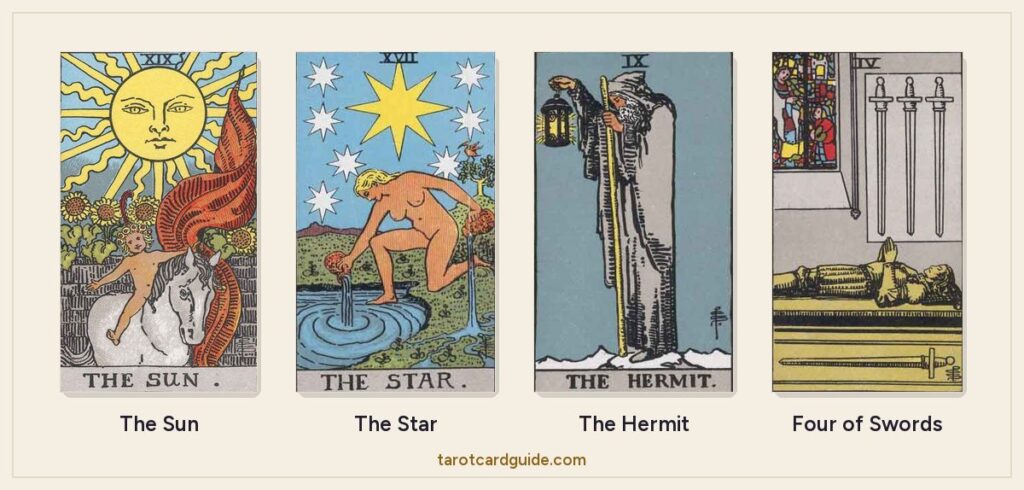
- The Sun: the season’s own card. Yule celebrates the sun’s return, so this card anywhere in the spread is a warm sign of joy and success ahead.
- The Star: hope and healing after a dark time. On the card a woman kneels by a pool under a night sky, pouring out water: renewal that keeps flowing.
- The Hermit: he stands on a snowy peak holding up a lantern, keeping his own light through the dark. A card of wisdom found in quiet.
- Four of Swords: rest and recovery. It gives you permission to pause over the holidays.
- Six of Pentacles: generosity, giving and receiving, the spirit of the season at its best.
- Ten of Cups: home, family and belonging, whether that means the family you were born into or the one you have chosen.
- Wheel of Fortune: cycles and turning points. The solstice is the year’s turning point, so the Wheel here says the tide really is changing.
Tips for a Yule Reading
- Let card 2 be a thank-you. Don’t rush past the evergreen to reach the hopeful cards.
- Keep the first step tiny. If you can’t picture doing it on a cold Tuesday in January, make it smaller.
- Be gentle with the season. December isn’t joyful for everyone. If it brings grief or loneliness, keep the reading short and focus on the evergreen and the gift. Tarot is a tool for reflection, and it is no substitute for talking to someone you trust.
Common mistakes
- Treating card 5 as a forecast. The returning light is a hope to tend, not a guarantee about next year.
- Reading a hard card in the bottom row as bad news. The bottom row describes what you have already come through. That part is behind you.
- Asking the cards about health, pregnancy or legal outcomes. Tarot isn’t the tool for those. Use the reading to reflect on how you are coping, and take the practical question to a professional.
Journal Prompts for the Solstice
Use these after the reading, or on their own if you would rather write than draw.
- Which part of me has stayed green all year, and have I thanked it?
- What am I still pushing that would do better left alone until spring?
- What help have I been offered that I haven’t accepted, and why?
- Where do I already notice a little more light than a month ago?
- What is one step I could take in the first week of January, and what would make it easier?
- What do I want to remember about this year when I read these notes next December?
Yule Tarot Spread FAQs
When should I do a Yule tarot reading?
On the night of the winter solstice (21 or 22 December in the northern hemisphere) or on any evening in the week around it. The quiet days between Christmas and New Year work well too.
Is Yule the same as the winter solstice?
They are closely linked. The solstice is the astronomical moment when the sun is at its lowest and the night is longest. Yule is the festival many modern pagans and witches hold at that time, drawing on older midwinter traditions.
Do I need to be pagan to use this spread?
No. Rest, gratitude and hope for the new year suit anyone at the end of the year, whatever they celebrate. You can use the spread at Christmas, Hanukkah, New Year or none of them.
I live in the southern hemisphere. Can I still use it?
Yes. Lay it at your own winter solstice on 20 or 21 June, or use the summer version in December.
What if I draw a difficult card in the top row?
Read it as a light that is slow to arrive rather than one that isn’t coming. A card like the Three of Swords as the returning light can mean that healing starts by facing a sadness honestly. Look at the card below it for what will help.
How likely is The Sun to turn up?
Any one card has a 6 in 78 chance of landing somewhere in a six-card spread, about 1 reading in 13. The chance that The Sun or The Star (or both) appears is about 15%, roughly 1 reading in 7. Either one is a welcome draw.
How many Major Arcana cards should I expect?
With 22 Majors in a 78-card deck, a six-card spread holds 1.7 Majors on average, and about 87% of readings contain at least one. A spread with none (about 1 in 8) is usually about everyday matters.
Should I read reversed cards in this spread?
It is up to you; decide before you shuffle. The free draw on this page reverses each card with a one in three chance, so about 91% of its readings contain at least one reversal.
Can I do this spread without a deck?
Yes. Use the free Yule draw at the top of this page, which deals all six cards into their two rows. For other ways to read online, see every free tarot reading on the site.
More Spreads to Try
Browse all our tarot spreads, including the Samhain spread for letting go at the end of October and the Celtic Cross for a deeper look at one question. For a gentler winter reading, the self-love spread suits a quiet evening. New to tarot? Start with how to read tarot cards and the full list of tarot card meanings.