The five-card cross is a five-card tarot spread laid out in the shape of a cross: one card in the centre, with one above, one below, one to the left and one to the right. It shows the heart of a situation, what you are aiming for, what led here, where it is heading and what lies underneath. It suits anyone who finds three cards too thin and ten too many, and it is one of the best spreads for learning to read cards in relation to each other.
It works for almost any open question, about love, work, a decision or how you are feeling. You can draw one for free right here.
Draw a free Five-Card Cross reading now: think of your question, then deal the five cards below. Each position shows its question, your card and what it means there, with a link to the card’s full meaning.
Your Five-Card Cross reading
- Heart of the matter What is this really about?
- Above: the goal What are you aiming for, or aware of?
- The past What has led to this?
- The future Where is this heading next?
- Below: the foundation What lies underneath?
Read the cross as two lines through the centre card: past, centre and future across; goal, centre and foundation down. How to read the positions together
Jump to a section:
- What the five-card cross is for
- How it compares with the three-card spread and the Celtic Cross
- The 5 positions at a glance
- Each position in depth
- Reading the positions together
- How to lay out the spread, step by step
- A full example reading
- Using it for love, work and personal questions
- Common mistakes
- Frequently asked questions
What is the five-card cross tarot spread?
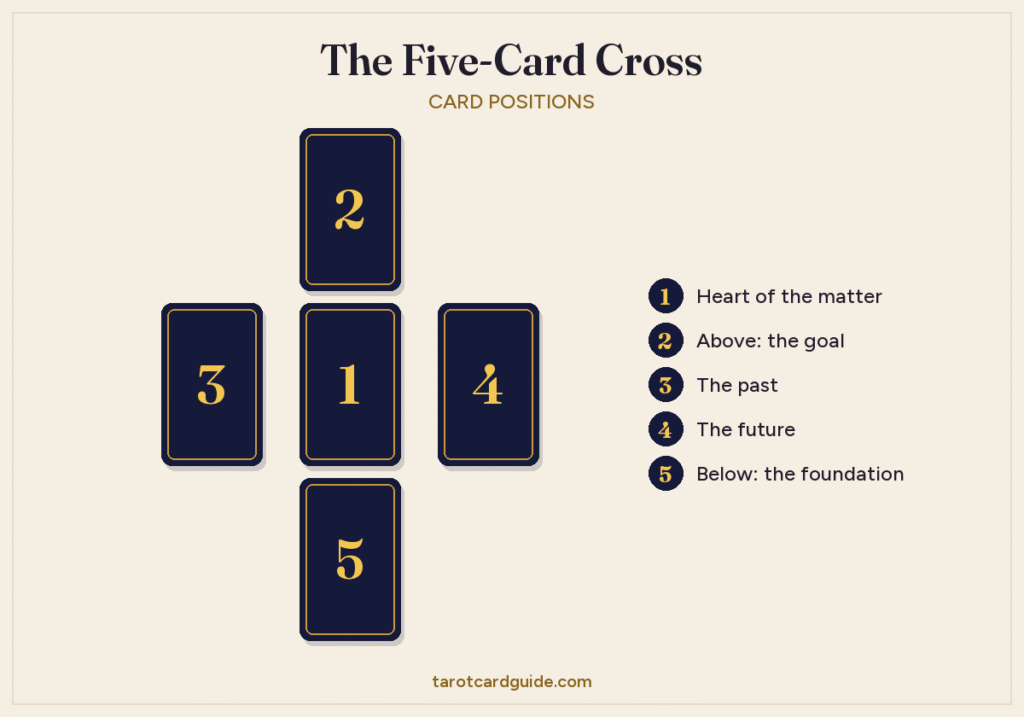
The five-card cross is built from two lines that meet in the middle. The horizontal line is time: the past on the left, the present in the centre, the future on the right. The vertical line is depth: what you are aiming for or aware of above, and what lies underneath below. The centre card belongs to both lines, which is why everything is read in relation to it.
That combination is what makes the spread useful. A three-card reading tells a story from past to future. The cross adds the question of why: what you want from the situation, and what is driving it beneath the surface. Very often the answer to a question sits in the gap between the card above and the card below.
Use the five-card cross when:
- you want more depth than a three-card spread but not the full ten cards of a Celtic Cross
- a situation feels stuck and you suspect the reason is not obvious
- what you want and how you feel seem to pull in different directions
- you are learning to read cards together rather than one at a time
It is less suited to some questions. For a quick yes or no, use the yes or no tarot. To compare two choices, the two options spread sets them side by side. If you already know what the obstacle is and mainly want advice, the interactive five-card spread has positions for the challenge, guidance and likely outcome. For a question about two people, try the relationship spread.
How it compares with the three-card spread and the Celtic Cross
The five-card cross sits neatly between the two best-known spreads, and it shares a lot with both.
| Spread | Cards | What it covers | Best for |
|---|---|---|---|
| Three-card spread | 3 | A simple story, such as past, present and future | Quick readings and everyday questions |
| Five-card cross | 5 | The same timeline, plus the goal above and the foundation below | Questions where you want to know why, not just what next |
| Celtic Cross | 10 | The cross, a challenge card, and four more cards about you, others, hopes and fears, and the outcome | Big, tangled questions with several people or layers |
Compared with three cards: the horizontal line of the cross (cards 3, 1 and 4) is a past, present and future reading. If you are used to three-card spreads, you already know how to read half of this one. The two extra cards add the vertical line, and with it the difference between what you think you want and what is really going on.
Compared with the Celtic Cross: the first six cards of the Celtic Cross also form a cross, with a centre card, the past to the left, the near future to the right, the conscious aim above and the subconscious below. On top of that, the Celtic Cross lays a challenge card across the centre and adds a column of four cards beside it. The five-card cross is essentially the heart of the Celtic Cross without the crossing card and the column. That makes it a good step towards the bigger spread, and a good choice when you want its core without the extra hour.
The 5 positions at a glance
| Position | What it asks | Read it with |
|---|---|---|
| 1. Centre: the heart of the matter | What is this really about, right now? | All four |
| 2. Above: higher perspective or goal | What are you aiming for, hoping for or aware of? | 5, 4 |
| 3. Left: the past | What has led to this? | 4, 5 |
| 4. Right: the future | Where is this heading next, if nothing changes? | 3, 2 |
| 5. Below: foundation or subconscious | What lies underneath, driving things? | 2, 3 |
The numbers give the order of laying: the centre first, then above, left, right and below. You can also draw a five-card cross with the interactive Cross Spread, which uses the same five places, numbered in a different order. Whichever order you use, the place on the table is what gives each card its meaning.
Each five-card cross position in depth
For each position: what it asks, how different kinds of card tend to read there, and which cards to compare it with. The one-card examples are a starting point; always check them against the rest of the cross.
Card 1, centre: the heart of the matter
The centre card is the situation as it stands, or the state you are in as you ask. It is not always the topic you asked about. Sometimes it names the real issue underneath the question, which is why it is worth sitting with before you move on. For example, the Two of Swords here shows a stalemate: a choice you are avoiding, and nothing moves until you look at the facts and decide.
- Major or Minor: a Major says this is a significant chapter, shaped by forces bigger than the week’s events. A Minor places it in everyday life, where you can deal with it directly.
- Court cards: very often you, acting in that card’s style, or a person who is central to the question.
- Reversed: energy that is blocked, delayed or turned inwards. The situation may feel stuck, or be changing in ways that are not yet visible.
- Compare with: every other card. Each of them describes something about this one.
Card 2, above: higher perspective or goal
The card above the centre shows what you are consciously aiming for: the goal, the ideal, the thought at the front of your mind. Some readers also read it as the higher perspective, the best that could come of the situation, or what it is trying to teach you. Both readings look upwards; see which fits. For example, The Chariot here shows a clear goal and the will to reach it, the wish to take the reins and move forward.
- Major or Minor: a Major ties the goal to something deep, such as a value or a life direction. A Minor points to a specific, practical aim.
- A difficult card: a hard card above can show what is on your mind, rather than what you want: a worry you keep returning to, or an aim that is costing you too much.
- Reversed: a goal that is unclear, half-hearted, or not really yours.
- Compare with: card 5 (the aim against what lies underneath) and card 4 (the aim against where things are heading).
Card 3, left: the past
The card on the left shows what led here: recent events, decisions or patterns that still shape the situation. Read it as the part of the story that explains the centre card. For example, the Five of Swords here may point to a recent conflict or power struggle, perhaps one that was won at too high a price.
- Major or Minor: a Major suggests a turning point whose effects are still unfolding, sometimes from further back. A Minor points to a recent event or phase that is passing.
- A happy card: a good card in the past can mean something you miss, or a strength you have forgotten you have.
- Reversed: unfinished business, or something from the past that has not quite been let go.
- Compare with: card 4, to see the direction of travel, and card 5, since old experiences often become the foundation.
Card 4, right: the future
The card on the right shows what comes next if things carry on as they are: the next stage, not a final result. It is a direction of travel you can change. A reversed card here often shows something delayed rather than denied. For example, the Eight of Wands suggests things are about to move quickly: messages arriving, plans taking off, a stuck situation breaking free.
- Major or Minor: a Major suggests a development you will feel strongly and may not fully control. A Minor points to a next step you can shape.
- Court cards: a person who may come into the situation, or a way of acting you are about to take on.
- Compare with: card 3 (where the story came from) and card 2 (does the future move towards the goal?).
Card 5, below: foundation or subconscious
The card beneath the centre shows what lies underneath: the root of the matter, feelings not yet put into words, or beliefs you take for granted. It is often the card people recognise with a jolt, and it is frequently the key to the whole reading. For example, the Nine of Swords here may show worry or overthinking quietly driving everything above it.
- Major or Minor: a Major points to a deep pattern or belief. A Minor shows a feeling or need that is easier to name once you see it.
- A positive card: a good card below is a real resource: a strength, a support or a sound instinct you can build on.
- Reversed: something hidden even from you, or a pattern you are ready to release. Read the card’s reversed meaning and ask which fits.
- Compare with: card 2, directly opposite, and card 3.
Reading the positions together
Five cards are few enough to hold in your head at once, which is what makes this spread such good practice. These are the connections worth checking every time.
The timeline: cards 3, 1 and 4
Read the horizontal line as one sentence from left to right: “this happened, so this is where I am, and this is where it is going”. Look at the direction: from difficulty towards relief, from ease towards a test, or the same theme repeating. If the past and future cards share a suit or a number, the story may be a pattern rather than a one-off.
Above and below: cards 2 and 5
The vertical line compares what you think you want with what is really driving you. When the two agree, progress tends to come more easily. When they clash, for example a card of ambition above and a card of exhaustion below, the clash is often the answer to your question. This pair is the main thing the cross adds to a three-card reading, so give it time.
Goal and future: cards 2 and 4
Put the card you are reaching for next to the card you are heading towards. If they point the same way, you are on track. If they do not, card 5 usually shows why, and card 3 may show the habit or event that set the course.
Past and foundation: cards 3 and 5
These two sit side by side in the lower left of the cross. When they echo each other, an old experience has become part of how you see things now. Naming that link is often more useful than any prediction.
Counting the cards
In five cards from a full deck, one or two Major Arcana cards is typical. Three or more suggests a significant chapter. Three cards of one suit shows what kind of question this really is: Wands for drive and action, Cups for feelings and relationships, Swords for thoughts, decisions and stress, and Pentacles for money, work and practical matters. Several reversed cards show energy that is blocked or turned inwards; note which line they fall on. For how particular cards change each other, see tarot card combinations.
How to lay out a five-card cross, step by step
- Choose an open question. “What do I need to understand about…?” or “What is really going on with…?” work well. A single, clear topic works better than two questions at once.
- Decide your conventions before you shuffle: whether you read reversed cards, and how far ahead card 4 looks, such as a few weeks or a few months.
- Shuffle and cut while you think about the question.
- Lay the centre first. Card 1 goes in the middle.
- Build the cross around it. Card 2 above the centre, card 3 to the left, card 4 to the right and card 5 below.
- Read in three passes. First look at the whole cross and count Majors, suits and reversals. Then read each card in its position, starting with the centre. Then read the two lines and the pairs.
- Sum it up in two sentences. One for what is going on, one for what you will do about it. Write both down with the date and the cards.
Variations
- A different numbering. Some readers lay the cross in another order, for example the centre, then above, then below, then left and right. The places mean the same; keep the order you choose.
- Advice and obstacle instead of goal and foundation. Some readers use the vertical line for “what helps” above and “what holds you back” below. It is a useful version for practical questions; decide on it before you draw.
- A clarifier. If one card stays unclear, draw one more and ask what you need to understand about it. Read it as a comment on that card, not a replacement. One is enough.
A full five-card cross example reading
Here is a complete hypothetical reading, to show how the cross fits together. It is an illustration, not a real person. Imagine someone called Maya, who moved to a new city for work four months ago. The job is fine, but she feels flat, keeps thinking about her old life and has not made any friends yet. She asks: “What do I need to understand about feeling unsettled since my move?” Maya reads reversed cards.
| Position | Card | In brief |
|---|---|---|
| 1. Centre: heart of the matter | Five of Cups | Grief and disappointment, eyes fixed on what was lost |
| 2. Above: goal | Three of Cups | Friendship, community, people to share things with |
| 3. Left: the past | Six of Swords | The move itself: a bittersweet transition |
| 4. Right: the future | Four of Wands | Belonging, a sense of home, something to celebrate |
| 5. Below: foundation | The Hermit, reversed | Withdrawal that has tipped into isolation |
The heart of it: card 1
The Five of Cups shows grief and disappointment, with attention fixed on what has been lost. It describes a lingering aftermath rather than a sharp blow, which fits a move that went well on paper. The card asks Maya first to acknowledge the loss: the friends, streets and routines she left behind. Two cups still stand behind the figure, though, and the card invites her to turn towards what remains when she is ready.
The timeline: cards 3 and 4
Behind her is the Six of Swords, the card of moving on and, quite literally, relocation. Its meaning allows for sadness about what you leave, even when the move is right. Ahead is the Four of Wands: belonging, a harmonious home and a supportive community. Read as one line, the story runs from leaving, through a sad middle, towards feeling at home. The direction is good.
Above and below: cards 2 and 5
Above the centre, the Three of Cups shows what Maya wants: friendship and people to share things with. Below it, The Hermit reversed shows what is actually happening underneath. Reversed, The Hermit points to withdrawing too far and cutting yourself off from people who could help. Solitude that once helped may now be keeping you stuck. This is the clash that answers the question: Maya wants company, but has been staying in.
Putting it together
The reading does not say the move was a mistake. It says Maya is grieving her old life (Five of Cups), which is normal after a move (Six of Swords), and that the feeling of home she wants is ahead (Four of Wands). What could delay it is the withdrawal underneath (The Hermit reversed). The Three of Cups gives the practical advice: accept the invitation, organise the get-together, or message an old friend. The Four of Wands adds another: invest in the places and people that make you feel at home, such as inviting a colleague round.
The count supports this. Two Cups make it a question about feelings and connection; the one Major, reversed and in the foundation, marks the deepest issue. Remember that the future card is not fixed. If Maya kept to herself, the Four of Wands might take much longer to arrive. If loneliness feels heavy for a long time, talking to someone you trust, or to your doctor, is a sensible step.
Using the five-card cross for love, work and personal questions
The positions stay the same for every question, but it helps to know how each tends to read for different topics:
| Position | Love | Work | Personal growth |
|---|---|---|---|
| 1. Centre | The relationship or your love life now | Your current job or situation at work | Where you are emotionally or mentally |
| 2. Above | What you want from love | Your ambition or ideal role | What you are trying to become |
| 3. Left | Past relationships or recent events between you | Your track record and recent events at work | Old patterns or experiences |
| 4. Right | Where the connection is heading | The next stage at work | The change that is coming |
| 5. Below | Unspoken needs, fears or attachment patterns | Beliefs about success, money or your worth | What is holding you back beneath the surface |
For love, ask about your part and the dynamic, such as “What do I need to understand about where this relationship is going?”, rather than what someone else will do. The love meanings of all 78 cards help here. For work, the career tarot card meanings give each card’s work and money reading, and the career path spread goes further with six positions built for work questions.
Good questions and weaker ones
| Instead of | Try |
|---|---|
| Will they come back? | What do I need to understand about this relationship ending? |
| Will I get promoted? | What is really going on with my progress at work? |
| Why am I so unlucky? | What is keeping me stuck, and what lies underneath it? |
| Should I move or change jobs? | Two separate readings, one for each question |
For more on wording, see how to ask the right questions in a tarot reading.
Common five-card cross mistakes
- Reading it as a straight line. The cross has two lines. If you only read left to right, you have a three-card reading with two spare cards.
- Treating the future card as fate. Card 4 is where things are heading if nothing changes. The vertical line often shows what could change it.
- Skipping the foundation. Card 5 is easy to rush past, because it is at the bottom. It is often the most important card on the table.
- Changing the positions after you draw. Decide what above and below mean before you shuffle, especially if you use the advice and obstacle variation.
- Adding clarifier after clarifier. One extra card can help. Five more turns a clear reading into noise.
Five-card cross: frequently asked questions
What are the positions in a five-card cross?
In the version on this page: 1 the centre, or heart of the matter; 2 above, the higher perspective or goal; 3 left, the past; 4 right, the future; and 5 below, the foundation or subconscious. Other versions use the same five places with different numbers.
Is the five-card cross good for beginners?
Yes. It is one of the best spreads to learn after the three-card spread, because its horizontal line is a past, present and future reading, and the vertical line teaches you to compare cards. It is also a good step towards the Celtic Cross.
What is the difference between the five-card cross and the Celtic Cross?
The first six cards of the Celtic Cross also form a cross, with the past, near future, conscious aim and subconscious around the centre. The Celtic Cross adds a challenge card laid across the centre and a column of four cards about you, other people, hopes and fears, and the outcome. The five-card cross keeps only the central cross.
Which card is the most important?
The centre card sets the scene, and every other card is read in relation to it. The card below is often the most revealing, because it shows what is driving the situation beneath the surface.
Can I use the five-card cross for a yes or no question?
It is not built for one. Turn the question into an open one and let the cross show the conditions. If you still want a leaning, look at the centre and future cards on the yes or no tarot page; for a direct answer, a single card is the better tool.
How far ahead does the future card look?
As far as you decide before you draw. A few weeks to a few months works well for most questions. Choose first, so you are not tempted to stretch the time frame to fit the card.
Ready to practise? Deal a free five-card cross at the top of this page, look up any card in the meanings of all 78 cards, move up to the full Celtic Cross, or browse the other tarot spreads.