A self-love tarot spread is a short reading that turns the cards towards you: how you see yourself, what you overlook, what you are ready to stop believing and how to treat yourself better this week. This one uses six cards in three pairs, and every position is written to be kind without being soppy.
It works for self-worth, self-care and those weeks when you are running on empty and being hard on yourself about it. Tarot here is a mirror for reflection. It won’t fix low self-esteem on its own, and it isn’t therapy, but it can give you a clear, specific place to start.
Draw a free Self-Love Spread reading now: take a breath, think about how you have been treating yourself lately, then deal all six cards below. Each position shows the question it asks, and each card links to its full meaning.
Your Self-Love Spread reading
- How I see myself How am I seeing myself right now?
- Unseen strength What don’t I give myself credit for?
- Old story What old story about myself is ready to go?
- What I need What do I need more of?
- Care this week How can I show myself care this week?
- What grows What grows when I treat myself kindly?
Read the cards in their three columns: 1 with 2, 3 with 4, and 5 with 6. Then compare card 1 with card 6 to see where kindness could take you. How to read the positions together
Jump to a section:
- What the self-love spread is, and when to use it
- The 6 positions at a glance
- Each position in depth
- Reading the positions together
- How to lay out the spread, step by step
- A full example reading
- Reading hard cards gently
- Cards that often speak to self-worth
- Journal prompts for each position
- Questions to ask
- Common mistakes
- Frequently asked questions
What is the self-love tarot spread?
Most spreads look outwards, at a job, a relationship or a decision. This one looks at the relationship you have with yourself. The six cards sit in three columns of two. The first column is about you as you are. The second is about what to put down and what to take in. The third is about one kind act and what it leads to.
The positions are deliberately practical. Self-love can sound vague, so the spread keeps asking small, answerable questions: what do I overlook, what do I need, what could I do this week? A reading that ends with one real act of care is worth more than one that ends with a nice feeling.
When the self-love spread works well
- You have been giving everything to other people and running low yourself.
- Your inner critic has got loud, after a setback, a breakup or a stretch of comparing yourself to everyone else.
- You want a gentle monthly or seasonal check-in on how you are treating yourself.
- You are starting something new, such as a routine, a boundary or a fresh start after a hard year, and want to begin from a kinder place.
When another reading is better
- Straight after a breakup: the broken heart spread is built for grief and letting go, and it pairs well with this one a few weeks later.
- A question about someone else’s feelings: try the love tarot reading or the How do they feel about me? reading.
- A quick daily nudge: one card is enough. Your card of the day can be read as a small self-care prompt each morning.
- A big life decision: the two options spread or the Celtic Cross have room for the moving parts.
A plain word on limits. Tarot is a reflection tool, not therapy and not a diagnosis. If you are struggling a lot, with low mood, anxiety or thoughts that frighten you, talking to your GP, a counsellor or a local support line helps. Reaching out is an act of self-love too.
The 6 self-love spread positions at a glance
Each position asks one question, and each has a partner in its column:
| Position | What it asks | Read it with |
|---|---|---|
| 1. How I see myself | How am I seeing myself right now? | 2, 6 |
| 2. Unseen strength | What don’t I give myself credit for? | 1, 4 |
| 3. Old story | What old story about myself is ready to go? | 4, 5 |
| 4. What I need | What do I need more of? | 3, 2 |
| 5. Care this week | How can I show myself care this week? | 6, 3 |
| 6. What grows | What grows when I treat myself kindly? | 5, 1 |
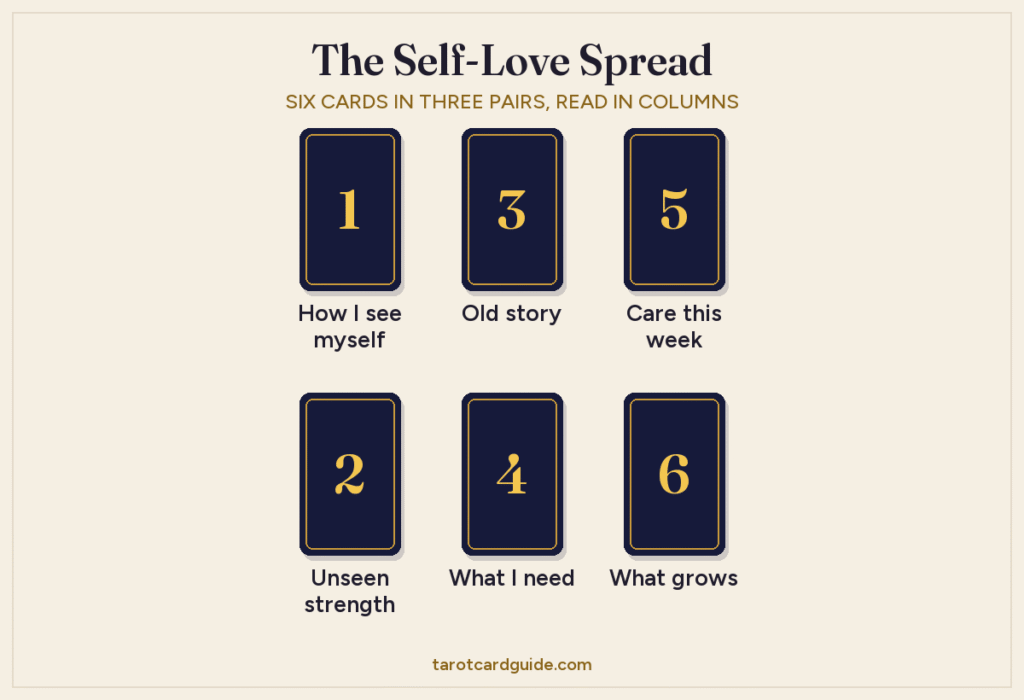
Lay the cards in two rows of three. The top row (1, 3, 5) runs from how you see yourself, through the story you tell, to what you can do. The bottom row (2, 4, 6) runs from the strength you already have, through what you need, to what grows. Each column is a pair, and the pairs carry most of the meaning.
Each self-love position in depth
For each position: what it asks, how cards tend to read there, and what to compare it with. The suits keep their usual areas: Wands for energy and drive, Cups for feelings and relationships, Swords for thoughts and self-talk, and Pentacles for the body, money, home and daily routine. In a self-love reading, Swords often show the inner critic, and Pentacles often show care that is physical and practical.
Card 1: How I see myself
The first card is your current self-image, the lens you are looking through this week. It isn’t the truth about you. It’s the view. For example, the Eight of Swords here suggests you see yourself as stuck or powerless, when the card itself says the restrictions are usually more internal than external.
- A bright card: you see yourself fairly well at the moment. Let the rest of the spread show how to protect that.
- A heavy card: this is how it feels, not a verdict. Look straight at card 2 for the part of the picture you are leaving out.
- Compare with: card 2, its partner, and card 6, where the reading is heading.
Card 2: Unseen strength
Card 2 names something good in you that you don’t give yourself credit for. People who struggle with self-worth tend to skip past their own strengths, so read this card slowly. Treat even a difficult card here as a strength in disguise. For example, the Nine of Wands upright is resilience and stamina: you have kept going through more than you admit.
- Court cards: often a quality you already have. A Queen of Cups here might be your compassion; see tarot court cards explained.
- Reversed: a strength you have been hiding or not using, rather than one you lack.
- Compare with: card 1 (what the self-image misses) and card 4 (can this strength help meet the need?).
Card 3: Old story
Card 3 shows a belief about yourself that has outlived its use. Everyone carries a few: “I have to earn rest”, “I’m the one who copes”, “I’m too much”. The card rarely spells the sentence out, so ask what story it would tell if it could talk. For example, the Ten of Wands can be the story that everything depends on you, and that nobody else will do it properly.
- A positive card here: a good quality taken too far. A generous card can point to always giving and never receiving.
- Major or Minor: a Major Arcana card points to a deep, long-running belief. A Minor points to a habit of thought you can start changing this week.
- Compare with: card 4, what could take the story’s place, and card 5, the action that answers it.
Card 4: What I need
Card 4 names what you are short of. It might be rest, company, fun, structure, honesty or simply time outdoors. Read the card as a need, not a flaw. For example, the Four of Swords here is a clear call for rest and quiet, and its advice is to protect that time as seriously as any appointment.
- Suit: Wands point to energy, play and movement; Cups to connection and feeling; Swords to clarity, honesty or a break from overthinking; Pentacles to the body, sleep, food, money and routine.
- A hard card: read it as the need behind the difficulty. A lonely card may say you need company; an anxious one, reassurance and support.
- Compare with: card 3 and card 2.
Card 5: Care this week
Card 5 is the practical heart of the spread. It suggests one way to look after yourself in the next seven days. Every card page on this site has an “as advice” section, which is the best place to check. Turn the card into one specific act you could actually do, not a mood. For example, The Empress says to nurture what you want to grow, including yourself: eat well, get outside, make something beautiful.
- Reversed: often care that means doing less: less over-giving, less scrolling, fewer commitments.
- A tough card: it still gives advice. The Five of Pentacles here would say the kindest thing this week is to ask for help and accept it.
- Compare with: card 6, what the care leads to, and card 3, the old story it quietly argues with.
Card 6: What grows
The last card shows what tends to grow when you keep treating yourself kindly. It is a direction, not a promise or a deadline. For example, The Sun here points to joy, warmth and optimism, and its advice is to stop playing small.
- A hard card: read it as what grows through the difficulty, such as honesty, stronger boundaries or the ability to ask for help. It can also be a gentle warning about what grows if nothing changes.
- Reversed: growth that is slow, private or still underground. Keep going with card 5.
- Compare with: card 5, its partner, and card 1, where you started.
Reading the self-love positions together
Read one by one, six cards are a list. Read in pairs, they start to talk to each other. These are the links worth checking every time.
The view and what it misses: cards 1 and 2
The first column sets how you see yourself against what you overlook. Read them as one sentence: “I see myself as this, but I forget that.” When card 1 is harsh and card 2 is warm, the gap between them is the reading’s first lesson. When both are warm, enjoy it; when both are heavy, look for the strength hidden inside card 2 before you move on.
Put down and take in: cards 3 and 4
The middle column is a swap. Card 3 is the story you can put down, and card 4 is what could fill the space. Often the two are linked: a story about having to be strong sits above a need for rest, or a story about being too much sits above a need for connection. If you can’t see the link, ask what the old story has been stopping you from getting.
The act and its fruit: cards 5 and 6
The last column is cause and effect. Card 5 is what to do this week; card 6 is what that kind of care tends to grow into. A small card at 5 with a big card at 6 is encouraging: modest acts, done often, add up.
Across the rows
- Cards 1 and 6: where you start and where kindness could take you. The difference between them is the distance the reading is inviting you to travel.
- Cards 3 and 5: the old story against the new habit. Good self-care advice usually argues with the story directly.
- Cards 2 and 4: the strength you already have against the thing you need. Often the strength is how you meet the need.
Then take a quick count. Several Swords point to self-talk as the main issue; several Pentacles to the body, rest or money; several Cups to feelings and connection. In six cards, expect one or two Major Arcana cards. More than that suggests a bigger chapter in how you see yourself. Repeated numbers repeat a theme; see tarot card combinations.
How to lay out a self-love spread, step by step
- Pick a quiet moment. Ten minutes with a drink and a notebook is plenty. This reading goes better when you aren’t rushed.
- Set your question. The spread works with no question at all, or with a gentle focus such as “How can I be kinder to myself this month?”
- Decide your conventions before you shuffle, such as whether you read reversed cards.
- Shuffle and lay two rows of three. Cards 1, 3 and 5 go along the top from left to right; cards 2, 4 and 6 go underneath them, so each pair forms a column.
- Read in three passes. First the whole spread: suits, Majors, reversals, the general mood. Then each card in its position. Then the three columns, and cards 1 and 6 last.
- Choose one act. Turn card 5 into something specific for this week, and write it where you will see it.
- Write it down and look back. Note the date and all six cards. In a week, check whether you did the act and how it felt.
A full self-love spread example reading
Here is a complete hypothetical reading, to show how the pairs work. It is an illustration, not a real person. Imagine someone called Maya, who works full time, helps care for a parent and is the friend everyone calls in a crisis. She feels flat and irritable and is cross with herself for it. She asks: “How can I be kinder to myself this month?” Maya reads reversed cards.
| Position | Card | In brief |
|---|---|---|
| 1. How I see myself | Nine of Wands, reversed | Worn down and defensive, stuck in survival mode |
| 2. Unseen strength | Six of Pentacles | Real generosity and fairness |
| 3. Old story | Ten of Wands | “I have to carry everything” |
| 4. What I need | Four of Swords | Rest, quiet and a proper pause |
| 5. Care this week | Queen of Pentacles | Practical care, with herself included |
| 6. What grows | The Star | Hope, healing and renewal |
The view and what it misses: cards 1 and 2
The Nine of Wands reversed describes burnout and walls that have grown too high: feeling overburdened, stuck in survival mode, and turning down help that is genuinely offered. That is how Maya sees herself right now, as someone barely holding on. Beneath it sits the Six of Pentacles: generosity, support and fair exchange. Her unseen strength is how much she gives, and how well. The card also reminds her that giving and receiving are two halves of the same thing, and neither role defines her worth.
Put down and take in: cards 3 and 4
The old story is the Ten of Wands, the card of the person everyone relies on. Its own text says the burden is often self-imposed, driven by guilt or a belief that nobody else will do it properly. On the card, the man carries all ten wands at once, and the bundle blocks his view of the road ahead. Underneath is the Four of Swords: rest, recovery and a deliberate pause. The swap is almost literal. Put some of the wands down, and use the space for real rest.
The act and its fruit: cards 5 and 6
The Queen of Pentacles is warm, practical care, and her advice is plain: take care of what you love, and include yourself in that care. For Maya this week, that might mean one evening off, a proper meal, or asking a sibling to cover one visit. It doesn’t need to be grand. The Star beneath her is hope and healing after a hard time, a quiet return of calm rather than anything dramatic. Kept up, the care leads somewhere lighter.
Putting it together
Read from card 1 to card 6, the spread goes from a worn-down Nine of Wands to The Star: from survival mode to hope. The route runs through the swaps in the middle. The Six of Pentacles and the Queen of Pentacles both say the same thing about giving: it should flow both ways. Maya already knows how to care for people. The reading asks her to count herself among them.
The count supports this. Two of the six cards are Pentacles, both about practical care, so the self-love the reading has in mind is down to earth: sleep, food, time and help. Two more are Wands, both about burden and stamina, and the one Sword asks for rest. There is only one Major, The Star, in the growth position, which suggests the change is gentle and largely in her hands. The single reversal is card 1, the self-image, which is exactly the thing the rest of the spread is working to turn upright.
How to read hard cards gently in a self-love spread
Sooner or later a heavy card lands in a self-love reading, and it can sting. Remember that the spread asks kind questions, so every card gets a kind reading. A hard card here usually names a feeling that deserves care, not a judgement about you. These are the ones people worry about most.
Nine of Swords
The Nine of Swords is worry, guilt and sleepless nights. On the card, nine swords hang on the wall behind a figure sitting up in bed, but none of them touch the sleeper. That’s the gentle reading: the fears are heavy, but much of the damage comes from what the mind does with them in the dark. At card 1, it suggests your self-image is being shaped by late-night thinking. Its advice is simple: don’t face the night alone, and tell someone what’s worrying you.
Ten of Swords
The Ten of Swords is a painful ending or rock bottom. The card’s own reading is that it marks the end of a chapter, not the end of you. At card 3, it can show a story of defeat that you are ready to stop retelling. At card 6, it can say that something draining has to end before anything new can grow. Reversed, it is recovery and rising again.
The Tower
The Tower is sudden upheaval and revelation, when something built on shaky ground falls. In a self-love spread it often points to a false belief about yourself breaking down. Reversed, it can be exactly that change happening quietly on the inside. If it falls at card 3, the old story may already be crumbling. The Tower’s advice is to stop propping up what is already falling, and to look after yourself first if the shake-up has already happened.
Five of Pentacles
The Five of Pentacles is hardship and feeling left out in the cold. On the card, two figures struggle through the snow past a lit church window, too focused on the storm to look up at the shelter. At card 4, the need is support, and letting someone in. Its own advice ends with a line worth keeping: hard times say nothing about your worth. Reversed, it can mean the worst is passing, or rebuilding the belief that you deserve help.
Eight of Swords
The Eight of Swords is feeling trapped, often by fear and your own thinking. It names limiting beliefs about what you can do or deserve, which makes it a natural fit for card 3. The card’s advice is to take off the blindfold: write down what you know for certain, then what you are only afraid of, and notice how different the two lists are. Reversed, it is release and self-acceptance.
A rule of thumb: when a hard card appears, read card 2 and card 5 again straight away. The spread always gives you a strength and an act of care to set beside the difficulty. If the same heavy cards keep appearing for weeks, see what it means when you keep pulling the same tarot card, and consider talking to someone you trust as well.
Cards that often speak to self-worth
Some cards carry self-worth themes in their own meanings, upright or reversed. When one of these turns up in the spread, it is often worth an extra look.
| Card | What it can say about self-worth |
|---|---|
| Nine of Pentacles | Self-worth and independence; enjoying what you have built without asking permission |
| Strength | Quiet courage and self-compassion; reversed, self-doubt and low energy |
| The Star | Faith in yourself and healing; reversed, self-doubt and burnout |
| The Sun | Letting yourself shine; reversed, self-doubt or feeling overlooked |
| The Empress | Nurturing yourself as well as others; reversed, over-giving and self-neglect |
| Queen of Cups | Compassion that includes you; reversed, poor boundaries and over-giving |
| Queen of Wands | Confidence and being seen; reversed, self-doubt and insecurity |
| Ace of Cups | Letting yourself receive; reversed, blocked emotions and self-neglect |
| Four of Cups | Overlooking what is being offered to you |
| Eight of Swords | Limiting beliefs about what you can do or deserve |
| Five of Pentacles | Hardship that says nothing about your worth; reversed, learning you deserve help |
Strength deserves a special mention. On the card, a woman gently closes a lion’s jaws with her hands, with no struggle and no chain. As self-love advice it is hard to beat: meet your own anxious or angry feelings with understanding, not harsh self-control.
Journal prompts for each position
If a card doesn’t speak to you straight away, write. These prompts give you somewhere to start, one or two per position.
- 1. How I see myself: If this card were a caption on a photo of me this week, what would it say? Would I say it about a friend?
- 2. Unseen strength: When did I last show this quality? Who has noticed it in me, even if I brushed it off?
- 3. Old story: Finish the sentence “I’m the kind of person who…” in the voice of this card. Where did I first learn that line?
- 4. What I need: What would one hour of this look like? What gets in the way of giving it to myself?
- 5. Care this week: What is one small, specific act this card suggests, and which day will I do it?
- 6. What grows: If this card described me in three months, what would be different about an ordinary Tuesday?
Questions to ask with the self-love spread
Good self-love questions are open, about you, and pointed at something you can do. Weak ones ask the cards to rate you, or turn the reading into a question about someone else. For more on wording, see how to ask the right questions in a tarot reading.
| Weak wording | Better for this spread |
|---|---|
| Am I good enough? | What don’t I see about my own worth right now? |
| Why do I always mess things up? | What old story about myself is ready to go? |
| Will they ever appreciate me? | How can I appreciate myself more this month? |
| What’s wrong with me? | What do I need that I haven’t been giving myself? |
| Will I ever feel confident? | What would help my confidence grow over the next few weeks? |
You can also give the whole spread a theme: body and rest, work and self-worth, or self-love after a relationship. Keep the six positions the same and let the theme colour how you read them.
Common self-love spread mistakes
- Reading card 1 as the truth about you. It is how you see yourself this week. Card 2 is there to argue with it.
- Using a hard card as more evidence against yourself. In this spread, every card is read kindly. If you catch yourself using the cards to criticise yourself, stop and reread card 2.
- Stopping at insight. A reading that ends with “that’s interesting” hasn’t finished. Turn card 5 into one act with a day attached.
- Choosing an act that is really another chore. A strict new regime isn’t self-care if it leaves you more tired. Pick something small enough that you will actually do it.
- Dealing again because the cards felt too honest. Sit with the first reading for a few days. If it still feels wrong, write down why.
- Using tarot in place of real support. The cards can point you towards help. They can’t be it. If things are heavy, talk to someone.
Readings that go well with this spread
- Card of the day: draw one card each morning in the week after your reading and ask how it relates to your card 5.
- Love tarot reading: once you feel steadier in yourself, a three-card reading for you, the other person and the relationship.
- Broken heart spread: for the grief and letting go after a breakup, before or alongside this spread.
- Week ahead tarot spread: a card for each day, useful for planning when your acts of care will fit.
- Reading tarot for yourself: tips for staying honest when you are both reader and subject.
Self-love tarot spread: frequently asked questions
What are the positions in a self-love tarot spread?
In the version on this page: 1 how I see myself, 2 unseen strength, 3 old story, 4 what I need, 5 care this week and 6 what grows. Other self-love spreads use different labels, so pick one set and stick with it.
Can tarot help with self-esteem?
It can help you notice how you talk to yourself and give you something concrete to try, which is a useful start. It isn’t a treatment for low self-esteem, anxiety or depression. If those are weighing on you, a GP, a counsellor or a local support line is the right place to turn.
What is the best tarot card for self-love?
There is no single one, but Strength, The Empress, The Star and the Nine of Pentacles all carry strong themes of self-compassion, self-care or self-worth. The Queen of Cups is a good reminder to include yourself in your own kindness.
How often should I do a self-love tarot spread?
Once a month is a good rhythm, with a daily card of the day in between if you like. That gives card 5 time to become a habit before you ask again.
What if I get lots of negative cards?
Read them as feelings that need care, not verdicts on you. Start with card 2, your unseen strength, and card 5, the act of care. If a run of heavy cards matches a heavy stretch in your life, talking to someone you trust will help more than another reading.
Can I use this spread after a breakup?
Yes, especially once the rawest part has passed. The broken heart spread is better for the grief itself. This spread then helps you rebuild how you see yourself.
Should I read reversed cards in a self-love spread?
Either way works, as long as you decide before you shuffle. If you do, read reversals gently: a strength you are hiding, a need you are ignoring, or care that means doing less.
Ready to try it? Deal your six cards with the free reading at the top of this page, look up any card in the meanings of all 78 cards, or browse the other tarot spreads.