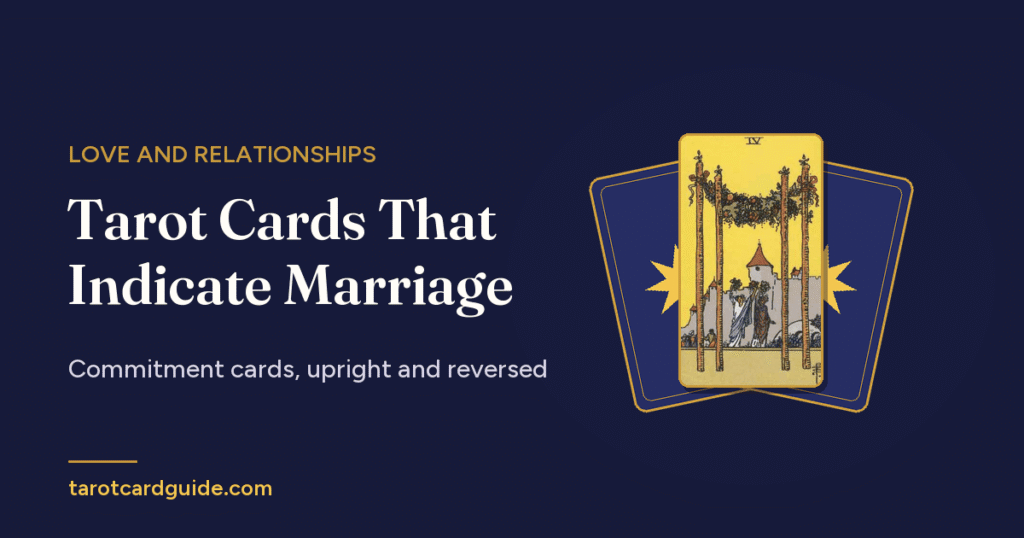
The tarot cards most often read as signs of marriage are the Four of Wands, the Hierophant, the Lovers, the Two of Cups, the Ten of Cups and the Ten of Pentacles. Around them sit supporting cards such as the Empress, the Ace of Cups, the Knight of Cups, the Sun and the World.
Before the list, one honest point. No card means “you will get married”, and tarot can’t give you a date or a name. What these cards show is a theme: commitment, partnership, a shared home or something to celebrate. The position they land in, and the cards around them, decide how much weight that theme carries.
Marriage here means any couple making a lasting commitment, wedding or not. A civil partnership, moving in together or simply choosing each other for the long haul all count. The cards don’t mind which form it takes.
Jump to a section:
- The quick answer
- The cards that point to marriage
- Summary table
- Cards that say “not yet”
- When a marriage card is reversed
- How position changes the meaning
- How to ask about marriage
- A five-card commitment spread (with a worked example)
- What tarot can’t tell you
- Frequently asked questions
- Draw a free love reading
The Quick Answer
If you only remember six cards, make it these. Each one names commitment, engagement or marriage in its traditional love meaning.
- Four of Wands: the wedding card. A celebration, a canopy, a new home.
- The Hierophant: formal, traditional commitment and shared values.
- The Lovers: a deep bond and a conscious choice to commit.
- Two of Cups: mutual love between equals, sometimes an engagement.
- Ten of Cups: a happy home life and lasting emotional fulfilment.
- Ten of Pentacles: long-term security, family and a life built together.
A word on odds. In a three-card reading from a full 78-card deck, there’s about a 22% chance that at least one of these six appears: roughly one reading in five. So read a single marriage card in context, not as a forecast.
The Cards That Point to Marriage
What each card brings to a marriage question, upright and reversed. Each one links to its full love meaning.
Four of Wands
The Four of Wands love meaning is the most explicit in the deck. It’s one of the traditional cards of commitment, moving in together, engagement and marriage. Four wands hold up a garland that many readers compare to a wedding canopy, and figures come out to greet you as if welcoming you home.
Upright, it suggests a stable, joyful bond that the people around you may welcome. Reversed, it rarely means an ending. It points to delays, mismatched goals, wedding stress or tension at home, and asks you both to talk about what makes you feel secure.
The Hierophant
The Hierophant in love stands for traditional commitment: marriage, shared values and partnership built on common beliefs. For couples it often shows things becoming serious, such as an engagement or meeting each other’s families.
Shared beliefs about family, faith and money matter here. Reversed, it can show conflicting values, fear of commitment or pressure from family to conform. It can also describe a relationship that breaks social norms, which may be freeing as well as hard.
The Lovers
The Lovers in a love reading is one of the most positive cards you can draw. For a couple, it can mean a new level of commitment, such as moving in together, getting engaged or choosing each other again.
The key is choice. The Lovers shows love as something you keep deciding, not a feeling that carries you along. Reversed, it points to misalignment: poor communication, a lack of trust, or two people who want different things and haven’t said so.
Two of Cups
Two figures stand face to face, each holding a cup, as if making a pledge. The Two of Cups love meaning covers mutual attraction and emotional honesty, and it can mark a commitment or an engagement.
What makes it a good marriage card is balance. Neither person towers over the other. Reversed, it can show one partner giving more than the other, unresolved conflict or a spark that has faded into habit.
Ten of Cups
A couple stand with their arms around each other under a rainbow of cups, while two children dance beside them. The Ten of Cups in love points to lasting fulfilment and building a life together, including engagement, marriage or growing a family.
It doesn’t insist on one kind of family. Its deeper symbol is belonging. Reversed, it can show a disagreement about the future, such as where to live or whether to have children, or an ideal of love that doesn’t match real life.
Ten of Pentacles
This is the practical side of marriage. The Ten of Pentacles love meaning describes long-term partnership, buying a home, merging finances, engagement or planning for children. There’s a sense of permanence and families blending well.
Reversed, it can point to family disapproval, money tension or staying together for security rather than love. Talk calmly about money and relatives before those issues grow.
The Empress
The Empress in love brings deep affection and support. For couples, she can show talk of moving in, starting a family or building a home. She isn’t a wedding card on her own, but next to the Four of Wands or the Hierophant she adds warmth and growth to the commitment.
Reversed, she warns of one partner doing all the giving, or of losing yourself in the relationship.
Ace of Cups
The Ace of Cups love meaning is about a fresh wave of tenderness. For couples it can mark a new stage together, such as a proposal, a move or a decision to start a family. Reversed, someone may be emotionally unavailable or guarding their heart.
Knight of Cups
The Knight of Cups is the tarot’s classic romantic suitor, and its love meaning names a proposal outright. In a relationship, a partner may plan a surprise, write something heartfelt or propose.
Reversed, the Knight blows hot and cold. Promises may not be kept, or someone may love the idea of romance more than the person. Look for consistency before you read it as a ring.
Three of Cups
The Three of Cups in love is the party after the decision: an engagement, a wedding, moving in or an anniversary, with friends and family around you. Reversed, it’s one of the cards that can point to a third party, gossip or interfering relatives, so read it with care.
The Sun
The Sun in a love reading describes a happy, trusting relationship and can point to a celebration such as an engagement or a joyful family event. Reversed, the warmth is still there but needs attention: a small misunderstanding or a bit of lost spark.
The World
The World in love marks a relationship milestone, such as marriage, moving in together or starting a family. It can also show a long-distance couple finally closing the gap. Reversed, the relationship may feel stuck short of the next step, often because one person is hesitant to commit.
King and Queen pairings
Some readers take a King and a Queen of the same suit, side by side, as a picture of a settled couple. That’s a reader’s convention rather than a fixed rule, but it works best with Cups. The King of Cups in love is an emotionally mature, deeply committed partner. The Queen of Cups in love brings loyalty, empathy and the feeling of being truly understood. Together they describe two people who can talk things through calmly.
Reversed, either court can show the shadow side: coldness or moodiness for the King, over-giving or insecurity for the Queen. For more on reading courts as people, see tarot court cards explained.
Summary Table
| Card | What it may say about commitment |
|---|---|
| Four of Wands | Engagement, wedding, a home others celebrate |
| The Hierophant | Formal, traditional commitment and shared values |
| The Lovers | A deep bond and a conscious choice to commit |
| Two of Cups | Mutual love between equals, sometimes an engagement |
| Ten of Cups | A happy shared home and lasting fulfilment |
| Ten of Pentacles | Long-term security, merged finances, family |
| The Empress | Growth, nurture, building a home or family |
| Ace of Cups | A new emotional stage, possibly a proposal |
| Knight of Cups | A romantic gesture or a proposal |
| Three of Cups | Celebrating with friends and family |
| The Sun | Happiness and a joyful event |
| The World | A milestone reached, the next step taken |
| King and Queen of Cups | Two emotionally mature, committed partners |
Two pairings are worth knowing. The Lovers with the Two of Cups describes a bond that is mutual, chosen and equal. The Four of Wands with the Ten of Pentacles often points to a wedding, moving in or buying a home. Both are covered in the love combinations guide. For all 78 cards in a love reading, see the love tarot card meanings table.
Cards That Say “Not Yet”
Some cards suggest that commitment isn’t ready, or that something needs work first. Read them as a list of what needs attention, not as a verdict on the relationship.
| Card | What needs attention |
|---|---|
| Two of Swords | A question you’ve both been avoiding. Saying nothing keeps the peace but delays the answer. |
| Seven of Cups | Falling for an idea of someone, or of a wedding, rather than the real person. |
| Four of Pentacles | Guardedness and control. Someone may be afraid to be vulnerable. |
| Three of Swords | A hurt that hasn’t been talked through. It doesn’t automatically mean the end. |
| Five of Cups | Regret, or focusing only on what has gone wrong. |
| Eight of Cups | Pulling away. It asks whether the relationship still fulfils you. |
| The Tower | A crisis or a truth coming to light. Some couples come through it stronger. |
The Two of Swords is the one I’d take most seriously in a marriage question. Its love text describes being stuck on a question you’ve avoided, such as moving in or commitment. The fix is plain: an honest, calm conversation, and a willingness to hear the answer.
The Four of Pentacles in love deserves a separate note. Mostly it shows caution. But if a partner controls your money or your movements, that’s a real-world problem, not a tarot one. Talk to someone you trust.
When a Marriage Card Is Reversed
A reversed marriage card rarely cancels the theme. More often it says the commitment is there in spirit but blocked, delayed or out of balance. Here’s how the main six lean when they’re upside down:
- Four of Wands reversed: still a gentle yes more often than a no, but with delays, wedding stress or family tension.
- The Hierophant reversed: fear of commitment or clashing values. Or a couple choosing an unconventional path, which isn’t a bad thing.
- The Lovers reversed: no, or not yet. Something is out of alignment, often a decision both people are avoiding.
- Two of Cups reversed: no, as things stand. An imbalance or a trust issue needs addressing.
- Ten of Cups reversed: maybe. You may disagree about the future, or one of you may be chasing a picture-perfect ideal.
- Ten of Pentacles reversed: not in this form. Money or family pressure is getting in the way.
If you use reversals, read them as the card’s energy turned inward or held back, not as its opposite. The full method is in how to read reversed tarot cards.
How Position Changes the Meaning
The same card can say very different things depending on where it lands. Take the Four of Wands in a few common positions:
| Position | How the Four of Wands reads |
|---|---|
| Past | A celebration or commitment that already happened. It may be part of your shared history, or an earlier relationship that still shapes you. |
| Present | A stable, happy period now. You may already be acting as a committed couple. |
| Obstacle or challenge | The pressure of the event itself: wedding plans, guest lists, family expectations. |
| Advice | Celebrate what you have. Make your relationship visible to the people you love. |
| Outcome | Where things seem to be heading as they stand: towards commitment and a shared home. |
An outcome card shows the current direction, which you can still change. In the past position, a marriage card isn’t a prediction at all. It’s context.
The Hierophant works the same way. As advice, it says “involve your families”. As an obstacle, it’s family expectations that don’t fit you.
How to Ask About Marriage
The question shapes the reading more than any single card. Yes or no questions about a fixed future tend to produce anxious re-draws. Open questions give the cards something to work with.
| Poor question | Better question |
|---|---|
| Will he propose this year? | What would help us move towards commitment? |
| Will I ever get married? | What am I looking for in a long-term partner? |
| Is she the one? | What does this relationship offer me, and what does it ask of me? |
| When will I get married? | What’s standing between me and the commitment I want? |
| Will they change their mind about marriage? | How can I raise the subject of our future honestly? |
The better questions keep you as the person acting, and don’t pretend to know someone else’s decision. There’s more on this in how to ask the right questions about love.
A Five-Card Commitment Spread
This spread looks at commitment from both sides, then at what helps and what’s in the way. Lay five cards in a row and read them in order.
| Position | What it asks |
|---|---|
| 1. What commitment means to me | What I’m really hoping for: security, family, a ceremony, or simply certainty. |
| 2. What commitment means to them | Their side, as it shows up in the relationship. Treat it as the dynamic, not a mind-reading. |
| 3. What supports a lasting bond | What’s already working between us. |
| 4. What needs attention first | The conversation, habit or fear to deal with before the next step. |
| 5. Where it’s heading as things stand | The current direction, which the other four cards can still change. |
Want a ready-made layout instead? The relationship spread looks at both partners in more depth, and the soulmate tarot spread suits people who are single and wondering what kind of partner fits them.
A worked example
Imagine someone who has been with their partner for four years. They ask: “What would help us move towards commitment?” They draw:
- Ten of Pentacles (upright) in position one.
- Knight of Cups (reversed) in position two.
- Two of Cups (upright) in position three.
- Two of Swords (upright) in position four.
- Four of Wands (upright) in position five.
Card one is clear. For this person, commitment means security: a home, shared finances, a life built to last. That’s worth knowing, because it’s a different wish from wanting a big wedding.
Card two is the reversal. A reversed Knight of Cups doesn’t say the partner lacks feeling. It says the romance hasn’t turned into consistent action. There may be lovely words about “one day”, and no plan behind them.
Card three is the good news. The Two of Cups says the bond is mutual and balanced. The foundation is real.
Card four names the problem. The Two of Swords is a conversation both people have been avoiding, probably to keep the peace.
Card five leans towards commitment and celebration. But it’s an outcome “as things stand”, and card four shows what stands in the way.
Read together, the spread doesn’t say “a proposal is coming”. It says you both care, you mean different things by “commitment”, and nobody has said so. The useful next step is a calm talk about what each of you wants.
What Tarot Can’t Tell You
Tarot can’t tell you a wedding date, or how many months until a proposal. Some readers use timing systems, but none is reliable enough to plan a life around.
It also can’t tell you whether a particular person will propose. That choice is theirs. A reading can show the dynamic between you, and your own hopes.
And it isn’t the tool for practical or legal questions, such as visas, prenuptial agreements or dividing property. Those need proper advice. If a relationship feels unsafe, talk to someone you trust or a support service, whatever the cards say.
If you find yourself drawing about the same question every day, take a break. Repeating a reading rarely adds clarity, and it tends to feed the worry it was meant to settle.
Frequently Asked Questions
Which tarot card means marriage?
The Four of Wands is the card most often linked with weddings, because its garland looks like a wedding canopy and its love meaning names engagement and marriage. The Hierophant (traditional commitment), the Lovers, the Two of Cups, the Ten of Cups and the Ten of Pentacles are also read this way.
Is the Lovers card always about marriage?
No. The Lovers is about a deep bond and a meaningful choice. In a relationship it can point to a new level of commitment, but it can also mark any decision that tests your values, in love or elsewhere. Read it with its position and the cards around it.
What tarot card means a proposal?
The Knight of Cups is the classic proposal card: its love meaning describes someone expressing their feelings or proposing. The Ace of Cups can also mark a proposal as a new emotional stage. If the Knight is reversed, look for consistency before you trust the promise.
Can tarot predict when I’ll get married?
No. There’s no reliable way to read a date from the cards. Tarot is better at showing what supports commitment and what’s in the way, which is something you can act on.
Is the Four of Wands a wedding card?
It’s the closest thing tarot has to one. Upright, it points to celebration, a shared home and commitment the people around you welcome. Reversed, it usually means delays or tension rather than an ending.
What does it mean if marriage cards keep coming up?
It’s more common than it feels: about one three-card reading in five shows at least one of the six main marriage cards. If they keep appearing, commitment is probably on your mind, so ask what you want from it.
Which tarot cards suggest a relationship won’t lead to marriage?
No single card decides that. The Two of Swords, the Seven of Cups, the Four of Pentacles, the Eight of Cups and the Tower point to things that need attention first: avoidance, illusion, guardedness, withdrawal or a crisis. They describe obstacles, not fate.
Do these cards apply if we don’t want a traditional wedding?
Yes. The marriage cards describe commitment, and they apply to any couple. The Hierophant reversed can even describe a couple choosing their own path rather than the conventional one.
Draw a Free Love Reading
Want to try this on your own relationship? The reading below draws three cards: one for you, one for the other person (or, if you’re single, the kind of love coming towards you) and one for the relationship. Each card shows its love meaning, upright or reversed. Treat it as a prompt for reflection, not a forecast.
Loading your deck. If nothing appears, please enable JavaScript.
For a longer guide to reading the result, see the love tarot reading page, which explains each position for singles and couples.