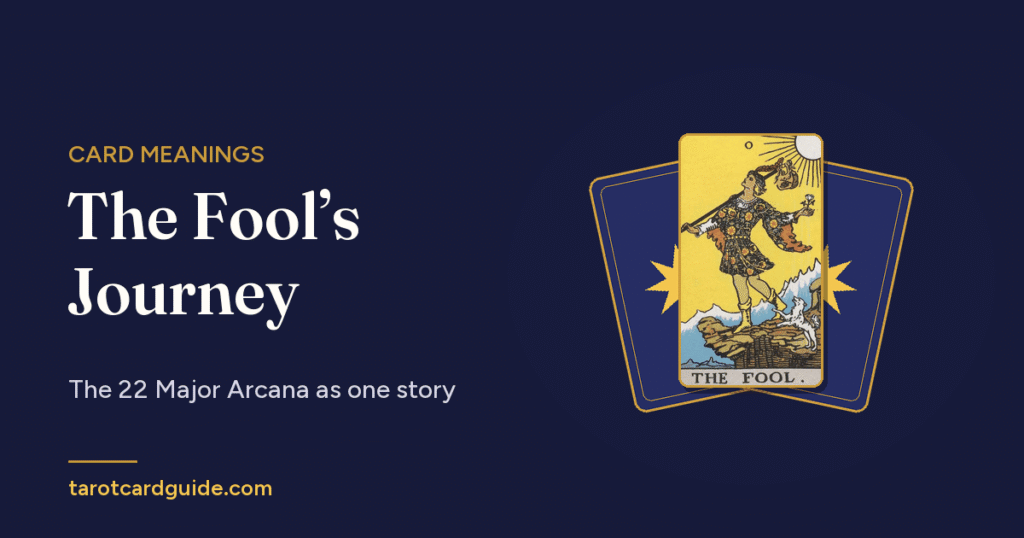
The Fool’s Journey is a way of reading the 22 Major Arcana cards as one continuous story. The Fool, card 0, is the traveller, and every Major from The Magician (1) to The World (21) is a person, a test or a lesson he meets along the road.
It’s a teaching device rather than ancient doctrine, and a good one: learn the Majors as a story and they stick far better than a list. This guide tells the story card by card, explains the popular “three rows of seven” model, and shows how to use the sequence in your own readings.
For a quick table of meanings, see the Major Arcana guide. This page is the story that links them.
Jump to a section:
- What the Fool’s Journey is (and isn’t)
- The three rows of seven
- Strength and Justice: why the numbers swap
- The story card by card: the Fool and the first row, the second row and the third row
- Echoes between the cards
- Using the Fool’s Journey in a reading (with how often Majors turn up)
- Where are you on the journey? A reflection exercise
- Frequently asked questions
What Is the Fool’s Journey?
The Fool’s Journey takes the numbered order of the Major Arcana literally. The Fool sets out with nothing but trust, meets teachers and parent figures, makes his first real choice and wins. Then he turns inward, loses things, heals, faces his shadow, watches something collapse, finds hope and arrives at The World. Then the story starts over.
The idea is modern. Arthur Edward Waite’s The Pictorial Key to the Tarot (1910), written to go with the deck Pamela Colman Smith illustrated and Rider published in 1909, describes the Majors one card at a time. It doesn’t set them out as the Fool’s Journey. That framework grew up later, among twentieth-century tarot writers and teachers, and it’s now one of the most common ways the Majors are taught.
It works because the numbers already suggest an order and because Smith’s pictures talk to each other (see echoes between the cards). What it isn’t: a timetable, a prediction, or the one true order of life. People meet The Tower at 19 and The Magician at 60. I think the model is most useful as a memory aid and a set of questions, and least useful as a map you’re failing to follow.
The Three Rows of Seven
The most popular way to structure the story is to set the Fool apart, as the traveller, and lay the other 21 cards in three rows of seven: 1 to 7, 8 to 14 and 15 to 21. Each row becomes a stage. It’s one model among several, and it’s the one this page follows.
| Row | What it’s about | Ends with |
|---|---|---|
| First: The Magician (1) to The Chariot (7) | The outer world: finding your skills, meeting parents, teachers and rules, and making a choice that’s truly yours | A victory in the world, won by focus and will |
| Second: Strength (8) to Temperance (14) | The inner world: patience, solitude, change you can’t control, honest accounting, surrender, endings and healing | Balance, found after an ending |
| Third: The Devil (15) to The World (21) | The big picture: facing your shadow, losing what was false, then hope, uncertainty, joy, a final call and completion | Wholeness, and a return to the start |
Notice the row endings: The Chariot holds opposites together by will, Temperance blends them patiently, and The World brings everything into balance. Each row answers the same problem more deeply.
You’ll meet other versions. Some teachers split the sequence into two halves instead. Some treat it as a circle, since The World leads back to The Fool, or as a spiral you pass round again at a deeper level. None is more correct. Use whichever helps you remember the cards.
Strength and Justice: Why the Numbers Swap
In some decks, Strength and Justice trade places. In older decks such as the Tarot de Marseille, Justice is VIII and Strength is XI. Waite swapped them for the Rider-Waite-Smith deck to fit the astrological scheme of the Hermetic Order of the Golden Dawn, which puts Leo (Strength) before Libra (Justice). The meanings are the same either way.
Both stay in the second row under either numbering. What changes is the story inside it:
| Numbering | How the second row reads |
|---|---|
| Rider-Waite-Smith (Strength 8, Justice 11) | Outer victory is followed at once by inner gentleness. Justice arrives just before The Hanged Man: weigh up the past, then pause and let go. |
| Marseille-style (Justice 8, Strength 11) | The victor meets the law and answers for how he won. Strength comes after the Wheel of Fortune, as the courage to bear a turn of fortune. |
This page uses the Rider-Waite-Smith order. If your deck uses the other, tell the second row both ways and notice which feels truer.
The Story Card by Card: The Fool and the First Row
Here is the whole story, one card at a time, using the Rider-Waite-Smith images. Each card’s own page has its full meanings. The first row is about growing up in the outer world.
0. The Fool: the one who sets out
Every telling starts at the cliff edge. The Fool stands on a high ridge, one foot close to the drop, with a white rose in one hand and a light bundle over his shoulder. A small white dog leaps beside him, and snow-capped mountains rise in the distance: the whole road, not yet walked. He is anyone starting something, with trust but no plan, and he walks through every other card. In a reading, he asks what you’d begin if you stopped waiting for a guarantee.
1. The Magician: finding the tools
The first person the Fool meets shows him what he already has. The Magician stands at a table laid with a cup, a pentacle, a sword and a wand, the symbols of the four suits. He raises a wand to the sky and points to the ground: inspiration comes down, and action grounds it. The Fool had potential. Now he learns skill, focus and will. One is the number of a decision. Reversed, the same gifts get scattered, wasted or misused.
2. The High Priestess: learning to listen
After the man of action comes the woman of stillness. The High Priestess sits between a black pillar and a white one, with a veil of pomegranates behind her and a partly hidden scroll in her lap. Now the Fool, who has learned to act, finds that some things can only be known from the inside, by waiting and paying attention. Where the Magician says “do”, she says “not yet”. In a reading, she suggests you already know more than you’re admitting.
3. The Empress: being cared for
Next the Fool meets the world that feeds him. The Empress reclines on soft cushions with ripe wheat at her feet, a stream and tall trees behind her and a crown of twelve stars. Many tellings cast her as the mother, or simply as the experience of being nurtured. Three is the number of creation, and here potential first becomes visible, like green shoots after planting. Her reversals, over-giving and self-neglect, add a quieter lesson: care has to include caring for yourself.
4. The Emperor: meeting the rules
After nurture comes structure. The Emperor sits on a stone throne carved with rams’ heads, holding an ankh sceptre and a golden orb, with armour under his red robe and bare mountains behind him. In the story he is the father and the law, the first rules the Fool lives by. His lesson is that structure can be a gift, because it frees you from chaos. Reversed, it hardens into control and rigidity, and most of us meet both sides.
5. The Hierophant: going to school
Then comes education in its widest sense. The Hierophant sits between two grey pillars in a three-tiered crown, one hand raised in blessing, with two crossed keys at his feet and two followers kneeling before him. He stands for teachers, traditions and shared beliefs: what a family, culture or faith holds true. Sitting between the Emperor’s rules and the Lovers’ choice, this is where the Fool learns the values he’ll soon have to choose by. Learn the rules first, then decide which to keep.
6. The Lovers: the first real choice
The Lovers shows a man and a woman beneath an angel with arms spread wide. The Tree of Knowledge, with its serpent, stands behind her, and a tree of flames behind him. The card is about love, and just as much about a decision that defines you. Until now the Fool has been taught. Here he has to choose by his own values, not his parents’ or his teachers’, which is why the card follows the Hierophant. Remember this couple: they return, chained, on The Devil.
7. The Chariot: the first victory
The first row ends in triumph. A young charioteer stands in a stone chariot under a starry canopy, with a walled city behind him and two sphinxes, one black and one white, in front. He holds no reins. He steers by will alone. The Chariot is the Fool leaving home for the wider world, carrying the Magician’s skill and the Lovers’ choice with him. It’s a real win, but over outer obstacles. The second row asks what’s going on inside.
The Second Row: Strength to Temperance
The second row turns inward. The Chariot won in the world. Now the Fool meets tests that can’t be won by pushing harder.
8. Strength: gentle power
The new row opens by answering the old one. On Strength, a woman in a white robe gently closes a lion’s jaws with her hands, with no weapon and no chain, and the infinity sign floats above her head, as it does above The Magician. The charioteer controlled opposing forces by will. She works with the wild animal through patience. For the Fool, this is the first inner lesson: courage that doesn’t need to shout, and self-mastery that comes from understanding anger, fear or appetite rather than crushing them.
9. The Hermit: stepping back
Next the Fool climbs away from the crowd. The Hermit stands alone on a snowy peak in a grey hooded cloak, leaning on a staff and holding up a lantern with a six-pointed star inside. The light reaches only a few steps ahead. That’s the lesson: insight usually comes one step at a time, and from within. After the busy first row, the Fool needs quiet to work out what he actually wants. Reversed, solitude slides into isolation or avoidance.
10. Wheel of Fortune: change you can’t control
Then life pulls the Fool back into motion. The Wheel of Fortune has no human figure at its centre. A great wheel turns in the clouds, a sphinx sitting calmly on top, a snake sliding down one side and a jackal-headed figure rising on the other. Fortune rises and falls, and some of it is out of anyone’s hands. What the Fool controls is his response: the sphinx’s steadiness. Near the middle of the run, this is where outer events and inner growth meet.
11. Justice: honest accounting
After the Wheel’s chance comes its opposite: cause and effect. Justice sits between two grey pillars with a sword held upright in one hand and scales in the other. Unlike the familiar statues, she wears no blindfold. She looks straight at you. For the Fool, this is honest accounting: what have my own choices set in motion, and what is mine to put right? It’s a sober card, not a harsh one. Take responsibility for your part, it says, then put down what isn’t yours to carry.
12. The Hanged Man: letting go
Then everything stops. The Hanged Man hangs upside down by one foot from a wooden beam that still has leaves growing on it, hands behind his back, face calm, a bright halo round his head. The pause looks willing. Upside down, he sees the world differently, and that’s the point. The Fool has acted, learned, won and reckoned up. Now he has to stop pushing and surrender control for a while. The living leaves say the pause isn’t wasted: something is growing even while nothing seems to happen.
13. Death: the ending that had to happen
What the Hanged Man let go of now ends. On Death, a skeleton rider carries a black banner marked with a white rose. A king lies fallen while a child looks up without fear. In the distance, the sun sits low between two towers. In the Fool’s story this is almost never a literal death, and tarot isn’t a tool for predicting one. It’s the end of an old self, role or chapter that has been winding down for a while. The rose and the sun say the cycle carries on.
14. Temperance: healing at the right pace
After the ending comes healing. On Temperance, an angel with large red wings stands with one foot in a pool and one on the land, pouring water between two cups, while a path winds up towards a light in the distant mountains. Where The Chariot held opposites together by will, Temperance blends them patiently until they become something new. The Fool leaves the inner row steadier and slower than he entered it, and that winding path leads into the hardest row of all.
The Third Row: The Devil to The World
The last row is the big picture. The Fool meets his own shadow, loses what was false and comes out into the light. It holds the cards people fear most, and they’re best read as stages to pass through, not verdicts.
15. The Devil: meeting the shadow
Balance won, the Fool meets what can knock it over. On The Devil, a horned figure crouches on a dark pedestal, and chained to it are a naked man and woman with small horns and tails: the couple from The Lovers, now ruled by appetite rather than choice. The detail that matters is the chains. They hang loosely, and the pair could lift them off. This is the Fool’s shadow: habits, attachments and fears that feel like a cage but are partly self-made. Excess is what follows when balance is lost.
16. The Tower: what was false falls
If the chains aren’t lifted willingly, something breaks them. On The Tower, lightning strikes a tall tower on a rocky peak and knocks off its crown. Flames burst from the windows and two figures fall. In the Fool’s story, this is the collapse of whatever was built on false ground: a belief about himself, or a life that only looked solid from outside. It’s sudden, and it hurts, but it clears the site for the gentlest card in the row.
17. The Star: hope returns
After the storm, a clear night. On The Star, a naked woman kneels at a pool with one foot in the water, pouring from two jugs: one back into the pool, one onto the land. A large eight-pointed star shines above her with seven smaller ones, and the landscape is open and green. For the Fool, this is hope coming back quietly once the false has gone. He’s recovering, and the card asks him to rest and remember what he’s working towards.
18. The Moon: walking through the fog
Hope doesn’t mean the road is clear. On The Moon, a path winds from a pool, where a crayfish crawls out, between a howling dog and wolf, past two towers and into the hills, lit only by moonlight. The towers mirror the pair on the horizon of Death. The Fool walks through uncertainty and old fears without seeing where the path ends. His task is to tell intuition from anxiety and keep going slowly. The Moon is the night you pass through to reach the morning.
19. The Sun: everything visible
And then the light comes. On The Sun, a large sun with a calm face fills the sky. Beneath it, a naked child rides a white horse without a saddle, arms wide, and sunflowers grow over a grey stone wall behind. The Fool’s innocence returns, but it isn’t the innocence of the cliff edge. He has been through the Tower and the Moon, and his joy now has nothing to hide. The Sun is success, clarity and the freedom to be seen as you are.
20. Judgement: the call
On Judgement, an angel blows a great trumpet from the clouds, and below, people rise from open coffins with their arms outstretched towards the sound. Nobody is dragged out. They choose to rise. In the Fool’s story, this is the call to become who he is meant to be. He looks back over the whole road honestly, forgives what he can and answers. Between the Sun and the World, it’s the last review before the cycle closes: honest awareness, not guilt.
21. The World: completion, and a new start
The story ends with a dance. On The World, a figure moves inside a large oval wreath, holding a wand in each hand, legs crossed like the Hanged Man’s but the right way up. The four creatures from the Wheel of Fortune sit in the corners. On the Wheel they were reading; here the lessons are learned. For the Fool, this is completion, every row brought together. It isn’t a finish line, though. After The World, the sequence begins again with The Fool, wiser and travelling lighter.
Echoes Between the Cards
Smith’s images repeat details from card to card, and spotting them is one of the quickest ways to learn the Majors: each echo ties two cards together in your memory.
| Cards | Shared detail | What it adds |
|---|---|---|
| The Magician and Strength | The infinity sign above the head | Power as willed action, then as patient kindness |
| The High Priestess and Justice | A figure seated between two pillars | Hidden inner knowing, then clear-eyed weighing of the facts |
| The Lovers and The Devil | The same naked couple, blessed and then chained | The same desire, chosen freely or ruling you |
| Wheel of Fortune and The World | Four winged creatures in the corners | Lessons being studied, then learned |
| The Hanged Man and The World | The crossed legs | Suspension turned into freedom and movement |
| Death and The Moon | Two towers on the horizon | A gateway into unknown ground, after an ending and before the dawn |
Another exercise reads the three rows as a grid, column by column, pairing each first-row card with the cards seven and fourteen places later. The Magician, Strength and The Devil read as power used, tamed and turned into a trap. The Lovers, Death and Judgement read as a choice, an ending and a call. Treat any link you find as a memory hook, not a rule.
How to Use the Fool’s Journey in a Reading
The story also gives you extra questions to ask whenever a Major lands in a spread.
Where a single Major falls
First, notice the row. A first-row card usually points to the outer side of the question: skills, authority, relationships and making your way. A second-row card points to inner work and endings. A third-row card points to a larger shift: facing something hard, recovering from it or finishing a cycle.
Then look at its neighbours in the sequence, which show where the Fool has just come from and where he’s heading. Draw The Star, and The Tower came just before it, so the reading may be about recovery after something broke. Draw Temperance, and the healing follows an ending. Draw The Hermit, and the Wheel of Fortune comes next: time alone in the lantern light is meant to end in movement.
Several Majors in one spread
Put the Majors in number order. If they come from one row, one kind of lesson dominates. If the numbers rise from past to future positions, the story is moving forward. If they fall, you may be going back over an old lesson, which isn’t a bad sign: learning comes in layers. Gaps can be revealing too. Say a past, present and future reading gives The Devil, the Six of Swords and The Star. The story moves forward, but it skips The Tower. With the Six of Swords, a quiet transition to calmer waters, in the middle, perhaps the break from an old attachment came without a dramatic collapse.
One Major in a mostly Minor spread
Read the Major as the headline and the Minors as the detail. The suit beside it shows where the lesson is playing out. The Tower next to Pentacles lands in money or work, next to Cups in a relationship. For more on pairs, see tarot card combinations.
How often Majors turn up
Majors are 22 of the 78 cards, so they’re common. For a well-shuffled full deck, drawing without replacement:
| Cards drawn | At least one Major | Roughly |
|---|---|---|
| 1 (card of the day) | 28% | A little more than 1 in 4 |
| 3 (three-card spread) | 64% | Nearly 2 in 3 |
| 5 (five-card spread) | 82% | About 4 in 5 |
| 10 (Celtic Cross) | 97% | Almost every time |
The arithmetic: take the chance that every card is a Minor from 1. For three cards, 56/78 × 55/77 × 54/76 is about 36%, leaving 64%. A ten-card Celtic Cross averages about three Majors (10 × 22/78 ≈ 2.8). Three or more turn up about 58% of the time, so three is ordinary. Four or more happen in about 29% of spreads and five or more in about 11%, roughly one in nine: that’s a reading genuinely weighted towards big themes.
A worked example with a reversed Major
Imagine someone asks, “What do I need to understand about wanting to leave my job and retrain?” They draw three cards for situation, challenge and advice: the Eight of Cups, The Hermit reversed and the Page of Pentacles.
- Situation: Eight of Cups. A voluntary decision to walk away from something that no longer fulfils them, even after years of effort.
- Challenge: The Hermit, reversed. The only Major, so it’s the headline. Reversed, useful solitude has tipped into withdrawing too far, or being alone with your own views so long that other perspectives can’t get in.
- Advice: Page of Pentacles. Study and a grounded, methodical beginning. Results won’t be fast, but the foundations will be solid.
Now add the story. The Hermit is a second-row card, so the challenge is inner, and the Wheel of Fortune comes next, when life moves again. The reading might say: “You’ve decided, and you’ve thought it through alone for long enough. Come down the mountain and start learning.” A concrete step: talk to someone who has done the course, or book a short taster.
Where Are You on the Journey? A Reflection Exercise
You need twenty minutes and a notebook. Lay the 22 Majors in three rows with the Fool apart, or use the rows table.
- Look at the whole layout. Which card do your eyes keep returning to?
- Pick the card that best describes the last year, then the one that describes this week. Are they in the same row?
- Read the cards either side of your “this week” card. What did you just come through? What does the next card ask of you?
- Find a card you passed through years ago. What did it teach you, and do you still use it?
- Find the card you’d least like to draw. What would it ask you to face? Read the advice section on its page.
- Choose the card you’d like to reach next, and write one small action for this week that moves you towards it.
For a quicker version, shuffle the 22 Majors on their own and draw one, asking, “Which part of the story am I in?” Each card has a 1 in 22 chance, so treat the result as a prompt, not a ruling.
Some Majors may feel like yours for life. The tarot birth card calculator finds your birth cards, which are always Majors, and the Which Tarot Card Are You? quiz matches you to one of the 22. See which row yours sit in.
Frequently Asked Questions
What is the Fool’s Journey in tarot?
It’s a way of reading the 22 Major Arcana as one story. The Fool, card 0, is the traveller, and each card from The Magician to The World is a stage, a person or a lesson he meets. It’s mainly a way to learn the Majors.
Who came up with the Fool’s Journey?
Not the deck’s creators. Waite’s Pictorial Key to the Tarot (1910) describes the Majors card by card without framing them as a journey. The story developed through twentieth-century tarot books and teachers, and this page doesn’t credit it to any single writer.
What are the three stages of the Fool’s Journey?
In the popular three-row model: The Magician to The Chariot (the outer world), Strength to Temperance (the inner world) and The Devil to The World (the big picture). The Fool stands apart as the traveller. Other models divide the cards differently.
Why is the Fool numbered zero?
Zero is pure potential, the empty circle before anything is written. In early decks the Fool was often unnumbered. Zero lets him stand outside the sequence, at its start or its end, so he can pass through every other card.
Why are Strength and Justice numbered differently in some decks?
In older decks such as the Tarot de Marseille, Justice is VIII and Strength is XI. Waite swapped them to fit the Golden Dawn’s astrology, with Leo (Strength) before Libra (Justice). The meanings are the same; only the order of the second row changes.
Does the Fool’s Journey mean my life will follow this order?
No. It’s a story about kinds of experience, not a forecast. Real life loops back, skips ahead and runs several cards at once.
What does it mean when a reading has lots of Major Arcana?
Less than people think. In a ten-card Celtic Cross, three or more Majors turn up about 58% of the time. Five or more, about 11% of the time, is genuinely unusual. In a three-card reading, two or more Majors happen about one time in five.
Is The World the end of the Fool’s Journey?
It’s the end of one cycle. After The World the sequence begins again with The Fool, which is why many readers picture the Majors as a circle rather than a line.
Where does today sit in the story? Draw a card of the day. If it’s a Major, find it in the rows above and read the cards on either side. If it’s a Minor, ask which Major’s lesson it might be playing out.