Reading tarot means drawing cards in answer to a question, then interpreting each card through three things: its picture, its place in the spread and the cards around it. You don’t need psychic gifts or a special deck. You need a deck, a clear question and a willingness to look closely.
This guide takes you from a sealed box to your first full reading in eight steps. Along the way it covers how the 78 cards fit together, how to shuffle, how to work out a card you’ve never seen before, what to do with reversed cards, and a four-week plan for learning the deck without a pile of flashcards.
No deck yet? You can still follow along. There’s a free three-card reading further down this page: ask a question, draw your cards and practise each step on them.
Jump to a section:
- What you need to start
- Step 1: Get to know your deck
- Step 2: Learn how the 78 cards are organised
- Step 3: Set a clear, open question
- Step 4: Shuffle, cut and draw
- Step 5: Lay the cards in a spread
- Step 6: Read each card in its position (including cards you don’t know yet and reversed cards)
- Step 7: Connect the cards into one story (with a full example reading)
- Step 8: Write the reading down
- A four-week plan for learning tarot
- Common beginner mistakes
- How long it takes to learn
- Try your first reading now
- Frequently asked questions
What You Need to Start
A deck. Start with the Rider-Waite-Smith deck or one of its many clones. It was created by Arthur Edward Waite, illustrated by Pamela Colman Smith and first published by Rider in 1909. Its 78 cards all show a full scene, so even the numbered cards give you a picture to read, and most books and websites, including this one, describe its imagery.
That scene on every card is the reason I’d steer a beginner towards it. Some older decks, such as the Tarot de Marseille, show the numbered cards as simple patterns of cups or coins, which are much harder to read by eye. Once you know the Rider-Waite-Smith system, moving to any deck built on it is easy.
Choosing between the hundreds of modern decks? Look at a few sample cards from the Minor Arcana, not just the showy Majors. If the Five of Cups and the Eight of Pentacles still tell you a story at a glance, the deck will be easy to learn with.
A quiet space and a few minutes. A table or the floor is enough. Some readers like a cloth, a candle or a crystal, which can help you settle, but none of it is required. A clear surface and ten undisturbed minutes matter more than any ritual.
A notebook. It sounds minor, but writing readings down is how you learn fastest (more on that in step 8).
You may have heard that your first deck must be a gift. It’s a popular superstition, not a rule. Buying your own deck is fine, and choosing it yourself means you get artwork you actually want to look at every day.
Step 1: Get to Know Your Deck
Before you open the guidebook, go through the cards one by one and simply describe what you see. Who is in the picture? What are they doing? What’s the weather like? How does the card make you feel?
Take the Three of Swords: a red heart pierced by three swords under a grey sky full of cloud and rain. You could guess it speaks of heartbreak or a painful truth without reading a word about it, and you’d be right. Most cards work this way. The symbolism was designed to be read.
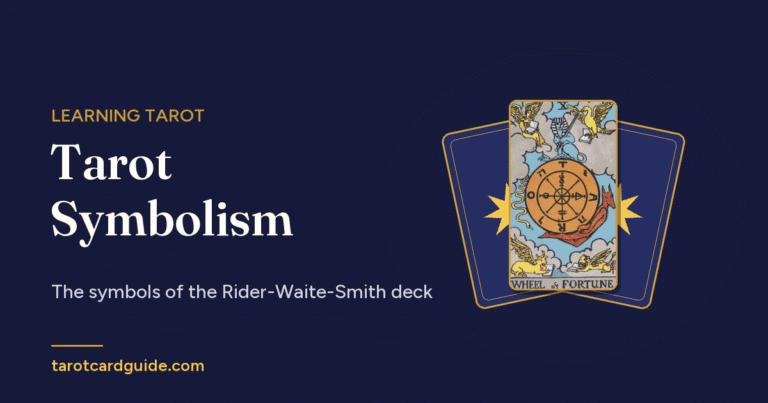
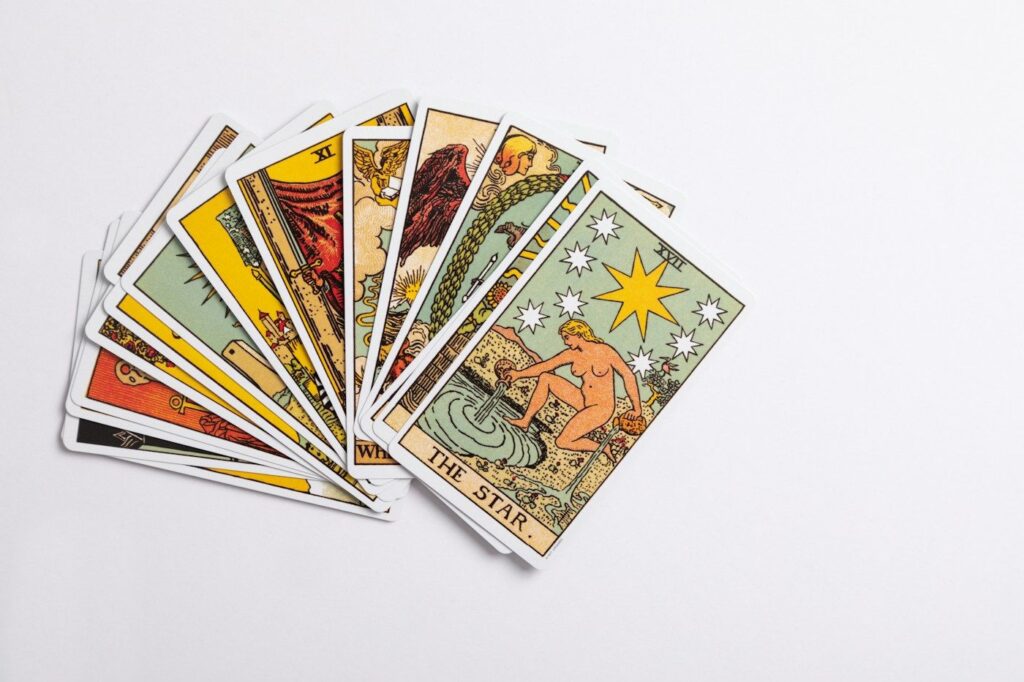
Or take The Star, the card on top of the fan in the photo above. A woman kneels by a pool at night, pouring water onto the land and back into the pool, under one large star and seven smaller ones. The scene is calm, open and green. It’s no surprise that the card means hope and healing after a hard time.
A good first exercise is to sort the whole deck into three piles: cards that feel good, cards that feel uneasy and cards that leave you cold. You’ll find you already have a rough sense of about two thirds of the deck. The “cold” pile is your study list.
A simple habit that helps: draw one card of the day each morning, look at it closely, then read its meaning and notice where it shows up in your day. Ten minutes a day beats a three-hour cram session at the weekend.
Step 2: Learn How the 78 Cards Are Organised
You don’t need to memorise 78 separate meanings. A tarot deck is a system, and once you know its structure you can work out the rough meaning of most cards from their suit and number.
The Major Arcana: 22 big themes
The Major Arcana runs from The Fool (0) to The World (21). These cards describe major life themes and turning points: love, loss, change, faith, endings and new beginnings. When several appear in one reading, the situation is usually a significant one.
Read in order, they tell one long story. The Fool sets out with nothing but trust, meets teachers such as The Magician and The High Priestess, is tested by The Tower, recovers under The Star and arrives at The World, where the cycle completes. Learning the Majors as a story is far easier than learning them as a list.
The Minor Arcana: 56 everyday cards
The Minor Arcana describes day-to-day events and feelings. It has four suits of 14 cards each: Ace to Ten, then four court cards (Page, Knight, Queen and King). Each suit is linked to an element and an area of life:
| Suit | Element | What it covers |
|---|---|---|
| Wands | Fire | Energy, ambition, creativity, passion and action |
| Cups | Water | Feelings, love, friendship and intuition |
| Swords | Air | Thoughts, words, decisions, conflict and truth |
| Pentacles | Earth | Money, work, the body and the home |
A quick way to remember them: Wands are what you want to do, Cups are what you feel, Swords are what you think, and Pentacles are what you have and build.
What the numbers mean
The numbers follow a rough story from beginning to end, and the same pattern runs through every suit. The suit decides where the story plays out.
| Number | Theme | One example |
|---|---|---|
| Ace | A beginning, raw potential | Ace of Cups: new love |
| Two | Choice and balance | Two of Swords: indecision |
| Three | Growth, first results | Three of Pentacles: teamwork |
| Four | Stability, sometimes standing still | Four of Pentacles: security |
| Five | Conflict, loss or a challenge | Five of Wands: competition |
| Six | Harmony and recovery | Six of Swords: transition |
| Seven | Reflection, a test | Seven of Cups: choices |
| Eight | Movement and effort | Eight of Wands: momentum |
| Nine | Nearly there, for better or worse | Nine of Swords: anxiety |
| Ten | Completion, or too much of a thing | Ten of Cups: happiness |
Combine the two and you have a working meaning. A Five is a challenge and Cups are feelings, so the Five of Cups is emotional loss. Pentacles are money and a Ten is completion, so the Ten of Pentacles is lasting wealth and family security. The Minor Arcana guide’s numbers table shows all four cards for every number side by side.
The court cards
Court cards can stand for people in your life, for sides of your own personality, or for an approach the situation needs:
- Pages: curiosity, learning, news and messages
- Knights: action and movement, sometimes too much
- Queens: inner mastery, care and emotional intelligence
- Kings: outer authority, leadership and control
Court cards are the part of the deck most beginners find slippery, because one card can mean a person or a mood. For all 16 at a glance and how to tell which reading applies, see tarot court cards explained.
Step 3: Set a Clear, Open Question
The question shapes the whole reading. Tarot answers best when you ask what you can understand or do, rather than asking it to predict a fixed future.
- Instead of “Will I get the job?”, try “What can I do to give myself the best chance at this job?”
- Instead of “Does he love me?”, try “What do I need to understand about this relationship?”
- Instead of “When will I be happy?”, try “What is standing between me and feeling settled?”
Three habits make almost any question better. Put yourself in it (“What can I do…” rather than “What will they do…”). Keep it to one topic, because “my job and my relationship” is two readings. And give it a timeframe if it needs one, such as “over the next three months”.
Say the question out loud or write it at the top of your notebook page before you shuffle. It sounds fussy, but a question you can’t write down clearly is usually one you haven’t decided on yet.
Our guide on how to ask the right questions in a tarot reading has many more examples. If you do want a quick answer, the yes or no tarot reading is built for exactly that.
Step 4: Shuffle, Cut and Draw
There is no single correct way to shuffle tarot cards. The aim is simply to mix them well while you keep your question in mind. Tarot cards are larger and stiffer than playing cards, so pick a method your hands find comfortable. For six methods step by step, and how many shuffles a 78-card deck needs, see how to shuffle tarot cards.
Three ways to shuffle
- Overhand: hold the deck in one hand and let small packets drop into the other, again and again. It’s gentle on the cards and the easiest method for small hands. This is the one I’d start with.
- Riffle: split the deck in two and flick the corners so the halves interleave, as a card dealer does. It mixes quickly, but bending the cards again and again creases them and wears the edges, and a worn deck starts to clump. Many readers avoid it for that reason.
- Wash: spread the cards face down on the table and swirl them around with both hands, like mixing dominoes, then gather them back into a pile. It’s the kindest method for the cards and mixes them thoroughly. It also turns some cards upside down, which matters if you read reversed cards.
Cutting the deck
After shuffling, many readers cut the deck. The usual way is to put it face down, split it into three piles, then restack them in a different order. Some people choose the pile that feels right and draw from its top. Nothing in the tradition makes this compulsory. It’s a pause that marks the move from mixing to reading.
When to stop shuffling
Stop when it feels right: when your mind settles on the question, or when your hands simply want to stop. If “when it feels right” means nothing to you yet, count seven shuffles and stop. A set number is perfectly respectable, and it keeps you from shuffling nervously for five minutes.
Drawing, and jumping cards
Draw from the top of the deck, or fan the cards out face down and pick the ones you’re drawn to. Both work. Just decide before you start, and lay each card in its position as you draw it.
Now and then a card will fly out of the deck while you shuffle. Readers call this a jumping card. Some treat it as an extra message worth reading alongside the spread. Others put it back and carry on. Either is fine. Pick one rule and stick to it, so you aren’t deciding based on whether you like the card.
Step 5: Lay the Cards in a Spread
A spread is a layout where each position has a meaning, such as “the past” or “the advice”. Positions give each card a job, which makes interpretation much easier. Start small:
- One card: a daily focus or a quick answer.
- Three cards: past, present and future, or situation, challenge and advice. This is the best spread to learn on.
- Five cards: a closer look at a situation, once three cards feel comfortable.
- The Horseshoe: seven cards that tell the story of a situation from start to finish.
- The Celtic Cross: the classic ten-card spread. Save it for when you know the cards reasonably well.
Honestly, the three-card spread can carry you for months. It’s big enough to show how cards affect each other and small enough that you won’t drown. Choose the positions before you shuffle and don’t change them after you see the cards. The twelve three-card variations cover most everyday questions.
Browse more layouts, each with a position diagram, in our tarot spreads guide.
Step 6: Read Each Card in Its Position
Take one card at a time and work through three layers:
- The picture. What’s your first impression? Which detail catches your eye?
- The meaning. What do the suit, number and traditional keywords say?
- The position. How does that meaning answer this position’s question?
The same card changes with its position. The Tower in a “past” position describes an upheaval you’ve already been through. In an “advice” position it might suggest that a structure in your life needs to come down before it falls on its own.
Say your reading out loud, even to an empty room. Speaking forces you to finish a thought, and you’ll often hear the meaning click into place halfway through a sentence.
How to read a card you don’t know yet
You’ll draw cards you can’t remember for months. That’s normal, and you don’t need to reach for the book straight away. Work through these four questions first:
- What do I see? Describe the scene in plain words, as if to someone on the phone.
- What suit is it? That tells you the area of life: action, feelings, thoughts or material things. No suit means a Major, so treat it as a big theme.
- What number or rank? That tells you what stage things are at, from the table in step 2.
- What does the position ask? Put the first three answers to work on that question.
Only then open the card’s page and compare. You’ll usually find you were close, and the parts you missed will stick far better than if you’d looked them up first.
A worked example. Imagine someone asks, “What do I need to know about my social life right now?” and draws the Four of Cups in the “present” position, without knowing the card.
- What I see: a young man sits under a tree with his arms folded and his legs crossed. Three cups stand on the grass in front of him. A hand comes out of a cloud beside him, offering a fourth cup, and he doesn’t seem to notice it.
- Suit: Cups, so feelings and relationships.
- Number: Four, stability that can tip into standing still.
- Position: the present, so this describes how things are now.
Put together: “Emotionally, I’ve gone a bit flat and closed off. Nothing is wrong, but nothing excites me, and I may be overlooking an invitation or a person who is already reaching out.” Now check the upright Four of Cups meaning: its keywords are contemplation, apathy, boredom, re-evaluation and missed opportunity, and its advice is to look again before you say no. The method got there without the book.
For a shortcut to the first keywords of every card, keep the list of all 78 tarot card meanings open in another tab.
Should you read reversed cards?
A reversed card is one that lands upside down. Readers genuinely split on reversals, and there is no wrong choice here. These are the common approaches:
- Blocked or turned inward. The card’s energy is still there but delayed, resisted or happening privately. This is the most widely used approach, and the one the card pages on this site mostly follow.
- Too much or too little. The reversal shows the card’s quality out of balance, so a card about rest might become restlessness or burnout.
- No reversals at all. Every card is read upright, and any difficulty shows up through the cards around it and the position. Plenty of experienced readers work this way.
The Four of Swords shows how this works. Upright it means rest and recovery. Reversed, its page describes burnout, restlessness or resisting a break you badly need: the same theme of rest, but out of balance.
If you’re just starting, I’d read everything upright for the first month and add reversals once the upright meanings feel familiar. When you’re ready, shuffle with the wash method or turn half the deck around before you shuffle, and check the “reversed” section on each card page as you go.
Step 7: Connect the Cards into One Story
This is the step that turns a list of meanings into a reading. Look at the spread as a whole before you go card by card again, and ask:
- Which suit dominates? Lots of Cups means the matter is emotional; lots of Swords, mental or conflict-driven.
- How many Major Arcana cards? Several suggests a significant life chapter rather than a passing issue.
- Any repeated numbers? Three Fives, for example, underline conflict or loss.
- Where are the figures looking? Figures facing towards or away from each other can hint at how the cards relate.
- What changes from first card to last? The movement often is the message.
Then read neighbouring cards as pairs. A card on its own is a word; two cards together make a phrase. Our guide to tarot card combinations goes deeper, with a simple method for reading pairs and 24 common combinations.
Finally, try to say the whole reading in two or three sentences. If you can’t, you haven’t found the story yet. Go back to the movement from first card to last.
A full example reading
Imagine someone who has been working long hours asks, “What do I need to understand about how tired I’ve been feeling?” They shuffle, draw three cards for past, present and future, and get the Ten of Wands, the Four of Swords and The Star, all upright.
Past: Ten of Wands. A man carries all ten wands at once, clutched awkwardly in front of him, and the bundle blocks his view of the road. A town waits in the distance. Wands are energy and effort, and Ten is completion, or too much of a thing. In the past position, this is the load that caused the tiredness: saying yes to everything and carrying it alone. The card’s own keywords are burden, responsibility, overwhelm, hard work and stress.
Present: Four of Swords. The effigy of a knight lies on a tomb inside a church, his hands together in prayer. Three swords hang above him and a fourth lies along the tomb. He is resting, not defeated: his armour is still on. Swords are the mind, and Four is stability or standing still. Right now the mind needs a proper pause. The keywords are rest, recovery, reflection and retreat.
Future: The Star. The kneeling woman pours water onto the land and back into the pool under a sky full of stars. A Major in the future position gives the outcome some weight. The Star means hope, healing and renewal after a hard time. As a future card, it describes where things are heading if the present card’s advice is taken.
Reading them together. Count first: one Wand, one Sword, one Major. The movement runs from doing too much (Wands) to switching off (Swords) to recovery (a Major, so a real change in how things feel). The figures tell the story too: a man bent under a load, then a figure lying completely still, then a woman kneeling calmly by the water.
The story might be: “You’ve been carrying more than your share for a long time, and the tiredness is the bill arriving. The cards don’t ask you to try harder. They ask you to stop for a while. Rest properly, and hope and energy come back.” A practical next step, taken from the Ten of Wands’ advice, would be to list everything they’re responsible for and hand over or drop one thing this week.
What if the Four of Swords had been reversed? Reversed, it points to burnout, restlessness or resisting a break. The present would then say, “You know you need rest and you’re not taking it.” The Star would still promise recovery, but the reading would lean harder on the need to actually stop. That’s how one reversal can shift the emphasis without changing the whole story.
A reading like this is a prompt for reflection, not a diagnosis. If tiredness goes on for weeks or comes with other symptoms, a GP is the right person to see.
Step 8: Write the Reading Down
Your notebook becomes your best teacher. Keep each entry short so you actually keep it up. A simple template:
- Date and question, written exactly as you asked it.
- Spread and cards, with each card’s position and whether it was reversed.
- First impressions, before you look anything up.
- Your reading in two or three sentences.
- What happened, added a week or a month later.
Look back after a few weeks. You’ll see which interpretations held up, which cards keep appearing, and how your own reading style is developing. You’ll also start to build personal associations: the card that always seems to turn up before a busy week, or the court card that keeps reminding you of your sister.
If a card keeps turning up, our article on pulling the same tarot card again and again explains what it can mean.
A Four-Week Plan for Learning Tarot
You can learn tarot in whatever order you like, but a little structure stops the deck feeling like 78 random pictures. This plan takes about ten to fifteen minutes a day.
| Week | Focus | Daily practice |
|---|---|---|
| 1 | The Major Arcana as one story, and describing cards in your own words | Draw a card of the day each morning. Describe it before you read its meaning. |
| 2 | Suits and numbers, using the tables in step 2 | Do a one-card pull with a real question. Work the card out with the four-question method first. |
| 3 | The 16 court cards, and reading cards in positions | Two or three times this week, lay a three-card spread for past, present and future. |
| 4 | Card combinations, and reversals if you want them | A three-card spread every other day. Say each reading in two or three sentences, then reread your first week’s notes. |
By the end of the month you won’t know every card by heart, and you don’t need to. You’ll have a method that works on any card, a notebook full of real readings and a feel for how cards talk to each other. From there, the next step up is a five-card or Horseshoe spread.
Miss a day? Just carry on. The habit matters more than the streak.
Common Beginner Mistakes
- Taking frightening cards literally. Death almost always means an ending or transformation, not a physical death. The Three of Swords describes hurt, not a curse.
- Asking the same question again and again. Redrawing until you get the answer you want makes every reading meaningless. Give it a few days, or until something has changed.
- Reading only from the book. Keywords are a starting point. What you see in the picture matters as much.
- Starting with a spread that’s too big. Ten cards with no practice behind you is a recipe for confusion. Earn the Celtic Cross with a few weeks of three-card spreads.
- Explaining away the cards you don’t like. If a hard card lands in a hopeful position, sit with it. It’s often the most useful card on the table.
- Reading about other people without their knowledge. Focus on your side of a situation: what you can understand and do.
- Using tarot instead of professional help. Tarot is a tool for reflection. For medical, legal, financial or mental health decisions, talk to a qualified professional.
How Long Does It Take to Learn Tarot?
With a card a day and a simple three-card spread now and then, most people can read the basic meanings of the whole deck within a few months. Reading fluently, where the cards form a story without the guidebook, takes longer and keeps deepening for years.
The structure speeds things up. Once you know the four suits, the ten numbers and the four court ranks, you have a working idea of all 56 Minor Arcana cards, which leaves 22 Majors to learn as a story. There’s no exam. You’re ready to start the day you get your deck.
Start Your First Reading
The best way to learn tarot is to read it. Shuffle your deck, ask one open question and lay out three cards for past, present and future. No deck yet? Type your question below and draw three cards here instead. Each card links to its full meaning, so you can check your reading against it.
Loading your deck. If nothing appears, please enable JavaScript.
Before you click through to the meanings, try the four-question method on each card, then connect them as in step 7. For a gentler start, draw a single card of the day, or browse every option on the free tarot reading page.
Frequently Asked Questions
Can anyone learn to read tarot?
Yes. Tarot is a system of symbols with a clear structure: suits, numbers, court cards and 22 Majors. Anyone willing to look closely and practise can learn it. There’s no special talent or initiation involved.
Do you need to be psychic to read tarot?
No. Reading tarot means interpreting pictures and traditional meanings in light of a question. Intuition helps you connect the cards, and it grows with practice, but it’s the ordinary kind of intuition: noticing, remembering and linking ideas.
Is it bad luck to buy your own tarot deck?
No. The idea that your first deck must be a gift is a popular superstition, not a rule. Buying your own works just as well, and it means you can choose artwork you enjoy looking at.
How often should you do a tarot reading?
A single card every day is a great way to learn. For bigger questions, one reading is usually enough until something changes. A few days or a week apart is a sensible gap. Reading the same question over and over tends to add confusion, not clarity.
Can you read tarot cards for yourself?
Yes. Reading for yourself is how most people learn. The main challenge is staying objective, so write the reading down and revisit it later. See our tips on doing accurate self-readings.
Can tarot cards predict the future?
There’s no scientific evidence that tarot predicts events. It works best as a tool for reflection: the cards give you a fresh angle on a situation and prompt questions you might not have asked. A “future” card is best read as where things seem to be heading as they stand, which you can still change.
Do you have to memorise all 78 card meanings?
No. Learn the four suits, the ten numbers and the four court ranks and you can work out a rough meaning for any Minor Arcana card. Look the rest up as you go. Using a guidebook or the card meanings list is completely normal, even after years.