A jumping card, or “jumper”, is a tarot card that flies out, slips or falls from the deck while you shuffle. Many readers treat it as a card asking to be read, a nudge towards whatever it shows, while others see nothing more than a shuffling accident and simply put it back.
Both views are reasonable, and readers genuinely split on this. What matters far more than which camp you join is that you decide how you’ll handle jumpers before you start shuffling, so a card landing on the floor doesn’t get to rewrite your reading halfway through.
Below: why cards jump, three house rules to choose from, reversed and repeat jumpers, what each suit might be pointing at, and a table of shuffling methods, because how you shuffle matters more than most people admit.
What a Jumping Card Means
For readers who take jumpers seriously, the card that escapes the deck is emphasis. It’s the part of the answer that wouldn’t wait its turn. If The Hermit slides out while you’re asking about a new relationship, the reading might be telling you that some time alone comes first, whatever the spread says after it.
For readers who don’t, a jumper is a card that happened to be near the edge when your hands slipped. They’d say that meaning comes from the question, the position and the reader’s attention, and that giving extra weight to whichever card is least firmly held adds nothing.
Here’s where I land: a jumper is a nudge, never a verdict. Tarot is a tool for reflection, and a falling card can make you notice something without deciding anything for you. It shouldn’t outrank a carefully laid spread. And if a jumper frightens you, that fear is the thing worth examining, not the card.
Why Cards Jump: The Practical Causes
Before you read meaning into a jumper, it helps to know how ordinary the mechanics are. Most jumping comes down to the deck, the weather or the hands doing the shuffling.
- A new, stiff deck. Fresh cards are slick and springy, and they haven’t settled into a flat stack yet. Almost every new deck throws cards for its first few weeks.
- The riffle shuffle. Bending two halves and letting them snap together sends cards flying, especially with tarot cards, which are taller and wider than playing cards and harder to hold.
- Humidity and static. Damp air can make card stock swell and stick together in clumps, and very dry air can build static, so cards cling and then release suddenly.
- Gilded or glossy edges. Decks with gold or silver edges often stick together when new, then separate all at once.
- A bent or worn card. One card with a slight curve, a thicker edge or a scuffed finish behaves differently from the rest and tends to be the one that escapes.
- Nervous or tired hands. If you’re anxious about the question, you grip harder and shuffle faster. That alone produces jumpers.
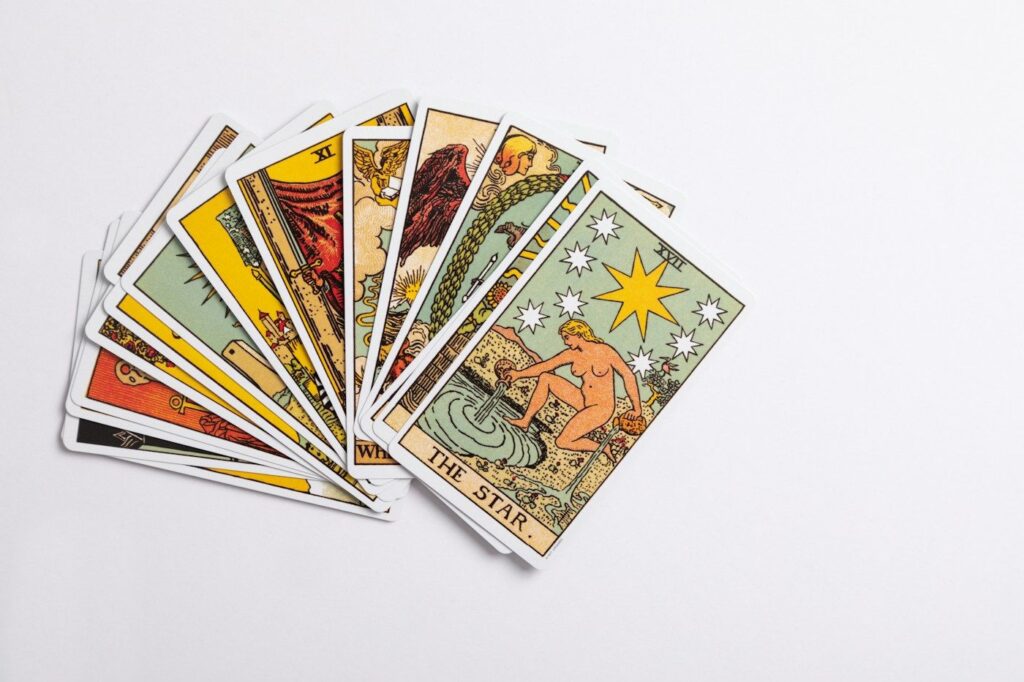
None of this rules out meaning. Plenty of readers accept that the cause is physical and still find the card worth reading, in the same way that the cards in a spread arrive by chance and still say something useful. If you’re new to the deck, the section on shuffling and drawing in our beginner’s guide covers the basics.
Decide Your House Rule Before You Shuffle
The one habit that makes jumpers manageable is choosing, in advance, what they mean in your practice. There are three common rules. Any of them works, as long as you stick to it.
Rule 1: Read the Jumper as a Message
The jumper becomes the headline. You read it first, on its own, like a one-card spread, then lay the spread as planned and read the rest in its light. This suits daily practice and readers who like a strong theme.
The risk is that every clumsy shuffle turns into an omen. If your deck is new or you riffle, you’ll be reading accidents several times a week.
Rule 2: Add It as a Clarifier
Set the jumper aside face up, finish shuffling, lay out the spread and read it normally. Then bring in the jumper last, as extra commentary on the whole reading. It adds colour without being allowed to hijack a position it was never drawn for.
Honestly, this is the one I’d start with. It respects the spread, gives the jumper a voice and keeps its weight in proportion.
Rule 3: Put It Back
The jumper is a shuffling accident, full stop. Slide it back into the deck without looking at it, or glance and let it go, and carry on. This is the cleanest rule if you riffle, if you read for anxious people or if you simply don’t believe falling cards mean anything.
Some readers use a hybrid: a jumper only counts if it lands face up, or only if it jumps during the final shuffle. That’s fine too. The only thing to avoid is changing the rule after you see the card. If The Tower jumps and you suddenly decide jumpers don’t count today, you’re reading your fear, not the cards.
Upright and Reversed Jumpers
If you read reversals, a jumper raises an awkward question: which way up is it? A card that flips through the air can land any way at all. You’ll need a convention, and there are two sensible ones.
- As it lands. Read the card upright or reversed depending on how it sits when you pick it up, facing you. Simple, though the orientation is pure chance.
- As it was in the deck. Keep the jumper turned the same way as the deck in your hands, so it matches the orientation it would have had if you’d drawn it normally.
A reversed jumper can soften, delay or turn inward the upright meaning. Say the Four of Cups jumps out reversed: the reversed Four of Cups is someone starting to look up from their boredom and notice what’s being offered. A reversed Nine of Swords might point to the worst of the worry easing. If you’re still working out how you like to read upside-down cards, our guide to reading reversed tarot cards walks through seven methods.
Face-down landings are a separate question. Some readers turn the card over and read it like any other. Others treat a face-down jumper as something not yet ready to be seen and put it back. Again, pick one and keep to it.
When the Same Card Keeps Jumping
Check the card before you check your soul. If one card jumps over and over, look at it closely: is it slightly bent, thicker at one edge, stickier or shinier than its neighbours? A warped card behaves differently every time you shuffle. Flatten it under a heavy book for a day or two and see whether the habit stops.
If the card is physically fine and still keeps jumping across different days and questions, many readers take it as a theme that hasn’t been dealt with. Imagine the Ten of Wands leaping out three times in a fortnight. You don’t need a mystical explanation to find that useful. It’s a prompt to ask what you’re carrying that you could put down.
We have a whole article on what it means when you keep pulling the same tarot card, and most of it applies to repeat jumpers too. A practical tip: write the card down each time it jumps, with the date and the question. After a month, you’ll know whether you’re looking at a pattern or a slightly curved piece of card stock.
When Several Cards Jump at Once
Sometimes a whole clump escapes. How you handle it depends on how many there are.
- Two cards: read them as a pair. Look for the common thread, as you would with any tarot card combination.
- Three cards: treat them as a mini reading in the order they landed, or as situation, challenge and advice. It works much like a three-card spread.
- Four or more: this is almost always the shuffle, not a message. Gather them up, shuffle more gently and start again.
With two or three jumpers, check what they share. Three jumpers from the Cups suit keep the focus on feelings. Two cards of the same number repeat that number’s theme: a Five of Swords and a Five of Pentacles together double the sense of conflict and loss, which our guide to tarot numerology explains in more detail. Two Majors together suggest a larger chapter of life is in play.
Jumpers When Reading for Someone Else
Reading for another person adds a layer of responsibility. They’re watching your hands, and a card flying out can feel dramatic in a way it doesn’t when you’re alone at the kitchen table.
- Say your rule out loud first. “If a card jumps, I’ll read it at the end as extra detail.” Then nobody is surprised, and nobody thinks you’re improvising.
- Treat it as theirs. Most readers count a jumper as part of the querent’s reading, whoever was shuffling, because the question is about them.
- Don’t dramatise difficult cards. If Death or The Tower jumps, say plainly what the card means: an ending that makes room for something new, or a sudden change that clears away what wasn’t working. Never let a falling card sound like a prophecy.
- Stay calm about the floor. Some people feel uneasy when a card hits the ground. Pick it up without fuss; there’s no rule that a dropped card brings bad luck.
A good reading for someone else starts with a clear question. If the jumper seems to answer a different question from the one they asked, that’s worth mentioning gently, and our guide on asking the right questions in a tarot reading can help you both reframe it.
What a Jumper Might Emphasise, Suit by Suit
If you do read jumpers, the suit tells you which part of life the nudge is about. This is a starting point rather than a rulebook; always check the card’s own meaning against your question.
| Jumper from | What it may emphasise | Example |
|---|---|---|
| Major Arcana | The bigger chapter you’re in, a life lesson rather than a daily task | The Hermit: step back before you decide |
| Wands | Energy, drive, ambition, creative projects | Page of Wands: follow a small spark of curiosity |
| Cups | Feelings, relationships, intuition | Ace of Cups: a feeling asking to be acknowledged |
| Swords | Thoughts, conversations, conflict, truth | Three of Swords: a hurt sitting under the question |
| Pentacles | Money, work, home, the body | Eight of Pentacles: steady practice, not a shortcut |
| Court cards | A person involved, or a way of behaving | Queen of Swords: someone clear-eyed, or the need to be |
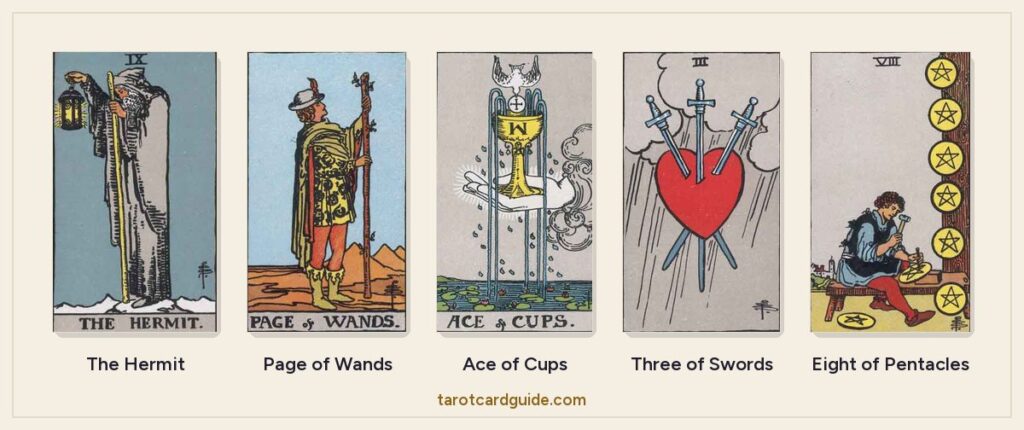
Majors carry the most weight. A jumping Hermit before a dating question doesn’t forbid dating; it hints that the clearer answer comes after some time alone. The Tower isn’t a disaster warning either. It usually points at something built on shaky assumptions you already half suspect.
Among the suits, the Page of Wands leaping out while you ask about a stale job might suggest trying something small before you overhaul everything. The Five of Cups may point to grief you’ve been stepping around, and the Two of Swords to a decision you’re holding off by refusing to look at it. The Four of Pentacles asks whether you’re gripping money, time or control too tightly.
For court cards, the three ways to read a court card will help you tell whether the jumper is a person or an attitude.
Shuffling Techniques Compared
If you’d rather have fewer jumpers, change how you shuffle. Each method has a trade-off between how well it mixes, how often cards escape and how hard it is on the deck.
| Technique | Effect on jumping | Wear on the cards |
|---|---|---|
| Overhand: slide small packets from one hand into the other | Occasional jumpers, usually from the front or back of the deck | Gentle. Edges wear slowly over years |
| Riffle: split the deck, bend the halves and let the corners interleave | The most jumpers of any method, especially with new or stiff cards | Hardest on a deck. Bends cards, creases corners and scuffs gilded edges |
| Wash or “smoosh”: spread the cards face down and swirl them with both hands | Almost none, though cards turn freely, which mixes in reversals | Light, but the faces can scuff on a rough table. Use a cloth |
| Cutting into piles: deal into three to seven piles, then restack | None at all. Every card stays under control | Very gentle. Mixes less on its own, so pair it with another method |
My preference for everyday use is the overhand shuffle: it’s quiet, easy on the cards and still throws the occasional jumper for anyone who reads them. The wash is lovely when you want reversals in the mix. I’d keep the riffle for sturdy decks you don’t mind ageing, and I’d avoid the bridge finish, the move that arches the cards back into one stack, altogether with tarot. It bends cards faster than anything else.
With a brand-new deck, cutting into piles a few times is a good way to break up the factory order without throwing cards across the room. Handling the cards daily also softens them. A quick card of the day draw is an easy way to get that daily handling in.
An Example: A Jumper in a Three-Card Reading
Imagine someone has been offered a job in another city. They ask, “What do I need to understand about this move?” Their house rule is Rule 2: jumpers are clarifiers. Halfway through an overhand shuffle, the Eight of Cups slides out face up, so they set it to one side.
They lay three cards for situation, obstacle and advice:
- Situation: Two of Wands. A figure on castle walls holds a small globe. The options are real and the planning is under way, but they haven’t left the castle yet.
- Obstacle: Four of Pentacles. A figure clutching coins at the heart, head and feet. Something here is being held too tightly: savings, a flat, a routine, a sense of control.
- Advice: The Chariot. Commit and steer. The charioteer holds opposing forces together by will, which suits a decision with pulls in both directions.
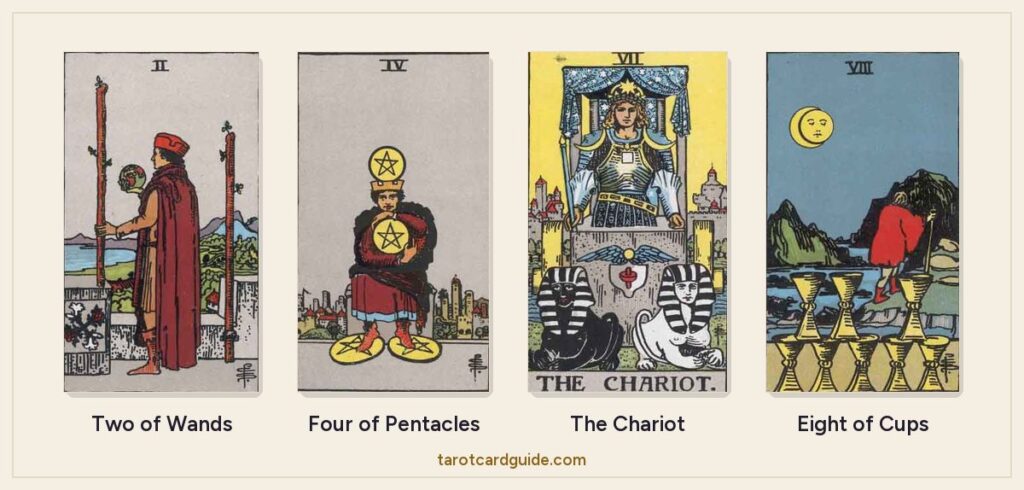
Now the clarifier. The Eight of Cups shows someone walking away from a neat stack of cups, not a broken one. It shifts the whole reading. The question may not be whether the new job is better, but whether the current life has already quietly emptied out. The jumper doesn’t decide for them. It points at the feeling underneath the practical worries in the Four of Pentacles.
If they wanted a blunter gut check afterwards, they could pull a single card with the yes or no tarot tool. For a decision this size, though, I’d treat that as a conversation starter rather than an answer, and something like the two options spread will give far more to work with.
Frequently Asked Questions
What does it mean when a tarot card falls out of the deck?
Many readers take a card that falls out while shuffling as extra emphasis, a theme worth noticing. Others see it as a shuffling accident. Decide your own rule before you shuffle and apply it consistently.
Should I read a jumping card or put it back?
Either is fine. The three common choices are to read it first as the main message, to read it last as a clarifier, or to put it back. The clarifier approach is a good middle ground for most readers.
Why do my tarot cards keep jumping out when I shuffle?
Usually because the deck is new and stiff, because you riffle shuffle, or because of humidity, static or a bent card. An overhand shuffle, a wash or cutting into piles will cut down jumpers a lot.
What if a jumping card lands reversed?
If you read reversals, either read it as it lands or turn it to match the deck in your hands. Pick one convention in advance. A reversed jumper usually softens, delays or turns inward the upright meaning.
Is it bad luck if a tarot card falls on the floor?
No. Some people feel uneasy about it, but there’s no rule that a dropped card brings bad luck. Pick it up, check it isn’t damaged and carry on with your reading.
What does it mean if the same card keeps jumping out?
First check the card isn’t bent or sticky. If it’s physically fine, many readers treat a repeat jumper as an unresolved theme. Note it down each time and look for a pattern over a few weeks.