
A money tarot spread is a six-card layout for looking honestly at your finances: where your money stands, what drains it, what supports it, your attitude to money, what to change and the next practical step. It won’t tell you what to buy or where to invest, but it is very good at showing the habits and feelings behind your spending, saving and worrying.
Use it for everyday money questions: why the month always runs out early, whether a purchase makes sense, how to face a debt, how to save for something, or how generous you can afford to be. This guide covers every position, how the cards pair up, money in all four suits, a full example and two shorter variants.
Draw a free Money reading now: think about your money situation, or one money question, then deal all six cards below. Each position shows the question it asks, and each card links to its full meaning. Then come back to the guide to read the cards together.
Your Money Spread reading
- Where your money stands What is my money situation, honestly, right now?
- What drains it What is draining my money, or my peace of mind about it?
- What supports it What is already working in my favour?
- Your money mindset What attitude or belief shapes how I handle money?
- What to change What would help most if I changed it?
- The next step What is one practical step I can take this week?
The top row is the picture and the bottom row is what you can do about it. Read each column from top to bottom as a pair. How to read the positions together
Jump to a section:
- What a money tarot spread is, and when to use another
- The 6 positions at a glance
- Each position in depth
- Reading the positions together
- Money in every suit, and in the Major Arcana
- 16 money cards and what they may point to
- How to phrase a money question
- Using the spread for a purchase, a debt, saving or giving
- Reversed cards in a money reading
- A full example reading
- A quick three-card money check
- A money month spread
- What tarot can’t do with money
- Common mistakes
- Frequently asked questions
What is a money tarot spread?
It is a reflection spread about your relationship with money. Most people know roughly what they earn and spend. What gets in the way is avoidance, habit and worry, and six cards give those things a shape you can look at.
The spread moves from looking to doing. The first three cards describe the situation: how things stand, what takes away and what adds. The last three turn it into action: the mindset behind it, the change worth making and one step small enough to take this week.
When another spread fits better
- Choosing a job, a career change or a business direction: the career path spread is built for that, and the career tarot reading guide covers job offers and interviews.
- Two specific options, such as two flats or two ways to pay something off: the two options spread sets them side by side.
- A quick gut check: the yes or no tarot reading gives a single card and a leaning.
- What one card means for money: the career and money meanings page has a money line for all 78 cards.
The 6 money spread positions at a glance
Each position asks one plain question. The third column shows which card it talks to most.
| Position | What it asks | Read it with |
|---|---|---|
| 1. Where your money stands | What is my money situation, honestly, right now? | 4, 6 |
| 2. What drains it | What is draining my money, or my peace of mind about it? | 5, 3 |
| 3. What supports it | What is already working in my favour? | 6, 2 |
| 4. Your money mindset | What attitude or belief shapes how I handle money? | 1, 5 |
| 5. What to change | What would help most if I changed it? | 2, 4 |
| 6. The next step | What is one practical step I can take this week? | 3, 1 |
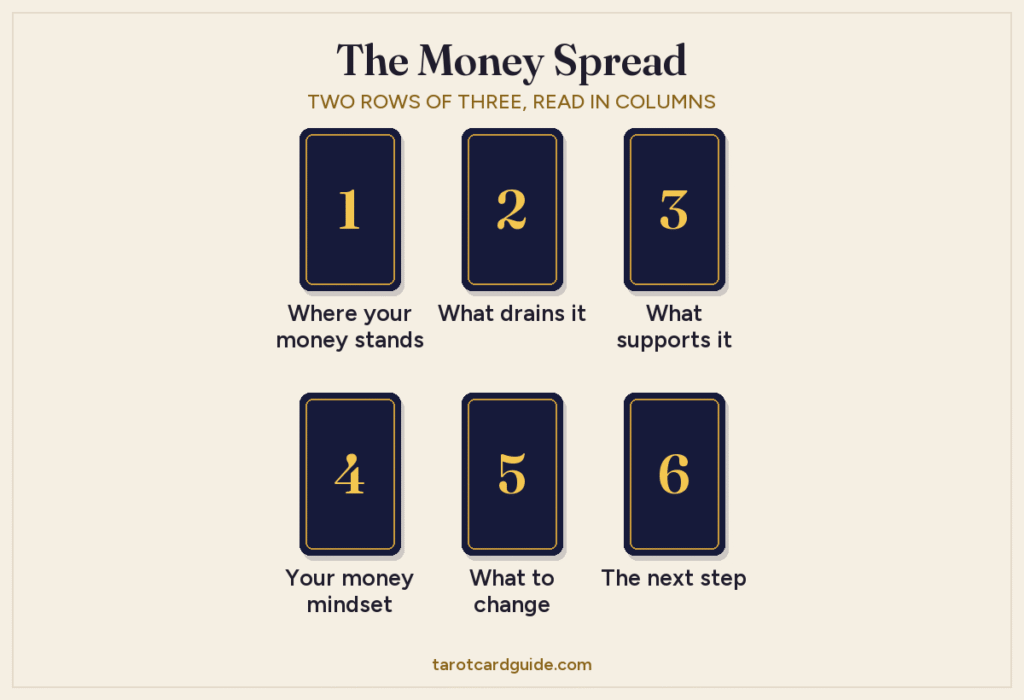
Lay the cards in two rows of three. The top row (cards 1, 2 and 3) is the picture as it is. The bottom row (cards 4, 5 and 6) is the part you can work on. Each card in the bottom row sits under the card it answers, so the columns read as pairs.
Each money spread position in depth
Money isn’t only a Pentacles matter, so read every suit through the question. A Swords card in a money spread is usually about thoughts and worry, a Cups card about feelings and spending, and a Wands card about drive, risk and effort.
Card 1: Where your money stands
This is the honest snapshot. It may describe the figures, or how the situation feels to live in. Take it as a description, not a verdict. For example, the Two of Pentacles here describes juggling: irregular income, bills timed against pay days and money moved between accounts to cover what’s due. You are coping, but there is no slack.
- A hard card here: it names what you probably already know. Naming it is the start of fixing it.
- Compare with: card 4 below it, which shows the attitude behind the situation, and card 6, the first step out of it.
Card 2: What drains it
Card 2 shows where money or calm leaks away. It may be a spending habit, a cost you’ve stopped noticing, a person or an unhelpful pattern of worry. For example, the Knight of Wands here points to impulse: quick gains and equally quick spending, or a financial decision made because it felt exciting. The card’s own fix is simple. Take a day to think before you commit.
- A pleasant card here: good things can drain you too. A generous card may mean you give more than you can spare.
- Compare with: card 5 below it, which is often the direct remedy, and card 3, which shows what can offset the drain.
Card 3: What supports it
This card shows what is already on your side: a skill, a habit, a person, steady income or simply good sense. People tend to skip it in money readings, because worry is louder. For example, the Knight of Pentacles here says your reliability is the asset: regular saving, paying things down and sticking to a plan. Returns come gradually, but they come.
- Reversed: support that exists but isn’t being used, such as an adviser you haven’t called or a skill you undercharge for.
- Compare with: card 6 below it. The next step usually builds on what already works.
Card 4: Your money mindset
Card 4 looks at the belief or feeling behind your choices. Scarcity, guilt, pride, avoidance and “I’m just bad with money” all live here. For example, the Four of Pentacles here shows a tight grip. Saving is a strength, but the card warns against holding so hard that you won’t spend on a course, a tool or a move that would improve your earning power.
- A Swords card here: very common. Money worry is a thinking pattern as much as a bank balance.
- Compare with: card 1 above it. If the mindset matches the situation, the situation may be feeding the belief, or the other way round.
Card 5: What to change
This is the lever: one habit, decision or attitude that would make the most difference. Read it as advice. For example, Justice here asks you to make money decisions on the numbers rather than on hopes or fears, settle what you owe and split shared costs fairly. If a household bill has quietly become one person’s burden, this is the card that says so.
- Court cards: usually an approach to take. The calm planning of a King, or the beginner’s curiosity of a Page. See tarot court cards explained.
- Compare with: card 2 above it, the drain it is meant to fix.
Card 6: The next step
The last card turns the reading into something you do this week. Keep it small and concrete: open the statement, make the call, set up the standing order. For example, the Ace of Pentacles here says pick one practical step, such as a budget, and start it today. It rewards slow, steady effort, not a grand plan.
- Reversed: a step that needs more groundwork first. Ask what has to be checked or prepared before you act.
- Compare with: card 3 above it, the support to lean on, and card 1, the situation the step should improve.
Reading the positions together
Six separate answers make a list. Read in pairs, they explain each other.
Situation and mindset: cards 1 and 4
This column asks how much of the situation is circumstance and how much is attitude. A hard situation over a calm mindset card suggests you are handling a rough patch well. A comfortable situation over an anxious mindset card suggests the worry is bigger than the problem.
Drain and change: cards 2 and 5
The most practical pair. Card 5 is often the plain answer to card 2. If they share a suit, the fix lives in the same area as the leak. If card 2 is emotional and card 5 is practical, the leak may be feelings being soothed with spending, and the change is a better way to meet that need.
Support and next step: cards 3 and 6
The step in card 6 usually works best when it uses card 3. If the support is a person, the step may be asking them. If it is a skill, the step may be charging properly for it.
Counts
In six cards from a full 78-card deck, expect one or two Major Arcana cards. Three or more turn up in about one reading in five and suggest the money question sits inside a bigger change. No Majors at all happens about one time in eight, and suggests a situation that is largely about everyday habits.
You’ll get about one Pentacle on average. Three or more Pentacles is unusual, about one reading in fifteen, and puts budgets, bills and figures front and centre. Three or more Swords, just as rare, points to worry doing more damage than the money itself. Repeated numbers repeat a theme; see tarot card combinations.
Money in every suit, and in the Major Arcana
Pentacles: the money suit
The Pentacles deal with what you can hold: income, savings, bills, property and the habits that build security. They move slowly, and almost all of them favour patience over shortcuts. The suit runs from the Ace of Pentacles, a new opportunity or income stream, to the Ten of Pentacles, long-term security that reaches beyond the next pay cheque.
Swords: money worry and avoidance
The Swords show how you think about money. The Nine of Swords is the classic card of debts that keep you awake and bills you’re afraid to open. The Two of Swords warns that unopened statements and postponed decisions don’t make a problem smaller. The Eight of Swords describes feeling trapped by debt or a tight budget. All three give the same practical advice: look at the real figures, which are usually less frightening than the imagined ones.
Cups: feelings, treats and spending to soothe
The Cups show the emotional side of money: what you spend to celebrate, to comfort yourself or to please other people. The Nine of Cups upright says you can treat yourself, but reversed it warns of overspending after a windfall. The Three of Cups is generous to a fault, so watch what the good times cost. The Seven of Cups cautions against wishful thinking and offers that sound too good to be true.
Wands: drive, risk and burden
The Wands show energy and ambition, which can make money or burn through it. The Ace of Wands is potential more than profit: an idea that can earn if you back it with steady effort. The Knight of Wands can show quick gains and impulse purchases. The Ten of Wands describes bills and responsibilities that feel crushing, and asks you to break them into smaller pieces.
Major Arcana cards in a money reading
- Wheel of Fortune: cycles and timing. Money can improve, but the wheel keeps turning, so plan for leaner times too. The card itself says it is not a sign to gamble on a lucky feeling.
- The Emperor: structure and discipline. Budgets, savings, tidy accounts and putting off a want for lasting security. Reversed, money slipping through your fingers for lack of a system.
- The Devil: what has a hold on you. Overspending, debt, gambling, a fixation on status or a well-paid job that keeps you unhappy. Reversed, it can show you taking back control.
- Justice: fairness and the numbers. Settling debts, sharing costs fairly, reading contracts and deciding on facts rather than feelings.
- The Tower: a shock, such as an unexpected expense. A reason to check how stable things really are and build a buffer.
- Temperance: moderation. A realistic budget, steady saving and an end to swinging between strict budgeting and splurging.
16 money cards and what they may point to
These are the cards that most often shape a money spread. Each line follows that card’s own money meaning; follow the link for the full reading, upright and reversed. For all 78 cards, see the money section of the career and money meanings.
| Card | What it may point to |
|---|---|
| Ace of Pentacles | A new income stream or opportunity; sensible, slow growth |
| Two of Pentacles | Juggling bills and irregular income; time to build a buffer |
| Four of Pentacles | Saving and caution; a grip that may be too tight |
| Five of Pentacles | Hardship or falling income; tighten the budget and look for support |
| Six of Pentacles | Fair exchange: pay, loans, debts repaid, giving what you can |
| Seven of Pentacles | Long-term saving or investment; judge it on the right timescale |
| Nine of Pentacles | Comfort and independence you have earned |
| Page of Pentacles | New money habits: a first budget, a savings goal |
| King of Pentacles | Patient, well-advised wealth building over quick wins |
| Nine of Swords | Money worry that keeps you up; face the actual figures |
| Ten of Wands | Debts or bills that feel crushing; break them into pieces |
| Knight of Wands | Quick gains and quick spending; wait a day before buying |
| Seven of Cups | Wishful thinking; schemes that sound too good to be true |
| The Devil | Overspending, debt or a habit that has a hold on you |
| Wheel of Fortune | A turn in your finances; enjoy the upturn and plan for the dip |
| The Tower | An unexpected cost or shock; check how solid things are |
How to phrase a money question
Ask about what you can see and change: your habits, choices and feelings. Avoid questions that ask the cards to forecast amounts, dates or markets. They can’t, and a confident-sounding answer would only mislead you.
| Poor question | Better question |
|---|---|
| Will I be rich? | What would help me feel more secure with money this year? |
| Should I buy these shares? | What am I hoping this investment will do for me? |
| When will money come? | What can I do to bring in more income? |
| Will I win the lottery? | Why do I keep hoping for a windfall, and what would I do differently without it? |
| Will my debt disappear? | What is stopping me from facing my debt, and what is the first step? |
| Is my partner wasting our money? | How can we talk about shared money fairly? |
One question per spread works best. For more on wording, see how to ask the right questions in a tarot reading.
Using the spread for a purchase, a debt, saving or giving
Keep the six positions and change only the question.
A big purchase
Ask, “What do I need to see before I buy this?” Card 2 shows the hidden cost, which may be money or stress. Card 4 shows why you want it. A Seven of Cups there suggests you are buying the idea of the thing; a Nine of Pentacles suggests a considered treat you have earned.
A debt worry
Ask, “What would help me get on top of this debt?” Card 3 and card 6 matter most here. Whatever they show, the practical step behind any debt reading is the same: list what you owe and to whom. Free, confidential debt advice services exist in many countries, and using one is a sensible move, not a defeat. The Five of Pentacles makes the same point: ask for help and accept it.
Saving for something
Ask, “What helps and hinders my saving for this?” Read card 2 as what keeps eating the savings and card 6 as the habit to start. The Page of Pentacles or Knight of Pentacles in card 6 both favour small, regular amounts over a big burst.
Income
Ask, “What would help me earn more?” Card 3 often names a skill you undervalue. The Three of Pentacles there favours earning through skill: a qualification, or rates that reflect your experience. If the question is really about changing jobs, switch to the career path spread.
Lending, borrowing and giving
Ask, “How can I be generous without hurting myself?” The Six of Pentacles is the card of fair exchange. It advises putting the terms of any loan in writing. Reversed, it warns of help with strings attached, or giving far more than you get back.
Reversed cards in a money reading
Reversals are optional. Decide before you shuffle whether you read them. If you do, read a reversed card as the same energy blocked, overdone or turned inwards. It isn’t automatically bad news.
- Some reversals are good news. The reversed Five of Pentacles often shows a hard time lifting. A reversed Devil can show you breaking an impulse-spending habit.
- Some show the same thing gone too far. The reversed Four of Pentacles can mean either greed and a grip that is too tight, or the opposite: money flowing out through overspending.
- Some show delay. The reversed Ace of Pentacles is an opportunity that is late or needs better groundwork, not a loss for ever.
The draw on this page turns each card with a one in three chance, so in six cards you’ll see two reversals on average. All six upright happens only about one time in eleven. Three or more reversals, which happens in about a third of readings, suggests a situation that needs slowing down and looking at, not pushing.
A full money spread example reading
Here is a complete hypothetical reading, not a real person or reading. Imagine someone called Sam, a freelance designer whose income arrives in lumps. Some months are flush; most end with a tense final week. Sam rarely opens the banking app. Sam asks: “What do I need to see about my money right now?” Sam reads reversals.
| Position | Card | In brief |
|---|---|---|
| 1. Where your money stands | Two of Pentacles | Juggling irregular income and bills |
| 2. What drains it | Nine of Cups, reversed | Overindulgence; overspending after a windfall |
| 3. What supports it | Three of Pentacles | Earning through skill; fair rates |
| 4. Your money mindset | Eight of Swords | Feeling stuck; avoiding the statements |
| 5. What to change | Temperance | Moderation; a steady middle way |
| 6. The next step | Page of Pentacles | Start a budget and a small savings habit |
Situation and mindset: Two of Pentacles over Eight of Swords
The Two of Pentacles describes Sam’s month exactly: irregular income and money shuffled to cover what’s due. The card’s advice is a small buffer and a clear record of what comes in and goes out. Beneath it, the Eight of Swords shows why that hasn’t happened. Sam feels trapped by money and avoids the statements altogether. The card’s point is that the real numbers are usually less frightening than the imagined ones.
Drain and change: Nine of Cups reversed over Temperance
The drain is the Nine of Cups reversed, and it is the only reversal in the spread, so it stands out. Upright, this card lets you treat yourself. Reversed, it warns of overindulgence and overspending after a windfall. For Sam, the pattern is plain: a big invoice lands, a week of treats follows, and the lean weeks pay for it.
Temperance, directly below, is the cure for exactly that swing. It asks for moderation, a realistic budget and steady saving instead of feast and famine. It is also the only Major in the spread, which marks this as the lesson of the reading.
Support and next step: Three of Pentacles over Page of Pentacles
The support is the Three of Pentacles: Sam’s skill is real, and the card favours rates that reflect experience. The next step is the Page of Pentacles, the card of first budgets and new savings habits. The amounts may be small at first. That is fine; the habit is the point.
Putting it together
Three Pentacles in six cards is unusual (about one reading in fifteen), so the reading is firmly about practical money habits rather than a big life change. Turned into concrete steps, Sam’s week looks like this:
- Open the banking app and write down three months of money in and money out. One sitting, no judgement.
- Open a separate savings pot labelled “lean months”.
- Agree a rule: when an invoice is paid, a fixed share goes into that pot before anything else.
- Keep the treats, but give them a set amount, so a good month stays a pleasure instead of a drain.
- Check the rates on the next quote against current experience.
A month later, Sam can lay the spread again and compare.
A quick three-card money check
For a fast check-in, or a single money worry, three cards are enough:
| Card | What it asks |
|---|---|
| 1. What I’m not seeing | What about my money am I avoiding or missing? |
| 2. What helps | What is on my side? |
| 3. One step | What can I do this week? |
Say you are tempted by an online course that promises fast income, and you draw the Seven of Cups, Justice and the Knight of Pentacles. What you’re not seeing is the wishful thinking: it sounds too good to be true. What helps is Justice’s habit of deciding on the numbers, not on hope, and reading the small print. The step is the Knight’s: keep to the steady plan and skip the risky shortcut. For more three-card layouts, see the three-card spread.
A money month spread
To plan the month’s money, lay five cards on or just after pay day:
| Card | What it asks |
|---|---|
| 1. This month’s money theme | What runs through my finances this month? |
| 2. A cost to watch | Where might money slip away? |
| 3. Where to save | What can I put aside or cut back? |
| 4. Spending worth doing | Where is money well spent this month? |
| 5. A habit to keep | What one habit will I hold to all month? |
Card 4 matters. A money plan that bans all pleasure tends to fail by week two, and the Four of Pentacles warns against refusing to invest in yourself. Write the five cards down and check them at the end of the month. For a broader monthly reading, pair it with the month ahead spread.
What tarot can’t do with money
Plainly: tarot is not financial advice. It can’t predict markets, prices, lottery numbers or the result of a bet, and no spread changes the odds of a gamble. If a reading seems to tell you to stake money on something, put the cards down. The Wheel of Fortune itself is not a sign to gamble on a lucky feeling.
What a money spread can do is help you think. It slows you down before a purchase, names the habit you keep repeating and gives you one step to take. For decisions about investments, pensions, mortgages or large sums, talk to a qualified, regulated financial adviser. For debt, free and confidential debt advice services exist in many countries, and they can help you set priorities.
If money worry has been costing you sleep for weeks, talk to someone you trust or to your doctor. If gambling feels out of control, free, confidential support services exist for that too.
Common money spread mistakes
- Asking for a forecast. “How much will I have by June?” has no useful answer. Ask what you can do instead.
- Reading only the drain. Card 3 shows what already works, and the next step usually builds on it.
- Using the cards instead of the figures. A reading is a prompt to open the statements, not a replacement for them.
- Making card 6 too big. “Sort out my finances” isn’t a step. “List my direct debits tonight” is.
- Redrawing until it looks better. If you don’t like the answer, that is usually the part worth reading. One spread per question; wait a month before asking again.
Money tarot spread: frequently asked questions
How do you do a money tarot spread?
Shuffle while thinking about your money or one money question, then deal six cards in two rows of three: where your money stands, what drains it, what supports it, your money mindset, what to change and the next step. Read each card in its position, then read each column as a pair. Finish by writing down one step for this week.
Can tarot predict money coming?
No, not in any reliable way. A card like the Ace of Pentacles can encourage you to go after an opportunity, but it can’t promise a payment, a sum or a date. Treat a money reading as reflection on your habits and choices, which you can change, rather than a forecast.
Which tarot card means money?
The Pentacles are the money suit, and the Ace of Pentacles, Nine of Pentacles and Ten of Pentacles are the most positive for finances. Money also shows up in other suits, and in Majors such as The Emperor and Wheel of Fortune. See the table of 16 money cards.
What does the Devil mean in a money reading?
The Devil points to something with a hold on you: overspending, debt, gambling, status or a well-paid job that leaves you unhappy. Its advice is to name the habit without shame and take one small step towards freedom. Reversed, it can show you taking back control.
Can I use tarot to decide on an investment or a bet?
Please don’t. Tarot can’t predict markets, prices or results, and it isn’t financial advice. Use the cards to look at why you want to invest or gamble, and take investment decisions with a qualified, regulated adviser.
What if my money spread is full of hard cards?
Read cards 3 and 6 first: what supports you and the next step. A spread heavy with Swords often shows worry doing more harm than the money itself. If debt is part of it, a free debt advice service can help you make a plan.
How often should I do a money tarot reading?
Once a month is plenty, ideally around pay day. That gives your changes time to work and gives you something to compare. A quick card of the day can keep the thread going in between.
Is this spread about my job or my money?
Money: spending, saving, debt, purchases, income and how you feel about all of it. For job choices and career direction, use the career path spread instead.
Ready to look? Deal your six cards with the free Money reading at the top of this page, write down your one step, and come back next month to compare. To look up any card you draw, browse the meanings of all 78 cards, or find another layout among the tarot spreads.