A new moon tarot spread is a short reading done at the start of the lunar cycle to choose an intention and the first step towards it. A full moon tarot spread, about two weeks later, looks at what has come to light since then and what you’re ready to let go of. Read together, they turn a month into a simple rhythm of planting and harvesting.
This guide gives you both spreads (original, with diagrams), a table of all eight moon phases with a reading theme for each, quick check-ins for the quarter moons and a way to track a whole cycle in a journal. There’s also a tour of the cards with a moon in the picture, from The Moon onwards, and a calm word about eclipses and blue moons.
You don’t need an astrology app or a perfect night sky. You need a deck, a notebook and a rough idea of what the moon is doing.
Why Read Tarot With the Moon
The honest answer is rhythm. A lunar cycle lasts about 29.5 days, which is long enough for something to change and short enough to remember what you asked. Tying your readings to it gives you a start, a middle and an end, instead of a pile of one-off spreads you never look at again.
There’s tradition behind it too. The moon has long been linked with intuition, dreams and cycles, and tarot carries that link in its imagery: The High Priestess is the Major Arcana card ruled by the moon, and The Moon itself is all instinct and half-light. Plenty of witches plan spellwork by the phases for the same reason.
What the moon doesn’t do is make your readings more accurate. Nobody has shown that, and I wouldn’t claim it. Treat the phases as a helpful calendar for reflection, the same way you’d treat the card of the day as a habit rather than a forecast.
The Eight Moon Phases and What to Read For
Each phase lasts roughly three to four days. The table gives a theme and one question for each, so you can pull a card or two whenever you notice the moon.
| Phase | Reading theme | A question to ask |
|---|---|---|
| New moon | Beginnings, intentions, planting seeds | What do I want to grow this cycle? |
| Waxing crescent | First steps, gathering support | What small action gets this moving? |
| First quarter | Decisions, obstacles, commitment | What’s resisting, and do I push or adjust? |
| Waxing gibbous | Refining, patience, fine-tuning | What needs tweaking before it’s ready? |
| Full moon | Illumination, results, release | What has come to light? |
| Waning gibbous | Gratitude, sharing, teaching | What have I learned that I could pass on? |
| Last quarter | Letting go, clearing, forgiving | What am I ready to put down? |
| Waning crescent or dark moon | Rest, reflection, the unseen | What needs quiet before the next start? |
Telling the phases apart
The moon waxes (grows) from new to full, then wanes (shrinks) back again. In the northern hemisphere a waxing moon is lit on the right and a waning moon on the left. In the southern hemisphere it’s the other way round, so a reader in Sydney or Buenos Aires sees the crescent facing the opposite way. The phases themselves happen on the same dates everywhere.
“Dark moon” and “new moon” get used in two ways. Astronomically, the new moon is the moment the moon sits between Earth and the sun, invisible to us. Some readers call the day or so before it the dark moon and save the new moon reading for the first thin sliver in the evening sky. Readers genuinely split on this, and both work.
The timing doesn’t need to be exact
The exact new or full moon is a single moment, and it may fall at 4am on a work night. Don’t set an alarm. Anything within a day or so either side is still the new or full moon for reading purposes, and a quiet evening that week beats a rushed spread at the “right” minute. If you like tarot for timing questions, the post on tarot timing explains why the cards are loose with dates anyway.
A New Moon Tarot Spread for Intentions
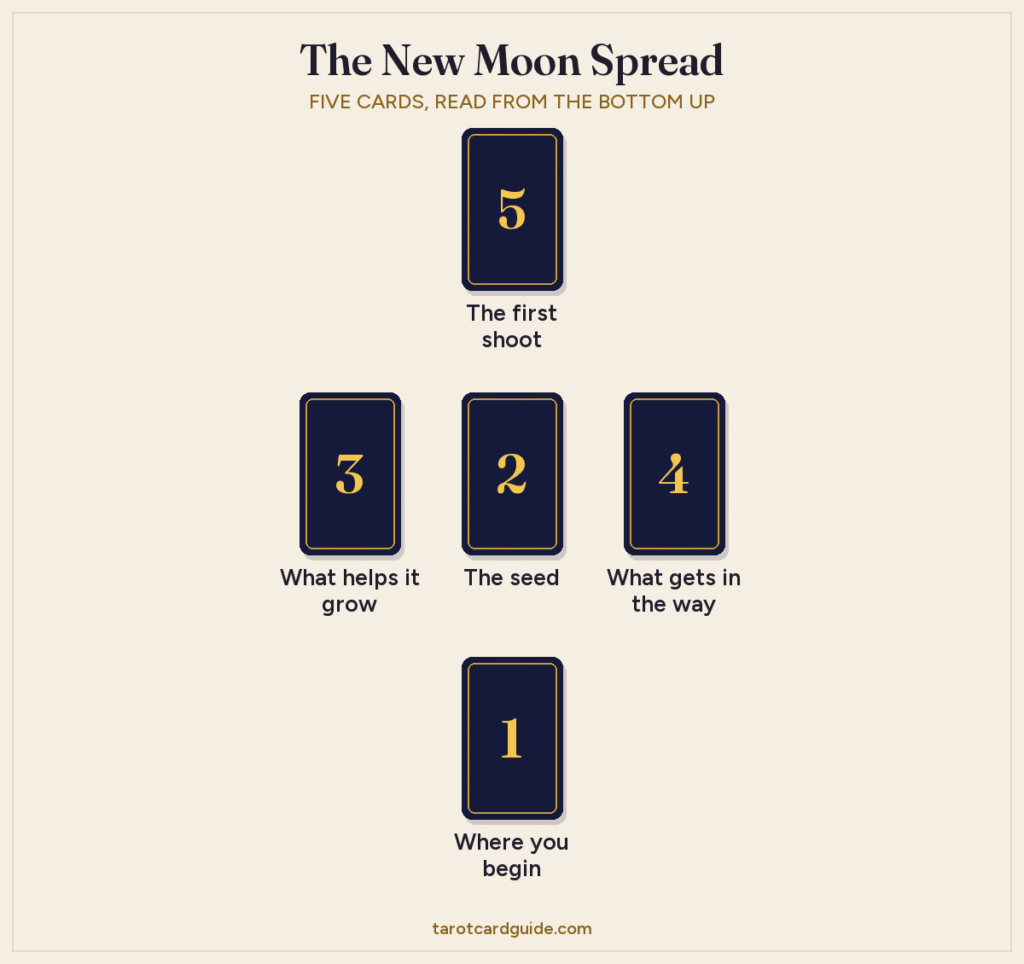
This five-card spread grows like a seedling: start with the card at the bottom and read upwards. Lay card 1 at the bottom, card 2 above it, cards 3 and 4 on either side of card 2, and card 5 at the top.
- Where you begin: the soil you’re planting in, meaning your energy and situation right now.
- The seed: the intention this cycle supports.
- What helps it grow: a strength, person or habit to lean on.
- What gets in the way: the weed to watch for.
- The first shoot: one step to take before the first quarter moon.
If you already know your intention, you can pick card 2 face up from the deck instead of drawing it and let the other four cards respond. An Ace anywhere in this spread is a lovely sign, since Aces are the tarot’s seeds, and The Fool in position 2 says the intention is simply to begin.
A new moon example
Imagine someone coming out of a draining few months draws the Four of Swords for where they begin, the Page of Pentacles as the seed, the Three of Pentacles for what helps, the Seven of Cups for what gets in the way and the Ace of Wands as the first shoot.
They’re tired (Four of Swords), and the intention is modest and practical: learn one new skill (Page of Pentacles). A teacher, class or knowledgeable friend will help (Three of Pentacles). The danger is the Seven of Cups, drowning in options and never choosing one. The Ace of Wands says to pick a course and sign up this week, while the spark is still there.
A Full Moon Tarot Spread for Release
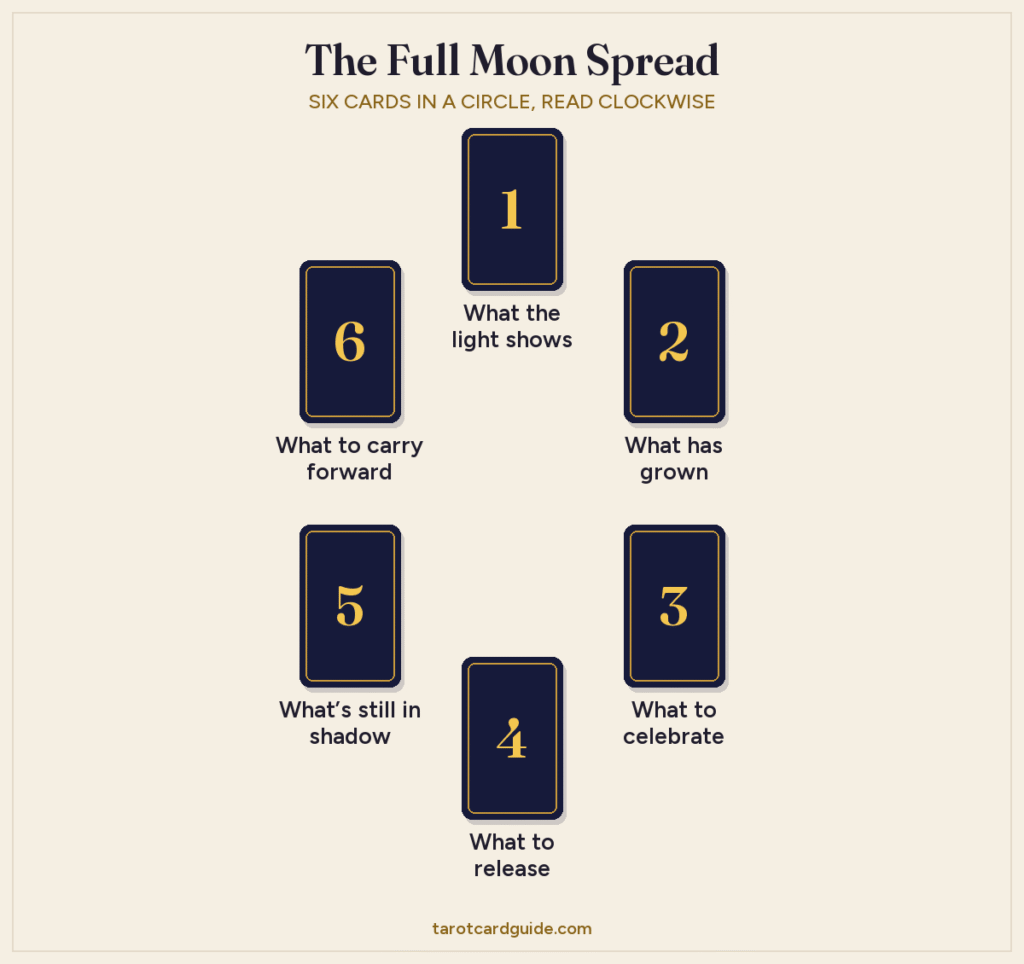
The full moon is the brightest night of the cycle, so this spread is about seeing clearly and then letting go. Lay six cards in a circle, starting at the top and going clockwise, like the face of the moon.
- What the light shows: what has become clear since the new moon.
- What has grown: how the new moon intention is doing.
- What to celebrate: the harvest, however small.
- What to release: the habit, worry or effort that has done its job.
- What’s still in shadow: what the light hasn’t reached yet.
- What to carry forward: the lesson or action for the waning weeks.
Read it next to your new moon notes. A Ten in “what to release” is a clear sign that a cycle is complete, and Death there is more welcome than it looks: it’s the card of endings that make room.
Card 5 matters more than people expect. The full moon lights up a lot, but not everything, and The Moon or The High Priestess in that spot suggests waiting for more information before you act. If a card in position 5 feels heavy, the shadow work spread is a good follow-up during the waning moon.
A full moon example
Two weeks after the new moon example above, the same person lays the full moon spread. The Star shows what the light reveals: their energy is coming back. The Eight of Pentacles in “what has grown” means the course is under way and the practice is paying off, and the Three of Cups is the harvest worth celebrating: the people they’ve met along the way.
The Ten of Wands in “what to release” names an old habit of taking on too much. The Two of Pentacles in shadow says it isn’t clear yet how the new skill fits around everything else, and Temperance to carry forward suggests a steady, moderate pace for the waning weeks. Nothing dramatic, just a month that moved in the right direction.
Some readers also leave their deck on a windowsill under the full moon afterwards. The guide to cleansing tarot cards with moonlight covers how to do that without damaging the cards.
Quick Check-Ins for the Quarter Moons
You don’t need a big spread for every phase. These take five minutes and keep the thread going between the new and full moon readings.
First quarter: two cards
- What’s resisting my intention?
- Do I push through or adjust the plan?
This is the half-lit moon, a natural point for a decision. A Wands card in position 2 usually says push; a Cups card says check how you feel about it first.
Last quarter: three cards
- What’s finished?
- What can I forgive, in myself or someone else?
- How do I rest before the next new moon?
The free three-card reading works well here if you swap its positions for these questions.
The phases in between: one card
For the crescents and gibbous moons, a one-card spread with the question from the table is plenty. At the dark moon, you may prefer not to read at all. A card like the Four of Swords is a reminder that rest is part of the cycle too.
How to Track a Whole Moon Cycle in Your Journal
The spreads are useful on their own, but the real value shows up when you can see a whole cycle on one page. Here’s a simple way to do it:
- Give each cycle a double page. Write the new moon’s date and your intention in one line at the top.
- Record every card. Note the phase, the card, whether it was reversed and a one-line reading. Short is fine.
- Count the suits at the full moon. Four cards from the Swords suit in one cycle tell you where your head has been.
- Mark repeats. If a card turns up in more than one phase, circle it. The post on cards that jump out of the deck and the guide to pulling the same card again both help with this.
- Close the page at the dark moon. Write two lines: what grew and what you’re leaving behind. Then turn the page for the next cycle.
After three cycles, read the pages back in one go. Patterns that were invisible week to week, like a Wheel of Fortune at every full moon or a string of Pentacles every time money comes up, tend to jump out.
The Moon’s Cards in the Tarot
The moon turns up far more often in the Rider-Waite-Smith deck than the one card named after it. These are the ones worth knowing for lunar readings.
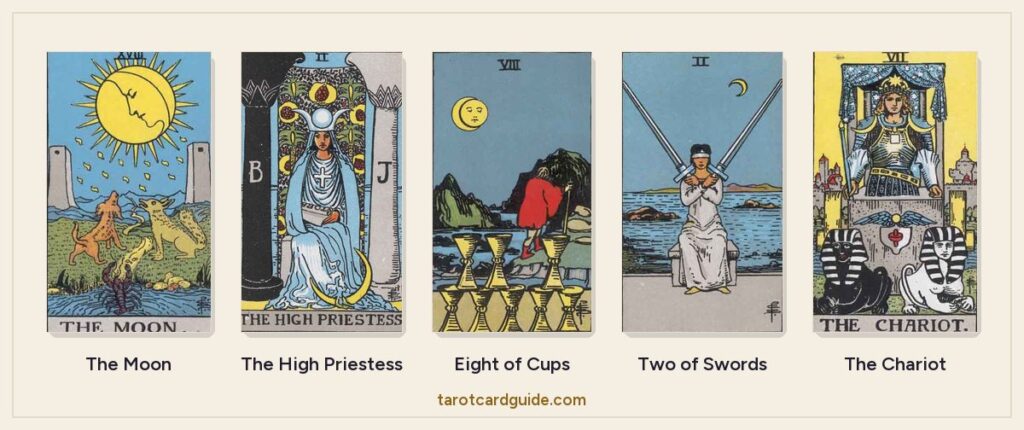
- The Moon: a large moon with a face drawn in profile, shedding drops of light over a dog, a wolf and a crayfish crawling out of a pool. It’s the card of instinct, dreams and uncertainty. In a moon reading it asks you to go slowly until the picture clears.
- The High Priestess: a crescent moon rests at her feet, and her crown echoes the moon’s phases. She’s ruled by the Moon in astrology, which makes her the natural card for new moon intuition and for anything you can’t force.
- Eight of Cups: a figure walks away from eight stacked cups under a moon with a face, drawn as a crescent and a full moon at once. It’s a quiet leaving by night, the perfect last quarter card.
- Two of Swords: a blindfolded woman holds two swords, with water behind her and a crescent moon in the sky. Its traditional astrology is the Moon in Libra, and it’s a good first quarter card: the decision you’ve been avoiding.
- The Chariot: the charioteer wears crescent moons on his shoulders, and the card is linked to Cancer, the sign ruled by the Moon. Strong feeling inside a disciplined shell.
In the Golden Dawn astrology that the deck draws on, the Moon is also paired with several Minor Arcana cards, including the Four of Cups (Moon in Cancer) and the Nine of Wands (Moon in Sagittarius). The post on tarot symbolism looks at how the moon and other symbols repeat across the deck.
Eclipses and Blue Moons
Eclipses only happen at a new moon (solar eclipses) or a full moon (lunar eclipses), and they come in clusters roughly every six months. Many astrologers read them as wildcards: turning points that speed things up. Some readers skip tarot on eclipse days and others love them. Either is fine. Nothing bad happens to you or your cards, and there’s no need to treat an eclipse as a warning.
If you do read on one, keep it simple: one card for what’s changing, one for how to meet it. Wheel of Fortune is the obvious eclipse card, and it says the same thing the sky does: cycles turn.
A blue moon is usually the second full moon in one calendar month; an older definition makes it the third full moon in a season that has four. It happens every two or three years. There’s no special rule for reading one, but it’s a nice excuse to repeat your full moon spread and see how far you’ve come.
Moon Phase Tarot FAQs
What is a good new moon tarot spread for beginners?
Start with three cards: where you are, what to plant and the first step. When that feels easy, move up to the five-card new moon spread above. If you’re new to reading, how to read tarot cards walks you through the basics.
What should I ask in a full moon tarot reading?
Ask what has come to light, what has grown and what you’re ready to release. Open questions work better than yes or no ones, and the guide to asking the right tarot questions has more ideas.
Do I have to read tarot at every moon phase?
No. Plenty of readers do the new and full moon spreads and leave it there. The quarter check-ins are a bonus, and skipping a phase, or a whole month, doesn’t break anything. Just pick up again at the next new moon.
Can I do a new moon reading a day or two late?
Yes. The new moon is a moment, but its energy is usually read as lasting a few days. A calm reading the day after is better than a rushed one at the exact time.
What does The Moon card mean in a new moon reading?
It usually says the intention isn’t fully clear yet. Keep it gentle and flexible, and let the next few weeks show you more. Reversed, it can mean clarity is returning; see The Moon reversed.
Do reversed cards mean something different in moon readings?
Not in themselves, but many readers find the waning half of the cycle a natural fit for reading reversals as energy turned inwards. The guide to reversed tarot cards explains that method and others.