The difference between tarot and oracle cards is structure. A tarot deck is a fixed system of 78 cards, 22 Major Arcana and 56 Minor Arcana in four suits, and the meanings are shared across thousands of decks; an oracle deck can have any number of cards, on any theme, with meanings set by whoever made it.
That one difference shapes everything else. Learn tarot once and you can pick up almost any tarot deck and read it. Oracle decks are easier to start with, but each one is its own little language, and the guidebook is the dictionary.
Below you’ll find how each is built, where they came from (the real history, which is less mysterious than the marketing), a side-by-side table, honest pros and cons, and a four-card spread that uses both at once.
How a Tarot Deck Is Built
Every tarot deck has the same skeleton. The 22 cards of the Major Arcana run from 0, The Fool, to 21, The World, and cover the big turning points: love, loss, change, faith, endings. The 56 Minor Arcana split into four suits of 14 cards, and deal with everyday life.
- Four suits, four elements: Wands (fire, drive), Cups (water, feelings), Swords (air, thought and conflict) and Pentacles (earth, money, work and the body).
- Ten numbered cards per suit, Ace to Ten, which follow a shared arc of beginning, growth, conflict and completion. The tarot numerology guide walks through it number by number.
- Four court cards per suit, Page, Knight, Queen and King: 16 in all, usually read as people or personalities. See tarot court cards explained.
Because the structure is fixed, the meanings are too, at least at their core. The Three of Pentacles is about skilled teamwork in almost every modern deck, whether the art is Victorian, minimalist or covered in cats. And the Queen of Cups is always a Queen, in the suit of feelings, so you know her temperament before you’ve read a word.
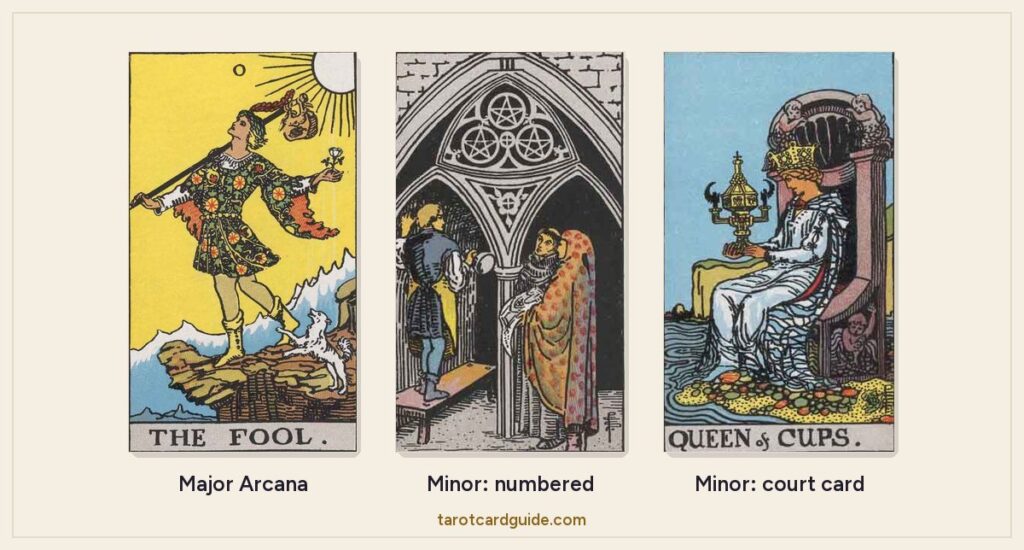
Most modern decks follow the Rider-Waite-Smith deck of 1909, and its pictures carry a lot of meaning on their own. If you want to read those images closely, the guide to tarot symbolism goes through the details that recur across the deck.
How Oracle Decks Work
An oracle deck is any deck of cards made for reflection or divination that isn’t tarot. There’s no required number of cards, no suits and no shared set of meanings. Decks of roughly 30 to 60 cards are common, but nothing says they have to be.
Each deck has a theme chosen by its creator: animals, plants, goddesses, angels, the moon, affirmations, colours, archetypes. Many cards carry a word or phrase, such as “Rest” or “Speak up”, printed under the image, so the message is right there. The meaning of each card comes from the creator’s guidebook, and a card called “Release” in one deck has nothing to do with a card called “Release” in another.
That freedom is the whole appeal. An oracle deck can be gentle, specific and beautiful in ways that a 78-card system can’t. It’s also why skills don’t transfer: learning one oracle deck teaches you that deck, and not much more.
Where Tarot and Oracle Cards Come From
Tarot: from card game to occult tool
Tarot didn’t start as a fortune-telling tool. The earliest surviving tarot cards were made in northern Italy in the 15th century, some of them hand-painted for noble families in cities such as Milan and Ferrara, and they were used to play a trick-taking card game. Versions of that game are still played today, notably in France.
The occult reading of tarot begins in 18th-century France. In 1781 Antoine Court de Gébelin claimed in his book Le Monde primitif that the cards preserved ancient Egyptian wisdom. There was no evidence for it (nobody could even read hieroglyphs yet), but the idea stuck. Around the same time a Paris cartomancer called Etteilla, his surname Alliette spelled backwards, published guides to reading the tarot and later a deck designed specifically for divination.
In the late 19th century the Hermetic Order of the Golden Dawn, a British occult society, wove tarot into a system of astrology, Kabbalah and ritual. One of its members, A. E. Waite, designed the deck that was published in London in 1909 and drawn by Pamela Colman Smith. The Rider-Waite-Smith gave full illustrated scenes to the numbered Minor Arcana, which is a big reason it became the standard for learning. The history section of The Fool shows how one card changed along the way.

Lenormand: a separate tradition
Lenormand is its own 36-card system, and it’s often lumped in with oracle decks. It’s named after Marie-Anne Lenormand, a famous French fortune-teller who died in 1843, but the deck bearing her name was published after her death, a piece of marketing rather than her own design. Its cards appear to derive from an older German parlour game.
Lenormand cards are plain and literal (a ship, a house, a key) and are read in strings and grids, closer to sentences than scenes. Like tarot, it’s a fixed system with shared meanings. Unlike tarot, it has no Major Arcana.
Modern oracle decks
Oracle decks as we know them now are recent. They grew from the late 20th century alongside the wider interest in astrology, meditation and self-help, and they’ve boomed since, helped along by independent artists and small publishers. Today there are thousands of them, and new ones arrive every month.
Tarot vs Oracle Cards at a Glance
| Tarot | Oracle cards | |
|---|---|---|
| Number of cards | Always 78 | Any number, often about 30 to 60 |
| Structure | 22 Majors, 56 Minors in four suits, 16 court cards | Whatever the creator chooses |
| Meanings | Shared across decks | Unique to each deck |
| Words on the cards | Usually just the card’s name | Often a keyword or phrase |
| Learning curve | Steeper, but the skill carries over | Gentle, but learned deck by deck |
| Best at | Detail, cause and effect, several people or options | One clear theme, a prompt or affirmation |
| Reversals | A long-standing option | Up to the deck and the reader |
| Origins | 15th-century cards, 18th-century occult use | Mostly late 20th century onwards |
Pros and Cons of Each
Tarot
- Pro: depth. With 78 cards you can show a situation from several angles. A Celtic Cross can hold the past, the fears, the outside influences and the likely outcome at once.
- Pro: cards talk to each other. Suits, numbers and court ranks give you ways to connect cards, which is the heart of reading combinations.
- Pro: it transfers. Books, courses and sites like this one all speak the same language, and your second deck will feel familiar.
- Pro: a tested spread for most questions. Tarot has been read in set positions for well over a century, so there are proven layouts for love, work and decisions, such as the relationship spread, the career path spread and the two options spread.
- Con: it takes time. Seventy-eight meanings, plus reversals if you use them, is a lot. Most people need weeks to feel comfortable and months to feel fluent.
- Con: it can be blunt. The Tower and the Ten of Swords don’t soften their messages, which some people find more than they wanted on a Tuesday morning.
Oracle cards
- Pro: instant. The message is often printed on the card, so you can use a deck on day one.
- Pro: gentle and specific. Many decks are designed to encourage, and a deck built around one theme, such as grief or creativity, can speak to it directly.
- Con: less nuance. A single-message card struggles with complicated situations, and many decks lean heavily positive, which can turn a reading into a pep talk.
- Con: nothing carries over. Every new deck means a new guidebook and a new set of meanings.
Which Should a Beginner Choose?
My honest recommendation: if you want to learn a skill, start with a Rider-Waite-Smith style tarot deck. Nearly every beginner’s book and site uses its images, including every card page here, so everything you read will match the cards in your hand. The early weeks are harder than with an oracle deck, but the effort compounds.
An oracle deck makes more sense if what you want is a daily nudge rather than a practice: a card on the fridge, a thought for the morning, something to journal about. There’s nothing lesser about that. It’s simply a different tool for a different job.
You also don’t need to buy anything to find out which suits you. Try a free card of the day for a week and see whether you enjoy working out what a tarot card means, or whether you’d rather be handed the message. If you do go with tarot, the step-by-step guide to reading tarot cards is the place to start.
How to Use Tarot and Oracle Cards Together
They work well as a pair, because each covers the other’s weak spot. Tarot gives detail; an oracle card gives a single theme to hang the detail on. The most common method is simple: do your tarot spread, then pull one oracle card as an overall message or a piece of advice.
I prefer to pull the oracle card first and lay it above the spread, like a title over a page. It sets the frame before you start interpreting, which makes it harder to talk yourself into the reading you wanted. Here’s a small spread built that way.
The Canopy Spread: one oracle card, three tarot cards
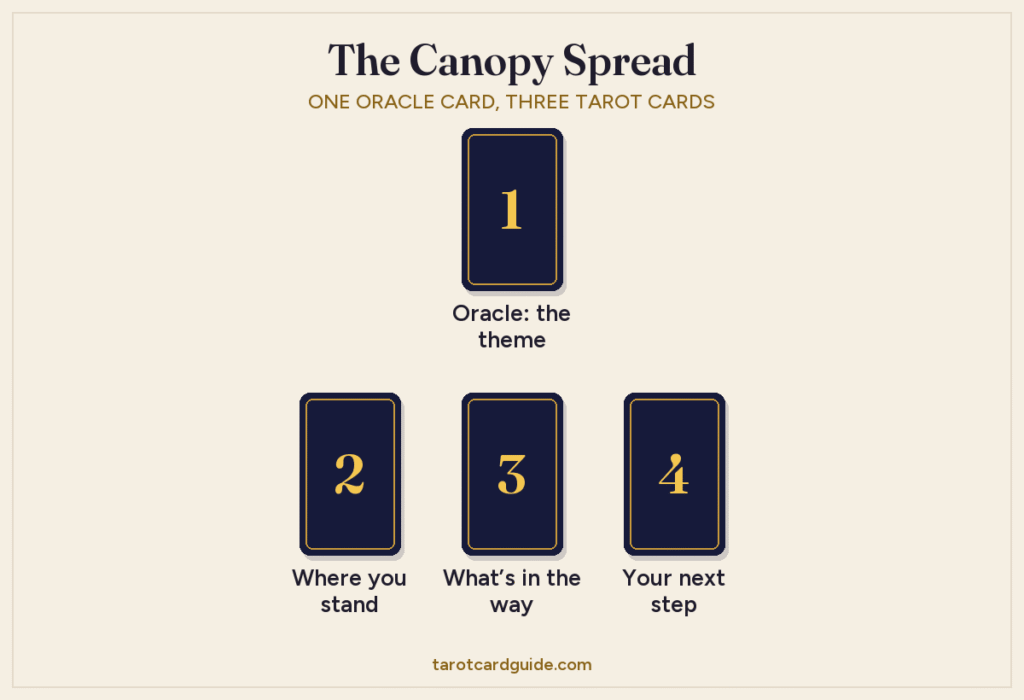
- The theme (oracle card, top). Shuffle the oracle deck and draw one card. This is the lens for the whole reading.
- Where you stand (tarot, left). The situation as it is now.
- What’s in the way (tarot, centre). The obstacle, habit or blind spot.
- Your next step (tarot, right). Something practical you can do.
Read the three tarot cards as you would a three-card spread, then check each one against the theme. Where a tarot card seems to argue with the oracle card, that tension is usually the most useful part of the reading.
An example
Imagine someone who feels stretched thin at work lays out the Canopy Spread. The oracle card on top reads “Boundaries”. Below it they draw the Ten of Wands, the Two of Swords and the Four of Swords.
On its own, the Ten of Wands says overload: a man bent under a bundle he can’t see past. With “Boundaries” above it, the question becomes whose wands those are. The Two of Swords, a blindfolded woman holding two swords crossed and still, shows what’s in the way: a decision about what to drop that keeps being put off. The advice of the Four of Swords is rest, taken on purpose rather than when the body forces it.
Without the oracle card, the tarot alone might read as “you’re tired, rest”. The theme sharpens it into something more useful: rest will only last if something gets handed back.
You can use the same idea with other layouts. An oracle card over a five-card cross works well, and one also makes a gentle closing card for new moon and full moon spreads or shadow work sessions.
Can You Read Oracle Cards Reversed?
You can, but many decks aren’t designed for it. Some guidebooks give reversed meanings; many don’t, and some creators say outright that every card should be read upright. When a deck says nothing, it’s your call.
If you do read oracle reversals, the simplest approach is the one many tarot readers use: the card’s message is blocked, delayed or turned inward. A reversed “Speak up” might mean the words are there but not yet safe to say. The guide to reading reversed cards has seven methods, and most of them work just as well on oracle decks. If that feels like too much, turn the card the right way up and carry on. Plenty of good readers never use reversals at all.
One related oddity: cards that leap out while you shuffle happen with oracle decks too. Treat them the same way you would jumping tarot cards, with a house rule decided in advance.
Can You Use Tarot Like an Oracle Deck?
Yes, and it’s one of the best ways to learn. Pull a single card with no spread and no set position, look at the picture before you look up the meaning, and ask what it says to you today. That’s all an oracle reading is.
The Majors in particular work beautifully this way. The Star as a one-word message is “hope”; The Hermit is “step back”; Strength is “gently does it”. A one-card spread or the free yes or no tarot reading is tarot at its most oracle-like.
What you lose is the system. Numbers, suits and positions are tarot’s superpower, and for questions with moving parts, such as when something might happen or how two people see a relationship, a proper spread will tell you far more than any single card.
Frequently Asked Questions
What is the difference between tarot and oracle cards?
Tarot is a fixed 78-card system with 22 Major Arcana and 56 Minor Arcana in four suits, and its meanings are shared across decks. Oracle decks have any number of cards, their own themes and meanings set by each creator.
Are oracle cards easier than tarot?
Easier to start, yes, because many cards carry their message in words and the guidebook explains the rest. Tarot takes longer, but once you know it you can read almost any tarot deck.
Should a beginner start with tarot or oracle cards?
For learning a lasting skill, start with a Rider-Waite-Smith style tarot deck, since most books and sites use its images. For a simple daily prompt with no study, an oracle deck is fine.
Is Lenormand a tarot or an oracle deck?
Neither, strictly. Lenormand is a separate 36-card fortune-telling system with fixed, shared meanings, named after the French fortune-teller Marie-Anne Lenormand but published after her death.
Do oracle cards need cleansing like tarot cards?
If cleansing is part of your practice, the same methods work for both. See how to cleanse tarot cards, and skip anything wet: card stock doesn’t forgive water.
Can you mix tarot and oracle cards in one reading?
Yes. Keep the decks separate while you shuffle, then use the oracle card as a theme or a closing message over the tarot spread, as in the Canopy Spread above.